Satoshi Kose (2024). How far has Japanese accessibility improved with Tokyo 2020 Olympics/Paralympics?. In: Design for Inclusion. AHFE Open Access, vol. 128, pp. 23–31. https://doi.org/10.54941/ahfe1004787
The IOC/IPC decision of Tokyo 2020 in September 2013 necessitated accessibility improvements in Tokyo to enable trouble-free visits for the guests including the athletes. At its preparatory stage, the author expressed concern whether the spectators can reach their seats in time. Otherwise, it would result in games missed due to various potential troubles (author, 2016). London IPC Guide, translated into Japanese, was forwarded to the organizing committee to examine problems and upgrade situations in Tokyo. The gaps between Japanese standard practice and IPC Guide were filled as much as possible, along with several policy developments to make the way toward inclusive environment. Since the games were played without spectators due to COVID-19 restrictions, feared problems never surfaced: traffic jam did not occur; no sight line problems were reported; nor shortage of accessible hotel accommodation emerged. (They definitely would have happened if the stadiums and arenas were fully occupied, even with delay of one full year, particularly for the renovated facilities of existing ones.) Although not in time for the Games, some of the problems are gradually being solved, such as increasing the number of wheelchair accessible seats for the new carriage of the Bullet Trains, introduction of accessibility guidelines for small businesses that are deemed non-mandatory, or various design of toilets for diverse users (not just wheelchair accessible ones). It still seems to be slow for businesses to understand/accept the concept of reasonable accommodation to enable the users to fully appreciate the benefits of inclusiveness. Is it because of the lack of disability discrimination legislation based on UN-CRPD? This paper will argue on the issue.
Accessibility and usability of buildings in Japan has been the problems for years, but the improvement was slow to be realized (Kose, 2010; Kose, 2014; Kose & Motokado, 2011). The IOC/IPC decision of Tokyo 2020 in September 2013 necessitated accessibility improvements in Tokyo to enable trouble-free visits for the guests, including the athletes. At its preparatory stage, the author expressed concern whether the spectators can reach their seats in time–the athletes will be given priority handling, but not the spec- tators as they try to proceed to their place. It would result in games missed due to various potential troubles (Kose, 2015). Updated London IPC Guide (2013), translated into Japanese in 2016, was forwarded to the national orga- nizing committee to examine existing problems and upgrade situations in Tokyo for everyone to enjoy the Games. The gaps between Japanese standard practice at that time and IPC Guide were filled as much as possible, along with
several policy developments to make the way toward inclusive environment (Tokyo IOC/IPC, 2017). However, not all measures were practiced in time for the Olympics/Paralympics. The games were played without spectators after one-year delay due to COVID-19 restrictions, and most of feared problems never surfaced. This paper tries to argue the issues with examination of what have been accomplished and what are still waiting to be practiced.
PROBLEMS FORESEEN, NEEDING SOLUTION When it was decided that Tokyo will host the Games in 2020, many poten- tial troubles were expected. They included: shortage of accessible hotel accommodation for people with disabilities (as spectators, not as Paralympic athletes because they will be accommodated in the Olympic village); traffic jam due to large number of spectators trying to rush into the venue within a limited time; choice of seating preference, and the sight line problems in stadiums and arenas. Most of these have been unnoticed or ignored until the decision of Tokyo 2020 (Kose, 2015; Kawauchi, 2015).
Some of these problems were directly related with the Games themselves, such as seating choice or sight line. They were within the capacity of the Olympic Committee to handle, and they were solved as much as practicable – not everything was possible particularly for remodelled existing stadiums and arenas.
Feared problems never surfaced since most of the games were played with- out spectators due to COVID-19, but troubles could have happened if the stadiums and arenas were fully occupied, even with delay of one full year, particularly for the renovated facilities of existing ones.
WHAT HAVE BEEN REALIZED IN REALITY After the Games, we can now examine what have been tried and realized in retrospect. We can also discuss the issues still waiting to be done.
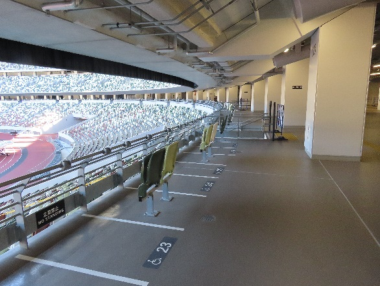
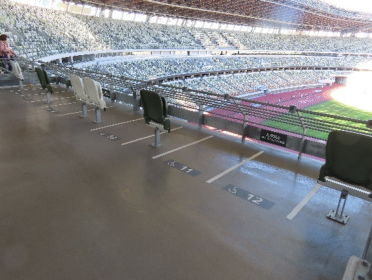
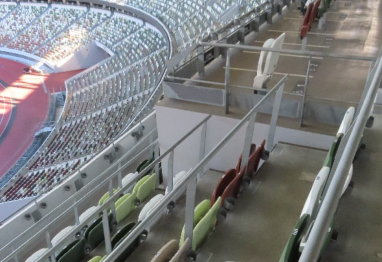
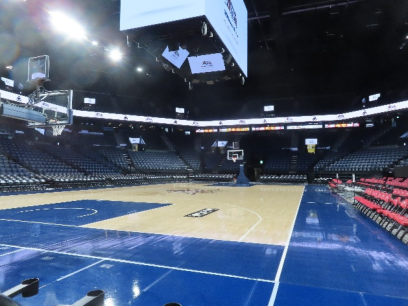
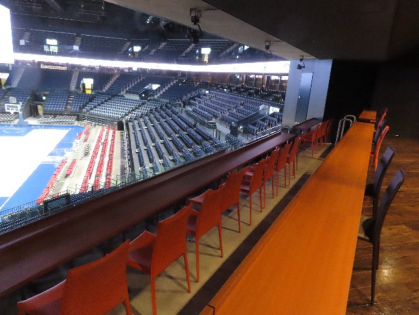
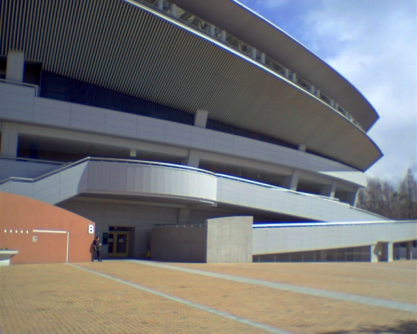
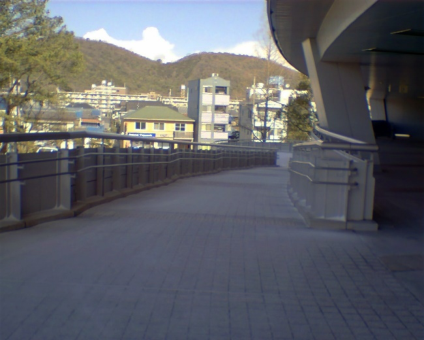
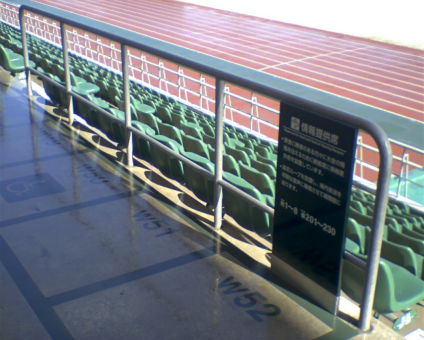
The Stadium Design The New National Stadium, the main venue for the Games was designed to abide by the requirements of the Tokyo IPC Guide. Enough number of wheelchair accessible seats with good sight line have been provided as shown Figs. 1, 2 and 3. Similar accessible design was completed in another arena in Okinawa (Figs. 4 and 5) – which weas designed and built almost the same timetable with the New National Stadium, ensuring that accessibility require- ments are followed if designers are sensible enough. Regarding the approach design, the New National Stadium has some difficulties: the spectators must go up several meters to reach the main seating area level from the surrounding approach roads. Elevators are provided, but not enough capacity for every- one wishing to use – they are in a sense reserved only for wheelchairs. Long ago, in 2005, the author witnessed a stadium in Okayama Prefecture, which introduced a slope as one of main approach routes, eliminating accessibility, and more importantly, egressibility (*1) problems for many (Figs. 6, 7). Rea- sonable number of wheelchair seats were also provided (Fig. 8). The slopes
How Far Has Japanese Accessibility Improved With Tokyo 2020 Olympics/Paralympics? 25
need enough space for the site, and unfortunately the New National Stadium is situated in a narrowly squeezed location. The Okinawa Arena sits in a gen- tly sloped location, and step-free access is available for both the lower and upper seating areas, main approach for the ground floor level, and another approach direct to the upper level from the major parking lot.
Figure 1: Wheelchair seating area on the lower level, the New National Stadium.Figure 2: Wheelchair seating area on the second-floor level, the New National Stadium.Figure 3: Sight line is secured: two front rows are removed, the New National Stadium.
26 Kose
Figure 4: Ground level main arena surrounded with flexible seat area, the Okinawa Arena.Figure 5: Wheelchair seating area on the second floor, the Okinawa Arena.Figure 6: Gently sloped access route, the Okayama Stadium.
How Far Has Japanese Accessibility Improved With Tokyo 2020 Olympics/Paralympics? 27
Figure 7: Gentle slope going downward, the Okayama Stadium.Figure 8: Wheelchair seating area, the Okayama Stadium.
The Seating Issue As shown above, all three examples seem to satisfy the reserved seat numbers and sight line requirements for spectators who use wheelchairs. The sight line requirements however involve losing seats which could have been sold, and revising design of existing stadiums and arenas might be more difficult businesswise. Problems of seat choice might also be less recognized. In the New National Stadium, no ringside seats seem to be available: only the seats high up at the main entrance level are provided (additional seats are available upper floors, but they are also at the rear). With the Okinawa Arena, seats on the ground level are flexible and no problems of ringside seats are foreseen.
Accommodation for Spectators For hotel accommodation, the government revised the requirements on the number of wheelchair accessible rooms from just one if the hotel has
28 Kose
50 rooms or more, to one in every 50 rooms in 2019. It was too late, however, considering the time necessary to do the work (for existing facil- ities, it is request only, not mandatory). Tokyo Metropolitan Government also issued guidelines on universal design in 2019 asking for somewhat bet- ter arrangements, which were unfortunately a little short of meeting higher requirements for some larger wheelchair users. It was only in 2023 that the Tokyo Metropolitan Government updated requirements on wheelchair accessible rooms (for new construction).
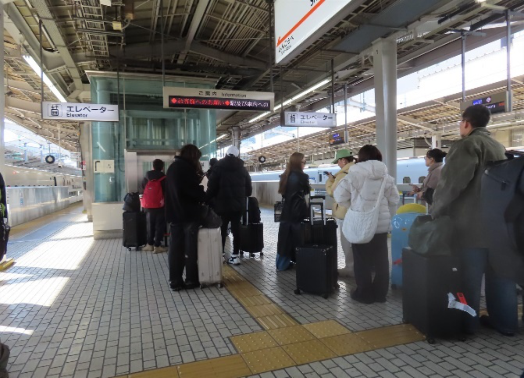
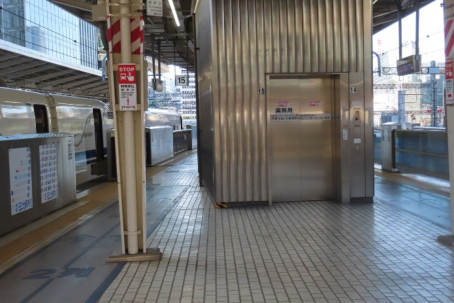
Multiple Accessible Routes The arrangement of accessible routes in train stations has been a serious issue. The minimum requirement of the accessible transportation law was to provide at least one accessible route for stations, and unfortunately train operators did not try to introduce multiple routes for years. A lawsuit was raised in Osaka to improve the situation in a very large, crowded station, and the operator finally gave way to introduce another route. The government introduced multiple route requirements in 2018. It will certainly need a long time before major stations succeed in revising them more easily accessible since introducing one accessible route quite often needed negotiations – find- ing the right position to install an elevator has never been easy thing to succeed. For existing stations, installing an elevator large enough to han- dle many travellers with suitcases are difficult as shown in the long cue at Shin-Osaka Station (Fig. 9). However, this is better than the case of origi- nal elevator reserved just for the staff as in Fig. 10. No other elevator was available until around 2002.
Figure 9: Many travellers are waiting the elevator at Shinkansen platform in Shin- Osaka Station. Elevators installed in existing platforms tend to be smaller than desirable.
How Far Has Japanese Accessibility Improved With Tokyo 2020 Olympics/Paralympics? 29
Figure 10: Original elevator reserved for staff in Tokyo Station. It has existed for more than 25 years, and passengers who use wheelchairs were cordially invited to use this.
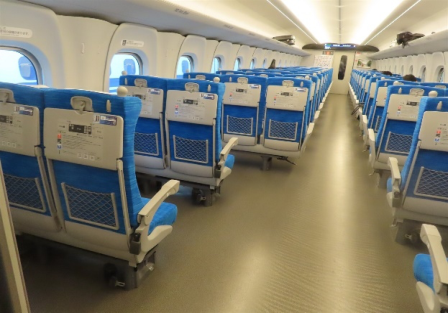
Accessible Seats on Trains for Wheelchair Travellers Although not in time for the Games, some of the problems were gradually being solved, such as increasing the number of wheelchair accessible seats for the new carriage of the Bullet Trains (but only for newly made coaches). Previously, the train had only two seats available for wheelchairs even for a long train with 16 coaches (in coach 11, as shown in Fig. 11).
For commuters within cities, wider area was commonly available, but the Bullet train system sticked to the minimum requirements by the law until recently. With repeated request from people with wheelchairs, the train sys- tem finally agreed to increase the number of seats. The government thus upgraded requirements on wheelchair accessible seats, depending on the total number of seats (six accessible seats if total number is more than 1,000). The new arrangements are expected to solve some of awkwardness, including the narrowness of the corridor.
Figure 11: Wheelchair seating area in the Shinkansen Bullet Train Coach 11.
30 Kose
Accessibility of Small Businesses Under the Accessible Built Environment Law in Japan, the buildings covered are large in scale (2000 square meters or larger), and small shops and the like are excluded, causing problems during daily activities. Therefore, accessibil- ity guidelines for small businesses that are deemed non-mandatory under the law were introduced. One of the reasons was that the requirements based on the law does not allow for relaxation in return to alternative accommodation. Written compromising guidelines by the government was therefore necessary. Otherwise, the choice was to abide by the whole set of requirements, or to do nothing, regarding accessibility: Neither was desirable form the viewpoint of users.
DISCUSSION
Compared to the USA that enacted ADA and Guidelines in 1990 and 1991 respectively, Japan was reluctant to make accessibility as mandatory require- ments, and some of long-awaited improvements on accessibility are slowly being introduced in Japan, partly triggered by the Tokyo Olympics/Para- lympics 2020, as we have examined so far. However, businesses do not seem to understand/accept the concept of accessibility and usability that will enable the users to fully appreciate the benefits of inclusiveness. Is it because of the lack of disability discrimination legislation based on UN-CRPD?
CONCLUSION
The revised Japanese law on elimination of discrimination of people with dis- abilities require that reasonable accommodation is a must from April 2024 onwards even for private sector: Until then, reasonable accommodation was only mandatory for public sector, and for private sector it was just advisory. The new requirement means that if the physical situation does not allow easy access by wheelchairs, some alternative measures must be taken, such as lift- ing the wheelchair beyond steps/stairs, or providing same level of service to the customer in a similar manner (for example, the delicious but expensive dishes of the inaccessible restaurant upper floor will be brought down to the accessible ground floor café). The policy statement by the government suggests that upgrading of physical accessibility is more appropriate and sen- sible than reasonable accommodation if repeated requests are anticipated. We must be vigilant that the principles of UN-CRPD is observed in good faith.
NOTE *1 The word “Egressibility” was coined by the author in a paper published in 1995 (Kose & Hokugo, 1995). Although egress is originally paired with ingress in English, it rhymes with access; therefore, I am confident that egressibility rhymes with accessibility.
How Far Has Japanese Accessibility Improved With Tokyo 2020 Olympics/Paralympics? 31
REFERENCES
International Paralympic Committee (2013). Accessibility Guide: An Inclusive Approach to the Olympic & Paralympic Games. Kawauchi, Y. (2015). Situation and issues of Japanese Stadiums and Arenas viewed
from the IPC Accessibility Guide. Journal of Rehabilitation Research No. 164, pp. 28–33 (in Japanese). Kose, S. (2010). “The Impact of Aging on Japanese Accessibility Standards”, in Universal Design Handbook, Second Edition, Chapter 11. Mc Graw Hill: New York, pp. 11.1–11.9. Kose, S. (2014). “Accessible Built Environment Law in Japan: Challenges and Oppor-
tunities toward Universal Design”, in Proceedings IAUD2010 in Hamamatsu, pp. 1–6. Kose, S. (2015). “What Need to Be Done to Accommodate Overseas Visitors during the Olympics and Paralympics in 2020?: Toward Universally Designed Tokyo”, in: Proceedings of the 5th International Conference for Universal Design in Fukushima & Tokyo 2014. pp. 1–7. ISBN978-4-9908179-0-9 Kose, S. & Hokugo, A. (1995) “Elevators and People With Disabilities in Japan:
From Accessibility to Egressibility?”, in The 2nd Symposium on Elevators, Fire, and Accessibility (ASME International), pp. 151–156. Kose, S. & Motokado, M. (2011). “Ordinance on universal design of the built environment: How can Hamamatsu City exercise its full potential?”, in Include 2011 Proceedings. 10p. Tokyo IOC/IPC (2017). Tokyo 2020 Accessibility Guidelines (in Japanese).
LISTED IN THE AHFE DIGITAL BOOKSTORE CATALOGUE
Explore the complete digital volume
Design for Inclusion
Read this individual research paper free through the original publisher, or explore the full digital proceedings book.
ISBN 978-1-964867-04-5
Explore this ISBN in the AHFE Bookstore ↗Listed in the July 2026 bookstore catalogue; search by ISBN to confirm current availability · Digital book purchase optional