Kin Wai Michael Siu, Zi Yang, Izzy Yi Jian (2023). Polyhedral public play spaces for children and caregivers: an inclusive perspective. In: Design for Inclusion. AHFE Open Access, vol. 75, pp. 156–165. https://doi.org/10.54941/ahfe1003336
Play is essential to children's social, emotional, cognitive, and physical well-being. Public play spaces provide important opportunities for children to participate equally in play and social interaction. In recent years, an increasing number of researchers have begun to focus on the inclusiveness of public play spaces for children with different motion, sensory and cognitive capabilities. At the same time, for care and safety reasons, children must go to the play space with their caregivers in most cases. Yet, play spaces are mainly designed for children, the caregivers, whose needs and demands are often overlooked, are obviously necessary to access the spaces. It shows a lack of understanding of inclusive and related concepts among researchers. This study examines how inclusive and related concepts are used in peer-reviewed articles about public play spaces. This study implemented a scoping review in December 2022, and 14 peer-reviewed articles were identified. These articles mainly concern inclusive and related concepts in public play spaces from caregivers' perspectives. The casual use of inclusive and related terms embodies these terms and design approaches' youthfulness, inconsistency, and confusion. Further research can distinguish these concepts through further development and research to expand the understanding of inclusion in public play spaces.
Play is a “fundamental need”and is as important to children as work (Dewey, 1916). In 1989, the United Nations included this fundamental right of all children in Article 31 of the United Nations Convention on the Rights of the Child (United Nations, 1989), recognizing that play is an important aspect of children’s development. Play in public play spaces is considered a “natural and critical part of a child’s healthy development” (Clements, 2004). Many researchers agree that play in public play spaces is a good way for chil- dren to develop physical, cognitive, social, and emotional aspects, including coordination, motor skills, social awareness, and language skills (Barnett, 1990). We have to admit that the environment affects people’s health, social participation, inclusion, and the realization of human rights (Woolley and
Polyhedral Public Play Spaces for Children and Caregivers 157
Lowe, 2013). Therefore, the play environment affects the quality and value of children’s play. In addition, Article 9 (among others) of the United Nati- ons Convention on the Rights of Persons with Disabilities (United Nations, 2006) advocates that the design of public play spaces should provide access to all children. General Comment No.17 on Play and Leisure (United Nations, 2013) and General Comment No.2 on Accessibility (United Nations, 2014) also provide a design guideline for equal access to public play spaces for all children (including physical and social barriers such as impairment, gender, poverty, race, etc.).
There are many design terms related to inclusive, including “inclusive design,” “universal design,” “design for all,” “barrier-free design,” and “accessible design.” can be used to promote the quality and value of public play spaces (Fernelius and Christensen, 2017; Moore, Lynch and Boyle, 2022; Burke, 2013; Sharma and Kumar, 2022; Iwarsson and Ståhl, 2003; Persson et al., 2015). In addition, accessibility and usability are important terms and dimensions for judging whether the environment is cohesive (Iwarsson and Ståhl, 2003). The fact that these concepts are freely used to discuss the design of inclusive environments suggests that they are still in a state of immaturity, inconsistency, and confusion.
The confusion of these concepts can lead designers and researchers to misunderstand the scope of inclusion. For example, treating public play spa- ces where intergenerational interaction exists as specific public spaces for all children narrows the space use. Therefore, this paper aims to conduct a scoping review to examine how the understanding of inclusive and related concepts can be used, from a caregiver’s perspective, in peer-reviewed articles on public play space design, social engagement, and inclusion.
METHODS
This study will use the scope review method based on the article’s purpose. Scope review is an ideal literature research tool to address such issues by identifying the scope, coverage, and extent of peer-reviewed literature on a particular topic and providing a broad scope and preliminary assessment of the available literature (Munn et al., 2018).
According to the outline of the scoping review, there are corresponding requirements for questions, sources and searches, selection, synthesis, and for the literature selection process to follow the PRISMA flow diagram (Peter et al., 2015; Levac, Colquhoun and O’Brien, 2010). The research process will be discussed in detail below.
Phase 1: Research Question Identification The following question guided this review:
How are inclusive and related concepts referred to and used in peer- reviewed papers discussing public play spaces, social engagement, and inclusion from a caregiver’s perspective?
For what purposes and to what extent are the concepts of inclusion used in peer-reviewed papers discussing public play spaces, social engagement, and inclusion from a caregiver’s perspective?
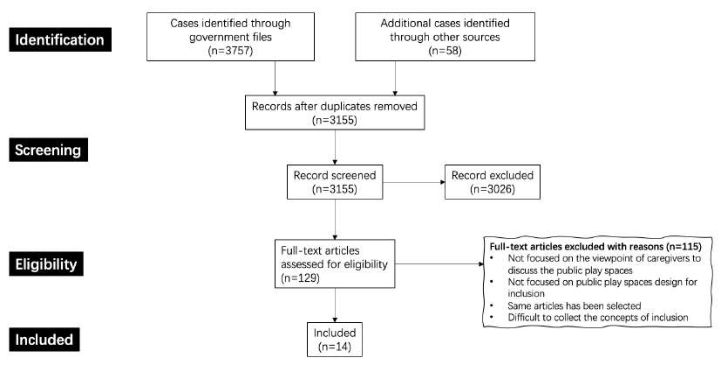
Phase 2: Relevant Studies Identification This study did not require a time frame, counting from the point in time when the relevant terms appeared. Relevant studies were identified by searching six databases. Boolean operators take into account search terms’ variations and maximize the search (see Table 1 for details). For the detailed selection process and information, can see Figure 1.
Phase 3: Studies Selections All identified studies from the six databases were uploaded to the EndNote 20 reference management software. Fourteen articles were finally obtained by reviewing the full text and further refining the inclusion criteria to select the articles that best fit the purpose of the study. The specific screening steps can be found in the Preferred Reporting Items for Systematic Reviews and Meta-Analysis (PRISMA) flow diagram (Figure 1).
Phase 4: Data Charting An Excel spreadsheet was explicitly designed for this study to accomplish the purpose of the study. The data from these 14 articles were extracted and placed in the spreadsheet to perform statistics on the data. The spre- adsheet is divided into the following main variables: year, country, discipline, terminology, and definition/description of the term used. According to the discussion in the introduction section, there are five main terminologies: inclusion, accessibility, usability, inclusive design, and universal design. Then all the data are analyzed according to the research question.
Table 1. The list of search terms (drawn by authors).
Table available in the original PDF paper.
Search Terms playground* OR “play space*” OR playspace* OR “outdoor play space*” OR “outdoor play environment*” OR “play area*” OR park* OR “Playing field*” OR “recreation ground*” OR “amusement park*” OR “adventure playground*” AND universal* design* OR “barrier-free design*” OR “design* for all” or “building* for everyone” or “access* design” or “inclus* design*”OR “architect* access*”OR usability* OR accessibility* AND children* OR child* OR caregiver* OR caretaker* OR parent* OR grandparent* OR teacher* OR “domestic assistants*” OR babysitter* OR disable* OR “disabled child*” OR “physical disability*” OR “mental disability*” OR capability* Databases Academic Search Premier (818), CINAHL Complete (284), ERIC (610), Medline (1013), Scopus (79), Web of Science (9563)
Others No restriction on the publication time or geographical location; Written in English; Published in peer-reviewed journals; Available in full text.
Polyhedral Public Play Spaces for Children and Caregivers 159
Figure 1: PRISMA Flow diagram of identified articles selection process (Drawn by authors).
Phase 5: Collation, Analysis, and Discussion of Results To address our research questions, the analysis and discussion in this study focused on two areas: (1) numerical analysis of identified articles; and (2) narrative summary of identified articles.
RESULTS AND DISCUSSION
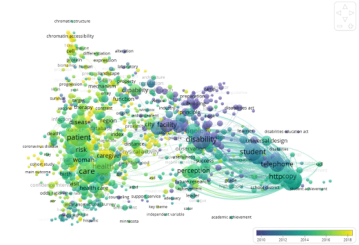
Numerical Analysis of Identified Articles All identified studies from the six databases, as well as additional records identified through other sources, were de-weighted for a total of 3155 articles and analyzed by VOS Viewer, a software tool for constructing and visu- alizing bibliometric networks. A co-occurrence analysis, which counts the co-occurrence of keyword noun phrases, is used to identify the link between the keywords. The map of co-occurrence analysis obtained by binary coun- ting can be seen in Figure 2. From the results, the words facility, disability, care, universal design, patient, caregiver, and perception are highly related to the themes, where discussions related to caregivers, such as care, patient, and caregiver, mainly appeared around the year 2016.
The 14 articles screened in this study were from several developed coun- tries and regions in the northern and southern hemispheres, spanning four continents (see Table 2 for details). In this literature, the leading academic fields are physical education and sports, occupational therapy, health science, landscape architecture, childhood education, playground service, tourism and recreation, design, etc.
All 14 peer-reviewed articles examined the link between inclusive and the design of public play spaces from the caregiver’s perspective. Most articles do not provide clear definitions, explanations, or definitions of these concepts.
Figure 2: Keyword co-occurrence analysis results: overlay visualization map and density visualization map (Drawn by authors).Table 2. The geographical location of studies (drawn by authors).
Table available in the original PDF paper.
Geographic Reference Location
Europe Greece (Karampetsios and Afthinos, 2022). Ireland (Lynch et al., 2020). Sweden (Prellwitz, and Skär, 2016). Poland (Ostrowska-Tryzno, Nałecz and Pawlikowska-Piechotka, 2020). Turkey (Likden, Nevin and Nur, 2010). North America USA (Stanton-Chapman and Schmidt, 2017); (Yildirim, Keshavarzi and Aman, 2022); (Stanton-Chapman and Schmidt, 2019); (Silver, Giorgio and Mijanovich, 2014). Canada (Bennet et al., 2012); (Ripat and Becker, 2012). Oceania Australia (Stafford, 2017); (Sterman et al., 2018). Asia Hong Kong
(Siu, Wong & Lam, 2018).
SAR China
And almost all articles still consider how to design better inclusive play- grounds for all children from the caregiver’s perspective but rarely explore and discuss them from the perspective of intergenerational inclusion.
Terms were used to describe inclusive and related design concepts, creating a degree of inconsistency and confusion. Among the 14 peer-reviewed articles included, the terms used were inclusion (n = 12, 86%), accessibility (n = 13, n = 93%), usability (n = 4, 28%), inclusive design (n = 5, 36%), and uni- versal design (n = 5, 36%). While the relationship between comments and descriptions about these terms and the number of terms mentioned varied, inclusion (n = 4,33%), accessibility (n = 5, 38%), usability (n = 1, 25%), inclusive design (n = 0, 0%), and universal design (n = 4, 80%). Through these data, we can see that the concepts of inclusive play space from the care- giver’s perspective mainly focused on inclusion, accessibility, and the mention of design methods. There is not much difference between inclusive design and
Polyhedral Public Play Spaces for Children and Caregivers 161
universal design. Still, for the degree of understanding of terms, it is obvious that the degree of knowledge of design concepts of universal design exceeds that of inclusive design, and the degree of familiarity with accessibility is also higher.
Narrative Summary of Identified Articles Two themes were identified through the analysis of the 14 peer-reviewed articles screened. The first theme explored design concepts and related conce- pts used to describe the design of public play spaces, social engagement, and inclusion. The second theme relates to how the screened peer-reviewed articles use inclusive and related design concepts.
Theme 1: The description of public play spaces, social engagement, inclusive and related design concepts.
Although all 14 articles deal with public play space and inclusion from the caregiver’s perspective, inclusion or inclusive design is not the primary design concept. Specifically, accessibility is the most frequently used term. When determining and discussing the inclusiveness of public play space in research, researchers prefer to use accessibility and usability as measures.
And when defining or describing these terms and design concepts, few authors define them. For example, regarding the concept of inclusion, only four articles were specified. Lynch et al. (2020) argued that age, size, and abi- lity of children and adults should be considered important factors to measure whether public play space is inclusive. Talay, Akpinar, and Belkayali (2010) emphasize the need to focus on children with disabilities in designing inclu- sive public play spaces. Yildirim et al. (2022) suggest accessibility of public play space should be reflected in both access and space. All, including chil- dren and adults (regardless of age, gender, and race), should be accessible in public play spaces. Stanton-Chapman and Schmidt (2019) focus on children with disabilities and their families, arguing that public play spaces should support the activities of such people in the design process. We can find that the design concept of inclusion is still based on all children, with more atten- tion to children with disabilities. Still, there is mention that caregivers are also users of public play spaces and need to pay attention to their experience of access and activities in the space.
For discussion of accessibility, Karampetsios and Afthinos (2022) iden- tified accessibility as an important peripheral factor influencing the overall satisfaction of child escorts. Lynch et al. (2020) also agree that accessibility is an essential element of inclusion and suggests explicitly that public play spa- ces should provide wheelchair-accessible sidewalks. Stanton-Chapman and Schmidt (2018) emphasized equal access. They indicated that the accessi- bility of public play space should not only focus on children with physical disabilities and children needing walking aids (such as wheelchairs, walkers, and braces) but also on the social engagement of all students with disa- bilities. Sterman et al. (2019) argued that accessibility is primarily about physical accessibility and found through interviews with stakeholders that physically accessible locations are unpleasant for children’s social accessibi- lity. Bennet et al. (2012) measured the accessibility of public play spaces in
terms of both walking distance and population density through quantitative analysis methods. These studies consider accessibility to refer primarily to physical accessibility and focus the primary target population on children with disabilities. There is a lack of discussion about social accessibility and the demands of other users (including children without disabilities, adults caring for children, the elderly, etc.).
For usability although there are four articles mentioning it, only one article discusses usability. Ripat and Becker (2012) agreed that “usability facilitates the ability to access and use the environment” (Iwarsson and Ståhl, 2003) and suggested that the inclusive concept of usability is an important design method to promote the future design of public play spaces.
Universal design is the most well-known of these five terms. Lynch et al. (2020) defined universal design as an approach to design that ensures inclu- sive environments for all children and their families, with and without disabilities. Prellwitz and Skär (2016) support universal design as an impor- tant approach to promoting equality and rights for all. Stafford (2017) emphasizes that universal design should be responsive to the needs of peo- ple of all ages and abilities. Ripat and Becker (2012) agreed that universal design promotes accessibility for all. It can be seen that universal design is recognized as a design approach that promotes coexistence and rights for all people and social integration. Researchers still interpret universal design when discussing public play spaces as being for all people, not just children.
For the most relevant term of inclusion – inclusive design – no articles defined or explained it.
Theme 2: The way to use inclusive and related concepts in the design of public play spaces.
The second theme primarily reflects core ideas related to inclusion. At the core of either terminology or design concept used is the view of inclusion as a common goal or priority for public play spaces. Although most of the discussions on inclusive in public play spaces from the caregiver’s perspective still address the needs of the children entering the space. It is, in fact, the result of a lack of clarity in the definition of inclusive.
Although inclusive and related design concepts are covered in all 14 iden- tified articles, only Yildirim et al. (2022) note in their inclusive discussion that it is for all social populations, including children and adults, regardless of age, gender, or race. And for accessibility, most researchers are concerned only with its physical accessibility. Stanton-Chapman and Schmidt (2019) refer to the accessibility of social engagement, but they only focus on children with disabilities. It indicates that most of the researchers for the definition of inclusive - under the public play spaces context – only refer specifically to children or extend to families of special needs regarding age, gender, and abi- lity. Still, it does not include adults who stay in public play spaces nor has intergenerational involvement.
Even from the perspective of the caregivers see inclusive in public play spaces, only six peer-reviewed studies (Yildirim et al., 2022; Lynch et al., 2020; Prellwitz and Skär. 2016; Stafford, 2017; Ripat and Becker, 2012; Siu, Wong and Lam, 2018) address the need to react to equitable opportunities for everyone, which is concerning. Only two articles (Siu, Wong and Lam,
Polyhedral Public Play Spaces for Children and Caregivers 163
2018; Silver, Giorgio and Mijanovich, 2014) call for the design of public play spaces to be responsive to the needs of caregivers and other social demograph- ics. They advocate that public play spaces for intergenerational interaction as public environments should not only be responsive and attentive to the needs of all children. However, they do not define inclusive and related design concepts.
CONCLUSION
This paper discusses the application of inclusive and its related concepts in the design of public play spaces from the caregiver’s perspective through the scoping review. It is found that there is a phenomenon of casual use of inclu- sive and its related concepts, and these concepts are not distinguished in detail at present. It is the premise for further development of inclusive-related rese- arch in the future. Secondly, the research focus of inclusive public play space is still on children, ignoring the nature of intergenerational integration of this public space. In the future, we can explore the inclusiveness of public play space from the caregiver’s perspective. Researchers should meet not only the requirements and needs of children but also the requirements and needs of caregivers and promote the interaction between children and caregivers. Public play spaces are public spaces created for the right of all children to use, but children are not the only ones who have the right to enter and use these spaces; they belong to everyone.
ACKNOWLEDGMENT
We would like to acknowledge the grant support of the Hong Kong RGC General Research Fund (RGC Ref: 15219021). We thank the support of Eric C. Yim Endowed Professorship, the RPg studentship, and postdoctoral fel- lowship fund (PolyU, 1-W187). We also thank the researchers of the Public Design Lab, PolyU, for their general assistance during the project.
REFERENCES
Barnett, L. A. (1990). “Developmental benefits of play for children,”Journal of Leisure Research, 22(2), pp. 138–153. Bennet, S. A., Yiannakoulias, N., Williams, A. M. and Kitchen, P. (2012). “Play-
ground accessibility and neighbourhood social interaction among parents,” Social indicators research, 108, pp. 199–213. Burke, J. (2013). “Just for the fun of it: Making playgrounds accessible to all children,” World Leisure Journal, 55(1), pp. 83–95. Clements, R. (2004). “An investigation of the status of outdoorplay,” Contemporary
issues in early childhood, 5(1), pp. 68–80. Dewey, J. (1916). Democracy and education. USA: Macmillan. Fernelius, C. L. and Christensen, K. M. (2017). “Systematic review of evidencebased practices for inclusive playground design. Children,”Youth and Environ- ments, 27(3), pp. 78–102. Iwarsson, S. and Ståhl, A. (2003). “Accessibility, usability and universal design—
positioning and definition of concepts describing person-environment relationsh- ips,” Disability and rehabilitation, 25(2), pp. 57–66.
Karampetsios, T. and Afthinos, Y. (2022). “A model of the overall satisfaction of children escorts using public playgrounds,” World Leisure Journal, 64(4), pp. 469–486. Levac, D., Colquhoun, H. and O’Brien, K. K. (2010). “Scoping studies: advancing
the methodology,” Implementation science, 5, pp. 1–9. Lynch, H., Moore, A., Edwards, C. and Horgan, L. (2020). “Advancing play participation for all: The challenge of addressing play diversity and inclusion in com- munity parks and playgrounds,” British Journal of Occupational Therapy, 83(2), pp. 107–117. Moore, A., Lynch, H. and Boyle, B. (2022). “A national study of playground pro-
fessionals universal design implementation practices,” Landscape Research, 47(5), pp. 611–627. Munn, Z., Peters, M. D., Stern, C., Tufanaru, C., McArthur, A. and Aromataris, E.
(2018). “Systematic review or scoping review? Guidance for authors when cho- osing between a systematic or scoping review approach,” BMC medical research methodology, 18, pp. 1–7. Ostrowska-Tryzno, A., Nałecz, H. and Pawlikowska-Piechotka, A. (2020). “Sport and physical activity in the urban area–housing estate greens for three gene- rations,” Sport i Turystyka. ´Srodkowoeuropejskie Czasopismo Naukowe, 3(2), pp. 105–128. Persson, H., Åhman, H., Yngling, A. A. and Gulliksen, J. (2015). “Universal design,
inclusive design, accessible design, design for all: different concepts—one goal? On the concept of accessibility—historical, methodological and philosophical aspects,” Universal Access in the Information Society, 14, pp. 505–526. Peters, M. D., Godfrey, C. M., Khalil, H., McInerney, P., Parker, D. and Soares, C. B.
(2015). “Guidance for conducting systematic scopingreviews,” JBI Evidence Implementation, 13(3), pp. 141–146. Prellwitz, M. and Skär, L. (2016). “Are playgrounds a case of occupational injustice? Experiences of parents of children with disabilities,” Children, Youth and Environments, 26(2), pp. 28–42. Ripat, J. and Becker, P. (2012). “Playground usability: what do playground users
say?,” Occupational therapy international, 19(3), pp. 144–153. Sharma, A. and Kumar, K. (2022). “A Review of Barrier-Free Design in Built Environment,” International Journal of Multidisciplinary Innovative Research, 2(1), pp. 33–37. Silver, D., Giorgio, M. and Mijanovich, T. (2014). “Utilization patterns and perce-
ptions of playground users in New York City,” Journal of community health, 39, pp. 363–371. Siu, K. W., Wong, Y. L. and Lam, M. S. (2018) “The needs of children and their caregivers in new urban lifestyles: A case study of playground facilities in Hong Kong,” Advances in Human Factors, Sustainable Urban Planning and Infrastructure, pp. 257–265. Silver, D., Giorgio, M. and Mijanovich, T. (2014). “Utilization patterns and perce-
ptions of playground users in New York City,” Journal of community health, 39, pp. 363–371. Stanton-Chapman, T. L. and Schmidt, E. L. (2017). “Caregiver perceptions of inclusive playgrounds targeting toddlers and preschoolers with disabilities: has recent international and national policy improved overall satisfaction?,” Journal of Research in Special Educational Needs, 17(4), pp. 237–246. Stanton-Chapman, T. L. and Schmidt, E. L. (2019). “In search of equivalent social
participation: what do caregivers of children with disabilities desire regarding inclusive recreational facilities and playgrounds?,”Journal of International Special Needs Education, 22(2), pp. 66–76.
Polyhedral Public Play Spaces for Children and Caregivers 165
Sterman, J. J., Naughton, G. A., Bundy, A. C., Froude, E. and Villeneuve, M. A. (2019). “Planning for outdoor play: Government and family decision- making,” Scandinavian journal of occupational therapy, 26(7), pp. 484–495. Talay, L., Akpinar, N. and Belkayali, N. (2010). “Barriers to playground use for
children with disabilities: A case from Ankara, Turkey,” African Journal of Agricultural Research, 5(9), pp. 848–855. United Nations. (November 20, 1989). Convention on the Rights of the Child.
https://www.ohchr.org/sites/default/files/Documents/ProfessionalInterest/crc.pdf United Nations. (December 6, 2006). Convention on the Rights of Persons with Disabilities. https://www.un.org/disabilities/documents/convention/convention_ accessible_pdf.pdf United Nations. (April 17, 2013). General comment no. 17 (2013) on the right of
the child to rest, leisure, play, recreational activities, cultural life and the arts (art. 31). Refworld: https://www.refworld.org/docid/51ef9bcc4.html United Nations. (2014, May 22) General comment no. 2 (2014), Article 9, Accessibility. United Nations Digital Library: https://digitallibrary.un.org/record/ 812025?ln=en Woolley, H., & Lowe, A. (2013). “Exploring the relationship between design
approach and play value of outdoor play spaces,” Landscape Research, 38(1), 53–74. Yildirim, Y., Keshavarzi, G., & Aman, A. R. (2022). “Does play-based experience provide for inclusiveness? A case study of multi-dimensional indicators,” Child Indicators Research, 1–18.
LISTED IN THE AHFE DIGITAL BOOKSTORE CATALOGUE
Explore the complete digital volume
Design for Inclusion
Read this individual research paper free through the original publisher, or explore the full digital proceedings book.
ISBN 978-1-958651-51-3
Explore this ISBN in the AHFE Bookstore ↗Listed in the July 2026 bookstore catalogue; search by ISBN to confirm current availability · Digital book purchase optional