Kin Wai Michael Siu, Izzy Yi Jian (2023). Human-centred design: Promoting interactions between children and caregivers in play spaces. In: Human Interaction & Emerging Technologies (IHIET 2023): Artificial Intelligence & Future Applications. AHFE Open Access, vol. 111, pp. 157–167. https://doi.org/10.54941/ahfe1004020
Most of the time children are necessary to go to play spaces with caregivers. However, play spaces in general are designed for children that caregivers are always excluded. Sometimes only basic resting facilities are provided for the caregivers. In the recent years, some studies have already concerned the inclusiveness of public play spaces for the needs of children and their peers with different motion, sensory and cognitive capabilities. On the other hand, there is still very rare to have research on the inclusiveness of the design of public play spaces for caregivers. Taking Hong Kong as a case study, this paper reviews and explores the meanings of public play spaces and identify direct and possible indirect users. The study also explores the current social issues, in particular the family and household-member factors, related to the design of public play spaces, in a densely populated city. The paper then identifies the needs and preferences of different direct and indirect users of public play spaces, addresses the commonly overlooked needs of caregivers in the design of public play spaces, and uncovers the design gaps which, if addressed, could significantly enhance the inclusivity and relevance of public play spaces amidst evolving social contexts.
Play is fundamental to children’s growth and development. The academic definition and understanding of play is complicated due to its multifaceted nature. While it may vary in different disciplines, contexts, and perspectives, play is typically characterized as being spontaneous and captivating, driven by intrinsic motivation. It is seen as a process rather than a result, and is not restricted by time or place (Hartt et al., 2023).
According to projections by the United Nations (UN), it is estimated that by the year 2025, approximately 60 percent of the world’s child population will reside in urban areas (Malone, 2006). Play activities are widely acknowl- edged as the primary motivation behind children’s utilization of outdoor environments during recess (Aminpour et al., 2020). Through play, children develop essential skills and competencies that lay the foundation for life- long learning and personal growth (Aminpour et al., 2020; Corominas et al., 2021; Potwarka et al., 2008). These include cognitive skills, such as problem- solving and decision-making, physical skills, like coordination and balance,
and social-emotional skills, such as empathy, cooperation, and communi- cation. Moreover, play fosters creativity, curiosity, and resilience, enabling children to adapt to new situations and overcome challenges (Hart et al., 1996). The importance of play spaces for children cannot be overstated. They not only provide venues for physical activity and socializing but also foster con- nections with nature (Visser and Aalst, 2022). Regardless of how frequently they are used, playgrounds hold considerable social value, as they are essen- tial spaces identified by children themselves. These spaces have the potential to promote active engagement in sports and recreational activities, encourag- ing inclusive social interactions among children of varying abilities (Jansson, 2015; Siu et al., 2017). In many ways, play spaces - areas specifically designed to stimulate and support children’s play - serve as a microcosm of the larger world (Burke, 2013; Veitch et al., 2006). They provide a safe and engaging environment where children can experiment, interact, and learn at their own pace. Yet, in the typical design of these spaces, one critical factor often gets overlooked: the role of caregivers (Siu et al., 2019). Current public play spaces often fail to meet the evolving lifestyles and emerging needs, in particular not serving as a “place” for caregivers (Siu et al., 2019b, 2017). More often than not, these play spaces are only narrowly designed to accommodate children playing individually or with their peers, overlooking the crucial role of caregivers. As a result, caregivers are often marginalized to the sidelines, offered minimal resting facilities.
This paper aims to challenge this paradigm, emphasizing the need for inclusivity not only for children with varying capabilities, but also for their caregivers. Using Hong Kong as a case study, this research explores the chang- ing family structures and social dynamics, with a focus on identifying the direct and indirect use of play spaces and specially highlight the needs and preference of caregivers. Through this investigation, we aim to shine a light on an often overlooked segment of users and engender a broader, more com- prehensive approach to the design of play spaces that truly serves all members of the community.
LITERATURE REVIEW
Societal Changes and the Design of Public Play Spaces Societal changes have significantly transformed family structures and compo- sitions over the past few decades, with families with non-relative caregivers (like nannies or babysitters) have become more common (Hin-yan Chan and Latham, 2022; Lo and Lindsay, 2022). Additionally, the rise of the aging population has led to an increased number of grandparents as care- givers (Siu et al., 2019a). These changes necessitate a more comprehensive understanding of the needs of diverse users in the design of public play spaces.
In families where nannies or babysitters are responsible for childcare, which is very common in Hong Kong, communication becomes crucial. More specifically, In Hong Kong, the role of caregiving is often fulfilled by foreign domestic helpers. As of 2021, there were nearly 400,000 foreign domestic
Human-Centred Design: Promoting Interactions Between Children and Caregivers 159
helpers in the city, primarily from the Philippines and Indonesia (Chan, 2023). They often accompany children to public play spaces (Lo and Lindsay, 2022).
On the other hand, Due to Hong Kong’s socio-economic dynamics, there’s an increasing trend of smaller families and single-parent families (Leung and Shek, 2018). This calls for the need for more interactive and inclusive play spaces that can facilitate interaction and mutual support among these fam- ily structures. In addition, Hong Kong is facing a rapidly aging population. Often, grandparents are involved in caregiving, leading to the necessity of designing play spaces that are accessible and comfortable for the elderly. Therefore, facilities should be designed keeping in mind their comfort, needs, and interactions with the children.
Play Spaces in High Density Cities Due to the direct or indirect high-density development pattern in Hong Kong, less than 25% of the land is designated for city development (Lai, 2017). Con- sequently, with a population of over 7 million residents, Hong Kong faces the challenge of accommodating its inhabitants within this limited space. It has been reported that Hong Kong residents are “suffering from a lack of urban life” due to the insufficient provision of public open spaces in terms of both quantity and quality (Jian et al., 2020; Tang, 2017). This unique geographical and demographic situation presents distinctive challenges and opportunities in urban planning and design, particularly concerning the design of public play spaces (Siu et al., 2019a).
As of 2023, the city’s Leisure and Cultural Services Department (LCSD) oversees 670 children’s playgrounds (Leisure and Cultural Services Depart- ment, 2022). These plays paces integrated at different levels in the city serve as essential elements to promote playability and walkability (Lai and Low, 2019). Among these, inclusivity is an explicit design feature in only around 40 venues. While it is reported that “about 70% of our children’s playgrounds offer diversified inclusive play equipment, suitable for all children, including those with disabilities,” the total number of thoroughly inclusive playgrounds remains notably low (Leisure and Cultural Services Department, 2023). In addition, the design of these playgrounds primarily focuses on children, often overlooking the significant role of caregivers (Siu et al., 2019a).
This underscores the need for a more comprehensive, human-centred approach to designing public play spaces in Hong Kong to create spaces that cater to the multifaceted needs of children while simultaneously considering the comfort and involvement of caregivers. This approach promotes mean- ingful interactions between children and caregivers, maximizes the use of limited space, and enhances the cost-effectiveness of play spaces.
METHODOLOGY
The methodology employed in this research encompassed an exhaustive sur- vey of 40 inclusive play spaces featured on the LCSD website (Leisure and Cultural Services Department, 2022). Two of these sites were excluded due to ongoing construction. Our investigative tools included site visits, video and photo documentation, unobtrusive observations, and supplementary
160 Siu and Jian
informal conversations with users present during these visits. The data col- lection process was executed from February to July 2023, spanning a period marked by temperatures ranging from 17 to 33 degrees Celsius.
FINDINGS AND DISCUSSIONS This section presents the general profiles, needs, and preferences of these direct and indirect users. We present a holistic understanding of their typical experiences and interactions within the play spaces, and specifically discuss the role of caregivers in the design of play spaces.
(In)Direct Users of Public Play Spaces To cultivate an inclusive environment and encourage comprehensive interac- tion within play spaces, it is essential to understand the user profiles from a human-centred perspective. This understanding includes not just direct users - the children - but also the indirect users - caregivers, who play a significant role in shaping the children’s play experience.
In Hong Kong, as confirmed by our survey, children predominantly visit play spaces accompanied by caregivers, who may be parents, grandparents, nannies, or domestic helpers. These caregivers perform a multitude of tasks, such as supervising play activities, facilitating social interactions, assisting with equipment usage, and providing emotional support.
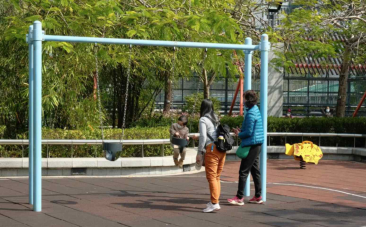
Sometimes, a child is accompanied by more than one caregiver, reflecting diverse familial and societal arrangements in the context of Hong Kong’s societal transitions (Figure 1, a-b). For example, the growing prevalence of domestic helpers and the phenomenon of relatively younger grandparents reveal the changing nature of caregiving. Interestingly, we noticed contrasting sentiments among some parents and grandparents. On the one hand, they expressed a desire to spend more time with their children. On the other, there was an underlying concern about the ability of domestic helpers to provide adequate care, particularly in the context of navigating potentially hazardous play facilities.
a b
Figure 1: A child is accompanied by domestic helper and grandma (a), a child is accompanied by grandparents (b).
Human-Centred Design: Promoting Interactions Between Children and Caregivers 161
This finding highlights the complexity of the caregiving scenario in public play spaces and underlines the importance of designing these environments to be as inclusive and supportive as possible, taking into account the various needs and concerns of all users.
The Needs and Preferences of Users The study’s initial findings underscore the role of caregivers as indirect users of play spaces and highlight the repercussions of current design practices that often disregard their needs and preferences.
Observational data further highlights the diverse needs of caregivers. Many grandparents, for example, lack optimal physical strength. Furthermore, a large portion of caregivers, often employed full-time, arrive at these play spaces after a long day’s work, already exhausted. Despite these challenges, play spaces rarely accommodate their needs. There is typically an inadequate provision of shaded areas and seating, and insufficient space to securely place belongings. As a result, caregivers are tasked with the dual responsi- bility of supervising their children and safeguarding their possessions. This multi-faceted burden, coupled with the physical discomfort, can lead to a heightened sense of fatigue and dissatisfaction.
While caregivers frequently display creative use of available play facilities due to a lack of relevant supporting amenities, their experience in these spaces significantly influences a child’s engagement and play duration. This initial finding underscores the need for a more holistic, human-centred approach to play space design, one that considers and caters to the needs of all users, not just children. By enhancing the experience of caregivers, we can indirectly promote longer and more engaging play experiences for children.
Storage One of the initial findings relates to the lack of adequate storage facilities in play spaces. Often, caregivers bring children to these locations directly after school, a time too early for dinner. As a result, children usually have their backpacks with them, and caregivers bring additional items required for childcare. Moreover, it’s not uncommon for caregivers to purchase gro- ceries for their household en route to the playground, adding to the load they carry.
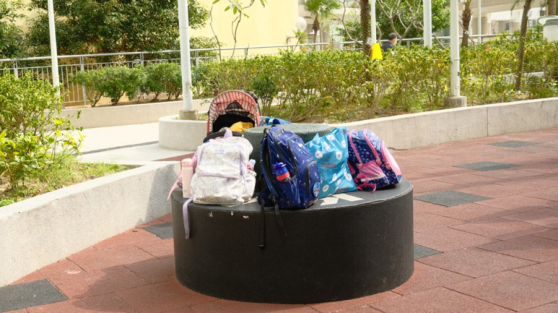
However, the current design of play spaces largely overlooks the need for storage. Consequently, caregivers are compelled to improvise, using available play equipment or seats to store their belongings or leaving items on the ground (Figure 2). In other instances, they are left with no choice but to carry these items while trying to engage with their children in play. This additional burden not only inhibits their participation but also creates a safety concern, as belongings left unattended or on play equipment may pose risks.
This finding highlights a significant design omission that needs address- ing. Incorporating adequate storage facilities in the design of play spaces can alleviate the load on caregivers, increase their enjoyment and partic- ipation in play activities, and contribute to a safer, more organized play environment.
162 Siu and Jian
Figure 2: Caregivers use seats to temporarily store their belongings.
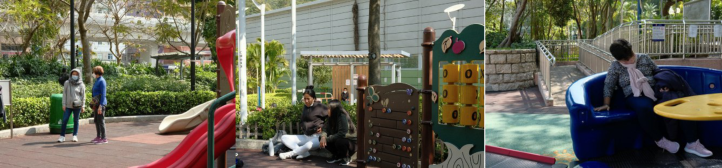
Sitting Area Another finding of this study pertains to the design and placement of sit- ting areas in play spaces. Current designs often neglect to provide adequate or strategically placed seating for caregivers. When present, these areas are typically relegated to the periphery of the space, making it challenging for caregivers to closely supervise their children (Figure 4-a, 4-b). As a result, caregivers are often forced to stand due to the lack of convenient seating options (Figure 3-a), or they resort to less than ideal alternatives like sit- ting at the edge of the road, beside bushes (Figure 3-b), or even leaning on play facilities for rest (Figure 3-c). The adequate provision and thoughtful design of sitting area would facilitate a more comfortable environment so that longer stays in the play spaces would be possible. This extra time nat- urally extends opportunities for meaningful interaction with their children and even between caregivers themselves.
Moreover, the inclusion of regular city benches in play spaces fails to enhance the overall quality of the environment. Instead of integrating seam- lessly with the design of the playground, these generically-designed standard benches often disrupt the aesthetic unity of the space. This inconsistency in furniture style can detract from the overall image and appeal of the play space, while also failing to address the fundamental needs of caregivers.
a b c
Figure 3: Caregivers are standing (a), sitting at the edge (b), taking a nap in play facility (c).
Human-Centred Design: Promoting Interactions Between Children and Caregivers 163
Shelter A third significant finding of this research revolves around the concept of “shelter”in play spaces, both as a physical amenity and as an abstract concept providing respite for caregivers.
Caregivers frequently need to stay close to their children, especially when they are young or when the play facilities necessitate close supervision (Figure 4-a, 4-b). Yet, play spaces rarely factor in this need. Shelters, when provided, are limited and often not conveniently co-located with seating areas. Trees, which could offer natural shade, are scarce. Consequently, caregivers are often left standing in the direct sun while supervising their chil- dren (Figure 4-a, 4-b). This is particularly problematic given Hong Kong’s hot summers. This discomfort may compel caregivers to limit the duration of children’s playtime in these spaces, potentially impacting children’s play experience and overall health.
a b c
Figure 4: Caregivers standing in the sun (a & b), playing with the phone while caring (c).
On a more abstract level, “shelter” represents a much-needed refuge for caregivers, offering them an opportunity to enjoy some “me time” amidst their busy routines and parenting duties (Figure 4-c). This kind of respite becomes particularly significant for caregivers of older children, who are capable of playing independently. However, the current setting of play spaces seems to overlook this need, failing to create an environment where care- givers can momentarily disengage from their responsibilities while remaining assured of their children’s safety. In short, both physical and abstract forms of “shelter” need to be better incorporated into the design of play spaces. This would not only enhance the comfort and well-being of caregivers but also pave the way for extended and more fruitful play sessions for children.
Play, Too An additional finding of this study addresses the overlooked play needs of caregivers in public play spaces. While the primary reason caregivers visit these spaces is to enable their children to play, they too harbour a desire to engage in playful activities. However, current design practices do not cater adequately to this need.
At present, facilities within children’s playgrounds are primarily aimed at children. Even interactive play equipment follows a child-cantered design,
164 Siu and Jian
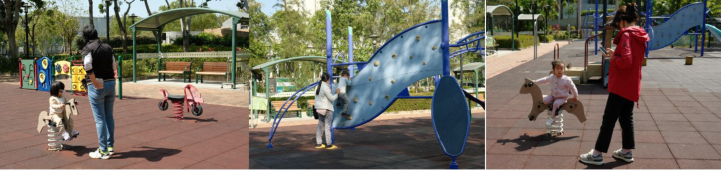
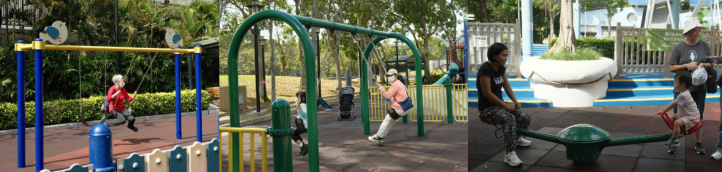
neglecting to consider caregivers’ play needs. Observations reveal that care- givers frequently engage in play within these spaces, yet they are limited by the range and inclusivity of available facilities. For instance, due to restric- tions such as size or weight limits, caregivers are often relegated to playing on swings or seesaws (Figure 5, a-c).
This gap in provision indicates a missed opportunity for enhancing the experience of caregivers in play spaces and fostering increased interaction between caregivers and children. A shift towards incorporating more inclu- sive, adult-friendly play facilities could enable caregivers to engage more fully in play, creating a more enjoyable and interactive experience for both children and their caregivers. By considering caregivers not just as supervisors but also as potential players, we can enhance the overall value and attractiveness of public play spaces.
a b c
Figure 5: Caregivers playing by themselves (a) or with children (b), caregivers playing seesaw with children (c).
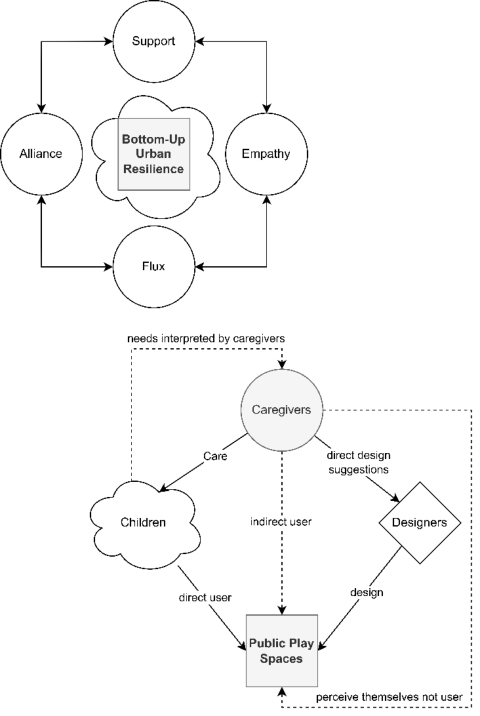
Design Paradox: The Role of Caregivers Indeed, the current conundrum presents an interesting paradox in the design of children’s playgrounds. While these spaces are primarily intended for chil- dren’s use, it is usually the caregivers’ perceptions and ideas that shape the design criteria. This is because children, especially younger ones, might not be able to express their needs and preferences explicitly, and the design- ers may lack the necessary tools or methods to involve them in the design process effectively. The result is a play space that’s created based on care- givers’ perspectives, often neglecting the imaginative and explorative aspects that children might find engaging. The irony lies in the fact that caregivers, despite their instrumental role in the design process, do not perceive them- selves as users of the play space according to our data. This also inadvertently excludes caregivers’ needs from the design, even though they play a signifi- cant role in the play space, supervising and interacting with the children, they are frequently confined to the periphery, with limited provisions to make their experience comfortable or enjoyable (Figure 6).
This situation highlights the need for a more inclusive and participatory design approach that actively considers both the children and the caregivers and recognising their role as (in)direct users. Innovative methods are also needed to involve children directly in the design process to better reveal their real needs. By doing so, we can create more engaging and inclusive play spaces that truly cater to all users and facilitate meaningful interactions between children and caregivers.
Human-Centred Design: Promoting Interactions Between Children and Caregivers 165
Figure 6: Caregivers’ paradoxical role in designing public play spaces.
CONCLUSIONS
This study underscores the need for a more holistic, human-centred approach to the design of public play spaces in Hong Kong. The traditionally child- centric design of these environments fails to adequately consider the needs and experiences of caregivers, who are integral to the effective and inclusive functioning of these spaces.
Our findings illustrate several key areas for improvement, including the provision of adequate seating and shade, appropriate storage facilities, and opportunities for caregiver interaction and play. Caregivers are not simply passive spectators but active participants who shape and enhance the play experience for children. Consequently, their needs, preferences, and potential for engagement should not be overlooked in the design process.
These observations are deeply intertwined with the societal changes tak- ing place in Hong Kong, such as the evolving roles of caregivers due to the prevalence of domestic workers and younger grandparents.
166 Siu and Jian
This research signals a call to action for more inclusivity in the design of public play spaces, urging a shift towards spaces that encourage and facilitate interactions between children and caregivers. By doing so, we can maxi- mize the utility of these limited spaces, enhance the experience for all users, and ultimately foster a more inclusive and vibrant community in one of the world’s most densely populated cities. It is our hope that these insights will inspire new directions in design research and practice, leading to play spaces that truly celebrate and accommodate the diverse needs of all users.
ACKNOWLEDGMENTS
The authors would like to acknowledge the support of the Hong Kong Research Grants Council GRF project (RGC 15219021), the postdoctoral fel- lowship fund (PolyU, 1-W187), and the Eric C. Yim Endowed Professorship. We also thank the researchers (Zi Yang, Ziyou Yin and Xinzhe Zhao) of the Public Design Lab, PolyU, for their general assistance during the project.
REFERENCES
Aminpour, F., Bishop, K., Corkery, L., 2020. The hidden value of in-between spaces for children’s self-directed play within outdoor school environments. Landsc. Urban Plan. 194, 103683. https://doi.org/10.1016/j.landurbplan.2019.103683 Burke, J., 2013. Just for the fun of it: making playgrounds accessible to all children.
World Leis. J. 55, 83–95. https://doi.org/10.1080/04419057.2012.759144 Chan, H. H., 2023. Reworking of care during workday outings: On migrant domestic workers’ everyday negotiation of migration infrastructure in the global city of Hong Kong. Trans. Inst. Br. Geogr. Corominas, M., González-Carrasco, M., Casas, F., 2021. Analyzing factors for an
optimum play environment through children’s subjective well-being indicators. Child. Youth Serv. Rev. 122, 105688. https://doi.org/10.1016/j.childyouth.2020. 105688 Hart, R., Daiute, C., Iltus, S., Sabo, K., Kritt, D., Rome, M., 1996. Child and Youth Development Through Community Participation and Children’s Develop- ing Capacity to Participate. Rep. Child. Environ. Proj. Calif. Wellness Found. Berkeley Calif. Hartt, M., Lee, C., Empey-Salisbury, M., 2023. Planning for Play? A System-
atic Literature Review. J. Plan. Lit. 088541222311692. https://doi.org/10.1177/ 08854122231169228 Hin-yan Chan, H., Latham, A., 2022. Working and dwelling in a global city: Goingout, public worlds, and the intimate lives of migrant domestic workers in Hong Kong. J. Ethn. Migr. Stud. 48, 3524–3543. Jansson, M., 2015. Children’s perspectives on playground use as basis for chil-
dren’s participation in local play space management. Local Environ. 20, 165–179. https://doi.org/10.1080/13549839.2013.857646 Jian, I. Y., Luo, J., Chan, E. H., 2020. Spatial justice in public open space planning: Accessibility and inclusivity. Habitat Int. 97, 102122. Lai, C., 2017. Unopened space: Mapping equitable availability of open space in Hong
Kong. Civic Exchange Hong Kong, China. Lai, P.-C., Low, C.-T., 2019. Provision of Convenient Play Space in a Densely Populated City. Int. J. Environ. Res. Public. Health 16, 651. https://doi.org/10.3390/ij erph16040651
Human-Centred Design: Promoting Interactions Between Children and Caregivers 167
Leisure and Cultural Services Department, 2023. Play Equipment for All Children [WWW Document]. URL https://www.lcsd.gov.hk/en/facilities/facilitieslist/child ren/playequipment.html (accessed 6.4.23). Leisure and Cultural Services Department, 2022. Statistics Report [WWW Document]. Stat. Rep. - Leis. Cult. Serv. Dep. URL https://www.lcsd.gov.hk/en/aboutlcsd/ppr/statistics/leisure.html#! (accessed 5.26.23). Leung, J. T., Shek, D. T., 2018. Families in transition in Hong Kong: Implications to
family research and practice. Int. Public Health J. 10. Lo, S. K., Lindsay, J., 2022. “My children,”“my grandchildren”: Navigating intergenerational ambivalence in grandparent childcare arrangements in Hong Kong. Fam. Relat. 71, 1834–1851. Malone, K., 2006. United Nations: a key player in a global movement for child
friendly cities, in: Creating Child Friendly Cities. Routledge, pp. 25–44. Potwarka, L. R., Kaczynski, A. T., Flack, A. L., 2008. Places to play: association of park space and facilities with healthy weight status among children. J. Community Health 33, 344–350. Siu, K. W. M., Wong, Y. L., Lam, M. S., 2019a. The Needs of Children and
Their Caregivers in New Urban Lifestyles: A Case Study of Playground Facili- ties in Hong Kong, in: Charytonowicz, J., Falcão, C. (Eds.), Advances in Human Factors, Sustainable Urban Planning and Infrastructure, Advances in Intelligent Systems and Computing. Springer International Publishing, Cham, pp. 257–265. https://doi.org/10.1007/978-3-319-94199-8_25 Siu, K. W. M., Wong, Y. L., Lam, M. S., 2019b. Children Deserve Better Public Life: Human-centred Design in Play Spaces. Presented at the IASDR Conference 2019 proceedings, IASDR, pp. 1–16. Siu, K. W. M., Wong, Y. L., Lam, M. S., 2017. Inclusive play in urban cities: a pilot
study of the inclusive playgrounds in Hong Kong. Procedia Eng. 198, 169–175. Tang, B., 2017. Is the distribution of public open space in Hong Kong equitable, why not? Landsc. Urban Plan. 161, 80–89. Veitch, J., Bagley, S., Ball, K., Salmon, J., 2006. Where do children usually play? A
qualitative study of parents’ perceptions of influences on children’s active free- play. Health Place 12, 383–393. https://doi.org/10.1016/j.healthplace.2005.02. 009 Visser, K., Aalst, I., 2022. Neighbourhood Factors in Children’s Outdoor Play: A Systematic Literature Review. Tijdschr. Voor Econ. En Soc. Geogr. 113, 80–95. https://doi.org/10.1111/tesg.12505
Read this individual research paper free through the original publisher, or explore the full digital proceedings book.
ISBN 978-1-958651-87-2
Explore this ISBN in the AHFE Bookstore ↗Listed in the July 2026 bookstore catalogue; search by ISBN to confirm current availability · Digital book purchase optional