Alex Pui-yuk King, Kin Wai Michael Siu (2023). Universal Design in Public Housing: Enhancing the Quality of Life of Older People with Mild Cognitive Impairment Living Alone. In: Human Interaction & Emerging Technologies (IHIET 2023): Artificial Intelligence & Future Applications. AHFE Open Access, vol. 111, pp. 121–129. https://doi.org/10.54941/ahfe1004016
1 Curriculum Development and Quality Assurance Department, Hong Kong Institute of Construction, Construction Industry Council, Kowloon Bay, Hong Kong ↗
2 School of Design, The Hong Kong Polytechnic University, Hunghom, Hong Kong ↗
The population of Hong Kong is ageing and is expected to gradually increase, and thus an increase in single older people with mild cognitive impairment is expected. This may progress to dementia overtime. By 2064, a third of Hong Kong's total population is expected to be aged 65 or above, which will put extreme pressure on long-term health services and increase social care costs. Studies of mild cognitive impairment (MCI) and dementia have mainly been conducted in the west, and evidence-based research addressing the genuine needs of patients with MCI in their daily activities is limited. The home is the central focus of many people's lives, and the elderly will spend most of time in it.The specific objectives of the study are first, to briefly review and explore the common strengths and limitations of public housing in Hong Kong and selected cities; second, to identify the deficiencies of current public housing in terms of universal design and broaden the scope of this approach; third, to develop a model of the relationships among coping strategies for enhancing quality of life, unmet needs and the feeling and concerns of people with MCI living alone.The present ethnographic study is aimed at revealing some of the contemporary concerns about human culture and social interaction. A triangulation study approach is taken, beginning with participatory design workshop followed by participant observations with five residents living alone with MCI, and an in-depth interview with a centre manager who assisted in this study and is a carer for those with dementia.This study suggests that universal design principles are not sufficiently applied in the development of public housing for single elderly people living with MCI. To address this deficit in interior, home furniture and product designs, the concept of a visible reminder has been suggested, which includes multisensory and psychological considerations. Design practitioners should fully utilise this conceptual model when developing universal design furniture for the general public, without stigmatising those with disabilities such as MCI. The coping strategies for improving the quality of life these older people are identified as continued home care and family support, an awareness of universal design principles, social networks and engagement and revisiting public health policies. Governments should take the lead in helping to improve the quality of life of people with MCI through healthcare, social engagement, caring and universal design.
As life expectancy continues to rise and the fertility rate remains low, the population of Hong Kong will continue to age. Older people in Hong Kong are likely to constitute up to 33% of total population, and will thus affect the current healthcare and social protection system. This will therefore become a major consideration for policy makers. Single elderly people should have the right to live independently, whether able-bodied or living with cognitive impairment. The main objectives of this research study include identifying any deficiencies in the interior and product designs of public housing for single elderly people and proposing new directions in relation to universal designs aimed at older people with mild cognitive impairment (MCI).
Research data were obtained through the Yan On Tong Wu Chung Com- munity Centre, Food Grace, under the parent organisation Community Leap, and the day care centre of the Christian Family Service Centre. Not surpri- singly, the principles of universal design are new to the majority of the older participants. As a major factor affecting the quality of life of people living with MCI, the physical housing space should be well-defined to provide easy access and promote inclusivity. Good design execution can minimise the bur- geoning cost of healthcare and social protection resulting from an ageing population.
PEOPLE WITH DEMENTIA LIVING ALONE Dementia refers to the biomedical disease accompanying degeneration and a loss of abilities over time. The phrase was coined in the1900s by Dr Alois Alzheimer, a psychiatrist and neuropathologist. Alzheimer’s disease is a dege- nerative brain syndrome characterised by a progressive decline in terms of memory, comprehension, thinking, calculation, learning capacity, language and judgement (World Health Organization, 2016). It involves a deterio- ration in cognitive function, which may not be expected in normal ageing. Dementia is progressive and can include losing memory, confusion, problems with speech and understanding (Alzheimer’s Society, 2016). The gradual decline in ability can lead to the need for extra support in daily activities. Subtle problems in terms of reasoning and memory can be classified as MCI. Reisberg used this term to characterise patients in the intermediate stage before it developed into dementia based on the investigation from various clinical, genetic and pathological perspectives (Reisberg, 1988). A mild level of cognitive deficit in addition to memory loss generally occurs, but no iso- lated decline in the non-memory domain is present in MCI sufferers, as not all forms of MCI will evolve into dementia.
Social structures have changed substantially over the past 30 years as the number of older adults living alone has been increasing. Loneliness is an aversive individual experience and emotional state and involves unfulfilled personal and social needs (Peplau & Perlman, 1982). Social isolation refers to being cut off from normal social networks and involves an enforced lack of integration into society. This can have a harmful effect on cognitive functi- oning and thus increase the risk of developing cognitive impairment such as dementia (Fratiglioni et al., 2004). Reports from the HKSAR Government indicate that the proportion of older people living alone increased over a ten-year period from 11.6% (2006) to 13.1% (2016) (Census and Statistics Department, 2016).
The ‘Guidelines for the Universal Design of Dementia Friendly Dwellings for People with Dementia, their Families and Carers’ were produced by the Centre for Excellence in Universal Design - aimed at ensuring people with dementia have the ability to live in dementia-friendly environments, either alone or supported by family and carers. These guidelines outline the specific design considerations that are the foundation of universal design. Universally designed home environments and interiors enable the largest possible number of people including those with disabilities to live independently within society
Universal Design in Public Housing: Enhancing the Quality of Life of Older People 123
or at home, while maintaining main stream aesthetics considerations. Thus, those with special needs are not stigmatised (CEUD, 2015).
UNIVERSAL DESIGN Universal design in a global context where ‘Universal’ refers to design diver- sity, and that application should be based on a user-centred approach. The ‘design’ is the solution generated by a creative approach and supported by empirical investigation (Froyen, 2012). By utilising universal design princi- ples, every environmental element can be made as accessible as possible as it addresses a full range of functionality, thus benefiting many people. Universal design increases the potential for many people to develop a better quality of life (Russell, 1999). It involves the creation of product design, furniture and other spaces, and thus can reduce the need for any special accommodation. Universal design supports increased socially engagement and reduces the eco- nomic burden of specially designed services and products that fit individual needs. Mace (1985) first defined universal design as the design of produ- cts and environments that are as usable as possible by all kinds of people, without the need for adaptation or specialism. Ronald L. Mace published seven Principles of Universal Design regarding the evaluation of designs, offering guidelines for design process so as to educate both designers and end-users about the characteristics of usable products and environments as follows: (1) Equitable Use: The design is useful and marketable to people with diverse abilities. (2) Flexibility: The design accommodates a wide range of individual preferences and abilities. (3) Simple and Intuitive to Use: The design is easy to use, regardless of the user’s experience, knowledge, langu- age skills or current concentration level. (4) Perceptible Information: The design communicates necessary information effectively to the user, regard- less of the ambient conditions or the user’s sensory abilities. (5) Tolerance for Error: The design minimises hazards and the adverse consequences of accidental or unintended actions. (6) Low Physical Effort: The design can be used efficiently and comfortably and with a minimum of fatigue. (7) Size and Space for Approach and Use. Appropriate sizes and spaces for appro- ach, reach, manipulation and use, regardless of user’s body size, posture or mobility.
Steinfeld and Maisel (2012) defined universal design as ‘a process that ena- bles and empowers a diverse population by improving human performance, health and wellness, and social participation’ (p.29). Fully utilising the pri- nciples of universal design can provide better social support and thus people in need can be more self-reliant and socially engaged (King and Siu, 2017). Through the utilisation of universal design principles, product, home furni- ture and interior design can not only reduce social stigma, but also promote social engagement by ensuring equality between those with functional disa- bilities and the able-bodied (Danford & Maurer, 2005). Most residents can benefit from universal design applied in housing regardless of one’s ability and age (Deardorff & Birdsong, 2003). Modification in housing becomes crucial to provide an accessible home for people so as to promote to live independently. UD principles can be applied effectively, for example, at
124 Pui-Yuk King and Michael Siu
main entrance, bathroom and toilet, kitchen, control switches, and also the circulation to fulfil the needs of disabled people (Souza, 2004).
PSYCHOSOCIAL INTERVENTION Psychological treatment for depression can be beneficial for those with cognitive impairment, and various approaches regarding the managing of behavioural and psychological symptoms have been identified in the litera- ture. Therapy related to cognitive behaviour has been increasingly applied as an effective treatment for older people living with dementia (Pinquart, Duberstein, & Lyness, 2006), to some extent, it could be an alternative to sedation and prevent further cognitive disability. The use of psychological therapy with older people is relatively limited compared to other age groups (Laidlaw, 2013). Cognitive-related content is increasingly applied by clinical practitioners to enable precise psychological interventions. Psychologists or mental health care professionals can support and motivate caregivers, and promote public awareness regarding mental healthcare issues within society (Powers, 2008). Conducting regular cognitive behavioural therapy training sessions with caregivers and family members can enhance their awareness and motivation regarding such therapeutic intervention for people with MCI who live alone.
METHODOLOGY
In this present study, an ethnographic study of older people living alone with MCI in Hong Kong is conducted. An interpretive research approach is taken, so the meanings attached to experiences can be established (Schutt, 2006). This research paradigm involves an empathetic approach of understanding of each participant’s routine and any problematic events, within a natural setting. Developing appropriate public housing for older people is neces- sary, and particularly for vulnerable people with cognitive impairment and disabilities who are from low-income families. Participant observations are gathered from various sites, supported by project partners and non-profit organisations, and in-depth interviews are then conducted with people with MCI, assisted by their relatives or care-givers, care professionals and demen- tia centre managers who have previous experience of such interviews (Black and Rabins, 2007). The participatory design workshop in this study was con- ducted in the activity room of the fourth floor of Yan Oi Tong Woo Chung District Elderly Community Centre (YOT). Yan Oi Tong, the parent organisa- tion, was first registered as a charitable organisation in the 1970s. It delivers comprehensive care services in various sectors including social, education and medical services, along with numerous social enterprises. This district has a population of 481,200, or around 6.6% of the total population of Hong Kong (Census and Statistics Department, 2017, p. 26).
The recruitment process was the responsibility of the YOT centre manager, who followed the stated requirements: older people who can understand and speak Cantonese, who are aged between 65 and 85 and who have MCI. The investigator organised a one-hour guest talk that attracted 58 people, who
Universal Design in Public Housing: Enhancing the Quality of Life of Older People 125
were either living with MCI or were care-givers of those with early demen- tia. They were all official members of the YOT centre and those with MCI were diagnosed using the Montreal Cognitive Assessment (MoCA) at the cen- tre by healthcare professionals. The participatory design workshop aimed to explore (1) memory ability, (2) thinking ability, (3) orientation to time and place, (4) comprehension, (5) calculation, (6) learning capacity, (7) language and (8) the judgement of older people suffering from MCI. My goal was to learn more about their daily needs and problems related to their kitchens, washrooms, living and dining rooms and bedrooms, and how they can cope with them.
Semi-structured interviews were conducted with caregivers in a private area of the district community centre. The investigator conducted a one-hour interview with M, the centre manager of the Yan Oi Tong Elderly Commu- nity Centre. The investigator asked her about the challenges and problems she faced with people with MCI when organising their regular activities and how we can communicate more effectively with people with cognitive impair- ment. TM (55), a male caregiver, was also recruited in the seminar. TM was asked to describe any stressful experiences he had. He explained his coping method and explained how caregivers rarely have professional training. Eth- ical approval was obtained before the study began and all informants gave their consent. The detailed discussion of semi-structured interviews will be covered in the future journal article.
FINDINGS AND RESULTS The workshops consisted of three groups of participants, each of which con- tained three people who were over 65 living with MCI and a social worker and an older volunteer. In this study, 15 older people with MCI (Elder A – O), two older volunteers and one centre manager attended the participatory design workshops. Surprisingly, almost all of the older participants with cognitive impairment were female except for one man accompanied by his spouse. Six half-day participatory design workshops were conducted, with the full support of M, the centre manager of the YOT, and the makeup of the participant groups in each workshop was identical. Three sessions were conducted per day every Thursday and Friday, and each session was split into two parts to facilitate the development of dummy testing models. These were composed of four to six older people living with MCI, 1 supporting older volunteer who prepared the table setting and facilitated the discussions and 1 social worker who ensured the participants could attend each session. Thus, 15 people living with MCI were recorded on each afternoon with their concerns and difficulties are illustrated in Figure 1.
DISCUSSION
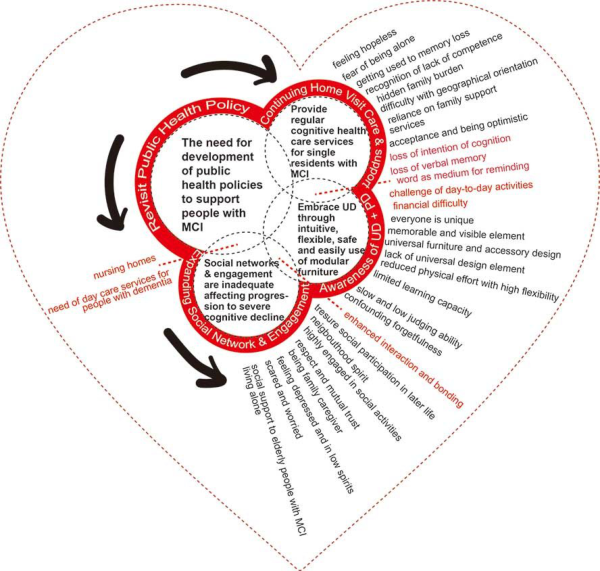
Four themes were identified using thematic analysis. They capture a common and recurring pattern across the extensive qualitative data, enabling patterns of meaning to be identified and thus analysed and interpreted. The coping strategies for improving the quality of life of older people with MCI who live
126 Pui-Yuk King and Michael Siu
Getting Used to Memory Loss
Elder A When I finish washing my hands in washroom, I don’t remember that I need to close the tap and leave…quite often, I forget this act and believe there is no need to act at all. It is difficult for me to clean the cupboard...if I don’t, I have to suffer with dirt and dust all over the cupboard. I have nothing else to do with it. Elder B I forgot the surname of the officer who reminded me to attend this workshop, I forgot to switch off the gas stove, I forgot to bring my door key…and my phone…seems to me I forget at least one thing a day…make me feel frustrated and that I cannot concentrate at all.
Memorable and Visible Element
Elder L The most effective way for me is to check the cooking pot again and again and to see it clearly and make sure no pot is on the gas stove. I need to make sure no fire remains on the gas stove. Elder F I could only remember it when I see the goods.
Recognition of a Lack of competence
Elder B I do not know why I had forgotten the password for my credit card two times. I am still using the password that provided by the bank printed on the envelope.
Highly Engaged in Social Activities
Elder Q I don’t want to go out too frequently, except to the activities provided by the community centre nearby here in YOT. I tried to avoid being disorientated like others.
Fear of Being Alone Elder A When there is nothing to do, I feel so completely lonely. No one is able to talk with me…I feel dumb and I really feel bad. If such loneliness makes me feel sick, I prefer to hang around the local shopping complex. Such activity would make me feel better.
Loss of Intention of Cognition
Elder A Very often when I open the tap and use water to clean, I forget to close it after use...I don’t have the intention to shut it down. I forget…forget this act at all. After a while, when I hear the sound of running water coming out, I realise I should shut down the tap immediately.
Difficulty with Geographical Orientation
Elder J I seldom go shopping. I only visit the community centre…when I finish an activity, I return home. This can reduce the problem of getting lost!
Limited Learning Capacity
Elder O I put a square mini white label with a circle that signifies the operation of the TV on top of the corresponding key. I needed to spend a long time to learn how to operate it. Eventually, I gave up and only use the 2–3 buttons marked with labels.
Words as a Medium for Remembering
Elder I I don’t know how to write…so I cannot mark down what I have to buy each time.
Slow and Low Judging Ability
Elder E I found that my induction cooker is not that sensitive, and I didn’t know whether I had pressed the switch or not.
Figure 1: Summary of the problems older people living with MCI can face in a typical day.
Figure available in the original PDF paper.
are identified as Continuing Home Visits and Family Support, Awareness of Universal Design Principles, Expanding Social Networks and Engagement, and Revising Public Health Policies. The relationships between these strate- gies, which involve improving public housing and thus the quality of life of elderly people, the unmet needs and the feelings and concerns of those with MCI are illustrated in Figure 2. The research revealed that home visit care and family support are not enough for people live alone with MCI, who have a greater potential for depression than those living with family members. In
Universal Design in Public Housing: Enhancing the Quality of Life of Older People 127
Figure 2: Conceptual model of the relationships among the coping strategies for enh- ancing the quality of public housing and the quality of life, unmet needs, feelings and concerns of those living alone with MCI.
addition to medication, social activities and cognitive training are essential, so they can have the opportunities to mitigate cognitive loss. The needs of patients with MCI are not completely fulfilled, and many participating resi- dents said that they have suffered from numerous product design mistakes. Continued home visits can prevent further social isolation and thus improve self-esteem. They can also effectively enable community-dwelling older peo- ple to live safely in their own place, giving them the opportunity to live with dignity without social stigma. Ageing at home enables one to maintain autonomy, however, the home setting should be defined and well-developed including the application of an effective reminder so that those with MCI can maintain ageing in place. The long waiting time for the various services provided to people with cognitive impairment and their carers also hinders the participation in social engagement, and thus the potential for MCI to fur- ther progress to become dementia is greater. Government bodies and related service providers should take the initiative to provide support and advice to sufferers and family carers through dementia prevention programmes.
CONCLUSION
Meeting health care and medical needs will be of paramount importance and is the most urgent task. The government of Hong Kong must review
128 Pui-Yuk King and Michael Siu
the current health care system, as the quality of life of older people with mental or physical illnesses can be affected by poorly designed living envi- ronments. Long-term medical care and support is required, but this brings a significant financial burden through medical expenditure. Redeveloping public housing for single elderly with MCI in particular is required, by consi- dering their genuine needs through universal design principles and involving them in participatory design workshops. Interior features such as self-locking door and visible cabinets integrated with key holders should be considered when applying universal design principles to those people living alone with MCI.
Building up and expanding their social networks through embracing UD principles and developing effective reminders as foundation in remodelling public housing can help alleviate loneliness and facilitate social connection. The government should take a leading role and re-assess this housing cate- gory. Strategic groups can be established to collect feedback from older people with MCI who live alone, care givers, health care professionals and social workers who provide care support to older people. Utilizing bottom- up approach to collect first hand information encourages the participation of the target groups and facilitates social interaction with older people with MCI. More guidance should be given to family carers as they are unlikely to have formal training in MCI or early dementia.
People living in public housing are normally in rental basis where the resi- dent is required to restore to its original design and interior when they moved out. Unlike public housing, people who live in private housing can have a better control of the remodelling process and thus, the flexibility is high. The affordability of the resident should take into consideration when designing and developing products, furniture and living environment, in particular, for those people who are aged, cognitive impaired and living alone. The majo- rity of the participants in this research are not living in rich families that the daily expenses rely on the monthly old age living allowance under the social security allowance scheme. The design practitioners should pay attention to the genuine needs and concerns when proposing new solutions to people in need.
ACKNOWLEDGMENT
The author’s team would like to express gratitude to the reviewers for their valuable comments. We would also like to thank the participants and sup- porting staff who took part in the main study. This research work was fully supported by The Hong Kong Polytechnic University and the Construction Industry Council in Hong Kong. We would also thank the partial support of the Eric C. Yim Endowed Professorship, PolyU.
REFERENCES
Alzheimer’s Society (2016). Facts about Dementia: Facts about Dementia: Website: https://www.alzheimers.org.uk/site/scripts/documents.php?categoryID=200120 [accessed 3 April 2023]. Black, B. S. and Rabins, P. V. (2007). Qualitative research in psychogeriatrics.
International Psychogeriatrics, 19, 167–173.
Universal Design in Public Housing: Enhancing the Quality of Life of Older People 129
Census and Statistics Department (2016). Hong Kong Population Projections. Hong Kong: Hong Kong Special Administration Region Government Printer. Census and Statistics Department. (2017). Population and Household Statistics
Analysed by District Council District 2016. Hong Kong: Census and Statistics Department. Website: https://www.statistics.gov.hk/pub/B11303012016AN16B 0100.pdf [accessed 3 April 2023]. Centre for Excellence in Universal Design (2015). Universal Design Guidelines: Dementia Friendly Dwellings for People with Dementia, their Families and Carers. Website: https://universaldesign.ie/Built-Environment/Housing [accessed 3 April 2023]. Danford, G. S., & Maurer, J. (2005). Empirical tests of the claimed benefits of uni-
versal design. In Proceedings of the Thirty-sixth Annual International Conference of the Environment Design Research Association (pp. 123–128). Deardorff, C. J., & Birdsong, C. (2003). Universal design: Clarifying a common vocabulary. Housing and Society, 30(2), 119–138. Fratiglioni, L., Paillard-Borg, S., &Winblad, B. (2004). Anactive and socially inte-
grated lifestyle in late life mightprotect against dementia. Lancet Neurology, 3, 343–353. Froyen, H. (2012). Universal design, a methodological approach. Boston: The Institute for Human Centered Design. King, A. P., & Siu, K. W. M. (2017). Participant observation in cognitive gameplay as
a rehabilitation tool for living alone elderly with dementia in Hong Kong: a pilot study. The Design Journal, 20(sup1), S2426–S2438. Laidlaw, K. (2013). A deficit in psychotherapeutic care for older people with depression and anxiety. Gerontology, 59, 549–556. Mace, R. (1985). Universal design: Barrier free environments for everyone. Designers
West. pp. 147–152. Peplau, L., & Perlman, D. (1982). Perspectives on loneliness. In L. Peplau & D.
Perlman (Eds.), Loneliness: A source- book of current theory, research and therapy (pp. 1–18). New York, NY: John Wiley and Sons. Pinquart, M., Duberstein, P. R., & Lyness, J. (2006). Treatments for late-life depressive conditions: A meta-analytic comparison of pharmacotherapy and psychotherapy. American Journal of Psychiatry, 163, 1493–1501. Reisberg B, Ferris S, de Leon MJ et al. (1988). Stage-specific behavioral, cognitive,
and in vivo changes in community residing subjects with age-associated memory impairment and primary degenerative dementia of the Alzheimer type. Drug Dev Res; 15: 101–14. Russell, L. (1999). The Future of the Built Environment. The Millennium Papers.
London: Age Concern England. Schutt, R. K. (2006). Investigating the social world: The process and practice of research (5th ed.). Thousand Oaks, CA: Sage. Steinfeld, E. & Maisel, J. (2012). Universal design: Creating inclusive environments.
John Wiley & Sons. World Health Organization (2016). Fact sheet No. 362: Dementia Website: https:// www.who.int/mediacentre/factsheets/fs362/en [accessed 3 April 2023].
Read this individual research paper free through the original publisher, or explore the full digital proceedings book.
ISBN 978-1-958651-87-2
Explore this ISBN in the AHFE Bookstore ↗Listed in the July 2026 bookstore catalogue; search by ISBN to confirm current availability · Digital book purchase optional