Jiaman Li, Kin Wai Michael Siu (2024). Participant Experience Evaluation in Digital Rural Poetry Activities: A Sentiment Analysis Case Study of Mingyue Village in China. In: Human Factors in Design, Engineering, and Computing. AHFE Open Access, vol. 159, pp. 612–621. https://doi.org/10.54941/ahfe1005627
In the era of digital intelligence, integrating digital technologies and social media has revitalized cultural activities in rural communities, attracting the attention of many visitors. Utilizing Mingyue Village in China as a case study, this research explores how poetry creation and dissemination have become new pathways for preserving rural cultural heritage, allowing participants to share and experience poetry creation in both physical and virtual spaces. The study aims to assess the emotional expressions of residents in digital poetry activities. Based on anthropological fieldwork, it employs SVM (Support Vector Machine) with SMOTE (Synthetic Minority Oversampling Technique) to analyze poetry text data, delving into participants' emotional interests and inclinations. The results show that digital poetry activities not only enhance rural residents' sense of place and community cohesion but also promote the expression of positive emotions. The study concludes that digital poetry activities are an inevitable outcome of technological advancement while responding to human emotional and cultural needs. Future research will focus on optimizing sentiment analysis techniques, expanding sample sizes, and integrating tourism and cultural activities to promote rural community development and cultural heritage preservation.
In the wave of post-digitalization, rural communities find themselves at a crossroads of innovation. With the rapid advancement of information technologies, many countries—under the guidance of UNESCO’s Digital Heritage Preservation Initiative—have implemented policies to integrate digital culture into rural development. These policies typically focus on three key areas: digital infrastructure (European Commission, 2020), the digital preservation and dissemination of cultural heritage (UNESCO, 2019), and the promotion of sustainable rural economic development through digital technologies (Sindakis, 2024). These top-down policies have further stimulated the emergence of new forms of cultural representation in rural areas.
Participant Experience Evaluation in Digital Rural Poetry Activities 613
In the southwestern Mingyue Village of China, the discovery of an ancient pottery kiln in 2008 catalyzed a cultural renaissance, drawing over 50 new villagers interested in cultural and artistic projects. With a shared vision of creating a “poetic countryside,” the village has witnessed a sixfold increase in per capita disposable income from 2009 to 2021(Mingyue Village Committee, 2024). This achievement reflects the successful integration of tradition and modernity, as well as the prosperity of both the economy and culture. The annual cultural festivals and monthly poetry recitals, creative meetings, and book clubs of Mingyue Village have become the cornerstone of its cultural activities. Notably, the Mingyue Gathering (明月集), presented through online live broadcasting, has attracted an audience exceeding 200,000 (Yuanjia, 2024). The village’s activities are gaining more attention, showing how vital technology has become in making local cultural events more accessible and engaging for everyone.
The digital transformation of rural cultural activities and its profound impact on the relationship between individuals and their environment is clearly demonstrated through the Mingyue Village case study. In this exploration, we have implemented cutting-edge analytical tools—namely the Support Vector Machine (SVM) and the Synthetic Minority Oversampling Technique (SMOTE)—to delve into a collection of poems. These works, harvested from fieldwork starting in 2021, allow us to tap into more profound emotional strata that conventional sentiment analysis might overlook. By constructing a multi-dimensional analytical framework, we aim to reveal the emotional dimensions of villagers as critical actors in the rural setting, while also exploring the potential dynamic processes of emotional resonance, cultural identity, and sense of belonging they experience through participation in rural cultural activities.
LITERATURE REVIEW
Digital Culture, Post-Digital Culture, and Rural Development In the academic sphere, digital culture encompasses creating, disseminating, and conserving cultural content via digital means (Bailenson, 2018). Post- digital culture, emerging post-revolution, delves into human-technology dynamics and societal implications (Murray, 2020). Its advent has stirred discussions around rural culture’s essence, with concerns about value dilution (WU et al., 2019) and advocacy for its role in fostering rural diversification through smart villages (Zavratnik et al., 2018) and digital villages (Faxon, 2022). Duxbury and Campbell (2011) underscore the vital role of arts and heritage in rural communities, a view echoed by stakeholders valuing creative activities’ contributions. These activities, categorized into heritage conservation and community art projects (Roberts et al., 2016), leverage digital empowerment for cultural protection (Wang, 2024) and integrate arts with new media to invigorate rural communities (Hartley, 2005). Literary and festival initiatives catalyze economic diversification (Yiannakis et al., 2012; Hjalager et al., 2017). Digitalization’s impact on these activities is significant, yet the essence of rural experience remains central to participants’ sense of belonging and identity (McHenry, 2011).
614 LI and Siu
Theoretical Framework of Sense of Place and Place Identity From the concept of “sense of place” to “place identity,” these theories highlight the deep emotional bonds between individuals and places— a unique human-environment relationship shaped by cultural and social attributes (Tuan, 1977; Proshansky et al., 1983). This framework is segmented into two primary constructs: place attachment and place identity (ZHU, 2011). Place attachment is structured by a tripartite framework consisting of process, place, and person, as proposed by Scannell and Gifford (2010). Hammitt (1996) expanded on this by suggesting a gradient of place attachment that deepens from familiarity and belonging to identity, dependence, and ultimately rootedness. Meanwhile, Proshansky et al. (1983) described place identity as a multi-dimensional construct that intertwines personal identity with the physical environment, encompassing ideas, beliefs, preferences, feelings, values, goals, and behavioral tendencies and skills. Based on the theories mentioned above, this study intends to construct a theoretical framework to analyze the interplay among individuals, places, and emotions within rural cultural activities, by examining participants’ poetic texts.
Participatory Research and Sentiment Analysis In rural research, farmers are pivotal as both economic development drivers and cultural heritage custodians. A spectrum of participatory research methodologies has been embraced, encompassing mapping, multi-criteria analysis, scenario planning, multi-agent systems, collaborative modeling, and action research (Menconi et al., 2017). Predominantly, these investigations concentrate on rural decision-making and economic prosperity, often neglecting the emotional nuances of farmers’ cultural experiences. Sentiment analysis, burgeoning as a research instrument, has primarily been harnessed in computer science, engineering, and linguistics to refine algorithmic capabilities (Ligthart et al., 2021). It has also been instrumental in dissecting online product reviews (Keramatfar et al., 2019) and social media discourse (LIU, 2012). Recently, its utility in rural tourism has been burgeoning, predominantly to gauge the emotional responses of tourists (Vázquez Loaiza et al., 2019). Nevertheless, the deployment of sentiment analysis in examining the poetry of rural regions is notably understudied.
In summary, while research on rural cultural activities has increased, it has neglected the emotional perspectives of residents. Remarkably, the emotional aspects of Southwest China’s Mingyue Village have yet to be explored. This study applies digital analysis to examine the emotional bonds within rural communities.
METHODS
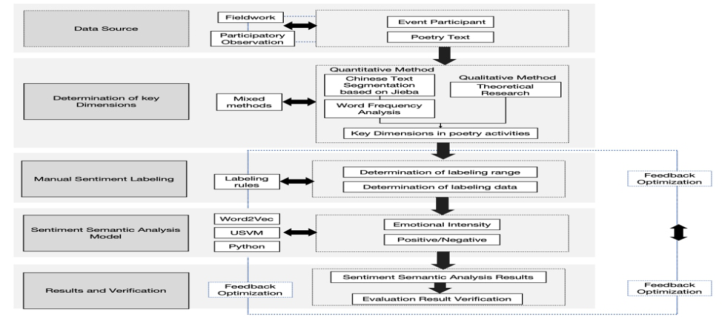
Overview This study adopts a mixed-methods approach, combining case study analysis, fieldwork, and quantitative data analysis to comprehensively examine the emotional practices of villagers participating in digital poetry
Participant Experience Evaluation in Digital Rural Poetry Activities 615
activities (see Figure 1). Since 2021, the research team has conducted extensive fieldwork in Mingyue Village, Southwest China, collecting 66 representative original poetry samples from residents, itinerant vendors, and tourists. Based on this dataset, the study develops an emotional dimension assessment framework rooted in human-environment relationship theories. The next step involved preprocessing the data, including tokenization and word frequency analysis, to identify key emotional dimensions in the poetry practices. Manual emotional labeling followed, defining the scope of emotional tags and annotating the dataset accordingly. In the sentiment analysis phase, techniques such as SVM, SMOTE, and Word2Vec were employed to identify and quantify positive and negative emotions and their intensities. Finally, the model was iteratively trained to optimize its performance, enhancing both its accuracy and predictive capacity.
Figure 1: Research approach (made by the authors).
Recognition on Key Dimensions in Poetry Activities The implementation of sentiment semantic analysis relies on the construction of emotional dimensions. In this study, by referencing sentiment lexicons and integrating theoretical models from the literature review, such as sense of place, place identity, and place attachment, we developed an evaluation metric for the key dimensions of poetry activities, as shown in Table 1. Our analysis of key words and frequencies in Mingyue Village’s poetry reveals strong emotional and behavioral connections to the place. “Mingyue” (mentioned 25 times) reflects a profound response to natural beauty. The terms “we” (8 times) and “friends” (5 times) indicate the importance of social bonds. Frequent mentions of “Mingyue Village” (25 times) show appreciation for its traditions. Words like “brilliant,” “laughter,” and “happiness” highlight emotional engagement, while verbs such as “go,” “look,” “drift,” and “practice” illustrate active participation in the village’s cultural activities.
616 LI and Siu
Table 1. Comprehensive affective rating scale for participants in rural cultural activities (by the authors).
Table available in the original PDF paper.
No. Evaluation Scale Reference Source Purpose Corresponding Chinese High-Frequency Words E0 Overall Satisfaction To assess the participants’ satisfaction with the cultural activities in Mingyue Village. E1 Landscape Environmental Identity
The scale proposed by LI et al. (2024) has been adjusted according to the actual research.
To analyze the participants’ identification with the natural environment and landscape design of Mingyue Village.
The scales proposed by LI et al. (2022) and ZHAO et al. (2017) have been adjusted according to the research.
To explore the participants’ identification with the social environment, including the local community and cultural activities.
E3 Historical and Cultural Identity
The scales proposed by Knez (2005), Lalli (1992), and Breakwell (1992) have been adjusted according to the actual research.
Mingyue Village (明 月村) 25 Ancient Times (上 古) 1 Marriage (婚姻) 1
To evaluate the participants’ identification with the historical and cultural heritage of Mingyue Village.
E4 Emotional Identity
Splendid (灿烂)3 Laughter (笑声) 2 Happy (快乐) 2
To examine the emotional connection of the participants with the culture of Mingyue Village.
The scales proposed by Scannell et al. (2010), Morgan (2010), and CHENG et al. (2019) have been adjusted according to the actual research.
E5 Behavioral Identity
Go (去)24 Look/Watch (看)2 Drift to (飘到)11 Practice (练习)5
The scales proposed by Ajzen (1991), Altman et al. (2012), and YE et al. (2020) have been adjusted according to the actual research.
To reveal the interactive relationship between individuals and places, as well as individuals’ behavioral tendencies and metaphors in places.
SENTIMENT ANALYSIS Data Preprocessing
Initially, textual data is collected from multiple sources and cleaned, which includes:
Removing redundant or invalid data, such as empty lines or invalid characters.
Handling missing values in sentiment labels and converting labels into a numerical form suitable for classification models.
Performing word segmentation. This study uses the jieba segmentation tool for Chinese text segmentation to facilitate subsequent word embedding feature extraction.
Participant Experience Evaluation in Digital Rural Poetry Activities 617
Equations and mathematical formulas are available in the original paper PDF.
d1, d2, ..., dn
l1, l2, ..., ln
D represents the input text dataset, and L represents the corresponding sentiment labels.
Word Embedding Feature Extraction This study employs a pre-trained Word2Vec model for text embedding representation. The Word2Vec model is trained on the text to generate word embedding vectors for each word. For each text, the vectors of all words are averaged to obtain the feature vector of the text. For Word2Vec, let text di contain m words w1, w2, …, wm, the embedding representation of the text is:
Equations and mathematical formulas are available in the original paper PDF.
di
Data Augmentation This study uses SMOTE to over-sample the minority class in the training set to address the issue of class imbalance.
Dresampled = SMOTE(D) (3) Generating synthetic samples balances the class distribution, improving the model’s performance on the minority class.
Support Vector Machine Classifier Training This study adopts SVM as the sentiment classification model, with specific steps as follows:
The extracted text features and label dataset are divided into training and testing sets.
The SVM model’s hyperparameters, including kernel functions (linear, rbf, poly) and regularization parameter C, are optimized through GridSearchCV to select the best model configuration.
The SVM classifier is trained to enable the model to learn the optimal decision boundary.
The optimization objective of the SVM classifier is: min
WTXi + b
1 2 ∥w∥2 subject to yi w,b Where w represents the model weight vector, b is the bias term, yi is the sentiment label, and xi is the text feature vector.
Model Evaluation The model’s performance is evaluated on the test set using metrics including Accuracy, Precision, Recall, and F1-score. Additionally, the model’s generalization ability is further assessed through Cross-Validation to prevent overfitting.
618 LI and Siu
RESULT ANALYSIS
Table 2. Result analysis (by the authors).
Table available in the original PDF paper.
Index Description Class distribution Negative: 37 entries Positive: 42 entries Best parameters C: 100 Class_weight: balanced Kernel: the radial basis function (RBF) Accuracy 0.875 Average score 0.767
This study employed the SVM with SMOTE to conduct an in-depth sentiment semantic analysis of user comments on digital poetry activities (see Table 2). We successfully optimized the model’s performance by meticulously adjusting the SVM model parameters. The analysis revealed the emotional tendencies within the user-generated content.
To counteract the mild imbalance within our dataset, we assigned ‘class_weight’ the value of ‘balanced.’This strategy enhanced the model’s capacity to recognize less prevalent classes. As a result, the model’s accuracy reached 87.5%, underscoring its robustness in detecting user emotions. Additionally, cross-validation yielded an average accuracy of 76.7%, substantiating the model’s dependability and ability to perform consistently across various data samples.
Then, applying our model to 20 unlabeled poems from villagers, we found an average sentiment score of 0.75, skewed towards positive emotions (15 positive, 5 negative). This may reflect a generally positive attitude towards such activities, indicating a high level of engagement and enjoyment of the event experience.
Consequently, the favorable outcomes provide crucial insights for event organizers, demonstrating that attendees are receptive to the event’s design, content, and engagement strategies. Participants’ active sharing and discussions of poetry via digital channels reflect a deep appreciation for traditional cultural values and highlight the pivotal role of technology in preserving and disseminating cultural practices. While the model performed competently, with a 10% error margin, there is acknowledged potential for refinement.
CONCLUSION
Engaging in digital poetry has emerged as a key driver in enhancing the cultural tapestry of rural areas, offering residents an online space to articulate and share their cultural stories. In addition to heightening the villagers’ appreciation of their local heritage, such inventive cultural engagement bolsters their collective cultural confidence and cohesion.
This study followed rigorous scientific procedures, from establishing a theoretical framework and specifying sentiment semantic dimensions to comprehensive textual analysis and validation of results to systematically
Participant Experience Evaluation in Digital Rural Poetry Activities 619
evaluate the emotions expressed in the poetry by individuals engaged in digital poetry activities. The findings indicate that the poetry from the villagers primarily expressed positive emotions, as evidenced by 15 poems that conveyed such sentiments. Local cultural symbols such as Mingyue Village, Mingyue Kiln, bamboo shoots, and oranges frequently appeared in the poems, indicating the important role these symbols play in enhancing local identity and community belonging. Therefore, as the stewards of their rural community, the villagers’ emotional ties to their local culture are reinforced through poetry, which serves as a cultural practice imbued with symbolic significance.
Although a few negative emotion samples (5 poems) reveal the tensions and challenges villagers face in the context of personal growth, cultural change, and technological development, these negative emotions also provide valuable insights into the emotional responses to social transformation. Moreover, villagers can express these complex emotions through digital platforms, stimulating their creativity and further enhancing the community’s cohesion. Digital platforms serve as an outlet for negative emotions and play a key role in overall cultural participation.
While the SVM model combined with SMOTE performed satisfactorily in the sentiment analysis, the limited sample size suggests there is room for further refinement of the model. Future research should focus on expanding the dataset to improve the model’s accuracy and better capture the complexity and diversity of villagers’ emotional expressions.
ACKNOWLEDGMENT
We would like to thank the research support of the Eric C. Yim Endowed Professorship in Inclusive Design (PolyU Ref.: 8.73.09.847K). We also acknowledge the research support of the PolyU-HIT Joint-Research Center for Inclusive Environment. The researchers and RPg students of the Public Design Lab of PolyU and the Institute of Literary Anthropology of ScU gave support to carry out the study.
REFERENCES
Ajzen, I. (1991). The Theory of Planned Behavior. Organizational Behavior and Human Decision Processes, 50(2), 179–211. Altman, I. & Low, S. M. (Eds.). (2012). Place Attachment (Vol. 12). New York:
Springer Science & Business Media. Bailenson, J. N. (2018). Experience on Demand: What Virtual Reality Is, How It Works, and What It Can Do. New York: W. W. Norton & Company. Breakwell, G. M. (1992). Social Psychology of Identity and the Self Concept. London:
Surrey University Press, pp. 35–55. Cheng, H., Li, X. & Lan, S. (2019). A study on the impact of villagers’ participation from the perspective of local belonging and value: A case study of rural areas in Jinjiang City, Fujian Province. Forestry Economics, (11), 55–64. Duxbury, N., & Campbell, H. (2011). Developing and revitalizing rural communities
through arts and culture. Small cities imprint, 3(1). pp. 111–122.
620 LI and Siu
European Commission. (2020). European Digital Agenda for Rural Development. European Union. Available at: https://eur-lex.europa.eu/legal- content/EN/TXT/?uri=CELEX:52020DC0312 (Accessed: 10 July 2024). Faxon, H. O. (2022). Welcome to the digital village: networking geographies of agrarian change. Annals of the American Association of Geographers, 112(7), pp. 2096–2110. Hammitt, W. E. & Stewart, W. P. (1996). Sense of place: A call for construct clarity
and management. In Sixth International Symposium on Society and Resource Management, pp. 18–23. Hartley, J. (2005). Creative Industries. 1st ed. Oxford: Blackwell Publishing. Hjalager, A. M., & Kwiatkowski, G. (2018). Entrepreneurial implications, prospects and dilemmas in rural festivals. Journal of Rural Studies, 63, pp. 217–228. Keramatfar, A., & Amirkhani, H. (2019). Bibliometrics of sentiment analysis
literature. Journal of Information Science, 45, 15–3. Knez, I. (2005). Attachment and identity as related to a place and its perceived climate. Journal of Environmental Psychology, 25(2), 207–218. Lalli, M. (1992). Urban-related identity: Theory, measurement, and empirical
findings. Journal of Environmental Psychology, 12(4), 285–303. Li, M., Wu, T.& Zhong, L.(2022). Features and interactive relationships of nostalgia, collective memory, and place identity of residents in ‘Internet-famous’ tourist villages: A case study of Naobao Village, Hohhot City, Inner Mongolia. Chinese Geographical Science, 42(10), 1799–1806. Li, X., Wang, Z. & Tang, Y. (2024). Evaluation of traditional village landscape genes
from the perspective of host and guest perception. Journal of Nanjing Forestry University (Natural Sciences Edition). Ligthart, A., Catal, C., & Tekinerdogan, B. (2021). Systematic reviews in sentiment analysis: a tertiary study. Artificial Intelligence Review, 54, 4997–5053. Liu, B. (2012). Sentiment Analysis and Opinion Mining. Cham: Springer. McHenry, J. A. (2011). Rural empowerment through the arts: The role of the arts in
civic and social participation in the Mid West region of Western Australia. Journal of Rural Studies, 27(3), pp. 245–253. Menconi, M., Grohmann, D., & Mancinelli, C. (2017). European farmers and participatory rural appraisal: A systematic literature review on experiences to optimize rural development. Land Use Policy, 60, 1–11. Mingyue Village Committee. (2024). Mingyue Village Development Records.
Unpublished raw data, provided by Mingyue Village Committee. Morgan, P. (2010). Towards a developmental theory of place attachment. Journal of Environmental Psychology, 30(1), 11–22. Murray, S. (2020). Postdigital cultural studies. International Journal of Cultural
Studies, 23(4), pp. 441–450. Proshansky, H. M., Fabian, A. K., & Kaminoff, R. (1983). Place identity: Physical world socialization of the self. Journal of Environmental Psychology, 3, 57–83. Roberts, E., & Townsend, L. (2016). The contribution of the creative economy to the
resilience of rural communities: exploring cultural and digital capital. Sociologia Ruralis, 56(2), pp. 197–219. Scannell, L. & Gifford, R. (2010). Defining place attachment: A tripartite organizing framework. Journal of Environmental Psychology, 30, 1–10. Sindakis, S., & Showkat, G. (2024). The digital revolution in India: bridging the gap in rural technology adoption. Journal of Innovation and Entrepreneurship, 13(1), 29.
Participant Experience Evaluation in Digital Rural Poetry Activities 621
Tuan, Y. F. (1977). Space and Place: The Perspective of Experience. Minneapolis, MN: University of Minnesota Press. UNESCO. (2019). Digital heritage preservation and rural communities. United
Nations Educational, Scientific and Cultural Organization. Available at: https: //en.unesco.org/themes/digital-heritage (Accessed: 10 July 2024). Vázquez Loaiza, J. P., Pérez-Torres, A., & Díaz Contreras, K. M. (2019). Semantic icons: A sentiment analysis as a contribution to sustainable tourism. Sustainability, 11(17), 4655. Wang, H. (2024). Research and Development of “Gathering Green” Digital Cultural
and Creative Collection Creative Platform under the Technical Support of Big Data and Advocacy of Rural Revitalization: A Typical Practice Based on Qingdao Coastal Villages. Applied Mathematics and Nonlinear Sciences. Wu, M., Ma, Y., Gao, Y., & Ji, Z. (2024). The impact of digital economy on income inequality from the perspective of technological progress-biased transformation: evidence from China. Empirical Economics, pp. 1–41. Ye, J., Li, J. & Li, L. (2020). A study on the relationship between tourists’ perceived
value, place identity, and behavioral intention in grassland tourism destinations. Arid Zone Research, (09), 202-208. Yiannakis, J. N., & Davies, A. (2012). Diversifying rural economies through literary tourism: A review of literary tourism in Western Australia. Journal of Heritage Tourism, 7(1), pp. 33–44. Yuanjia. (2024). Mingyue Collection Tencent Live Data. Unpublished raw data,
provided by Yuanjia. Zavratnik, V., Kos, A., & Stojmenova Duh, E. (2018). Smart villages: Comprehensive review of initiatives and practices. Sustainability, 10(7), p. 2559. Zhao, H. & Wu, B. (2017). Research on the place identity model based on leisure
space-time involvement. Tourism Tribune, 32(03), 95–106. Zhu, H. & Liu, B. (2011). Analysis and research implications of concepts such as sense of place, place attachment, and place identity. Journal of South China Normal University (Natural Science Edition), (1), 1–8.
LISTED IN THE AHFE DIGITAL BOOKSTORE CATALOGUE
Explore the complete digital volume
Human Factors in Design, Engineering, and Computing
Read this individual research paper free through the original publisher, or explore the full digital proceedings book.
ISBN 978-1-964867-35-9
Explore this ISBN in the AHFE Bookstore ↗Listed in the July 2026 bookstore catalogue; search by ISBN to confirm current availability · Digital book purchase optional