Zi Yang, Izzy Yi Jian, Kin Wai Michael Siu (2023). Public art, public space and service design: Communication between artists and audience. In: Human Factors in Communication of Design. AHFE Open Access, vol. 90, pp. 31–41. https://doi.org/10.54941/ahfe1003693
Since the 1980s, cities in Europe, the US and other regions have witnessed a "renaissance" of public art. More and more artists have also begun to focus on the design process of public art, as well as the definition, function and its impact on urban development. These discussions mostly focus on the concept of public art itself and its location in public space, with little attention given to the relationship between public art and public space, its intended audience and the service functions it should provide. This article starts from the classification and function of public art, and re-examines the relationship between public art and public space, its service functions and effects based on Dewey's "art as communication" theory, as well as the link between artists and audiences in public space settings. Through some case studies, this research discusses the impact of public art and hopes that public artists will take responsibility for optimizing the quality of public space services by involving the audience in the design process of public art.
INTRODUCTION: ART IN PUBLIC SPACE Public art potentially includes various forms of creative expression in public space. Public art may be site-specific, a product of artistic creativity designed for a specific public site, or place-specific, a creative product resulting from collaboration between artists and communities (Fisher, 1996). Place-specific art differs significantly from art that is only, or mainly, specific to a given site.
Site-Specific Public Art Phillips (1988) said that public art is a field that lacks a clear definition, a con- structive theory and a consistent goal. Some researchers have defined ‘public art’ very broadly. Miles (2005) categorised public art as works within the space and convention of art galleries and museums, which are open to public access. Omar, Sakip and Akhir (2016) suggested that artworks traditionally exhibited in galleries and buildings show exclusivity, whereas artworks that are scattered around outdoor public spaces nowadays for ordinary people to enjoy constitute public art. These examples indicate that although there is no consistent definition of public art, there is always a relationship, in that
public art occupies public space. Public art is usually created for a specific position or site, and is related to its environment.
Other researchers have studied public art from the perspective of the art form. They hold that in addition to traditional landscape art and other forms of ‘high’ visual cultural expressions, art forms in public space (Cosgrove, 1985; Rees, 1976) include performances, installations (Hawkins, 2010a), photography (Hawkins, 2010b; Lombard, 2013), monuments (Johnson, 1995), sculptures (Morris and Cant, 2006), plays (Daya, 2011), sound art (Butler, 2006; DeSilvey, 2010), community art (Rose, 1997) and street art (McAuliffe, 2012). Most of these artistic practices are not displayed in museums and art galleries but performed or embodied in streets, squares and other public spaces. Landi (2012) holds the opinion that public art encompas- ses both functional objects in the landscape and expressive, decorative forms, either permanent or temporary, that belong to any established classic or con- temporary artistic disciplines, including, but not limited to, sculpture, murals and relief, all of which are installed with the intent to enhance, physically define, promote or establish identity in a space or a place. These characteri- stics show that public art is a kind of visual practice that integrates, expresses and conveys vision, image and space. It can include all art forms, and its parameters are constantly expanding.
The above discussion positions public art as a kind of visual art or artistic expression set up and performed in public space and taking various artistic forms. More importantly, it indicates that public art and public space are inseparable.
Place-Specific Public Art The ‘public’ in public art can be either site-specific or place-specific. The term ‘site’ represents the constituent physical properties of a place, its mass, space, light, duration, location and material process, whereas ‘place’ repre- sents the practical, vernacular, psychological, social, cultural, ceremonial, ethnic, economic, political and historical dimensions of a site (Siu and Huang, 2013). Place-specific public artists idealise public art as space that promotes public relations and citizen participation by providing open and inclusive oppor- tunities for participation and interaction between strangers (Walzer, 1995). Unlike site-specific public art, place-specific public art is more like a source of intergroup association, ‘the common ground where people carry out the functional and ritual activities that bind a community’ (Carr, Francis and Rivlin, 1992).
This approach regards public art as more than just a public work of art in space; the focus is not on the end product but emphasises people’s expe- riences in the production process (Sharp, 2007). Bonin-Rodriguez (2015) suggested that public art is the expression of life and direct participation in various public and public issues, and that artists can contribute creatively to community issues. Knight (2011) regarded public art as conceived for large audiences and placed in open spaces to provide edifying, commemorative, or entertaining experiences for everybody.
Public Art, Public Space and Service Design 33
The above discussion regards public art as place-specific, encompassing not only the physical aspects of the space but also the related social concepts. From the perspective of social participation, public art solves the social pro- blem of exclusion from ‘community’ space or lack of opportunities through art. By providing various activities for different audiences, art space allows for community participation and interaction within and between groups.
The Function of Public Art Based on Site- and Place Based on the previous discussion about site-specific and space-specific art, researchers have made several interrelated claims concerning the place- making potential of public art (Hall and Robertson, 2001; Zebracki, Van Der Vaart and I Van Aalst, 2010) and the different aspects of value creation it can achieve.
The physical characteristics of public art in its surroundings (Grodach, 2010) can beautify the environment (Hall and Smith, 2004) and enable the community to participate in environmental improvement. Through public art, artists even can enhance urban planning and urban design strategies. Cooperation between artists and architects can promote the integration of art, architecture and landscape to a higher level.
Public art can also create economic value, and promote the development of communities, cities and urban areas (Currid, 2010). By the 1980s, scholars increasingly acknowledged the contribution of public art to the urban renais- sance (Sharp, Pollock and Paddison, 2005). Public art can attract tourists and investors from within and beyond the local community (Hall and Robertson, 2001), boosting tourism and the local economy. Public art can also create social value by instilling civic pride, promoting social interaction, raising community awareness, strengthening local identity and reducing social exclusion (Miles, 2005; Rose, 1997; Sharp, Pollock and Paddison, 2005; Simpson, 2011). Public art is regarded as a tool for commu- nity participation and cooperative activity. It can improve public spaces for cultural and social interaction, increase the sense of security and reduce the fear of public spaces. It can also provide a way for the public to participate in the planning, design and creation of public space, a form of ‘democratic art’ (Becker, 2004).
THE RELATIONSHIP BETWEEN ART AND COMMUNITY The value created by public art has prompted artists to re-examine its function and use it to express and convey various information in public spa- ces (Hawkins, 2010a). Dewey argued that art is ‘the most effective mode of communication that exists’ and ‘the most universal and free form of commu- nication’ (Dewey, 2008). The key to his argument is that when art is closely linked to people’s daily lives, it becomes a form of communication. Through this communication, people can understand each other’s similarities and differences, break down barriers of understanding and ritual, and develop commonalities to define communities. Compared to other forms of commu- nication, public art can express meanings that language cannot convey by
creating a new experience, and it also has a positive role in promoting the development of the community.
Linking Art to the Community Doss (1992) proposed that art is a kind of social contract, a medium of communication between artists and audiences. As a powerful method of communication, art has unique advantages in creating ‘community’. Because ‘communication is a process of creation and participation’, it can ‘make isolated and single things common’. Art can create and strengthen com- mon ground by sharing experience if the artist creates a work of art that integrates the seemingly disparate and unrelated experiences of members of the social group. By publicly expressing people’s common history, experi- ences and concerns through art, the artist potentially creates new shared meaning in the life of a social group to enhance their sense of conne- ction and cohesion. For example, murals in street art help to develop and strengthen the common memory and common understanding. When arti- sts integrate the experiences and history of social groups to create murals to express ‘who we are’, they increase cohesion and integration within the social group. Because of the common experience conveyed by murals, people experience new emotions when observing them. Other art forms have simi- lar functions that contribute to the internal cohesion and development of the community.
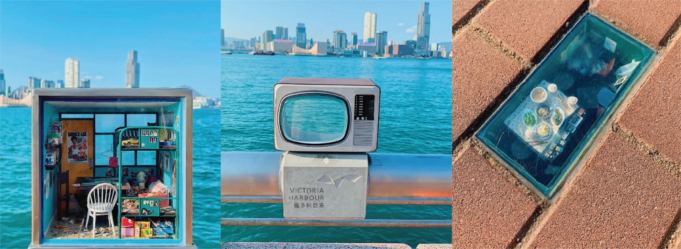
The miniature art on the waterfront promenade of Victoria Harbour (shown in Figure 1) was created by the miniature artist Yi Antai. Through these miniature artworks, we can recall the past and pass on the feel and cul- ture of old Hong Kong from generation to generation. The mini television fixed with cement to the promenade railing allows people to enjoy the beau- tiful scenery of Hong Kong, also they can do some interactive activities, such as capture photos with public artworks. They may also discover other works inlaid into the floor tiles, causing intrigue and stimulating their memories of ‘home’.
Figure 1: Hong Kong cottage on the waterfront promenade, Victoria Harbour (photos by authors).
Public Art, Public Space and Service Design 35
Public Art With Community Art can help organise community groups, promote awareness of common problems and build the support and commitment needed for public issues. With this in mind, there is a more participatory form of public art pra- ctice commonly known as the ‘new type of public art’. Art has always been used as a medium and tool for artists to express and convey information. More recently, artists have begun to ‘engage with communities and existing social struggles, to develop collaboration and dialogue with residents, and to employ different modes of address’ (Sharp, 2007).
Unlike sculptures or installations in public places in the past, these forms of artistic creation pay more attention to social issues, the ecological envi- ronment and community identity, and are more ‘relational’, ‘connective’, ‘conversational’ and ‘dialogical’ than before (Iannelli & Marelli, 2019). Arti- sts try to create locally through practical action, seeking consensus as a core goal, opening a dialogue with the community and letting the public partici- pate in the entire process from the beginning. The aim of such public art is not to turn the public into professional artists, nor to showcase the artistic objects produced by the public. It is about giving everyone the opportunity to take part and interact. Public participation has become an important part of public art.
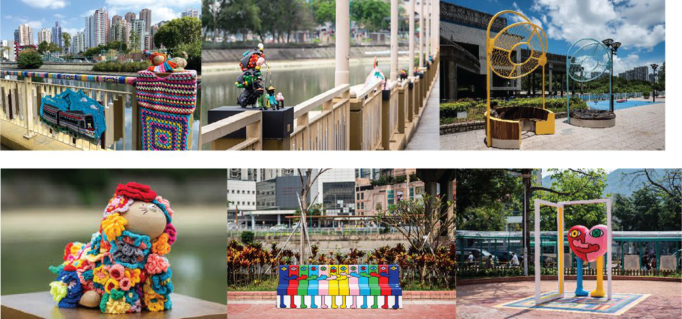
In 2020, the Hong Kong Leisure and Cultural Services Department lau- nched the Viva! River public art project to revitalise the Tuen Mun River and its surrounding areas. To learn more about the area, art creators entered into dialogue with community groups and visited and experienced the scho- ols, shopping centres, parks and residential areas. A wide range of activities and collaborations with Tuen Mun community residents created six sets of public artworks, including sculptures, urban furniture, knitted art and inte- ractive installations with musical elements. This public art series renewed the riverside’s appearance and stimulated people to reimagine the public space. The Viva! River project was accompanied by creative community activities and interactive videos all along the Tuen Mun River, as shown in Figure 2.
Figure 2: Viva! river project (adapted from leisure and cultural service department, 2021.)
Multiple Identities for Artists Public art is different from works of art displayed in museums and art gal- leries. The act of placing or performing a work of creative expression in a public space alters how the space is seen and how audiences see the work. If it is sufficiently noticeable and engaging, it may also change how both the artist and the audience see themselves and their world. Public art is, at essence, a form of communication, which leads to a change in the artists’ identity.
Lacy (1995) defined four steps for an artist’s identity, including experiencer, reporter, analyst and activist. As shown in Figure 3, the artist begins as an experiencer and gradually progresses to a reporter, analyst, activitist, and finally a communicator, which clearly requires the establishment of dialogue and communication. When there is no rapid solution to some urgent and complex social problems, artists can only use their ability to feel and expe- rience the reality around the public, which is the service provided by artists for the world (‘experiencer’). With further development, artists are no longer satisfied with merely focusing on experience but more on the narration of situations; In other words, artists begin to collect information for others to use. They choose information consciously, though not necessarily by analy- sing it (‘reporter’). From reporting or presenting information to analysis is a small step, but the artist’s role has changed dramatically. The first two steps emphasise the skills of artists, such as intuitive, receptive, experiential and observation. Artists began to analyse the social situation through their art (‘analyst’). The fourth step along the proposed continuum is from analysis to activism, where art-making is contextualised within local, national, and glo- bal situations, and audiences are included as active participants. When they became civic activists, they began to develop a skill - working with people. The question that separation is the primary position of art and undertake the consensual production of meaning with the public (‘activist’). The last but most important step is artists as ‘communicators’. To better understand how to reach a consensus with the public, artists must learn how to communicate and cooperate with the public, clarify visual and process symbols for people who have never received art education, and understand the public’s ideas and help them express themselves.
Figure 3: The change in an artist’s identity (adapted from Lacy, 1995).
Figure available in the original PDF paper.
The Case of Public Art Audiences in Hong Kong However, once a public artwork is incorporated into the everyday lives of urban citizens, the meaning derived from it will not necessarily correspond to its iconographies or the intentions of its producer (Hall and Smith, 2005).
Misunderstandings can arise between artists and audiences in relation to public art. As this art usually contains complex information at multiple levels,
Public Art, Public Space and Service Design 37
it may have an unintended effect on the audience if it appears to be inappro- priate. For example, topics such as ecological disaster, nuclear threat, fear, death, suicide and others pose a threat to people and elicit negative emoti- ons. While an artist may want to guide the public to know, understand and even resolve these negative issues through public art, the choice of an inap- propriate art form may lead the audience to misunderstand the artwork and can even strengthen their negative psychological stance. Therefore, artists need to re-examine the importance of the audience and ‘understand what the public needs [in order] to appreciate, discover and utilise public art’ (Hall and Smith, 2005).
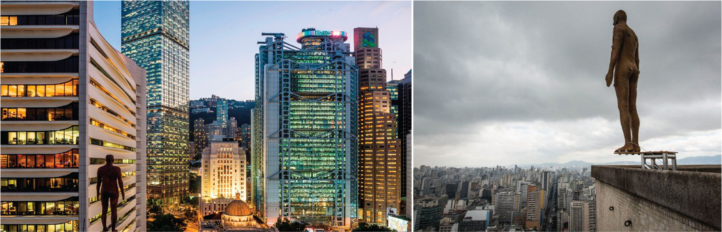
Antony Gormley’s Event Horizon, exhibited by the British Council in Hong Kong (see Figure 4). Gormley says, ‘this project is an invitation to look up... the principle dynamic of the work is the relationship between imagina- tion and the horizon, involving the citizen in a game of seeking and perhaps finding’ (Azzarello, 2015). The purpose of his work, consisting of 31 fibre- glass statues, was to challenge people to look up and engage with familiar places in a new way, to stimulate questions on how human nature responds to the built environment (HK Magazine, 2016). However, this public artw- ork was poorly suited to the social context of Hong Kong, where each year approximately 500 people kill themselves by jumping off buildings, accoun- ting for 40 to 50 per cent of all local suicides. As a result, Event Horizon has disturbed, outraged and frightened countless people. Following the erection of the work, police were inundated with calls from worried residents about naked men standing on the edges of skyscrapers. Confusion reigned at street level, too: the sculpture on the Queen’s Road Central footpath was deemed an ‘obstruction’ and temporarily barricaded by the Highways Department after a complaint from a member of the public (Ross, 2016).
Figure 4: Antony Gormley’s Event Horizon (adapted from British Council, 2016; Johnston, 2014).
DISCUSSION: INVESTIGATING THE AUDIENCE OF PUBLIC ART Public art is beginning to shift attention away from the artists and their works towards a discussion of how audiences participate in art creation. Artists may no longer take the role of ‘spokespeople’ to express specific interests, but rather provide opportunities for the audience to participate in art. However, although the study of public art acknowledges the audience (Hall and Smith,
2005), few researchers have attempted to investigate the audience of public art or the significance of public art to the daily life of the urban public.
Divergence of Information Although art can break through the gullies, walls and obstacles that other means of communication cannot penetrate, some differences in meaning will still arise. Even if important aesthetic education is carried out, people will receive different information from art, and not necessarily what the arti- sts intend to convey. There are a thousand Hamlets in a thousand people’s eyes. Different people interpret the same artwork differently and use the same artwork for different purposes. As Dewey said, even artists can see different meanings in their own works. If there is room in a work of art for different interpretations, we can conclude that people will tend to disagree on what it aims to convey.
Public art is a special kind of art compared with works placed in museums and art galleries. First, in the museums or gallery context, the importance of works of art is taken for granted. Those who visit such places will have higher levels of aesthetic education, and they will pay greater attention to the artistry. Thus, museums and art galleries engender ‘an aesthetic emotion whose specialness is defined, in part, by its separateness from everyday life’ (Fleming and Goldman, 2005). Public art, placed in the public space, does not engender this emotion. Second, public art must face the public, and the public must be its audience. Although people can choose not to go to art galleries or museums, public works of art are placed in public spaces, and the public are inevitably affected. Even if it offends them, they cannot avoid seeing the artwork, and they have the right to criticise anything that hinders or annoys them in the public sphere. Public art is not only for artists to express themse- lves but also for the particularity of the place where they are placed, making it easier and more widely affect the public. Therefore, artists should be more cautious when creating public art to convey information and communicate.
Rediscovering the Value of Audience The two words’ public’ and ‘art’ reflect an unknown relationship between the artist and the audience. Most public art focuses on attempts to ‘read’, ‘unpack’ or ‘deconstruct’ the meaning of art products (Hall, 1997; Miles, 2005). Whilst these approaches offer ‘sophisticated methods of saying a great deal about the art they can say very little about the public’, missing the crucial and complex audience dimension (Hall and Robinson, 2001). The audience have their own thoughts and actions; they are not a passive group that simply accepts public works.
When art is placed in a public space, it needs to face an audience with independent thinking ability (Siu, 2007). The information transmitted by public art and the public’s understanding and feedback constitute informa- tion communication. However, the inequality or difference in experiences, information, knowledge of art and life between the artist and the audience will cause misunderstandings in information communication. Unfortuna- tely, poor information communication can lead to negative social effects and
Public Art, Public Space and Service Design 39
consequences. Therefore, artists need to pay more attention to the commu- nicative ability of public art, rediscover the value of their audience and strive to co-create value with the audience.
CONCLUSION
This paper starts by examining the relationship between public art and public space, traces the essence of art, explores the differences between public art and art in museums and art galleries, and attempts to draw artists’ atten- tion to their audience through case studies. As public art develops, the role of artists is constantly changing. Artists should re-examine the significance and value of their audience (like aesthetic values, moral values, etc.) and encourage the audience to participate in open dialogue between different communities from their own perspective, sharing and negotiating the design of public art. By recognising the value of the audience of public art, and carefully examining the audience, their experience and the meaning they con- struct, artists can correctly convey the true core of their artistic work to the audience. Only in this way can they make public art that realises its full environmental, economic and social value.
ACKNOWLEDGMENT
We would like to acknowledge the funding support of Eric C. Yim Endowed Professorship, PolyU’s postdoctoral fellowship fund (1-W187), and the RPg studentship. We also thank the researchers of the Public Design Lab, PolyU, for their assistance in the data collection and other research assistance during the project.
REFERENCES
Azzarello, N. (December 7, 2015) Antony gormley’s controversial event horizon installation in Hong Kong. Designboom: https://www.designboom.com/art/anton y-gormley-event-horizon-hong-kong-12-07-2015/ Becker, J. (2004). Public art: An essential component of creating communities.
Americans for the Arts. Bonin-Rodriguez, P. (2015). Performing policy: How contemporary politics and cultural programs redefined US artists for the twenty-first century. Palgrave Macmillan. Butler, T. (2006). “A walk of art: the potential of the sound walk as practice in
cultural geography,” Social & cultural geography, 7(6), pp. 889–908. Carr, S., Stephen, C., Francis, M., Rivlin, L. G. and Stone, A. M. (1992). Public space.
Cambridge University Press. Cosgrove, D. (1985). “Prospect, perspective and the evolution of the landscape idea,” Transactions of the Institute of British Geographers, pp. 45–62. Currid, E. (2010). “Art and economic development: new directions for the growth of
cities and regions,” Journal of Planning Education and Research, 29, pp. 257–261. Daya, S. (2011). “Performing place, mobility and identity in South Africa,” Area, 43(4), pp. 488–494. DeSilvey, C. (2010). “Memory in motion: soundings from Milltown, Mon- tana,” Social & Cultural Geography, 11(5), pp. 491–510.
Dewey, J. (2008). “Art as experience,” In The richness of art education (pp. 33–48).
Brill. Doss, E. (1992). “Raising community consciousness with public art: Contrasting projects by Judy Baca and Andrew Leicester,” American Art, 6(1), pp. 63–81. Fisher, D. H. (1996). “Public art and public space,” Soundings: An Interdisciplinary
Journal, 79(1/2), pp. 41–57. Fleming, R. L., Goldman, M. T. (2005). “Public art for the public,” Public Interest, 65(159), pp. 55–76. Grodach, C. (2010). “Art spaces, public space, and the link to community develo-
pment,” Community Development Journal, 45(4), pp. 474–493. Hall, T. and Robertson, I. (2001). “Public art and urban regeneration: advocacy, claims and critical debates,” Landscape Research, 26, pp. 5–26. Hall, T. and Smith, C. (2005). “Public art in the city: Meanings, values, attitudes and
roles. Interventions,” Advances in art and urban futures, pp. 175–179. Hall, T. (1997). “Images of industry in the postindustrial city: Raymond Mason and Birmingham,” Ecumene, 4(1), pp. 46–68. Hawkins, H. (2010a). “‘The argument of the eye’? The cultural geographies of
installation art,” cultural geographies, 17(3), pp. 321–340. Hawkins, H. (2010b). “Turn your trash into… Rubbish, art and politics. Richard Wentworth’s geographical imagination,” Social & Cultural Geography, 11(8), pp. 805–827. HK Magazine. (May 27, 2016) “Event Horizon” Wraps Up Its Hong Kong Leg.
South China Morning Post: https://www.scmp.com/magazines/hk-magazine/artic le/2037959/event-horizon-wraps-its-hong-kong-leg. Iannelli, L. and Marelli, C. M. (2019). “Performing civic cultures: Participatory public art and its publics,” International Journal of Cultural Studies, 22(5), pp. 630–646. Johnson, N. (1995). “Cast in stone: monuments, geography, and nationalism,” Envi-
ronment and planning D: Society and Space, 13(1), pp. 51–65. Johnston, I. (May 13, 2014). Is it an Antony Gormley sculpture or a man ready to jump? Hong Kong art installation cancelled after suicide of banker who threw himself from roof. Independent: https://www.independent.co.uk/arts-entertain ment/art/news/is-it-an-antony-gormley-sculpture-or-a-man-ready-to-jump-hon g-kong-art-installation-cancelled-after-suicide-of-banker-who-threw-himself-fr om-roof-9358871.html. Knight, C. K. (2011). Public art: Theory, practice and populism. John Wiley & Sons. Lacy, S. (1995). “Debated territory: Toward a critical language for public art,” Map-
ping the terrain: New genre public art, pp. 171–185. Landi, Pamela Jo. (2012). “Public Art - Purpose and Benefits: Exploring Strategy in the New England City of Pittsfield, Ma”, Masters Theses 1911 - February 2014. 840. Leisure and Cultural Service Department. (2021). Viva! River. Art Promotion Office:
https://www.lcsd.gov.hk/CE/Museum/APO/en_US/web/apo/viva_river.html Lombard, M. (2013). “Using auto-photography to understand place: reflections from research in urban informal settlements in Mexico,” Area, 45(1), pp. 23–32. Miles, M. (2005). Art, space and the city. Routledge. Morris, N. J. and Cant, S. G. (2006). “Engaging with place: artists, site-specificity
and the Hebden Bridge Sculpture Trail,” Social & Cultural Geography, 7(6), pp. 863–888.
Public Art, Public Space and Service Design 41
Ness, R. (2016). A year at a glance 2015–16 Hong Kong. British Cou- ncil: https://www.britishcouncil.hk/sites/default/files/british_council_in_hong_ko ng_a_year_at_a_glance_2015-16.pdf Omar, S. S., Sakip, S. R. M. and Akhir, N. M. (2016). “Bringing the New to the Old: Urban regeneration through public arts,” Procedia-Social and Behavioral Sciences, 234, pp. 515–524. Phillips, P. (1988). “Out of order: the public art machine, Artforum, Decem-
ber,” Reprinted in: Miles, M., Borden, I. & Hall, pp. 96–102. Rees, R. (1976). “John Constable and the art of geography,” Geographical Review, pp. 59–72. Rose, G. (1997). “Spatialities of ‘community’, power and change: The imagined
geographies of community arts projects,” Cultural Studies, 11(1), pp. 1–16. Ross, M. (March 14, 2016) Gallery Without Walls: The Case For Public Art in Hong Kong. Tatler: https://www.tatlerasia.com/lifestyle/arts/gallery-without-walls-the- case-for-public-art-in-hong-kong Sharp, J. (2007). “The life and death of five spaces: public art and community
regeneration in Glasgow,” Cultural geographies, 14(2), pp. 274–292. Sharp, J., Pollock, V. and Paddison, R. (2005). “Just art for a just city: Public art and social inclusion in urban regeneration,” Urban studies, 42(5-6), pp. 1001–1023. Simpson, P. (2011). “Street performance and the city: Public space, sociality, and
intervening in the everyday,” Space and Culture, 14(4), pp. 415–430. Siu, K. W. M. (2007). Urban renewal and design: City, street, street furniture. School of Design, The Hong Kong Polytechnic University. Siu, K. W. M. and Huang, Y. H. (2013). “Back to everyday life: inspiration for
urban design in the continuous metropolitan transformation of Hong Kong,” The International Journal of Constructed Environment, 3(2), pp. 129–146. Walzer, M. (1995). “The pleasures and costs of urbanity’In P Kasinitz,” Metropolis: center and symbol of our times, pp. 320–30. Zebracki, M., Van Der Vaart, R. and Van Aalst, I. (2010). “Deconstructing
public artopia: Situating public-art claims within practice,” Geoforum, 41(5), pp. 786–795.
LISTED IN THE AHFE DIGITAL BOOKSTORE CATALOGUE
Explore the complete digital volume
Human Factors in Communication of Design
Read this individual research paper free through the original publisher, or explore the full digital proceedings book.
ISBN 978-1-958651-66-7
Explore this ISBN in the AHFE Bookstore ↗Listed in the July 2026 bookstore catalogue; search by ISBN to confirm current availability · Digital book purchase optional