Kin Wai Michael Siu, Xinzhe Zhao, Jiayi Zou, Yijia Jiang, Maoen He, Keren Zhang, Qian Jiang, Jiaman Li (2024). Human-centred design in AI era: Inclusive AI assistance for visually impaired persons in recycling practice. In: Human Factors in Design, Engineering, and Computing. AHFE Open Access, vol. 159, pp. 547–557. https://doi.org/10.54941/ahfe1005621
More science and social researchers have advocated to use the high-tech to support the persons with special needs. Since the early 2010s, the design research team of the Public Design Lab has put effort to conduct in-depth qualitative studies on the needs of visually impaired persons (VIPs) in their daily lives. The team has worked with VIPs to propose some “creative” ideas to support their needs. Moreover, by exploring the recent front-end technological advancements, the team has advocated possibilities of AI technology to be included in the “design” of daily objectives for VIPs. By using persona method and case study, the team facilitate the VIPs to propose a model which is based on the current known AI technology to assist them to carry out the recycling practice independently. The model is expected to be possible to be applied in other daily needs of VIPs as well as other persons with special needs.
The application scenario of emerging technologies is an increasingly important research topic (Spaniol & Rowland, 2023; Verganti et al., 2020). Its research perspectives encompass both the human-centred design for universal or special needs (Tuttle & Carter, 2022; Verganti et al., 2020; Wald, 2021), and development-oriented approach to solving social issues (Spreafico & Sutrisno, 2023; Van Wynsberghe, 2021). With the advent of artificial intelligence (AI), scientists and social researchers have increasingly advocated for the convergence of these two research perspectives (Shneiderman, 2022, pp. 33–41; Zhang et al., 2023), particularly in the human-centred AI solutions to support people with special needs (PSN) or disabilities (Wald, 2021). Regarding the visually impaired persons (VIPs), AI technology has been implied into various life scenarios, including education and transportation (Alhichri et al., 2020; Federici et al., 2020). These outcomes provide a foundation for further exploration of the potential applications of AI in daily lives of VIPs. For instance, it is a worthy attention to facilitate the VIPs’ recycling participation by human-centred AI.
Since the early 2010s, the Public Design Lab has put effort to conduct in- depth qualitative studies on the needs of VIPs in their daily lives (King & Siu, 2018; Siu, 2011a). The visually impaired volunteers were invited to participate in the workshops of inclusive recycling facilities and offered crucial insights (Siu, 2011b; Siu et al., 2020). With the aim to assessing the possibility and feasibility of human-centred AI in the design of daily objectives for VIPs, this study examined the scenarios of VIPs’ engagement in recycling activities. We combined persona methods and case studies with 32 implemented cases related to recycling, VIPs, and human-centred AI globally. A model based on the current known AI technology was developed, which is enabled to facilitate the VIPs to carry out the recycling practice independently. It can be applied to other life scenarios and daily needs of VIPs, as well as other PSN.
LITERATURE REVIEW
Human-Centred Design in AI Era AI extends the boundaries and enriches the possibilities of Human-centred Design at the theoretical and methodological levels. As AI is increasingly becoming a social infrastructure, promoting the accessibility, inclusiveness, and fairness of AI use is also being continuously incorporated into academic research and practice (Trewin et al., 2019). However, for recycling scenarios, the design research and application for the VIPs are still limited. On one hand, Hong Kong has been exploring and practicing the inclusive design in recycling products and service systems for many years, which is specifically reflected in the braille and colour settings of bins, but the integration of AI technology is still less considered. On the other hand, smart recycling products and systems are also developing rapidly, including computer vision-based waste sorting systems and monitoring systems for trash bin fill levels (Lu et al., 2020), and analysis and feedback systems for user recycling behaviours (Zhou et al., 2021). However, these AI-enabled smart recycling products are rarely aimed at the VIPs. In a participatory workshop conducted by the Public Design Lab for the inclusive design of recycling facilities, the VIPs volunteers were invited to join and contribute their significant insights into specific recycling processes (Siu & Xiao, 2020; Siu et al., 2020). These studies also suggest that people in general may misunderstand the situation of the visually impaired (Shiose et al., 2010). The intervention of AI can provide a more objective and equal perspective. Therefore, this paper focuses on the waste recycling scenario targeting the VIPs. Through case studies, it aims to build a product and service design model integrated with AI.
AI Assistance for Visually Impaired Persons in Recycling The integration of AI not only enhances the rationality and efficiency of Human-centric Design process but also enriches the perspectives and approaches when addressing special scenarios and groups, especially in designs targeting vulnerable populations such as the elderly, children, and people with disabilities. VIPs, who constitute a significant portion of individuals with disabilities, have garnered widespread attention from
Human-Centred Design in AI Era: Inclusive AI Assistance for Visually Impaired Persons 549
researchers. To meet the basic needs of VIPs, various products and service systems have been developed, with core functionalities including colour identification (Kumar & Meher, 2015), text recognition (Ouali et al., 2023), and route planning (El-Taher et al., 2023), covering daily life scenarios such as crossing the road (Tian et al., 2021), taking walks (Xia et al., 2023), and shopping (Hussien et al., 2020).
METHODS
This study combines persona methods and case studies.
Persona Method Since the late 1990s, the persona approach has evolved into a mature technical form of user analysis, but more importantly, it embodies a comprehensive user-centred design philosophy and methodology (Nielsen, 2013; Anvari et al., 2019). Persona-based descriptions will help the researcher to maintain the perspective of VIPs. This study focuses on case evaluation using the final personas rather than creating new personas and redesigning. Inclusive design emphasizes the matching degree of product demands and user capability (Buß, 2020; Persad et al., 2007). The complexity and diversity of visual impairments can influence the inclusive design of recycling facilities. The typically categorizes visual impairments into three main types based on visual acuity: blindness, severe visual impairment, and moderate visual impairment (World Health Organization, 2024).
Case Study Based on the objectives of this study, we need to identify the motivations of VIPs to participate in recycling activities, design their action strategies, and use new technologies that keep pace with the times to conduct new explorations and build new daily environments or scenarios for VIPs (Buchanan, 1992). In the case collection step, the researchers found that VIPs were not taken seriously in most recycling activities, which means that the design of these cases did not consider the needs of VIPs. Although there are not many cases designed specifically for VIPs to carry out recycling activities, there is still room for analysis and insights in many cases to improve the barrier-free participation of VIPs in recycling activities. The researchers collected 32 recycling activity cases from the Internet database. The clear criteria for case selection and exclusion and inclusion criteria are shown in Table 1.
Table 1. Case selection and inclusion and exclusion criteria. (By the authors).
Table available in the original PDF paper.
Case Selection Criteria Inclusion/Exclusion Criteria Inclusion Criteria: Relevant to recycling; Beneficial to the VIPs; Real case implemented. Exclusion Criteria: Programs not sustainable.
Clear signage and labelling; Distinct bin shapes and textures; Accessible bin heights; adequate lighting; Auditory cues; Pathways and guidance; Staff training; Educational resources; Disability consultation; Ongoing maintenance and feedback.
RESULTS AND DISCUSSIONS Personas Description
The diverse characteristics of users markedly impact the prioritization of needs and system requirements in conceptual design (Anvari et al., 2017). A comprehensive understanding of the personas’ motivations and barriers to using a specific product can lead to a more effective evaluation of product features and effectiveness (Wang et al., 2021). This study first addresses the heterogeneity of user classification and the utilization of the recycling field (focal area) within the persona framework’s personal information. For instance, children with visual impairments may experience blurred vision regardless of the object’s distance. Some VIPs are unable to correctly distinguish object colours. Multi-sensory cues and adjustments are needed to accommodate a variety of recovery methods. The following are the characteristics, recycling barriers and recycling motivations of this group: (1) Characteristics: Relying on other senses to compensate for the lack of vision; The overall education level is relatively low (educational restrictions); The economic situation is relatively poor (employment restrictions); Easily dented self-esteem. (2) Barriers: Difficulty in visual recognition; Inconvenient access to information; Social prejudices and misunderstandings. (3) Motivations: living like ordinary person; A sense of environmental protection; A sense of responsibility as a member of the community.
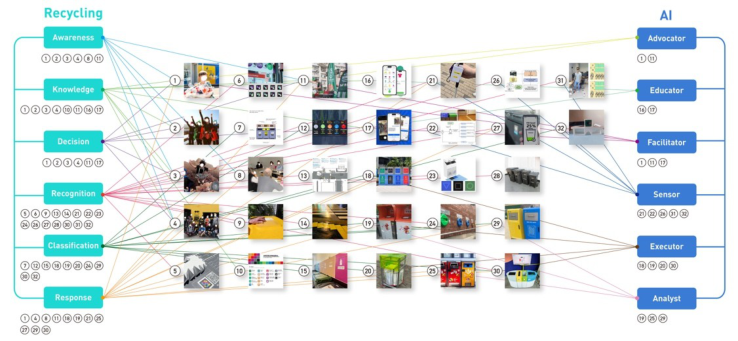
Case Analysis Illustration The researchers clustered the 32 cases (see Appendices) according to the activity process from the four aspects of perception, cognition, practice, and feedback (see Figure 1). The cases were selected according to the design principles in Table 1.
Figure 1: Final 32 inspiration cases mapping. For the details, see Appendices. (By the authors).
Human-Centred Design in AI Era: Inclusive AI Assistance for Visually Impaired Persons 551
Although the cases do not cover all situations, it represents most recycling facilities, services or systems. By analysing, generalizing, and summarizing the 32 cases, two dimensions of information were extracted: (1) the six key steps for visually impaired people to participate in recycling; (2) the role and function of the AI technology involved in the recycling process. The relationship between the two dimensions was further analysed. On the one hand, VIPs recycling activities should not only focus on the facilities themselves, but also on the paths to find, reach and touch the facilities, as well as the promotion, learning and training of recycling knowledge; on the other hand, the existing cases are rarely combined with new technologies, and the new technologies mainly play the role of perceivers to promote VIPs users to identify facilities.
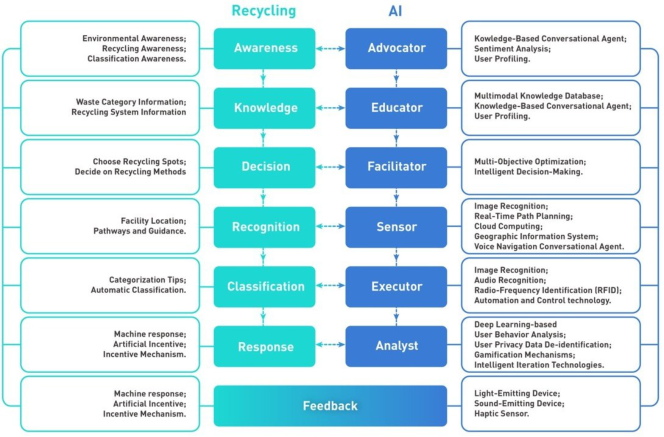
Six Key Steps for VIPs to Participate in Recycling We compared the recycling activities designed for general users and VIPs, through case analysis. It found that the two have a high degree of similarity in the recycling process. Case 11 is a community recycling network service (Tam & Tam, 2008). This case first promotes the importance of recycling and teaches users recycling knowledge. Then, recycling facilities and paths with obvious visual characteristics are established to guide users to approach the recycling sites. After successfully recycling the garbage, users will receive positive feedback. Through case analysis, six key steps for VIPs to participate in recycling are summarized, namely: awareness, knowledge, decision, identification, classification, and response. Although the recycling designed for VIPs is similar to other recycling, this recycling design requires higher levels of detail.
In the awareness stage, more diverse ways are needed to convey recycling information and knowledge to VIPs. For example, Case 4 designed a portable reading system for VIPs to increase their access to information. During the event, voice introductions, video leaflets, and Braille texts to convey information are used (Santos et al., 2009). Accumulating certain information can help VIPs form their own unique recycling knowledge. At this stage, VIPs have formed their own insights into recycling, including why recycling is necessary, how to recycle, and what items can be recycled. In the third stage, VIPs’ knowledge drives them to decide to recycling practice. For example, the complete recycling system and active organizational environment in Case 1 can help VIPs to start recycling practices faster (City of Vancouver, 2024). The recognition stage is the focus of most current cases. In this stage, VIPs need to reach the recycling facility, so the guidance of the path and the location of the recycling station need to be focus on. Case 23 is an inclusive path guidance designed for VIPs, which uses different raised symbols on the floor to help users determine where to place the waste (Nebraska recycling council, 2024). The fifth key step is classification. VIPs will successfully classify and discard the garbage with the help of humans or technology. How VIPs can independently classify the garbage is a perspective that is missing in existing practices. In the sixth stage, the VIP needs to know whether the recycling is performed correctly, which is the response stage. When person put in the
recycling correctly, the recycling bin in Case 29 will make funny sounds to inform the delivery results and give praise (Julia Georgii, 2023).
For these six key stages of VIPs recycling activities to run normally, sufficient feedback needs to be provided in each stage. For VIPs, this feedback can be visual, auditory, tactile, etc., to make up for the inherent weaknesses of the VIPs group with positive feedback, forming a positive cycle to continuously promote VIPs to carry out recycling activities.
Technology Analysis and Roles This study summarizes the technology applications involved in 32 cases. By reviewing the specific functions of AI technology, six distinct AI roles have been identified. The AI technology of each part can be seen in Figure 2. The definition and function of the roles: (1) Advocator refers to technologies that promote the development of awareness in various stages of the recycling process for VIPs. (2) Educator refers to technologies that impart knowledge and skills related to the recycling process to VIPs. (3) Facilitator refers to technologies that facilitate VIPs in making correct recycling decisions. (4) Sensor refers to technologies that assist VIPs in identifying key points along recycling routes and specific recycling points, guiding their actions. (5) Executor refers to technologies that help VIPs perform specific operations such as waste sorting and disposal. (6) Analyst refers to technologies that provide real-time responses and personalized incentives for VIPs’ environmental actions.
Figure 2: Recycling process and corresponding AI roles. (Made by the authors).
When guiding VIPs to independently carry out recycling practices or other life goals, considering new technologies will bring new possibilities. New technologies can assist, promote or replace some behaviours and cognitions. These are also the three key functions of AI technology in VIPs’
Human-Centred Design in AI Era: Inclusive AI Assistance for Visually Impaired Persons 553
recycling practices. The use of AI technology to assist requires consideration of application scenarios, thereby comprehensively expanding the scope of application of the technology. For example, VIPs can quickly understand their surroundings and read pictures and texts through mobile phone applications (Wiberg, 2013). This situation can assist in learning knowledge and identifying paths and is not limited to recycling. Similarly, VIPs can use smart canes to find the correct bus stop when traveling (Hong Kong Federation of the Blind, 2016). This technology can be used for path recognition and navigation in recycling and other daily life. Secondly, the spread of information through technology has not only promoted VIPs’ awareness and understanding of policies, but also promoted the implementation and promotion of good solutions. In addition, when behaviours or cognition are too complex and challenging, AI technology can replace them. For example, after the garbage is delivered, the recycling facility will automatically sort the garbage into different areas based on the different collision sounds (Alexander, 2023).
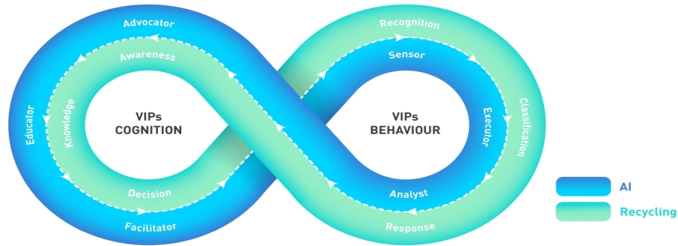
AI-Enhanced Recycling Model for VIPs This study develops an AI-enhanced Recycling Model (AIER Model) for VIP (Figure 3). The overall recycling process for VIPs is divided into two parts, Cognition and Behaviour, and loops infinitely like a Möbius loop. VIPs Cognition contains awareness, knowledge, and decision, which correspond to advocator, educator, and facilitator of AI technology, respectively. VIPs Behaviour includes recognition, classification, and response, which correspond to sensor, executer, and analyst of AI technology, respectively. The function of AI technology has shifted during the process, from assisting (Outer) in the cognitive component to leading (Inner) in the behavioural component (see Figure 3).
When designing and planning VIPs to independently complete a daily life goal, these six dimensions can be comprehensively considered (see Figure 2 for details). In this process, the help of artificial intelligence will promote VIPs to have a positive experience in recycling, thus promoting a virtuous circle. This model can outline how a combination of different AI techniques can be used to collect data and guide design practices to help stakeholders improve their effectiveness in the engagement process, which can be extended to apply to different practices related to new technologies to guide VIPs.
Figure 3: AI-enhanced recycling model for VIPs. (Made by the authors).
Furthermore, when designing facilities, especially public facilities, they should be easy to identify and access. Path and facility information and operations should be within the capabilities of VIPs and need to meet the requirements of simplicity, safety, clarity, and ease of use (Wong et al., 2020). It is recommended to use AI technology to assist and replace complex behaviours that VIPs cannot complete independently: (1) Optimize existing information and facilities based on VIPs’ characteristics; (2) Establish communication channels through technology to promote help and cooperation; (3) AI technology replaces some complex operations, thereby improving efficiency and reducing difficulty. This situation is not only beneficial to the VIPs, but also to other groups.
CONCLUSION
We investigate the current waste recycling scenario and facilities targeting the VIPs, as well as the application of AI in this context. Based on the literature review and persona method, the requirements for recycling are different depending on degrees of visual impairment. Thus, accessibility is a significant point when implementing recycling practice for VIPs. Through 32 case studies, we extract information on two aspects: the six key steps of recycling for VIPs, and the corresponding six roles of AI technology in the recycling process. Then an AIER Model including these elements is created to indicate the relationship and interaction between the two aspects: cognition and behaviour of VIPs. AI (Outer) assists cognitively, whereas AI (Inner) dominates behaviourally. The results form a framework to connect the AI- enhanced recycling and VIPs, and it is also a guideline for human-centred design in AI era. Our findings also reframe the interplay of consciousness, behaviour, and technology from a user perspective, and it can be extended to apply to other practices related to new technologies. Next stages of the research would major in design practice, and inclusive facilities would be developed based on current findings. An inclusive design framework of recycling facilities would also be created.
APPENDICES Case 1: Panta system, Sweden; Case 2: Live educational theatre shows, Canada; Case 3: Zero heroes teaching resource, Canada; Case 4: Social Inclusion of Blind people, Brazil; Case 5: Tactile Map Boards, United Arab Emirates; Case 6: NaviLens system, Spain; Case 7: The recycling centre, Australia; Case 8: Valentin-Haüy, French; Case 9: Braille bin lid labels, Canada; Case 10: Braille bin lid labels, The Nordic countries; Case 11: GREEN@COMMUNITY, Hongkong; Case 12: Waste management, Sweden; Case 13: Sight Line, England; Case 14: Guiding the blind in Tokyo, Japan; Case 15: Recycling Depot in Gothenburg, Sweden; Case 16: AI Platform Supporting Sustainable Recycling, America; Case 17: Be My Eyes, Denmark; Case 18: Beijing ai Waste classification station, China; Case 19: RFID- equipped recycling bins, Korea; Case 20: AI Audio Classifier Recycle Bin, Australia; Case 21: Audio Bus Stop, Hongkong; Case 22: DeepNAVI,
Human-Centred Design in AI Era: Inclusive AI Assistance for Visually Impaired Persons 555
Norway; Case 23: WasteFinder, German; Case 24: Multiple bins of the apartments, Finland; Case 25: IoT-based Recycling Bins, Japan; Case 26: VisPercep, America; Case27: Wastebook Jaete, Finland; Case28: Garbage bins, Canada; Case29: BUGA Talking Trash Bin, German; Case30: Oscar, Canada; Case 31: Wearable Urban Mobility Assistive Device, Mexico; Case 32: AIris, Greece.
ACKNOWLEDGMENT
We thank the support of the HK RGC’s GRF (Ref.: 15612022). We also acknowledge Eric C. Yim Endowed Professorship of PolyU (Ref.: 8.73.09.847K), and the PolyU-HIT Joint-Research Center for Inclusive Environment. The researchers and research postgraduate students of the Public Design Lab, PolyU, gave great support to carry out the study.
REFERENCES
Alexander, S., (2023). AI Audio Classifier Recycle Bin; Recycle Bin that sorts rubbish based on the sound of collision using Edge AI audio classification. [Online]. Available at: https://hackaday.io/project/191802-ai-audio-classifier-recycle-bin. Alhichri, H., Bazi, Y. and Alajlan, N., (2020). Assisting the visually impaired in
multi-object scene description using OWA-based fusion of CNN models. Arabian Journal for Science and Engineering, 45, pp. 10511–10527. Anvari, F., Richards, D., Hitchens, M. & Babar, A. (2017). An empirical investigation of the influence of persona with personality traits on conceptual design. Journal of Systems and Software, 134, pp. 324–339. Anvari, F., Richards, D., Hitchens, M. & Babar, A. (2019). Teaching user-centered
conceptual design using cross-cultural personas and peer reviews for a large cohort of students. In: 2019 IEEE/ACM 41st International Conference on Software Engineering: Software Engineering Education and Training (ICSE-SEET). IEEE, pp. 62–73. Buchanan, R. (1992). Wicked problems in design thinking. Design Issues, 8(2), pp. 5–21. Buß, R., (2020). Inclusive Design - Go Beyond Accessibility. In: Kurosu, M., ed.
Human-Computer Interaction. Human Values and Quality of Life. HCII 2020. Lecture Notes in Computer Science, 12183. Springer. City of Vancouver. (2024). Green Vancouver - Zero Waste 2040 - Outreach and education - School programs. [Online]. Available at: https://vancouver.ca/green-v ancouver/zero-waste-school-programs.aspx. Federici, S., De Filippis, M. L., Mele, M. L., Borsci, S., Bracalenti, M., Gaudino,
G., Cocco, A., Amendola, M. and Simonetti, E., (2020). Inside Pandora’s box: a systematic review of the assessment of the perceived quality of chatbots for people with disabilities or special needs. Disability and Rehabilitation: Assistive Technology, 15, pp. 832–837. Hussien, N. A., Alsaidi, S. A. A., Ajlan, I. K., Mohamed Firdhous, M. F. & Alrikabi, H. T. H. S. (2020). Smart shopping system with RFID technology based on Internet of Things. International Journal of Interactive Mobile Technologies, 14, pp. 17–29. Julia Georgii. (2023). Talking garbage cans at the BUGA in Mannheim. SWR Aktuell.
Available at: https://www.swr.de/swraktuell/baden-wuerttemberg/mannheim/spre chende-muelleimer-buga-100.html.
King, A. P. Y. and Siu, K. W. M., (2018). Enhancing the play and leisure experiences of visually impaired young adults in Hong Kong: A qualitative study. International Journal of Design in Society, 12, pp. 29–39. Kumar, R. & Meher, S. (2015). A novel method for visually impaired using object
recognition. In: 2015 International Conference on Communications and Signal Processing (ICCSP). IEEE, pp. 772–776. Lu, X., Pu, X.& Han, X.(2020). Sustainable smart waste classification and collection system: A bi-objective modeling and optimization approach. Journal of Cleaner Production, 276, 124183. Nebraska Recycling Council. (2024). Stil Solutions: Sustainability through an
inclusive lens. [Online]. Available at: https://nrcne.org/stil-solutions-sustainabilit y-through-an-inclusive-lens/. Nielsen, L. 2013. Personas-User Focused Design. London: Springer. Ouali, I., Halima, M. B. & Wali, A. (2023). An augmented reality for an Arabic text reading and visualization assistant for the visually impaired. Multimedia Tools and Applications, 82, pp. 43569–43597. Persad, U., Langdon, P. and Clarkson, J., (2007). Characterising user capabilities to
support inclusive design evaluation. Universal Access in the Information Society, 6, pp. 119–135. Santos, V. R. dos, Lima, E. C., Berezovsky, A., Schor, P., Uras, R. & Belfort Junior, R. (2009). Avaliação de Sistema de Leitura Portátil (SLP) para baixa visão desenvolvido no Brasil. Revista Brasileira de Oftalmologia, 68(5), pp. 259–263. Shiose, T., Kagiyama, Y., Toda, K., Kawakami, H. & Katai, O. (2010). Expanding
awareness by inclusive communication design. AI and Society, 25, pp. 225–231. Shneiderman, B., (2022). Human-centered AI. Oxford University Press. Siu, K. W. M. and Xiao, J. X., (2020). Public facility design for sustainability: Participatory action research on household recycling in Hong Kong. Action Research, 18(4), pp. 448–468. Siu, K. W. M., (2011a). Public toilets for visually impaired persons: Application of
the Principles of Universal Design. International Journal of Interdisciplinary Social Sciences, 6, pp. 117–126. Siu, K. W. M., (2011b). Trends in public design for the disabled: A case study on public design for visually impaired people. In: Handbook of research on trends in product design and development: Technological and organizational perspectives. IGI Global. Siu, K. W. M., Wong, Y. L. and Lo, C. H., (2020). Inclusive Design for Recycling
Facilities: Public Participation Equity for the Visually Impaired. Advances in Intelligent Systems and Computing, pp. 312–317. Spaniol, M. J. and Rowland, N. J., (2023). AI-assisted scenario generation for strategic planning. Futures & Foresight Science, 5, e148. Spreafico, C. and Sutrisno, A., (2023). Artificial intelligence assisted social failure
mode and effect analysis (FMEA) for sustainable product design. Sustainability, 15, p. 8678. The Hong Kong Society for the Blind, (2016). Audio Bus Stop - a New Way to Navigate for Visually Impaired. [Online]. Available at: https://www.hksb.org.hk/en/newsDetail/3229146/AudioBusStop-aNewWayto NavigateforVisuallyImpaired/ Tian, S., Zheng, M., Zou, W., Li, X. & Zhang, L. (2021). Dynamic crosswalk scene understanding for the visually impaired. IEEE Transactions on Neural Systems and Rehabilitation Engineering, 29, pp. 1478–1486.
Human-Centred Design in AI Era: Inclusive AI Assistance for Visually Impaired Persons 557
Trewin, S., Basson, S., Muller, M., Branham, S., Treviranus, J., Gruen, D., Hebert, D., Lyckowski, N. and Manser, E., (2019). Considerations for AI fairness for people with disabilities. AI Matters, 5, pp. 40–63. Tuttle, M. and Carter, E. W., (2022). Examining high-tech assistive technology use
of students with visual impairments. Journal of Visual Impairment & Blindness, 116, pp. 473–484. Van Wynsberghe, A., (2021). Sustainable AI: AI for sustainability and the sustainability of AI. AI and Ethics, 1, pp. 213–218. Verganti, R., Vendraminelli, L. and Iansiti, M., (2020). Innovation and design in the age of artificial intelligence. Journal of Product Innovation Management, 37, pp. 212–227. Wald, M., (2021). AI data-driven personalisation and disability inclusion. Frontiers
in Artificial Intelligence, 3, p. 571955. Wang, T., Li, Y., Chen, C., Sun, Q., Deng, P. & Li, M. (2021). Development of a design strategy for playful products of older adults. The Design Journal, 24(4), pp. 525–545. Wiberg, H. J., (2012). Be My Eyes: Hans Jørgen Wiberg at TEDxCopenhagen. [Video
Online]. Available at: https://www.youtube.com/watch?v=IfeLJxCSLC0&t=12s. Wong, Y. L., Siu, K. W. M. & Lo, C. H. (2020). Reliability of recycling facilities for the visually impaired persons: A case study of Hong Kong. In: J. F. Silva Gomes & S. A. Meguid, eds. Proceedings IRF2020: 7th International Conference Integrity- Reliability-Failure. FEUP-INEGI, Lisbon, Portugal, pp. 399–404. World Health Organization. (2024). The International Statistical Classification of
Diseases and Related Health Problems (11th ed.). Available at: https://www.who. int/standards/classifications/classification-of-diseases. Xia, H., Yao, C., Tan, Y. & Song, S. (2023). A dataset for the visually impaired walk on the road. Displays, 79, 102486. Zhang, A. et al. (2023). Stakeholder-Centered AI Design: Co-Designing Worker Tools
with Gig Workers through Data Probes. Proceedings of the 2023 CHI Conference on Human Factors in Computing Systems, pp. 1–19. Zhou, J. et al. (2021). Designing a smart incentive-based recycling system for household recyclable waste. Waste Management, 123, pp. 142–153.
LISTED IN THE AHFE DIGITAL BOOKSTORE CATALOGUE
Explore the complete digital volume
Human Factors in Design, Engineering, and Computing
Read this individual research paper free through the original publisher, or explore the full digital proceedings book.
ISBN 978-1-964867-35-9
Explore this ISBN in the AHFE Bookstore ↗Listed in the July 2026 bookstore catalogue; search by ISBN to confirm current availability · Digital book purchase optional