David Smolka, Zuzana Papulova (2023). Industry 4.0 Adoption – A Case of Manufacturing Companies. In: Human Interaction & Emerging Technologies (IHIET 2023): Artificial Intelligence & Future Applications. AHFE Open Access, vol. 111, pp. 934–941. https://doi.org/10.54941/ahfe1004103
The paper discusses the topic of Industry 4.0 as one of the key trends that are shaping the current business environment as well as the whole society. Industry 4.0 is often represented by the latest technical innovations and new technologies. Many experts and researchers have already pointed out the significant benefits of Industry 4.0 adoption in terms of lower costs, improved efficiencies, increased yield, mass customization, and most importantly, new revenue and business models. However, the level of adoption of Industry 4.0 can vary across industries and companies. There are still differences in the companies' approaches to adapting to the technologies and technological progress connected with Industry 4.0. In our research, we focused on manufacturing companies from various industries and studied their perceptions of the current state of Industry 4.0 in respective industries and its effect on competitiveness. We used structural interviews to gather the data on the sample of 47 companies.
Nowadays, companies are facing many changes to which they need to adapt. To a large extent, the major and radical changes are linked to the techno- logical progress coming with the Fourth Industrial Revolution, known as Industry 4.0 (Ross and Maynard, 2021). Despite the years of widespread use of the term Industry 4.0 in the scientific debate, it can be difficult to understand the term clearly and unambiguously. Many authors have already pointed out the unclarity of the term, as there are more than 100 defini- tions of it (Moeuf, 2018), and also other concepts can be included under this umbrella term (Mertens, 2018). Therefore, in the first part of the paper, we summarize the key elements of Industry 4.0, discuss different points of view, and point out the importance of Industry 4.0 adoption towards gaining and maintaining competitiveness.
The focus of the paper is on manufacturing industries. Especially for man- ufacturing companies, the digital transformation towards Industry 4.0 has become necessary as it makes them more flexible, agile, and responsive to customers (Khin and Kee, 2022). In the paper, we also present the results of our research. In the second section, we present methodology, and in the third section, we present the results of the research performed on selected manufacturing companies from various industries and evaluate their views
Industry 4.0 Adoption – A Case of Manufacturing Companies 935
on Industry 4.0 adoption. After the results and discussion, we summarize the main findings and outcomes of the research.
INDUSTRY 4.0 For the first time, the term Industry 4.0 was used in 2011 at Hannover, when the German government first announced a new initiative to digitize manufacturing (Pfeiffer, 2017). The concept of Industry 4.0 has expanded rapidly in just a few years and over time has evolved into a broader and more general approach that encompasses much more than just conventional indus- trial production. Industry 4.0 is not a static concept, as it has become much more complex with almost universal applicability (Madsen, 2019). Many researchers dedicated to this topic claim that Industry 4.0 is a broad field that mainly includes manufacturing processes, efficiency, data management, customer relations, and competitiveness (Piccarozzi et al., 2018).
To discuss the complexity, we can point out the individual characteristics of this term discussed in scientific literature:
1. Many definitions of Industry 4.0 focus on examining the characteris- tics, individual components, and/or technical features and associated concepts. Examples of this category:
Industry 4.0 is a whole sphere of the economy in which fully automatic production processes are based on artificial intellect and internet tech- nologies, with the help of which machines communicate and create new machines without human participation (Alekseev et al., 2018).
Industry 4.0 is about the introduction of intelligent networked systems that carry out self-regulating production: people, machines, equip- ment and products will communicate with each other (Kovács and Kot, 2016).
Industry 4.0 is an umbrella term used to refer to a group of inter- connected technological advances that provide the basis for increased digitization of the business environment (Burritt and Christ, 2016).
2. Some authors definitions deepen the concept of Industry 4.0 by introduc- ing its tools and/or other concepts in an effort to improve understanding, and above all improve links with other related areas, not only at the man- agerial level but also at the engineering and information technology levels (Piccarozzi et al., 2018). Examples of this category:
Industry 4.0 represents nothing more than the Fourth Industrial Rev- olution, which includes 3D printing, big data, the Internet of Things and the Internet of Services, i.e. all components needed to facilitate intelligent manufacturing and logistics processes (Prause and Atari, 2017).
Industry 4.0 incorporates the latest technical innovations in manufac- turing and combines cyber-physical structures such as the Internet of Things and the Internet of Services with other technologies such as artificial intelligence, big data, machine learning, and others (Javaid, 2022).
936 Smolka and Papulová
3. Other categories of definitions focus on value creation and value chain structure (Piccarozzi et al., 2018). It includes the full range of activities that companies and workers perform to bring a product or service from concept to end use and beyond. The basis of value chain analysis is to examine and evaluate how individual activities contribute to the creation of overall added value. However, managers often do not realize that in the creation of overall added value, individual activities bring different benefits (Papula et al., 2019). In this context, we can see that Industry 4.0 affects all business processes, activities and their dynamics, not least by changing well-established business models. An example of this category:
Industry 4.0 will bring greater flexibility and resilience, and Industry 4.0 related value chains will be built on flexible and adaptable busi- ness structures that have a sustained capacity to evolve internally to cope with the changing business environment (Piccarozzi et al., 2018).
4. In other definitions, we can find a link with the concept of a smart factory. Smart factories are closely linked to production methods and industrial processes, but some authors also focus on the role of consumers and competition in defining them. An example of this category:
Industry 4.0 is synonymous with transforming factories into smart factories designed to address and overcome today’s challenges of shorter product lifecycles, highly scalable products, and fierce global competition (Weyer, 2015).
5. Another set of definitions focuses on competitiveness (Piccarozzi et al., 2018). Some define Industry 4.0 as an indispensable tool for maintaining competitiveness (Industry 4.0 as a necessity in order to remain competi- tive), while others argue that it can be an innovative tool for increasing competitiveness and a critical factor for the development of strength of a company (Javaid et al., 2022). An example of this category:
Industry 4.0 acts as a competitive differentiator that helps to set com- panies apart as the gap widens between the digital haves and have nots. Those who are moving forward with Industry 4.0 initiatives are gaining the benefits of sophisticated new capabilities, while the lagging companies are realizing the need to catch up quickly (Merlo, 2020).
All these views point to the significance of Industry 4.0 and to the com- plexity of this term. However, later in the paper, the focus will be mainly on the last view.
METHODOLOGY
Research Goal, Sample, and Data Collection Based on the literature review, we focused our study on Industry 4.0 and its connection to competitiveness. We set the main goal to examine man- ufacturing companies from various industries and study their perceptions of the current state of Industry 4.0 in respective industries and its effect on competitiveness.
Industry 4.0 Adoption – A Case of Manufacturing Companies 937
To obtain the data, we used structural interviews we conducted with selected manufacturing companies.
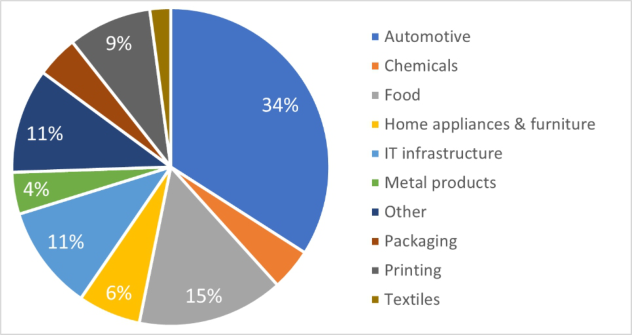
Our sample consists of 47 manufacturing companies from various indus- tries. The distribution of the industries in the sample is presented in Figure 1.
Figure 1: Distribution of industries in the sample (own processing according to the answers from the structural interviews).
In the sample, large enterprises represent 55% of the respondents, medium- sized enterprises represent 23%, while the remaining respondents were almost equally divided between small and micro enterprises. These compa- nies operate throughout Europe, notably in the central region, while 61% of companies operate also in other markets outside the EU.
RESULTS AND DISCUSSION
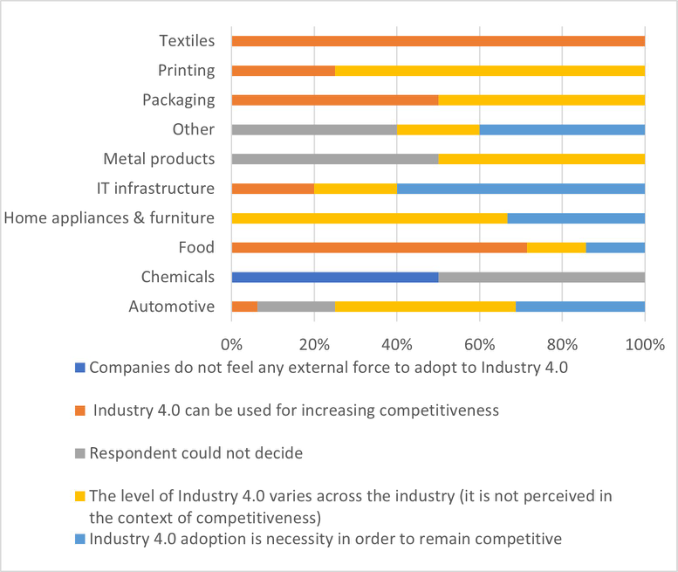
The Necessity of Industry 4.0 Adoption for Competitivness In the first part of the study, we focused on the perceptions of the compa- nies towards Industry 4.0 adoption related to competitiveness. As we already mentioned, there are different views in this area in connection to competitive- ness. According to some, Industry 4.0 can be a necessity in order to remain competitive, however others think it can be used to increase competitiveness, while the rest claim that Industry 4.0 is not important or considered in terms of competitiveness. Also, situations can be different across industries. The major results are presented in Figure 2.
The results presented in Figure 2 can be divided into the following five major categories/situations:
Companies do not feel any external force to adopt Industry 4.0 (it is not perceived or considered). This was noticeable within the chemical industry (50%).
Industry 4.0 can be used to increase competitiveness (it is not a necessity but can create an advantage). This was mainly noticeable within textiles (100%), food (71%), and the packaging industry (50%).
938 Smolka and Papulová
Figure 2: Level of Industry 4.0 adoption (own processing according to the answers from the structural interviews).
Respondent could not decide.
The level of Industry 4.0 varies across the industry (it is not perceived in the context of competitiveness). This situation was mentioned mostly by companies in printing (75%) and home appliances & furniture industry (67%).
Industry 4.0 adoption is a necessity in order to remain competitive (com- panies are forced to implement Industry 4.0 solutions to stay competitive in their market). This was mainly answered by companies operating in IT infrastructure (60%) and other industries (40%).
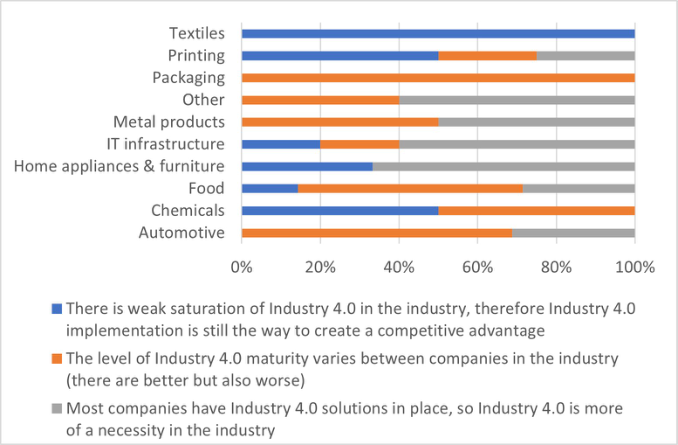
The Level of Industry 4.0 Adoption Another view on Industry 4.0 was that the primary focus was on the level of its adoption. In this part of our study, we focused on the perceptions of com- panies in the sample on the level of Industry 4.0 adoption in their respective industries. The major results are presented in Figure 3.
We grouped the answers into following three major categories:
There is weak saturation of Industry 4.0 in the industry, therefore Industry 4.0 implementation is still the way to create a competitive advantage. This was especially true of the textile industry, which responded with this eval- uation by 100%. The printing and chemical industries are also evaluated at this level by 50% of companies.
Industry 4.0 Adoption – A Case of Manufacturing Companies 939
The level of Industry 4.0 maturity varies between companies in the indus- try (there are better but also worse). Mostly, the companies from packag- ing (100%), automotive (69%) and food (57%) industries confirmed this level.
Most companies have Industry 4.0 solutions in place, so Industry 4.0 is more of a necessity in the industry. This option was confirmed mostly by home appliances & furniture (67%), IT infrastructure (60%), other (60%), and metal products (50%).
If we compare results for the first and second parts, we can see that some companies answered similarly, especially in the textile and IT infrastructure industries, and in their answers, the level of adoption of Industry 4.0 was interconnected with competitiveness. Some companies could not define the answer to the question related to competitiveness but were able to define the level of Industry 4.0.
Figure 3: Level of Industry 4.0 adoption (own processing according to the answers from the structural interviews).
Based on the results presented, we can conclude that the situation is dif- ferent within different industries. Most of the answers were linked to the different maturity levels of Industry 4.0, following the third option that most of the companies are already using Industry 4.0 solutions.
CONCLUSION
Our paper summarizes some of the major findings about the Fourth Indus- trial Revolution, often referred to as Industry 4.0. Industry 4.0 is considered a socio-economic phenomenon that affects all industries, changing not only products, processes, and services but also business models, organizational
940 Smolka and Papulová
structures, and strategies (Prim, 2022). Many consider Industry 4.0 adop- tion important to companies’ competitiveness (Piccarozzi et al., 2018, Javaid et al., 2022). At the same time, others point out that adoption of Industry 4.0 is not necessarily uniform across all companies and industries and that it rep- resents a competitive differentiator (Merlo, 2020). Our study also confirms that the situation across the manufacturing industries is different. Companies operating in the textile, packaging, and food industries perceive Industry 4.0 as a tool for increasing their competitiveness. Especially in the textile indus- try, the saturation of Industry 4.0 showed 0%. But other industries showed a higher level of adoption of Industry 4.0. The IT infrastructure industry already perceives Industry 4.0 as a necessity to remain competitive for 60% of the companies operating in this industry.
Our study was limited due to the smaller sample we chose in order to be able to conduct structural interviews. In this connection, further studies could focus on a deeper study of the topic within specific industries, use methods of comparison between the industries, or use benchmarking.
ACKNOWLEDGMENT
This paper was supported by the Scientific Grant Agency of Slovakia (inter- nal grant system of the Ministry of Education of the Slovak Republic and the Slovak Academy of Sciences) [VEGA 1/0614/23 titled Preparedness of Companies for the Challenges Associated with Industry 4.0 in Terms of Business Processes and Business Process Management].
This paper was supported by Comenius University Bratislava [UK/224/2023 titled Current State of Use of Industry 4.0 Solutions in Companies Operating in Slovakia].
REFERENCES
Alekseev, Alexander, et al. (2018) Financial Strategy of Development of Industry 4.0 in the Countries with Developing Economy. In: Revista ESPACIOS, vol. 39(12), Venezuela: Grupo Editorial Espacios GEES, 7 pp. ISSN 0798–1015. http://w.revi staespacios.com/a18v39n12/a18v39n12p01.pdf Burritt, Roger. Christ, Katherine. (2016) Industry 4.0 and environmental accounting:
a new revolution? In: Asian Journal of Sustainability and Social Responsibility, vol. 1, Switzerland: Springer Nature, pp. 23–38. ISSN 2365–6417. https://doi.or g/10.1186/s41180-016-0007-y Javaid, Mohd, et al. (2022) Understanding the adoption of Industry 4.0 technologies in improving environmental sustainability. In: Sustainable Operations and Computers, vol. 3, Netherlands: Elsevier, pp. 203–217. ISSN 2666–4127. https://doi.org/10.1016/j.susoc.2022.01.008 Khin, Sabai. Kee, Daisy Mui Hung. (2022) Factors influencing Industry 4.0 adop-
tion. In: Journal of Manufacturing Technology Management, vol. 33(3), United Kingdom: Emerald, pp. 448–467. ISSN 1741-038X. https://doi.org/10.1108/JM TM-03-2021-0111 Kovács, György. Kot, Sebastian. (2016) New logistics and production trends as the effect of global economy changes. In: Polish Journal of Management Studies, vol. 14(2), Poland: Czestochowa University of Technology, pp. 115–126. ISSN 2081- 7452. https://doi.org/10.17512/pjms.2016.14.2.11
Industry 4.0 Adoption – A Case of Manufacturing Companies 941
Madsen, Dag Øivind. (2019) The Emergence and Rise of Industry 4.0 Viewed through the Lens of Management Fashion Theory. In: Administrative Sciences, vol. 9(3), Switzerland: MDPI, 25 pp. ISSN 2076–3387. https://doi.org/10.3390/ admsci9030071 Merlo, Bob. (2020) The State Of Industry 4.0 In 2020. United States: Forbes. https:
//www.forbes.com/sites/sap/2020/05/08/the-state-of-industry-40-in-2020/ Mertens, Peter. Barbian, Dina. Baier, Stephan. (2018) Digitalisierung und Industrie 4.0 – eine Relativierung. Germany: Springer, 173 pp. ISBN 978-3-658-19632-5. https://doi.org/10.1007/978-3-658-19632-5 Moeuf, Alexandre, et al. (2018) The industrial management of SMEs in the era of
Industry 4.0. In: International Journal of Production Research, vol. 56(3), United Kingdom: Taylor & Francis, pp. 1118–1136. ISSN 0020-7543. https://doi.org/10. 1080/00207543.2017.1372647 Papula, Jozef. Papulová, Zuzana. Papula, Ján. (2019) Strategicky’ manažment: Aktuálny koncept pre rýchlo sa približujúcu budúcnosˇt. Slovakia: Wolters Kluwer. 320 pp. ISBN 978-80-7598-535-4. Pfeiffer, Sabine. (2017) The Vision of “Industrie 4.0” in the Making—a Case of
Future Told, Tamed, and Traded. In: Nanoethics, vol. 11, Netherlands: Springer Nature, pp. 107–121. ISSN 1871–4765. https://doi.org/10.1007/s11569-016- 0280-3 Piccarozzi, Michela. Aquilani, Barbara. Gatti, Corrado. (2018) Industry 4.0 in Management Studies: A Systematic Literature Review. In: Sustainability, vol. 10(10), Switzerland: MDPI, 24 pp. ISSN 2071–1050. https://doi.org/10.3390/ su10103821 Prause, Gunnar. Atari, Sina. (2017) On sustainable production networks for Indus-
try 4.0. In: Entrepreneurship and Sustainability Issues, vol. 4(4), Lithuania: Entrepreneurship and Sustainability Center, pp. 421-431. ISSN 2345–0282. https: //doi.org/10.9770/jesi.2017.4.4(2) Prim, Marcelo Fabricio, et al. (2022) Identifying the Dynamics of Intangible Resources for Industry 4.0 Adoption Process. In: IEEE Access, vol. 10, United States: Institute of Electrical and Electronics Engineers (IEEE), pp. 101029–101041. ISSN 2169–3536. https://doi.org/10.1109/ACCESS.2022. 3208250 Ross, Philip. Maynard, Kasia. (2021) Towards a 4th industrial revolution. In:
Intelligent Buildings International, vol. 13(3), United Kingdom: Taylor & Francis, pp. 159–161. ISSN 1756–6932. https://doi.org/10.1080/17508975.2021. 1873625 Weyer, Stephan, et al. (2015) Towards Industry 4.0 - Standardization as the crucial challenge for highly modular, multi-vendor production systems. In: IFAC-PapersOnLine, vol. 48(3), United Kingdom: Elsevier, pp. 579–584. ISSN 2405–8963. https://doi.org/10.1016/j.ifacol.2015.06.143
Read this individual research paper free through the original publisher, or explore the full digital proceedings book.
ISBN 978-1-958651-87-2
Explore this ISBN in the AHFE Bookstore ↗Listed in the July 2026 bookstore catalogue; search by ISBN to confirm current availability · Digital book purchase optional