Nowadays, the topic of technology implementation is gaining more importance. Industry 4.0 technologies can bring significant benefits to companies, especially improvements to their competitive position as well as to their value chains and business processes. New challenges and opportunities are arising nowadays, especially with the transition to the Fourth Industrial Revolution, known as Industry 4.0. Emerging and disruptive technologies are at the center of the transformation to Industry 4.0. In this context, the automotive sector, which is often considered a leader in innovation, plays a crucial role. The paper presents the results of research that was aimed at examining the current attitude of selected companies in the automotive sector and their perception of the necessity of implementing Industry 4.0 technologies. To gather the data, structural interviews were conducted with 22 companies in the automotive sector, which were mostly large-sized companies with international operations. The paper also discusses the current trends and challenges connected to Industry 4.0 in the automotive sector.
Looking throughout history, innovations developed in the automotive sector often caused revolutionary changes not only for the companies in the sec- tor but for the whole society (Cassia and Ferrazzi, 2018). The automotive sector plays a central role in manufacturing as it has been a source of some of the most important technological, but also organizational and managerial innovations affecting other sectors as well. The automotive sector is still con- sidered one of the most innovative in the current conditions of global markets (Sinay, 2020).
Nowadays, new challenges that affect the existence and sustainability of companies are arising with the transition to the Fourth Industrial Revolu- tion (Stachová et al., 2019). This revolution is considered an industrial stage, often referred to as Industry 4.0, in which several new emerging technologies are converging to provide digital solutions (Frank et al., 2019). Industry 4.0 is often interpreted by associated technologies and technological progress as advanced automation, data exchange, and connectivity between machines, devices, and factories. It involves digitizing, integrating, and networking
physical objects, products, production lines, company networks, and sup- ply chains (Whitley, 2022). The automotive sector is important to study in the context of Industry 4.0 as it represents one of the most complex sectors where technological processes are applied the most. Also, it is one of the most important sectors due to its interconnections with other sectors and its significant impact on employment (Özcan et al., 2020).
Due to the mentioned facts, we set a goal to examine the current attitude of selected companies in the automotive sector towards the implementation of Industry 4.0 and their perception of the necessity of implementing Industry 4.0 technologies in terms of their competitiveness. In the first part of the paper, we summarize the most relevant trends associated with Industry 4.0 and the automotive sector. Then, we present the methodology and results of the research based on the data obtained from 22 automotive companies. In the last part, we conclude the paper with our main findings.
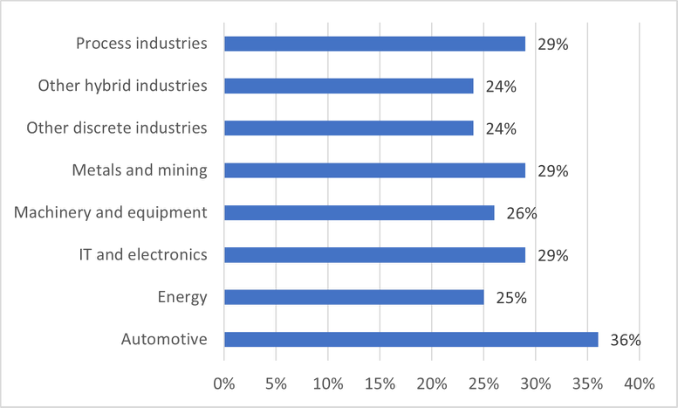
AUTOMOTIVE SECTOR AND INDUSTRY 4.0 The current development stage is often referred to as the Fourth Industrial Revolution, which is based on emerging and breakthrough technologies such as advanced robotics, 3D printing, the Internet of Things, artificial intelli- gence, blockchain, cloud computing, system integration and analytics, etc. (Young, 2020). These technologies have the potential for significant improve- ments in efficiency and quality. In the automotive sector, the potential of Industry 4.0 provides opportunities for increasing the efficiency of produc- tion and distribution processes. This creates conditions for the quality of the final product in the form of a car according to the customer’s needs (Sinay, 2020). The automotive industry is very dynamic and generally considered one of the most innovative industries as well as one of the fastest developing. In the context of Industry 4.0 implementation, the automotive sector is consid- ered a leading sector (Cassia and Ferrazzi, 2018). Although some authors (Dutt et al., 2020) argue that in some aspects, automotive companies remain a slow follower of the data and technology companies that define the com- petitive landscape of Industry 4.0. According to the analysis of IoT Analytics, the companies in the automotive sector are among the leaders in the rate of introduction of innovative Industry 4.0 solutions (Figure 1). In the studied regions (North America, Europe, and Asia), the automobile companies were ranked among the three best companies in the implementation of Industry 4.0 in each of the individual regions. There are some major trends that are shaping the automotive sector and forcing automotive companies to respond, e.g. changing consumer pref- erences, the need to limit emissions, and the penetration of technologies into the industry and into the car itself. Evolving customer preferences (e.g. demand for customization and fast delivery), the transition away from inter- nal combustion engines, and changing regulations require car manufacturers and their suppliers to be more adaptable and flexible (Wopata, 2020). This demand for flexibility is probably one of the reasons why the automotive sector achieves the highest level of Industry 4.0 implementation compared to other sectors.
Industry 4.0 Technologies Implementation in Automotive Sector 919
Figure 1: Adoption rates of Industry 4.0 technologies in different sectors (Wopata, 2020).
According to the portal industry4.sk, there are four trends of change and innovation in the automotive sector: (industry4.sk, 2021).
1. Focus on the customer – Customers’ views of mobility are changing rad- ically today. It affects not only the car sales process but also design, production, and sales. Automotive companies must learn how to respond to new business models and continue to meet customer expectations and sales goals. Data obtained from customers will play a key role in the development of services, which will enable them to innovate and person- alize in real time. As Dutt et al. mentioned, companies that are successful at capturing and analyzing data and information can unlock exponential growth opportunities and accelerate along the innovation curve (Dutt et al., 2020). 2. Connected cars – Accelerating the pace of innovation and continuous adaptation to customer and market requirements is based on increased vehicle connectivity. It is necessary to have real-time access to larger data sets that can be used to bring newer models to market faster, save on research and development costs, and provide better services directly in the car. 3. Digital supply chain and smart factories – It is essential to build agile dig- ital supply chains that must use smart technologies to ensure fast flows. This is reflected in the even more intensive use of the principles of Indus- try 4.0 based on a high degree of automation, which is largely realized with the help of production and assembly processes using robots. Their use requires a digital form of input information about individual work procedures at workplaces as part of production processes, assembly, and internal logistics (Sinay, 2020). 4. Sustainable mobility – The automotive sector needs to change to a more sustainable business model. Electric cars also need green electricity. By minimizing the carbon footprint, car companies must think about how
920 Smolka and Papulová
to become part of the circular economy and minimize waste in the future. The changes are not easy and require new investments in tools and technologies to enable car manufacturers to change their practices.
Trends in the automotive sector reflect the need for higher automation of processes, changes in management, and the need for online tracking of car production. These procedures contribute to the reduction of risks within the life cycle of cars. Also, growing global competition demands intelligent production facilities in combination with flexible logistics sys- tems (Sinay, 2020). Therefore, for the automotive sector, Industry 4.0 plays a critical role. It refers to technologies that enable automation, data exchange, connectivity between machines and devices, and the creation of smart factories (Whitley, 2022). The authors Dutt et al., point out short-term obstacles companies need to overcome while implementing Industry 4.0 and call for the attention of managers to have an inte- grated organizational approach towards technology and innovation, so that automotive companies are able to stay active in Industry 4.0 (Dutt et al., 2020).
METHODOLOGY
Research Goal, Sample, and Data Collection Based on the relevance of Industry 4.0 and the mentioned role of the auto- motive sector, we set our main goal and methodology. The main goal was to examine the current attitude of selected companies in the automotive sector towards the implementation of Industry 4.0 and their perception of the necessity of implementing Industry 4.0 technologies in terms of their competitiveness.
As several authors have already pointed out the necessity of implementing Industry 4.0 in this sector, our research questions were:
1. How do automotive companies perceive the current market supply of Industry 4.0 solutions for this sector? 2. How do automotive companies perceive the necessity and external pres- sure to implement Industry 4.0 solutions/technologies in the current business environment?
To obtain data, we conducted structured interviews with 22 companies in the automotive sector. Respondents answering our questions occupied at least a senior management position and had been with the company for at least 5 years. We contacted enterprises that are primarily engaged in either manufacturing or service provision, with respondents being predominantly manufacturing enterprises, which accounted for as much as 72%.
In terms of size, respondents were mostly large enterprises, accounting for up to 66%, with the remainder being mainly medium-sized enter- prises. Responses came from enterprises operating in Europe, particularly in the central part of Europe. Almost all enterprises surveyed operate internationally within the EU, however 66% also operate in markets outside the EU.
Industry 4.0 Technologies Implementation in Automotive Sector 921
In terms of length of operation, the majority of enterprises were well- established, with 77% having been in business for more than 15 years (the rest of the sample ranged from 5 to 15 years), while these enterprises were in a phase of stabilization or growth.
Industry 4.0 Solutions Offerings for the Automotive Sector on the Current Market The changes in the automotive sector are connected to Industry 4.0 and there- fore create some necessities for companies to stay competitive on the market. It is among these necessities that enterprises adopt technological develop- ments (Özcan et al., 2020). To succeed in the innovation era, automotive companies will likely need to implement a variety of advanced technologies (Dutt et al., 2020).
However, a number of interrelated technologies are being discussed in the context of Industry 4.0. Not only technologies themselves are necessary, but many times companies also need the external help of consulting companies to implement certain technological solutions. Consulting companies provide not only consulting services but also concrete applications and IT solutions related to Industry 4.0. To start, analysis and evaluation of the current state of the company are needed, especially its business processes, technological possibilities, and security management. Often, maturity level and readiness for digital transformation are recommended to be evaluated.
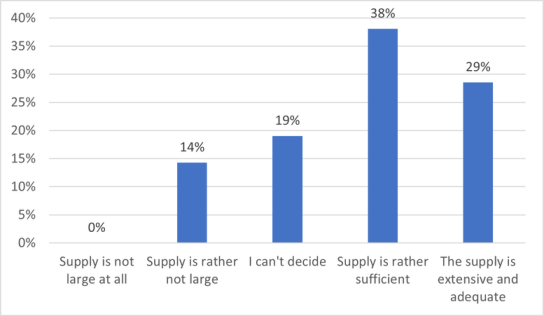
Major results related to the opinion and experiences of the companies, if there are available solutions on the market while they implement Industry 4.0 in their companies, are presented in Figure 2. Less than 15% of the com- panies identified the market as rather not large with available Industry 4.0 solutions. The majority (67%) of answers confirm that companies are able to find solutions for implementing Industry 4.0, 38% of the companies consider the supply rather sufficient, and 29% consider it extensive and adequate. By evaluating this part, we can say that there is still potential for the suppliers of Industry 4.0 solutions and services to improve their offer and support the needs of the automotive sector.
Figure 2: Market supply of Industry 4.0 solutions (own processing according to the answers from the structural interviews).
922 Smolka and Papulová
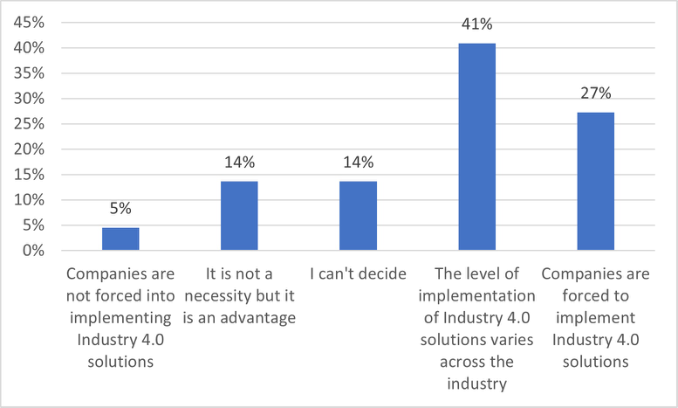
Pressure From the Environment on the Implementation of Industry 4.0 Technologies/Solutions in the Automotive Sector The second part of the research focused on the perception of automo- tive companies regarding the need and necessity to implement Industry 4.0 technologies and solutions. Figure 3 shows the main findings.
Figure 3: External pressure for the implementation of Industry 4.0 solutions (own processing according to the answers from the structural interviews).
The main findings point to the fact that, to a large extent (43%), com- panies perceive that the level of implementation of Industry 4.0 solutions is currently different in the automotive sector. On one side, 27% of the compa- nies consider it already as necessary to implement Industry 4.0 technologies, and they feel the pressure to adapt to Industry 4.0. On the other side, only 5% of the companies do not feel any pressure to implement Industry 4.0, and 14% of the companies find the implementation of Industry 4.0 technologies an advantage. This leads to the conclusion that Industry 4.0 is still not fully implemented in the automotive sector, and only a third of the companies feel the pressure to implement it. However, by preparing a literature review, we can see that many researchers and experts in the field expect its importance to grow.
The automotive sector thus faces many challenges, from increasing the attractiveness of technical subjects through a more intensive connection between education and practice, to developing new skills in employees. It is expected that in smart factories, employees will take on new roles that will require them to acquire advanced competence to manage new technologies (Cassia and Ferrazzi, 2018). Implementation of Industry 4.0 technologies will have an inevitable impact on the quality of work, on the qualification requirements of employees at all levels of production and business process management, on new ways of work organization, and on changes in the
Industry 4.0 Technologies Implementation in Automotive Sector 923
human-machine interface, which can be imagined in the context of a digital factory as new forms of collaborative work (Sinay, 2020). The automotive sector must prepare for the transition to new jobs and skills. As a result, it will be necessary to define the professions brought about by Industry 4.0 (Bendová, 2022).
CONCLUSION
The automotive sector is constantly developing. Automobiles, as a product of the automotive sector, not only represent a way of transportation but also a lifestyle, status, and wealth. They reflect customers preferences and have always been prominent in the minds of society thanks to their technol- ogy, as well as the mobility, travel, and recreation they enable (Cassia and Ferrazzi, 2018). Automotive companies need to constantly search for and evaluate which trends are going to affect the customers of the sector, how their behavior might change, and what effects that could have on their pref- erences. Trends are pointing to dramatic changes in the automotive sector and forcing the companies inside the sector to be more innovative, flexi- ble, and adaptive to the trends. The paper summarizes some of the key issues and trends that are shaping the automotive sector, as well as its connection to Industry 4.0 and its role in supporting and developing innovations in the sector.
Industry 4.0 provides many opportunities for automotive companies to implement technologies, not only for increasing the efficiency of their busi- ness processes but also to develop innovations and innovative solutions according to the customer’s changing needs. Individual companies operating in the automotive sector can have a different perception of the importance and necessity of Industry 4.0 implementation. The results of the research point to a diversity of views and levels of Industry 4.0 implementation in the studied companies. The results can support the need for future development of solutions and technologies needed for the automotive sector as well as point out to the necessity to invest not only in new technologies but also in staff and their skills to be able to progress with Industry 4.0.
ACKNOWLEDGMENT
This paper was supported by the Scientific Grant Agency of Slovakia (inter- nal grant system of the Ministry of Education of the Slovak Republic and the Slovak Academy of Sciences) [VEGA 1/0614/23 titled Preparedness of Companies for the Challenges Associated with Industry 4.0 in Terms of Business Processes and Business Process Management].
This paper was supported by Comenius University Bratislava [UK/224/2023 titled Current State of Use of Industry 4.0 Solutions in Companies Operating in Slovakia].
Cassia, Fabio. Ferrazzi, Matteo. (2018) The Economics of Cars. United Kingdom: Agenda Publishing, 136 pp. ISBN 978-1-911116-71-4. https://doi.org/10.2307/j. ctv5cg94w Dutt, Debanjan, et al. (2020). Steering into Industry 4.0 in the automotive sector In:
Industry 4.0 in automotive, United States: Deloitte Insights, pp. 7–10. https://www2.deloitte.com/content/dam/insights/us/articles/automotive-news_in dustry-4-0-in-automotive/DI_Automotive-News-Supplement.pdf Frank, Alejandro Germán. Dalenogare, Lucas Santos. Ayala, Néstor Fabián. (2019).
Industry 4.0 technologies: Implementation patterns in manufacturing compa- nies. In: International Journal of Production Economics, vol. 210, Netherlands: Elsevier, pp. 15–26. ISSN 0925–5273. https://doi.org/10.1016/j.ijpe.2019.01.004 industry4.sk, editorial staff. (2021) Štyri trendy zmien a inovácií v automobilovom priemysle. Slovakia: SOVA Digital. https://industry4.sk/magazin/inovacie/styri-tr endy-zmien-a-inovacii-v-automobilovom-priemysle/ Özcan, Nermin Av¸sar. (2020) Evaluation of the Transition Process of Industry 4.0
in Automotive Supplier Industry. In: Ticari Bilimler Fakültesi Dergisi, vol. 4(2), Turkey: Ba¸skent Üniversitesi Yayınıdır, pp. 1–18. https://dergipark.org.tr/en/pub/ jcsci/issue/57092/710652 Sinay, Juraj. Kotianová, Zuzana. Glatz, Juraj. (2020) Priemysel 4.0 V podmienkach automobilového priemyslu – nové riziká. In: Soudní inzenýrství, vol. 31(2), Czechia: Akademické nakladatelství CERM a Ústav soudního inženýrství VUT v Brnˇe, pp. 25–30. ISSN 1211-443X. https://www.doi.org/10.13164/SI.2020.2.25 Stachová, Katarína, et al. (2019). External Partnerships in Employee Education and
Development as the Key to Facing Industry 4.0 Challenges. In: Sustainability, vol. 11(2), Switzerland: MDPI, 19 pp. ISSN 2071-1050. https://doi.org/10.3390/su 11020345 Young, Ron. (2020) Towards the development of intellectual capital stan- dards. In: Intellectual Capital in the Digital Economy. United Kingdom: Routledge, pp. 206–216. ISBN 978-1-032173-29-0. https://doi.org/10.4324/ 9780429285882 Whitley, Eric. (2022) Benefits of Industry 4.0. United States: SME (formerly called Society of Manufacturing Engineers). https://www.sme.org/technologies/articles/ 2022/july/benefits-of-industry-4.0/ Wopata, Matthew. (2020) Industry 4.0 Adoption 2020: who is ahead? Germany: IoT
Read this individual research paper free through the original publisher, or explore the full digital proceedings book.
ISBN 978-1-958651-87-2
Explore this ISBN in the AHFE Bookstore ↗Listed in the July 2026 bookstore catalogue; search by ISBN to confirm current availability · Digital book purchase optional