Karolina Mrazova, Vladimira Lipsova, Kateřina Bátrlová, Martin Stepanek, Tomas Navratil, Sergey Zacharov (2023). Overview of intervention measures for the prevention of psychosocial risks at workplaces of Labour Offices in the Czech Republic. In: Human Interaction & Emerging Technologies (IHIET 2023): Artificial Intelligence & Future Applications. AHFE Open Access, vol. 111, pp. 942–948. https://doi.org/10.54941/ahfe1004104
1 National Institute of Public Health, Srobarova 48, Prague, Czech Republic ↗
2 National Institute of Public Health, Srobarova 48, Prague, Czech Republic; Department of Occupational Medicine, General University Hospital in Prague and First Faculty of Medicine, Charles University, Prague, Czech Republic ↗
3 Occupational Safety Research Institute, Jeruzalemska 9, Prague, Czech Republic ↗
4 Department of Occupational Medicine, General University Hospital in Prague and First Faculty of Medicine, Charles University, Prague, Czech Republic ↗
In December 2021, an online questionnaire survey was conducted at 5 selected branches of the Labor Office in the Czech Republic focused on the analysis of psychosocial risks at work. Based on the findings from this survey, the problematic areas were defined and specific intervention measures were applied based on their evaluation. These measures started in September 2022. They were focused on two levels: building psychological resistance (resilience) provided in the form of online seminars: "Supporting positive coping mechanisms and increasing resistance to stress", "Sleep hygiene", "Active psycho hygiene and coping with demanding clients" and special seminar for managers "Psychological support and basic intervention for your subordinates". From December 2022 to March 2023, group and individual psychotherapy were conducted for a much smaller group of employees under the guidance of a psychotherapist.
Work-related psychosocial risks in the workplace can be a source of occu- pational stress as well as other factors. (Hauke 2011) They result from the poor nature, organisation and management of work, interpersonal relation- ships at the workplace and unsatisfactory work-life balance. (Mutkins 2011) In the Czech Republic, 49% of employees perceive work stress, almost 7% have symptoms of clinically severe depression and up to 30% of the wor- king population have mild symptoms of depressive disorders (Raboch 2015, Winkler 2021).
Employees of labour offices in the Czech Republic have been facing a great deal of psychological pressure stemming from the nature of their work and the behaviour of their clients, which, especially in some regions, is very burdensome for employees.
The Research Project As part of the research project “Options for intervention measures for emplo- yees exposed to difficult communication with clients in public administration
Overview of Intervention Measures for the Prevention of Psychosocial Risks 943
with a focus on labour offices”, an online questionnaire survey was con- ducted in December 2021 at the branches of labour offices in the Czech Republic in five selected regions, with 1448 respondents participating. Of these numbers, 1168 questionnaires were filled in.
Overall, a high percentage of workers in employment offices are women, who are also much more likely to be victims of inappropriate social behavi- our. The largest age groups of respondents were 50–64 years old (33%) and 40–49 years old (32%). The largest group of respondents had a secondary education with a high school diploma 56%, and 33% of respondents had a university degree. The questionnaire also included an area to determine the current status of the so-called adaptive systems of the respondents. The cho- sen questions were designed to map the areas of employees’ work and private life, their well-being and resilience (psychological resilience).
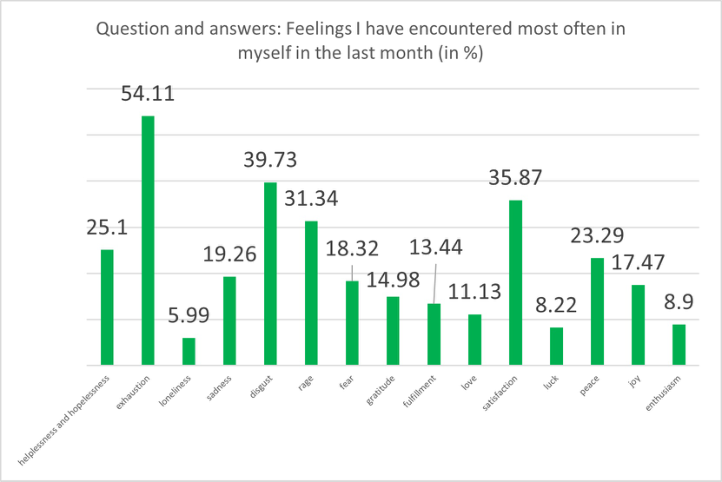
Figure 1 is shown answers to the question “Feelings I have encountered most often in myself in the last month”. It shows that an alarming number of labour office employees feel exhaustion (54.11%), disgust (39.73%) and anger (31.34%), which are factors significantly predicting the inability to continue in any work activity for a long time and factors significantly ham- pering a warm and proactive approach to clients. It is also worth noting the fact that more than a quarter of employees feel helplessness and hopelessness, which tend to be a catalyst for trauma. Sadness with 19.26% and fear with 18.32% are also very often present emotions. On the other hand, more than a third of employees are satisfied and almost a quarter of them feel calm. More than one-sixth of employees also feel joy, more than one-seventh feel gratitude and almost one-seventh feel fulfilled.
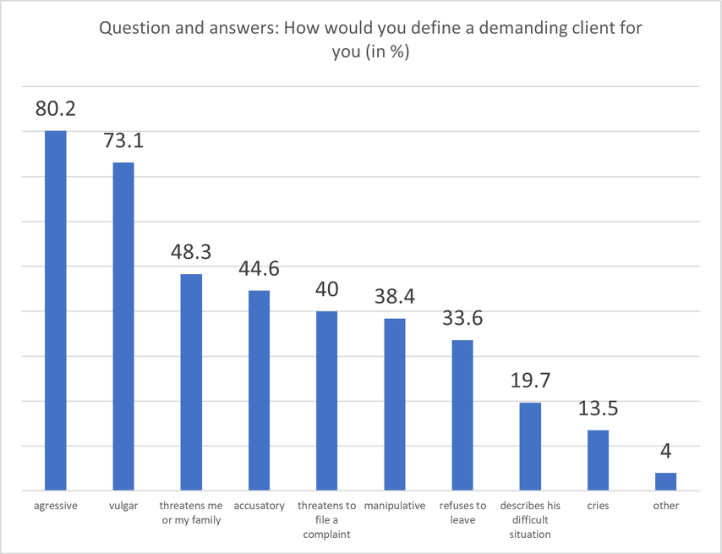
Figure 1: Feelings I have encountered most often in myself in the last month (% of answers).Figure 2: How would you define a demanding client for you? (% of answers).
The question “How would you define a demanding client for you per- sonally?” explored what kind of client is difficult for the workers of the employment offices (Figure 2). The vast majority (80.3%) of employees find it difficult to handle aggressive clients. Right after that, people are bothered by rude clients (73.1%). Clients threatening employees or their families (48.3%) occur far and far too often. Various manipulation tech- niques are also very common - accusations (44.6%), threats of complaints (40.0%) or other manipulative techniques (38.4%). Relatively less frequent are clients in a difficult life situation (one in five difficult clients) or crying clients (13.5%).
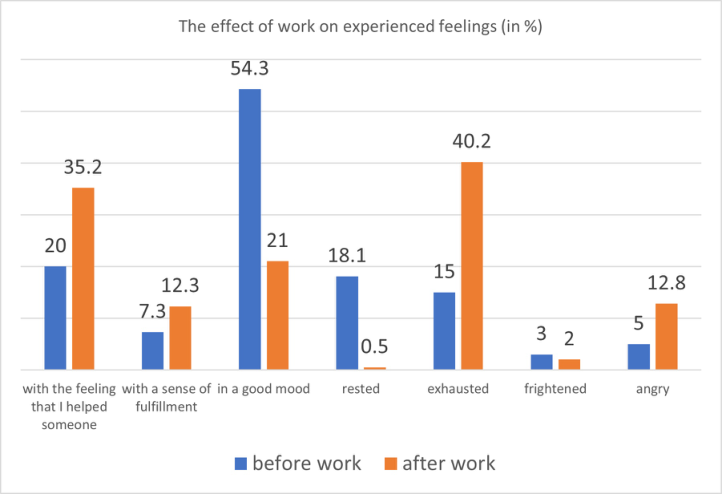
The question shown in Figure 3 dealt with the analysis of the feelings with which employees go to work and with which they leave work. The answers to these questions are intended to reveal the state of mind emplo- yees are in before starting work, and how their feelings change during working hours. The results of the questionnaire survey showed that three- fifths of employees leave work tired, two-fifths even exhausted, but almost a third of employees already come to work tired (more than a seventh are exhausted). Only 18.1% of employees go to work rested. Furth- ermore, it was found that a third of employees lose their good mood during work, but only a small percentage of employees get scared at work and a relatively small percentage (12.8%, while this applies to 5.0% of employees already when they come to work) leaves with by getting angry.
Overview of Intervention Measures for the Prevention of Psychosocial Risks 945
Figure 3: The effect of work on experienced feelings (% of answers).
Intervention Measures at Three Levels Based on a complete evaluation of the results, specific intervention measures were proposed to improve the level of psychosocial risks in the workplaces of the labour offices. Psychosocial risks at work were aimed to be addressed at three levels of intervention (Giorgi, 2017).
Interventions at the primary level aim to eliminate or reduce risks at source. (Chechak 2014) Interventions at the secondary level provide workers with coping strategies for psychosocial risks and interventions at the tertiary level assist workers who have already suffered harm.
Interventions at the primary level aim to increase the perceived and actual safety of frontline workers, overall quality of work and well-being of the employees. Suggestions and recommendations have been designed based on the results of a questionnaire survey conducted among the employees and included several measures according to time requirements. Short-term mea- sures include opting for a virtual telephone switchboard or installing safety cameras. Medium-term suggestions included expanding employee benefits, modifying client and employee areas or adding security staff to the workplace. Time-consuming and long-term suggestions recommend mapping and recor- ding high-risk and challenging clients, i.e., automatic alerts if these clients are coming to the office through an internal call system.
Interventions at the secondary level provided workers with coping stra- tegies for psychosocial risks. In collaboration with psychologists series of online webinars were started, which consisted of courses and training focused on the psychological resilience of the individual. The online training por- tal was launched in the second half of September 2022. The portal includes
courses that focus on increasing resilience to stress, improving mental health and working with challenging, difficult clients. Individual courses include videos, information leaflets, useful links and tests. The portal provides trai- ning and seminars for all employees as well as special training for middle and senior management on psychological support and basic interventions for subordinates.
Specific interventions and measures focused on sleep hygiene, as inade- quate sleep leads to feelings of sleepiness, impaired psychomotor activity, reduced work productivity, mood disorders, including the onset of anxi- ety, depression and other illnesses, attention disorders and risky behaviour, including risky conflict resolution.
Furthermore, it is the promotion of positive coping mechanisms, which many employees of labour offices already use effectively, especially the acquisition of meditation techniques and education on the positive effects of sufficient physical activity, healthy eating and support for strengthening social activities outside of work.
It is also important to develop techniques for creating emotional dista- nce from clients and for better working with boundaries, especially with a focus on coping with aggression and personal verbal vulgar attacks, but also for better coping with clients in difficult life situations, including preventing secondary traumatization after encounters with, for example, refugees from Ukraine. Education in the field of psycho-hygiene is also important, and this is to make psycho-hygiene tools more widely available to the employees of the labour offices other than sharing with colleagues, which is massively used across all the labour offices that were involved in the questionnaire survey.
So far, around 350 Job Centre employees have been trained online and through the training portal.
The series of training sessions and webinars was followed by group and individual psychotherapy and interventions at the tertiary level. The main topic at this level was the issue of recognition of manipulation, anti- manipulative behaviour and promoting professionalism in the approach to the client. These sessions were conducted in the form of group sessions, with up to 15 participants. This was not a therapeutic group, but rather an edu- cational and open group. The number of group interventions was 5 sessions per branch. One group session lasted about 90 minutes.
The proposed areas of intervention and the specific measures were chosen to have the greatest potential to achieve the maximum measurable increase in resilience among the labour office staff. As a result of the implementation of these measures, we expect to see a reduction in the drop in the representation of feelings of well-being and an increase in feelings of exhaustion and fatigue during working hours. As a result of this shift, we expect that there will also be a secondary increase in the satisfaction of the clients of the labour offices and a reduction in the frequency of the occurrence of so-called difficult clients. We expect that the increase in resilience among employment office staff will lead to a change in the perception of some incidents, i.e., they will no longer perceive them as “difficult clients” because they will be able to handle them easily.
Overview of Intervention Measures for the Prevention of Psychosocial Risks 947
CONCLUSION
Employees of labour offices are exposed to high levels of psychosocial risks at work. Preventive measures should help to improve the psychological resili- ence of employees, lead to an understanding of the response to a crisis event, normalise the stress response and teach appropriate ways of adapting to stress and psychological strain.
A repeated questionnaire survey is currently being conducted among the target group, employees at the workplaces of the labour offices, to verify the effect of the intervention measures and to improve the resilience of employees. The results of the project will be used and implemented in the preparation and development of the strategic document National Action Programme on Occupational Safety and Health at Work.
ACKNOWLEDGMENT
This research was financially supported by institutional support for the long- term conceptual development of the research organization for the years 2018–2022 and it is a part of the research task 10-S4-2021-VÚBP “Possi- bilities for intervention measures for employees exposed to demanding com- munication with clients in public administration with a focus on employment offices”, solved by the Occupational Safety Research Institute in cooperation with the National Institute of Public Health in the years 2021–2023.
This research was supported by the Ministry of Health of the Czech Republic - RVO (National Institute of Public Health - NIPH, 75010330).
REFERENCES
Chechak, D., Csiernik, R. 2014. Canadian perspectives on conceptualizing and responding to workplace violence. In: Journal of Workplace Behavioural Health. 29(1), s. 55–72. EU-OSHA, 2021, Managing stress and psychosocial risks. E-guide. Online: https://osha.europa.eu/cs/tools-and-resources/e-guides/e-guide-managing-stress -and-psychosocial-risks Giorgi, G., Arcangeli, G., Http Perminiene, M., Lorini, C., Ariza-Montes, A.,
Fiz-Perez, J., Di Fabio, A., Mucci, N. 2017. Work-Related Stress in the Banking Sector: A Review of Incidence, Correlated Factors, and Major Consequences. In: Front. Psychol. 12 December 2017. Hauke, A., Flintrop, J., Brun, E., Rugulies, R. 2011. The impact of work-related psychosocial stressors on the onset of musculoskeletal disorders in specific body regions: A review and meta-analysis of 54 longitudinal studies. In: Work & Stress. 25, s. 243–256. Mutkins, E., Brown, R. F., Thorsteinsson, E. B. 2011. Stress, depression, workplace
and social supports and burnout in intellectual disability support staff. In: Journal of Intellectual Disability Research. 55(5), 500–510. Raboch, J., Ptacek, R., 2015, Stress, depression and lifestyle in the Czech Republic, https://www.veda.cz/article.do?articleId=76264 Violence and Harassment in the Workplace - Warning Signs. 2020. Canadian Centre
for Occupational Health & Safety. Online: https://www.ccohs.ca/oshanswers/ps ychosocial/violence_warning_signs.html
Well-being and occupational safety & health (OSH) in central government administrations: tackling psychosocial risks at work. Background study. 2017. Online: https://www.fonctionpublique.gouv.fr/files/files/europe_et_international /Final-background-study_OHS_EN.pdf Winkler, P et al., 2021, Prevalence of current mental disorders before and during
the second wave of COVID-19 pandemic: An analysis of repeated nationwide cross-sectional surveys, May 2021, Journal of Psychiatric Research 139(32), DOI: 10.1016/j.jpsychires.2021.05.032.
Read this individual research paper free through the original publisher, or explore the full digital proceedings book.
ISBN 978-1-958651-87-2
Explore this ISBN in the AHFE Bookstore ↗Listed in the July 2026 bookstore catalogue; search by ISBN to confirm current availability · Digital book purchase optional