Vladimira Lipsova, Jindrich Adolf, Jaromir Dolezal, Jan Husak, Ilona Kacerova, Katerina Janeckova, Karolina Mrazova (2025). Automated 3D Ergonomic Assessment from a Single Standard Camera for Confirmation of Work Overload of Lumbar Spine. In: Human Interaction and Emerging Technologies (IHIET 2025). AHFE Open Access, vol. 197, pp. 480–488. https://doi.org/10.54941/ahfe1006741
1 National Institute of Public Health, Srobarova 48, 10000 Prague 10, Czech Republic Czechia; Department of Occupational Medicine, 1st Faculty of Medicine, Charles Unversity Prague, Czech Republic, Czechia ↗
2 Czech Technical University, Czech Institute of Informatics, Robotics and Cybernetics (CIIRC CTU), Prague, Czech Republic, Czechia ↗
3 National Institute of Public Health, Srobarova 48, 10000 Prague 10, Czech Republic, Czechia ↗
4 National Institute of Public Health, Srobarova 48, 10000 Prague 10, Czech Republic Czechia; Health institute based in Usti nad Labem, Czech Republic, Czechia ↗
Chronic lumbar spine disease is a new item on the list of occupational diseases in the Czech Republic from January 1, 2023. This disease is defined by clear clinical characteristics and necessary exposure criteria at work. The diseases arise during heavy physical work, during which the relevant structures are overloaded for a long time to such an extent that, according to current medical knowledge, overloading is the cause of the disease.The essential exposure criterion is the determination and confirmation of work tasks, work activities and work shifts in which the hygienic limits set by Government Decree No. 361/2007 Coll., as amended, for handling loads, taking into account the working position, are exceeded. To meet the hygienic exposure criteria, it must be confirmed that the compression force on the L4/L5 disc exceeds the value based on the NIOSH US 3400 N limit and taking into account the relevant anthropometric characteristics of the person and the ergonomic, time and frequency parameters of work, for at least 3 years and at least 60 shifts per year. At the present time is used traditional certified method for work risk assessment which is based partly on the subjective assessment by a specialist in the field of occupational physiology. To replace this method a new ErgoVison, full-stack web-based application designed to automate ergonomic evaluations in industrial settings is tested. This system leverages advanced computer vision techniques to reconstruct a 3D representation of human posture from videos recorded with a single standard camera. By extracting key body joint angles—including spine angle and the distance to a handled weight—ErgoVision provides objective, quantifiable assessments that help ergonomists make rapid and reliable decisions. The ErgoVision web application streamlines video uploads, data processing, and reporting. The system designed to align with the ergonomic and legislative standards as defined by the Czech health government directives. Previous research in camera-based ergonomic assessments has largely focused on multi-camera setups. In contrast, this work is motivated by the need for a more accessible solution. By employing a single-camera approach combined with specialized reconstruction algorithms and a user-friendly web interface, ErgoVision seeks to democratize ergonomic assessments and offer a certified, objective evaluation tool for a broader audience. In the initial step, video footage is captured of a subject performing physical labor using a standard, single camera. The objective is to record high-quality visual data that accurately represents the subject's posture and movements during various tasks. This approach is designed to simplify the ergonomic evaluation process by leveraging readily available hardware, thereby reducing both cost and complexity in comparison to multi-camera setups. The accuracy of ergonomic assessment and its availability for industry is crucial in safeguarding worker´s health and optimizing productivity in industrial environments. Challenges such as the accurate reconstruction of extreme postures remain, highlighting avenues for future research. Ongoing developments will focus on refining the 3D reconstruction algorithms and expanding the system’s capabilities to accommodate a wider range of ergonomic scenarios. Ultimately, ErgoVision represents a significant step forward in automating ergonomic evaluations, with the promise of supporting informed interventions to improve worker safety and productivity. Future work will further explore integrating advanced sensor data and machine learning models to overcome current limitations, ensuring that the system remains adaptable to evolving ergonomic standards and industrial demands.ACKNOWLEDGMENT: Supported by Ministry of Health, Czech rep. - RVO (NIPH, 75010330).
Automated 3D Ergonomic Assessment from a Single Standard Camera for Confirmation 481
INTRODUCTION
Chronic lumbar spine disease is a new item on the list of occupational diseases in the Czech Republic from January 1, 2023 (Government Regulation 506/2021 Coll.). This disease is defined by clear clinical characteristics and necessary exposure criteria at work. The diseases arise during heavy physical work, during which the relevant structures are overloaded for a long time to such an extent that, according to current medical knowledge, overloading is the cause of the disease. The essential exposure criterion is the determination and confirmation of work tasks, work activities and work shifts in which the hygienic limits for handling loads, taking into account the working position, are exceeded (Government Regulation No. 361/2007 Coll.).
CURRENT PROCEDURE FOR ASSESSING CHRONIC LUMBAR SPINE DISEASE AS OCCUPATIONAL DISEASE IN THE CZECH REPUBLIC Occupational diseases are diseases arising from the adverse effects of chemical, physical, biological or other harmful influences, if they arose under the conditions specified in the List of Occupational Diseases (Government Regulation 290/1995 Coll.), which is an annex to this Regulation. Occupational diseases also include acute poisoning arising from the adverse effects of chemical substances.
Chronic lumbar spine disease caused by long-term overexertion due to heavy physical work (registration code II.11 of the List of Occupational Diseases) was recognized for the first time since this item was added to the list in 2024, 1 (and only) reported occupational disease in a construction worker (Occupational Diseases in the Czech republic, 2024). Currently, a few cases are in the stage of verification and assessment of exposure by regional public health office, therefore the number of cases of this disease may increase in the future.
Clinical evaluation of lumbar spine disease consists of two main parts: clinical neurological examination and radiological examination. Neither of these methods is able to determine whether a specific disease arose as a result of work activity. Clinical evaluations serve only to assess the presence of changes in the spine and their extent. A detailed procedure for a complete clinical evaluation is given in Bulletin No. 15/2022 of the Ministry of Health of the Czech Republic (Bulletin 15/2022, 2022).
If the clinical criteria are met, the regional public health office assesses the risk of the work activity at the workplace. Its task is primarily to obtain detailed information about work activities and identify potentially risky work tasks (Bulletin 11/2023, 2023). Objective measurement and evaluation of risky work tasks and occupational overload are performed by an authorized laboratory. The measurement cannot be performed on the person being assessed or on a person with a lumbar spine disease; it is performed on an alternate person who works in the same position and has, if possible, similar anthropometric parameters as the person being assessed. The assessment takes place on site with the acquisition of photo documentation or video recording, from which the frequency, range of movements and duration of working positions can be clearly determined. The output is an authorized
protocol with a clear conclusion, which must contain information on how many shifts the legally established hygienic limits of compression force were exceeded during the monitored period, a specific description of potentially risky shifts, including the work and rest regime. In this step, at the current time, the BackSolver program is used to calculate the value of the compression force on the L4/L5 intervertebral disc. To meet the work exposure criteria, it must be confirmed that the compression force on the L4/L5 disc exceeds the value based on the NIOSH US 3400 N limit and taking into account the relevant anthropometric characteristics of the person and the ergonomic, time and frequency parameters of work, for at least 3 years and at least 60 shifts per year (Bulletin 11/2023, 2023).
If all criteria are met, the specific case is recognized as an occupational disease by the Occupational Diseases Center. The case is recorded in the National Register of Occupational Diseases and the worker is entitled to compensation. The entire process is based on objective evidence and strict criteria so that an occupational disease is recognized only in cases where it is demonstrably associated with work overload.
METHODOLOGY
System Overview At the present time is used in the Czech Republic traditional certified method for work risk assessment which is based partly on the subjective assessment by a specialist in the field of occupational physiology. The traditional, subjective methods of ergonomic assessment are inadequate for dynamic settings, highlighting the need for affordable, automatic tools for continuous monitoring of workers’ postures to evaluate ergonomic risks effectively during tasks. To replace this method (Backsolver) a new ErgoVison, full- stack web-based application designed to automate ergonomic evaluations in industrial settings is tested.
Previous research in camera-based ergonomic assessments has largely focused on multi-camera setups. For example, studies using dual-camera configurations combined with frameworks like OpenPose have demonstrated promising results in 3D reconstruction and objective posture analysis (Adolf, 2024). The accuracy of risk assessments with multi-camera setups varies by specific environmental conditions and workstation setups. In some conditions achieve high accuracy—as evidenced by intraclass correlation coefficients (ICC) and Pearson correlation coefficients (PCC) (Agostinelli, 2024). But their reliance on multiple cameras increases setup complexity and cost.
In contrast, this work is motivated by the need for a more accessible solution. By employing a single-camera approach combined with specialized reconstruction algorithms and a user-friendly web interface, ErgoVision seeks to democratize ergonomic assessments and offer a certified, objective evaluation tool for a broader audience.
This system leverages advanced computer vision techniques to reconstruct a 3D representation of human posture from videos recorded with a single standard camera. ErgoVision integrates computer vision algorithms with a
Automated 3D Ergonomic Assessment from a Single Standard Camera for Confirmation 483
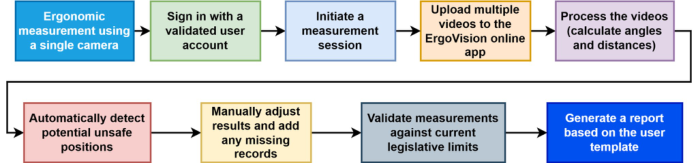
full-stack web application to provide an end-to-end ergonomic assessment solution. System overview is in Figure 1.
Figure 1: System overview (CIIRC, CTU, 2025).
Ergonomic Measurement Using a Single Camera In the initial step, video footage is captured of a subject performing work task with physical overload using a standard, single camera. The objective is to record high-quality visual data that accurately represents the subject’s posture and movements during various tasks. This approach is designed to simplify the ergonomic evaluation process by leveraging readily available hardware, thereby reducing both cost and complexity in comparison to multi-camera setups.
Key aspects of this step include:
Camera Setup: The camera is strategically positioned to maximize the field of view and to ensure that the recorded video captures the subject’s key joints and segments with clarity. Proper placement is essential to obtain a comprehensive perspective of the subject’s movements.
Data Acquisition: The recorded video serves as the raw input for subsequent computer vision processing. Both the quality and resolution of the footage are critical, as they directly affect the accuracy of keypoint detection and 3D reconstruction in later stages.
Simplification and Accessibility: Relying on a single camera minimizes the requirement for specialized equipment, making the technology accessible to a broader range of users and facilitating rapid data collection in real- world environments.
Environmental Considerations: The method assumes a controlled setting where lighting and background conditions are optimized to enhance the visibility of the subject. Consistent recording conditions contribute significantly to the accuracy of the ergonomic measurements.
This single-camera approach capitalizes on recent advances in computer vision, enabling detailed posture extraction from standard video recordings and offering a cost-effective solution for ergonomic assessment.
Sign in With a Validated User Account To ensure system integrity and data security, access to ErgoVision is restricted to validated users only. A validated user is defined as an individual who has been authenticated and approved by the system operator through a licensing
process. This validation process confirms that the user possesses the necessary credentials and has been granted access rights to operate the software.
Key elements include:
User Validation: Prior to access, users undergo a licensing-based authentication that verifies their identity and authorizes them for usage.
Security and Accountability: Limiting access to validated users protects sensitive data, including video footage and measurement results, and ensures that all evaluations are performed by qualified personnel.
Operator Control: The system operator manages the licensing and approval process, ensuring that only certified individuals are permitted to conduct ergonomic assessments.
System Integrity: By enforcing validated user sign-in, the system upholds high standards of security and reliability, thereby maintaining the trustworthiness of the generated ergonomic data.
This rigorous validation process, based on a licensing model, guarantees that ErgoVision is employed responsibly and exclusively by certified professionals.
Initiate a Measurement Session Upon successful sign-in, the user initiates a measurement session that functions as a comprehensive container for all data pertaining to a specific ergonomic evaluation. During this phase, the ergonomist enters essential information about the measured subject, including personal details, relevant notes, dates, and any additional contextual data. This step is critical for organizing and tracking the session, as it tailors the analysis to the individual’s characteristics and work conditions. The session then serves as the linkage between the uploaded videos and the subsequent processing results, streamlining the evaluation workflow and maintaining a detailed record for future reference.
Upload Multiple Videos to the ErgoVision Online App The next phase involves uploading multiple video recordings to the ErgoVision online platform. We have developed a robust system capable of handling large volumes of video data, ensuring seamless performance even with high-resolution and lengthy recordings. The web-based interface is designed for efficiency and ease of use, supporting batch uploads and providing real-time feedback on upload progress. This functionality guarantees that all pertinent data is quickly and reliably transferred to the system, where it will be processed to extract key ergonomic metrics.
Process the Videos (Calculate Angles and Distances) In this stage, the system employs Mediapipe to extract three-dimensional (3D) real-world coordinates from the video frames. Based on these coordinates, angular measurements between selected body key points are computed. To enhance accuracy, these computed angles are refined using a linear regression model calibrated against golden standard measurements
Automated 3D Ergonomic Assessment from a Single Standard Camera for Confirmation 485
obtained via Xsense instrumentation. A similar methodology is applied for distance measurements. Subsequently, the computed angles and distances are re-projected onto the original two-dimensional (2D) video frames and annotated with preview values, thereby providing users with immediate visual feedback for verification and validation purposes.
Automatically Detect Potential Unsafe Positions The processed measurements are then subjected to an automated evaluation against predefined ergonomic thresholds and limits. Specifically, the system systematically compares the computed angles and distances to established safety standards and regulatory limits. Any deviation that exceeds these predefined thresholds is flagged as a potential risk. This automated detection mechanism enables rapid identification of hazardous positions, thereby facilitating timely interventions and corrective actions to prevent ergonomic injuries.
Manually Adjust Results and Add Missing Records While the automated analysis provides a preliminary assessment, ergonomists are allowed to manually adjust the results to address any discrepancies or account for unrecorded details. This user intervention ensures that the final measurements accurately reflect real-world conditions, offering the flexibility to fine-tune the analysis when the automated system encounters ambiguous postures or challenging environmental conditions.
Validate Measurements Against Current Legislative Limits Following manual adjustments, the results undergo a validation process to ensure compliance with current legislative limits defined by health and safety regulations. This step is crucial for confirming that the ergonomic assessment not only reflects accurate biomechanical measurements but also adheres to legal standards. The outcome is a certified evaluation that can be reliably used for regulatory compliance and occupational health monitoring.
Generate a Report Based on the User Template In the final step, the system generates a comprehensive report based on a user- defined template. This report synthesizes all collected and analyzed data into a structured document that details key metrics, identified risks, and overall compliance status. The output serves as both a diagnostic tool for immediate ergonomic improvements and a formal record for ongoing monitoring and regulatory documentation.
EXPERIMENTS AND RESULTS To validate the performance of ErgoVision, a series of preliminary experiments was conducted comparing system measurements with assessments provided by certified ergonomists. A linear regression model was developed using a calibration dataset consisting of 10,000 frames capturing
diverse postures. This calibration process was integral to refining both our 3D reconstruction and measurement algorithms.
Keypoint Accuracy The extracted 2D keypoints demonstrated high consistency across multiple test videos. This consistency underlines the reliability of our computer vision framework, ensuring that subsequent 3D estimations are built on robust initial detections.
Angle Measurement Our computed angles, particularly for the spine, correlated strongly with expert evaluations. The system achieved an average angular accuracy of 7.5
when benchmarked against the golden standard measurements, suggesting that the single-camera approach, supported by our calibration model, provides sufficiently objective and precise results.
Distance Measurement For the distance measurement, specifically regarding the weight handled by the subject, our system demonstrated an accuracy of approximately 9 centimeters. This level of precision further validates the methodology employed for distance estimation from 3D real-world coordinates.
Efficiency The web-based application significantly reduced the overall time required for ergonomic assessments. The streamlined workflow—from video upload to report generation—allows for faster feedback compared to traditional manual methods, enhancing the practical applicability of the system in industrial settings. While these results are promising, challenges remain in accurately capturing complex postures, such as extreme neck flexion. Ongoing work is focused on refining the reconstruction algorithms to address these limitations. Overall, the experimental outcomes indicate that ErgoVision offers a viable and objective solution for ergonomic assessments, with potential for broader implementation across diverse work environments.
DISCUSSION
The experimental evaluation of ErgoVision reveals several promising aspects of the system alongside opportunities for further refinement. The reliable extraction of 2D keypoints across diverse test videos forms a solid foundation for the subsequent 3D reconstruction and biomechanical analysis. Our calibration approach—leveraging 10,000 frames to develop a linear regression model—has proven effective in enhancing measurement precision, as evidenced by the system’s average angular accuracy of 7.5
and a distance measurement accuracy of 9 centimeters.
A notable strength of ErgoVision lies in its ability to offer objective, rapid assessments through a single-camera setup. This not only simplifies the hardware requirements but also significantly reduces the time needed
Automated 3D Ergonomic Assessment from a Single Standard Camera for Confirmation 487
for comprehensive ergonomic evaluations compared to traditional, manual methods. By automating key steps and integrating them within a user-friendly web application, the system enhances both efficiency and accessibility for ergonomists.
However, the evaluation also identified challenges. For example, the system encounters difficulties with capturing complex postures, such as extreme neck flexion, where the 3D reconstruction may be less reliable. This limitation underscores the need for further improvements in the reconstruction algorithms and suggests that future iterations could benefit from incorporating additional sensor data or enhanced deep learning techniques to better handle such cases.
Overall, the findings suggest that while ErgoVision demonstrates robust performance in most scenarios, targeted enhancements are essential to address edge cases and further improve measurement accuracy. The system’s ability to integrate objective data with expert input positions it as a viable tool for standardized ergonomic assessments, with the potential to significantly impact workplace safety and health.
CONCLUSION
Chronic lumbar spine disease caused by long-term overexertion due to heavy physical work was added to the List of Occupational diseases in the Czech Republic in 2023. The first recognized case was reported in 2024. Currently, a few cases are in the stage of verification and assessment of exposure by regional public health office, therefore the number of cases of this disease may increase in the future. If the clinical criteria are met, the objective measurement and evaluation of risky work tasks and occupational overload are. At the present time is used traditional certified method for work risk assessment which is based partly on the subjective assessment by a specialist in the field of occupational physiology. To replace this method (Backsolver) a new ErgoVison, full-stack web-based application designed to automate ergonomic evaluations in industrial settings is tested.
By integrating state-of-the-art computer vision techniques with a robust calibration model derived from a substantial dataset, ErgoVision effectively measures key biomechanical parameters—achieving an angular accuracy of 7.5
and a distance accuracy of 9 centimeters. These results, corroborated by comparisons with certified ergonomist evaluations, demonstrate the system’s potential to enhance traditional ergonomic assessments by making them more objective, efficient, and accessible.
Despite the encouraging performance, challenges such as the accurate reconstruction of extreme postures remain, highlighting avenues for future research. Ongoing developments will focus on refining the 3D reconstruction algorithms and expanding the system’s capabilities to accommodate a wider range of ergonomic scenarios. Ultimately, ErgoVision represents a significant step forward in automating ergonomic evaluations, with the promise of supporting informed interventions to improve worker safety and productivity. Future work will further explore integrating advanced sensor data and machine learning models to overcome current limitations, ensuring
that the system remains adaptable to evolving ergonomic standards and industrial demands.
ACKNOWLEDGMENT
Supported by Ministry of Health, Czech rep. - RVO (NIPH, 75010330).
Supported by EDIH 1.5.01.5 - Objectification of ergonomic measurement of working positions using artificial intelligence and computer vision to evaluate lumbar spine strain.
REFERENCES
Adolf, J., Kaˇcerová, I., Jurˇcová, K., Lipšová, V., Doležal, J., Lhotská, L. (2024).
Assessing Ergonomic Compliance in Industrial Environments with Markerless 3D Camera-Based Systems. In: Jarm, T., Šmerc, R., Mahniˇc-Kalamiza, S. (eds) 9th European Medical and Biological Engineering Conference. EMBEC 2024. IFMBE Proceedings, vol. 112. Springer, Cham. https://doi.org/10.1007/978-3-031-61625- 9_13 Agostinelli, T., Generosi, A., Ceccacci, S. et al. Validation of computer vision-based ergonomic risk assessment tools for real manufacturing environments. Sci Rep 14, 27785 (2024). https://doi.org/10.1038/s41598-024-79373-4 Bulletin No. 11/2023 of the Ministry of Health of the Czech Republic. [cited 2025-
04-24]. Available from: https://mzd.gov.cz/vestnik/vestnik-11-2023/. Bulletin No. 15/2022 of the Ministry of Health of the Czech Republic. [cited 2025- 04-24]. Available from: https://mzd.gov.cz/vestnik/vestnik-15-2022/. Government Regulation 506/2021 Coll., of 13 December 2021, amending Government Regulation No. 290/1995 Coll., establishing the list of occupational diseases, as amended. [cited 2025-04-24]. Available from: https:// www.zakonyprolidi.cz/cs/2021-506. Government Regulation No. 361/2007 Coll. Government Regulation laying down
the conditions for health protection at work, as amended. [cited 2025-04-24]. Available from: https://www.zakonyprolidi.cz/cs/2007-361. Government Regulation No. 290/1995 Coll., establishing the list of occupational diseases, as amended. [cited 2025-04-24]. Available from: https:// www.zakonyprolidi.cz/cs/1995-290. Occupational Diseases in the Czech Republic, 2024, [cited 2025-04-24]. Available
Human Interaction and Emerging Technologies (IHIET 2025)
Read this individual research paper free through the original publisher, or explore the full digital proceedings book.
ISBN 978-1-964867-73-1
Explore this ISBN in the AHFE Bookstore ↗Listed in the July 2026 bookstore catalogue; search by ISBN to confirm current availability · Digital book purchase optional