Vladimira Lipsova, Karolina Mrazova, Kateřina Bátrlová, Martin Stepanek, Tomas Navratil, Sergey Zacharov (2023). Occupational psychosocial risks identification and assessment at Labour Offices in the Czech Republic. In: Human Interaction & Emerging Technologies (IHIET 2023): Artificial Intelligence & Future Applications. AHFE Open Access, vol. 111, pp. 909–916. https://doi.org/10.54941/ahfe1004100
1 National Institute of Public Health, Srobarova 48, Prague, Czech Republic; Department of Occupational Medicine, General University Hospital in Prague and First Faculty of Medicine, Charles University, Prague, Czech Republic ↗
2 National Institute of Public Health, Srobarova 48, Prague, Czech Republic ↗
3 Occupational Safety Research Institute, Jeruzalemska 9, Prague, Czech Republic ↗
4 Department of Occupational Medicine, General University Hospital in Prague and First Faculty of Medicine, Charles University, Prague, Czech Republic ↗
Psychosocial risks at work can be defined as a set of risks resulting from the employee's interaction with the work environment, the nature and organization of work and interpersonal relationships both inside and outside the workplace. Data collection was provided through an online questionnaire survey in December 2021 in 5 selected Labour Offices in the Czech Republic. A special questionnaire was prepared and tailored to the needs of workers exposed to demanding communication with clients. This questionnaire survey was done after the pilot study to ensure the adequacy of the questions, comprehensiveness of the contents, and clearness of instructions. The questionnaire was divided into the mandatory part with Demographic data (7 questions), Work with the client (10 questions) and Resilience (10 questions). Optional areas of the questionnaire covered Communication with superior and team (9 questions), Nature of the work (8 questions), Work organization (9 questions), Job evaluation (5 questions), and Job change, digitalization and unexpected crises (4 questions). A total number of 1168 questionnaires were included for further analysis. The study group consisted of 93% women and 7% men. The biggest age group of respondents was between 50 to 64 years (33%). The results showed the highest satisfaction of employees in the area of communication at the workplace, whereas employees were most dissatisfied with work changes. For 58% of respondents, communication with the work team and superior impacted their job satisfaction. If there was a conflict or escalation of communication when dealing with a client at the counter at the Labour Office, only 1.7% of respondents stated that they had equipment at the workplace place to signalize and monitor the potentially dangerous clients. Our results demonstrated several very problematic areas of psychosocial risks at the workplaces of Labour Offices.Acknowledgements:This result was financially supported by institutional support for the long-term conceptual development of the research organization for the years 2018–2022 and it is a part of the research task 10-S4-2021-VÚBP “Possibilities for intervention measures for employees exposed to demanding communication with clients in public administration with a focus on employment offices”, solved by the Occupational Safety Research Institute in cooperation with the National Institute of Public Health in the years 2021–2023.This research was supported by the Ministry of Health of the Czech Republic - RVO(National Institute of Public Health - NIPH, 75010330)
Psychosocial risks at work can be defined as a set of risks resulting from the employee’s interaction with the work environment, the nature and organi- zation of work and interpersonal relationships both inside and outside the workplace. The unsatisfactory work-life balance also has a major impact on an employee’s well-being and performance (WHO 2008). Psychosocial risks at Labour Offices in the Czech Republic are expected to be on a very high
level. Very frequent communications with very demanding clients in need of different financial aids, not optimal organisation of work, time pressure, high demand of work and resilience of employees were between the main topics we tried to address in our research.
ESENER’s Europe-wide surveys, which are conducted by EU-OSHA every 5 years, focus on new occupational risks, including psychosocial risks at work. The most significant psychosocial risks at work in organizations were identified already in the ESENER 2009 and ESENER 2014 surveys, namely work-related stress, time pressure, contact with problematic customers, pati- ents, students, etc. According to the latest ESENER 2019 survey, European workplaces are most at risk of musculoskeletal disorders and subsequently psychosocial risks (Esener 2019). Psychosocial risks at work are a problem for many professions, these risks and work-related stress have been repe- atedly presented in various professions, nurses, physicians or teachers, for example (Berlanda 2019; Bernal 2015; Dutheil 2019; Vévoda 2018).
In the Czech Republic, 49% of employees perceive work stress, almost 7% have symptoms of severe depression and up to 30% of the work popula- tion have mild symptoms of depressive disorders (Raboch 2015). Workplace stress is a critical issue with potentially negative impact on the mental and physical health of workers and organisational and societal costs (Gray 2019; Havermans 2018, Sara 2018; Yang 2019). In the banking sector most studies showed that mental health problems had increased and that they were stress- related. Examples began with anxiety and depression, carried on through maladaptive behaviors, and ended in job burnout. (Giorgi 2017; Mutkins 2011). Psychosocial risks are among the areas to be addressed, as highlighted by the EU Strategic Framework on Occupational Safety and Health for the period 2021-2027, developed by the European Commission, which defines key priorities and measures to improve the health and safety of workers.
MATERIALS AND METHOD The standard tools for assessing psychosocial risks at work in promoting occupational safety and health and assessing occupational risks are question- naires. The questionnaire results help to identify psychological hazards and select specific groups of workers that should be given particular attention for further action (Dettmers 2021).
Data collection was provided through an online questionnaire survey in December 2021 in 5 selected Labour Offices in the Czech Republic. A special questionnaire was prepared and tailored to the needs of workers exposed to demanding communication with clients. This questionnaire survey was done after the pilot study to ensure the adequacy of the questions, comprehensi- veness of the contents, and clearness of instructions. The questionnaire was divided into the mandatory part with Demographic data (7 questions), Work with the client (10 questions) and Resilience (10 questions). Optional areas of the questionnaire covered Communication with superior and team (9 que- stions), Nature of the work (8 questions), Work organization (9 questions), Job evaluation (5 questions), and Job change, digitalization and unexpected crises (4 questions).
Occupational Psychosocial Risks Identification and Assessment at Labour Offices 911
The questionnaire contained different types of questions. For the questi- ons concerning satisfaction with various aspects of the work (6 in total), the respondents had the opportunity to choose the answer on a scale of 1 to 10. In addition, the questionnaire contained dichotomous questions, where the respondents had the choice of answering yes / no. Further closed questions with the possibility of either one or more answers. These types of questions prevailed in the questionnaire. In addition, the questionnaire contained seve- ral open questions, in which respondents had an empty text box in which they could write an answer. However, these questions were not mandatory.
Participants The total number of 1448 questionnaires was received. Of this number, 1168 were completed and included for further analysis. The remaining questionnai- res were discarded due to incompleteness. For most of these questionnaires, the respondents did not fill in the basic socio-demographic data, and therefore these questionnaires could not be considered relevant in the further analysis. The average time needed to complete the questionnaire was 24 minutes. The study group included 93% women and 7% men. The biggest age group were respondents between 50 to 64 years (33%). The largest group of respon- dents had secondary education with a high school diploma (56%), 33% of respondents had university degree.
Data Analysis PS QUAESTIO PRO software was used for questionnaire creation, data col- lection and subsequent data processing. It is a comprehensive software for data collection, analysis and reporting. Due to the centralized platform, all collected data is immediately ready for further analysis. The questionnaire was created using a scripting tool.
Subsequent data analysis was performed using the PS IMAGO program, based on the analytical tool IBM SPSS Statistics. Its functionality has been extended by a number of procedures and graphs and by the tools for auto- mation and output sharing. Pearson’s chi-square test and Pearson’s linear correlation coefficient were used for analysis.
RESULTS AND DISCUSSION
Each area of the questionnaire started with the question on satisfaction. The result and average level of satisfaction calculated shows in Table 1. Only the area specified for Communication with clients was mandatory for all respon- dents which shows on the number of completed questionnaires (N in Table 1). The highest satisfaction is shown in the area of communication at the work- place, whereas employees are most dissatisfied with work changes. For 58% of respondents, communication with the work team and superior has the greatest impact on their job satisfaction.
The highest values (above 0.7) of the correlation coefficient are for these three areas of satisfaction - job characteristics, organization of work and job evaluation. The value of the coefficient is positive, which means that the respondent also evaluates the remaining areas positively. See Table 2.
Table 1. Average level of satisfaction calculated from all completed questionnaires (possibility to answer on a scale of 1–10).
Table available in the original PDF paper.
Satisfaction - area Mean Std. Deviation N Workplace communication 7,84 2,13 677 Job characteristics 7,15 2,06 524 Organization of work 6,91 1,90 446 Communication with clients 6,22 1,96 1168 Job evaluation 5,68 2,30 400 Work changes 4,99 1,95 199
Table 2. Pearson correlations of areas of satisfaction (*Sig. (2-tailed) <0,001).
Table available in the original PDF paper.
Job chara- cteristics
Organization of work
Communication with clients
Job evaluation
Work changes
Satisfaction - area Workplace communi- cation - Workplace communication
0.624* 0.621* --
Job characteristics 0.302* -- Organization of work 0.470* 0.621* 0.738* -- Communication with clients
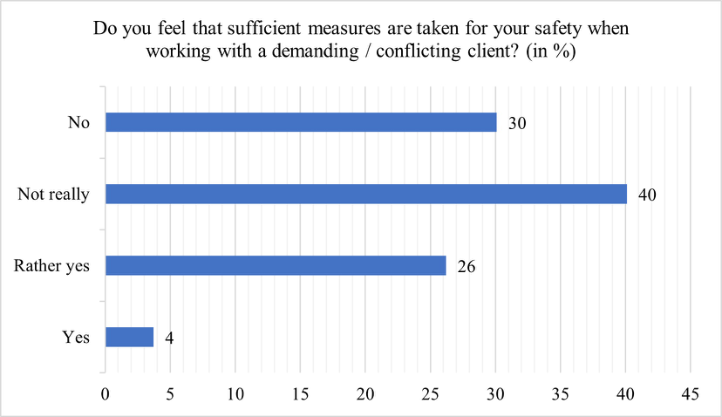
If there is a conflict or escalation of communication when dealing with a client at the counter at the employment office, only 1.7% of respondents state that they have a system in place to indicate and monitor the potential of dan- gerous clients. Overall, 70% of workers do not feel that sufficient measures are undertaken for their safety when working with demanding clients – see Figure 1.
How safe employees feel about these meetings with demanding and even dangerous clients depends also on the type of agenda they are working with. Here were found statistically significant differences in the answers to the que- stion whether sufficient measures are taken for the safety of employees when working with conflicting clients. Workers dealing with the “Agenda of mate- rial need” (the system of assistance in material need is a form of assistance to persons with insufficient income to help them with living allowance or sup- plement for housing or emergency immediate financial assistance) more often chose the answer “no”, in 80%, compared to workers with the “Agenda of the labour market”, where the answer “yes” prevailed (in 55%).
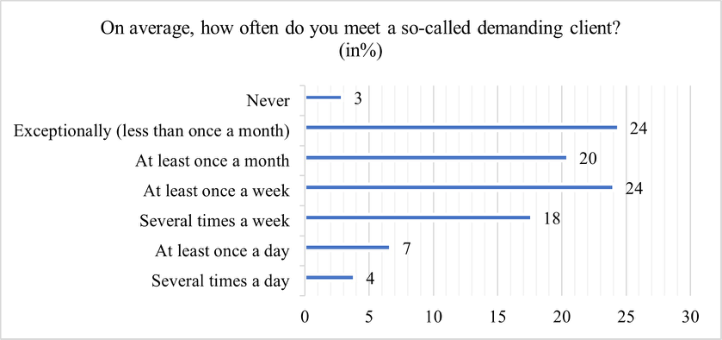
The frequency of dealing with demanding clients differs but more than half of the employees state that they meet and have to deal with demanding or conflicting clients more than once a week – see Figure 2, Table 3, Table 4.
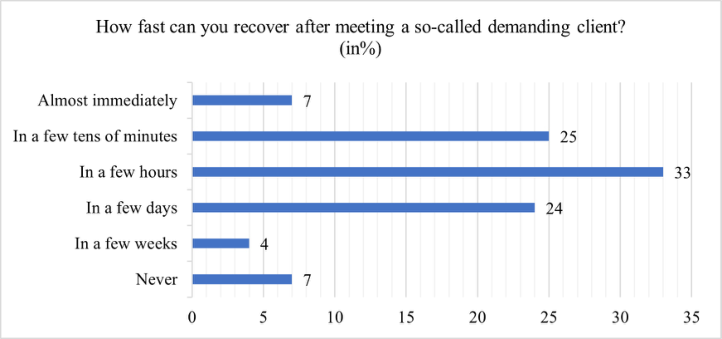
Only one third of the employees recovers quickly after a meeting with a demanding or conflicting client – immediately or within tens of minutes. Another one third of the employees recovers within days or weeks and 7% of employees state that they do not recover at all. See Figure 3, Table 5, Table 6.
Occupational Psychosocial Risks Identification and Assessment at Labour Offices 913
Figure 1: How employees feel about the measures undertaken for their safety when working with demanding or conflicting clients.Figure 2: Frequency of dealing with demanding client.Table 3. Frequency of dealing with demanding client.
Table available in the original PDF paper.
Satisfaction - area Observed N Expected N Sign Schema Several times a day 47 166,9 --- At least once a day 78 166,9 --- Several times a week 205 166,9 ++ At least once a week 280 166,9 +++ At least once a month 238 166,9 +++ Exceptionally (less than once a month) 286 166,9 +++ Never 34 166,9 --- Total 1168
Table 4. Test statistics, frequency of dealing with demanding client.
Table available in the original PDF paper.
On average, how often do you meet a so-called demanding client?
Chi-Square 440,046* Df 6 Asymp. Sig. <,001 *0 cells (0,0%) have expected frequencies less than 5. The minimum expected cell frequency is 166,9.
Figure 3: Recovery after meeting a demanding client.Table 5. Recovery after meeting a demanding client.
Table available in the original PDF paper.
Satisfaction - area Observed N Expected N Sign Schema Never 84 194,7 --- In a few weeks 50 194,7 --- In a few days 273 194,7 +++ In a few hours 380 194,7 +++ In a few tens of minutes 296 194,7 +++ Almost immediately 85 194,7 --- Total 1168
Table 6. Test statistics, recovery after meeting a demanding client.
Table available in the original PDF paper.
How fast can you recover after meeting a so-called demanding client?
Chi-Square 492,921* Df 5 Asymp. Sig. <,001 *0 cells (0,0%) have expected frequencies less than 5. The minimum expected cell frequency is 194,7.
CONCLUSION
Our results showed some very problematic areas in the field of psychosocial risks at the workplaces of Employment Offices. Employees were most dissati- sfied with work changes and when dealing with a potentially dangerous client only 1.7 % of respondents stated to have tools to signalize and monitor that
Occupational Psychosocial Risks Identification and Assessment at Labour Offices 915
client. For more than one third of clerks at Labour Offices it takes at least few days or weeks to recover from this meeting. We also found some promising results in high satisfaction of employees in the area of communication at the workplace, with the work team and managers. To prevent the negative conse- quences of psychosocial risks on employee’s health and improve the working conditions tailored intervention techniques shall be applied.
ACKNOWLEDGMENT
This research was financially supported by institutional support for the long- term conceptual development of the research organization for the years 2018–2022 and it is a part of the research task 10-S4-2021-VÚBP “Possi- bilities for intervention measures for employees exposed to demanding com- munication with clients in public administration with a focus on employment offices”, solved by the Occupational Safety Research Institute in cooperation with the National Institute of Public Health in the years 2021–2023.
This research was supported by the Ministry of Health of the Czech Republic - RVO (National Institute of Public Health - NIPH, 75010330).
REFERENCES
Berlanda S et al. (2019), Psychosocial Risks and Violence Against Teachers. Is It Possible to Promote Well-Being at Work? Int J Environ Res Public Health. 2019 Nov 12;16(22):4439. doi: 10.3390/ijerph16224439. PMID: 31726772; PMCID: PMC6887968. Bernal D et al., (2015), Work-related psychosocial risk factors and muscu-
loskeletal disorders in hospital nurses and nursing aides: a systematic review and meta-analysis. Int J Nurs Stud. 2015 Feb;52(2): 635–48. doi: 10.1016/j.ijnurstu.2014.11.003. Epub 2014. Dettmers et al., (2021) How to Use Questionnaire Results in Psychosocial Risk Assessment: Calculating Risks for Health Impairment in Psychosocial Work Risk Assessment. Int. J. Environ. Res. Public Health 2021, 18, 7107. https://doi.org/10. 3390/ijerph18137107 Dutheil F et al., (2019), Suicide among physicians and health-care workers: A syste-
matic review and meta-analysis. PLoS One. 2019 Dec 12;14(12): e0226361. doi: 10.1371/journal.pone.0226361. PMID: 31830138; PMCID: PMC6907772. ESENER 2019, European Survey of Enterprises on New and Emerging Risks - background briefing. 2020. Online: https://osha.europa.eu/en/publications/european- survey-enterprises-new-and-emerging-risks-esener-2019-background-briefing Franklin P et al., (2021). A Scoping Review of Psychosocial Risks to Health Workers
during the Covid-19 Pandemic. International journal of environmental research and public health, 18(5), 2453. https://doi.org/10.3390/ijerph18052453 Giorgi G et al., (2017), Work-Related Stress in the Banking Sector: A Review of Incidence, Correlated Factors, and Major Consequences. In: Front. Psychol. 12 December 2017. Gray P et al. (2019), Workplace-Based Organizational Interventions Promo-
ting Mental Health and Happiness among Healthcare Workers: A Rea- list Review. Int J Environ Res Public Health. 2019 Nov. 11;16(22):4396. doi: 10.3390/ijerph16224396. PMID: 31717906; PMCID: PMC6888154.
Havermans BM, et al. (2018), Work stress prevention needs of employees and supervisors. BMC Public Health. 2018 May 21;18(1):642. doi: 10.1186/s12889- 018-5535-1. PMID: 29784044; PMCID: PMC5963034. Mutkins E et al. (2011). Stress, depression, workplace and social supports and bur-
nout in intellectual disability support staff. In: Journal of Intellectual Disability Research. 55(5), 500–510. OSH, 2017, Well-being and occupational safety & health in central government administrations: tackling psychosocial risks at work. Background study. 2017. Online: https://www.fonction-publique.gouv.fr/files/files/europe_et_internationa l/Final-background-study_OHS_EN.pdf Raboch J et al. (2015) Stres, deprese a životní styl v ˇCR. Online: http://www.veda.c
z/article.do?articleId=76264 Sara JD, Prasad M, Eleid MF, Zhang M, Widmer RJ, Lerman A. Association Between Work-Related Stress and Coronary Heart Disease: A Review of Pros- pective Studies Through the Job Strain, Effort-Reward Balance, and Organi- zational Justice Models. J Am Heart Assoc. 2018 Apr 27;7(9): e008073. doi: 10.1161/JAHA.117.008073. PMID: 29703810; PMCID: PMC6015274. Vévoda J, Vévodová Š, Nakládalová M. Psychosocial risks in healthcare. Cas Lek
Cesk. 2018 Dec 17;157(8): 411–418. English. PMID: 30754978. WHO 2008, PRIMA-EF: Guidance on the European Framework for Psychosocial Risk Management: A Resource for Employers and Worker Representatives. (Pro- tecting workers’ health series, 9), WHO 2008, online: https://apps.who.int/iris/ha ndle/10665/43966 Yang T et al. (2019) Work stress and the risk of cancer: A meta-analysis of observational studies. Int J Cancer. 2019 May 15;144(10): 2390–2400. doi: 10.1002/ijc.31955. Epub 2018 Dec 8. PMID: 30484859.
Read this individual research paper free through the original publisher, or explore the full digital proceedings book.
ISBN 978-1-958651-87-2
Explore this ISBN in the AHFE Bookstore ↗Listed in the July 2026 bookstore catalogue; search by ISBN to confirm current availability · Digital book purchase optional