William Payre, Saif Alatrash, Costas Karageorghis (2026). Back Behind The Wheel: Musically Induced Emotions and Driving Behaviour in an Immersive Simulator. In: Advances in Human Factors of Transportation. AHFE Open Access, vol. 224, pp. 291–299. https://doi.org/10.54941/ahfe1007857
Music listening is one of the most common activities that people engage in when behind the wheel. The aim of the present study was to raise situational awareness of both the risks and benefits associated with in-vehicle music use via a highly engaging simulator experience. To do so, we offered participants an interactive experience in an immersive and high-fidelity simulator, where they were required to navigate a dynamic city centre environment. We collected data to ascertain the impact of the simulation task on users’ road safety awareness. We also assessed how participants responded to two contrasting music conditions in psychological (e.g. pleasure, mental workload, intention to use) terms. The trials were administered using a within-subjects design, with 3 × 3 min scenarios for each participant in a counterbalanced order. An urban driving simulation was employed with facilitative music, debilitative music and a no-music (urban traffic noise) control condition. Each experimental condition included one of three potential hazardous event – a delivery rider on the side of a road, a dog crossing or a parked car. Results showed no effect of the type of music or event on self-reported emotions and workload. However, both young and more experienced participants indicated that using an immersive driving simulator raised their awareness of safe driving behaviours vis-à-vis in-vehicle music.
Music streaming services paired with connected vehicles have made à la carte music-listening while driving highly accessible. While music can keep drivers optimally activated during long journeys, it can also be overstimulating when the driving environment is particularly demanding. This can increase the likelihood of road crashes (Karageorghis et al., 2022a), which is particularly problematic for younger drivers given that they are overrepresented in road crash statistics (Department for Transport, 2020). A low level of driving experience coupled with overstimulating music listening has been identified as a cause of distraction during driving (Brodsky & Slor, 2013). Prevention strategies to reduce the number of distraction-related road crashes among young drivers need to be supported by behaviour change programmes, including simulation (Buckley et al., 2014). This is supported by previous research showing that younger Received February 6, 2026; Revised April 3, 2026; Accepted April 18, 2026; Available online July 20, 2026
people engage readily with virtual environments (Narros et al., 2025), making driving simulation a fit-for-purpose solution to raise road safety awareness (Karageorghis et al., 2021a). Moreover, research has shown that immersive simulation can help in bridging the gap between theory-based knowledge and practical application (i.e., promoting safe music-listening habits among drivers; Best et al., 2024). Borawski and Borawska (2021) suggested the use of computer games to promote road safety among younger drivers, and the present study embraced an analogue of just that.
Aims and Hypotheses The objectives of this study were twofold. First, we sought to increase situational awareness of the effects of music listening while driving. Second, we aimed to assess the efficacy of immersive simulation in supporting road safety intervention. We targeted the profiles of drivers most at risk and repeatedly overrepresented in road crashes statistics – soon-to-be drivers and young drivers aged 15–24 years – via an immersive and interactive experience in a high-fidelity driving simulator. However, older participants were also eligible to take part in this study, as there was potential for them to benefit from the interactive simulation.
METHOD
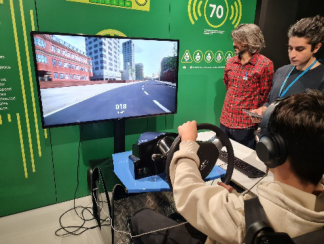
Participants Ethical approval was obtained from the Coventry University Research Ethics Committee (ref. P188399). Volunteer participants comprised a convenience sample of 35 individuals aged 15+ yr (Mage = 31.26 yr, SDage = 20.9 yr) with a mean of 13.7 years’ driving experience (SDdriving experience = 20.2 yr) visiting the feature exhibition Beep-Beep, Yeah!: The Sounds and Songs of the Motor Car at the British Motor Museum in Gaydon, Warwickshire, UK (Figure 1). They or their guardians provided informed written consent, with under 18s also providing assent. Participants were recruited through social media posts at Coventry University and the British Motor Museum. Participants had to meet four inclusion criteria: (a) be 15 years of age or older; (b) report good mental and physical health; (c) report a lack of motion-sickness susceptibility when playing immersive video games or as a road passenger; and (d) report no hearing deficiency and/or visual impairment.
Figure 1: A participant experiencing the immersive simulator at the british motor museum.
Back Behind The Wheel: Musically Induced Emotions and Driving Behaviour 293 Simulator Development
The driving simulator comprised a custom-built rig integrated with a force- feedback steering and pedal system, designed to support controlled behavioural and data collection in a virtual driving environment. The simulator was developed using Epic Games Unreal Engine 5, enabling real-time rendering and physics-based vehicle dynamics. The virtual environment was presented from a first-person driving perspective and configured to support continuous driving along a closed-loop route.
The simulated route consisted of three continuous laps, each incorporating a single critical driving event presented in a randomised order to reduce anticipation effects. The first event includes a dog crossing the road, the second presents a parked vehicle on the left-hand side of the road, while the third requires the driver to negotiate a delivery cyclist. Visual feedback was delivered through a single forward-facing display, with all driving-relevant information rendered directly within the virtual scene. Vehicle control was achieved via a force-feedback steering wheel and pedal manufactured by Thrustmaster, providing realistic resistance and input fidelity.
The simulator rig was housed within a rigid steel arcade-style frame and fitted with an automotive seat to replicate standard driving posture. The simulator was configured to continuously log high-frequency driving behaviour data, including vehicle trajectory, speed, steering angle, throttle and brake inputs, event triggers, and collision states. Prior to each experimental session, the simulator underwent functional testing to ensure consistent input response and stable data acquisition.
Psychological Measures After each trial, a range of psychological measures was administered to assess how the participant responded to two contrasting music conditions; specifically in respect to mental workload, affective valence and affective arousal. After the trials, we ascertained the impact of the simulation task on users’ road safety awareness and intention to listen to music while driving (Table 1).
Table 1: List of the scales and items administered during the trials.
Table available in the original PDF paper.
Authors Range Instructions Administration
Name of the Scale/Item
After each trial
NASA Task Load Index
Hart & et al., 1988
1–10† Adapted for British teenagers After each trial
Felt Arousal Scale
Svebak et al., 1985 1 Low to 6 High Adapted for British teenagers After each trial Feeling Scale Hardy et al., 1989 1 Very good to 11 Very bad Adapted for British teenagers
User Experience
bespoke 1 Not at all to 6 Very much so
Adapted for British teenagers
Once, at the end of the study
Road Safety Awareness
bespoke 1 Not at all to 6 Very much so
Adapted for British teenagers
Once, at the end of the study
Behavioural Intention
bespoke 1 Not at all to 6 Very much so
Adapted for British teenagers
Once, at the end of the study
†Each item has a different verbal anchor.
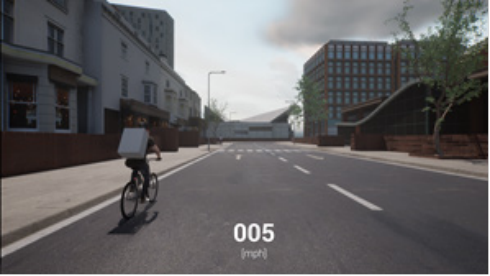
Experimental Procedure The trials were administered using a within-subjects design, that featured 3 × 3 min scenarios for each participant, presented in a counterbalanced order. An urban driving simulation resembling Coventry city centre was employed with facilitative music (Cruel Summer by Taylor Swift [85 bpm]), debilitative music (APT. by Rosé & Bruno Mars [149 bpm]) and a no-music (urban traffic noise) control condition. The music was selected by the research team and predicated on track popularity in the UK billboard charts at the time of the study (autumn/winter 2025–26), as well as musical characteristics (e.g., tempo, beat and non-explicit lyrical content; Karageorghis et al., 2021b; Millet et al., 2019). Participants were required to navigate a dynamic city centre environment with bidirectional traffic, using a right-hand drive, automatic transmission vehicle. Each experimental condition included one of three potential hazardous event – a parked car, a dog crossing or a delivery rider on the side of the road (Figure 2) – also administered in a counterbalanced order.
Figure 2: An illustration of the delivery rider event.
RESULTS
Descriptive Interpretation of Workload and Affective Measures Across Laps To examine the influence of music, event type, and their interaction, two- way ANOVAs were conducted separately for each lap and each dependent variable. Music Condition and Event were entered as fixed factors, and full factorial models were specified. Across most variables and laps, no significant main effects of music or event were observed, nor were consistent Music Condition × Event interactions detected. This indicates that neither music type nor event type was associated with disruptive effects on drivers’ self- reported affective state, workload, or performance at specific moments of the task. One exception was observed for mental demand during Lap 1, where a significant Music Condition × Event interaction emerged. This indicates that
Back Behind The Wheel: Musically Induced Emotions and Driving Behaviour 295 certain combinations of music and event initially increased cognitive load. However, this interaction did not emerge in Lap 2 or Lap 3, indicating that participants adapted to task demands.
Statistical Results Descriptive statistics indicate relatively stable patterns across the three laps, with modest fluctuations in several affective and workload dimensions. Mean arousal levels increased from Lap 1 (M = 3.69) to Lap 2 (M = 4.06) before slightly increasing in Lap 3 (M = 3.80), suggesting no progressive increase in arousal across laps. This pattern is consistent with the absence of statistically significant effects of music, event, or their effects on arousal across all laps (ps > .05). Affective valence scores remained consistently high across all laps, with mean values of 9.23 in Lap 1 and 9.43 in both Lap 2 and Lap 3, indicating a relatively stable level of positive affect throughout the task.
All NASA TLX scores were reversed to facilitate interpretation of the results. Frustration showed moderate levels that were stable across laps (Lap 1: M = 6.57; Lap 2: M = 6.86; Lap 3: M = 6.74), with no significant effects detected.
Perceived effort increased from Lap 1 (M = 5.74) to Lap 2 (M = 6.26) and then declined in Lap 3 (M = 5.83), indicating a transient rise in exertion during the second lap. However, no significant main or interaction effects were observed for effort across laps (ps > .05).
Mental demand increased from Lap 1 (M = 5.17) to Lap 2 (M = 5.77) and decreased slightly in Lap 3 (M = 5.43). Although this pattern suggests a temporary increase in cognitive workload during Lap 2, only one significant interaction effect (Music Condition × Event) was observed for mental demand in Lap 1 (p = .019), with no significant effects in subsequent laps. Physical demand remained relatively stable and moderate across laps (Lap 1: M = 5.94; Lap 2: M = 6.03; Lap 3: M = 5.74), with minimal variability and no significant effects.
Perceived performance scores were high in general and improved from Lap 1 (M = 6.63) to Lap 2 (M = 7.09), before declining in Lap 3 (M = 6.40). Despite this minor improvement during Lap 2, no statistically significant effects were found, indicating that performance perceptions did not vary reliably across conditions or laps.
Temporal demand showed a gradual increase over time, rising from Lap 1 (M = 5.89) to Lap 2 (M = 6.17) and further to Lap 3 (M = 6.40). This trend suggests a progressive increase in perceived time pressure; however, no significant main or interaction effects were observed across laps.
Overall, the descriptive results suggest modest, non-systematic fluctuations in self-reported affective measures and workload across laps, particularly during Lap 2. However, the largely non-significant (p > .05) inferential findings indicate that these changes should be interpreted with caution and do not provide strong evidence for condition-related or lap-related effects.
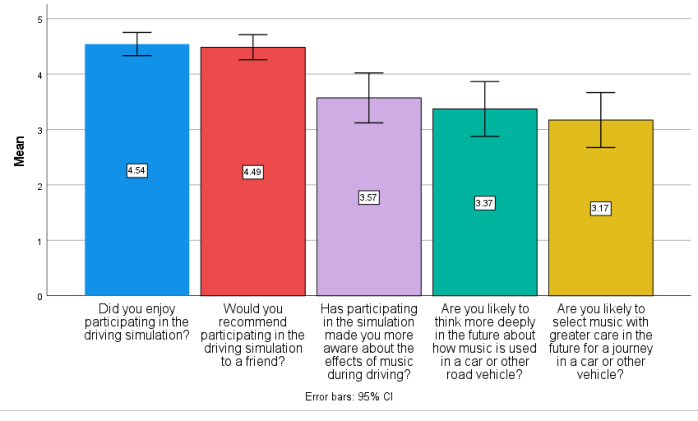
User Experience and Road Safety Awareness The descriptive analyses indicated that the driving simulation was positively received by participants (Figure 3). They reported high enjoyment of the simulation (M = 4.54, SD = 0.61) coupled with a strong willingness to recommend the experience to a friend (M = 4.49, SD = 0.66). Moderate levels of engagement were observed, with participants indicating increased awareness of the effects of music during driving (M = 3.57, SD = 1.31), a moderate likelihood of thinking more deeply about music use in vehicles (M = 3.37, SD = 1.43), and a moderate intent to select music more carefully for future journeys (M = 3.17, SD = 1.45).
Figure 3: Descriptive statistics of the items on user experience.
A series of independent-samples t tests showed that none of these post-experiment responses differed significantly (p > .05) between participants < 18 years and those aged > 18 years, including enjoyment of the simulation, t(32) = 0.033, p = .974, willingness to recommend the simulation, t(32) = 0.485, p = .631, awareness of music effects during driving, t(32) = 1.319, p = .196, likelihood of thinking more deeply about music use, t(32) = 0.684, p = .499, and likelihood of selecting music more carefully in the future, t(32) = 0.662, p = .513. Effect sizes were small (d ≤ .02), with the notable exception of awareness of music effects, which was small-to-medium (d = .44), indicating minimal practical differences between age groups. Collectively, the present findings suggest that the simulation was well received by participants and elicited comparable post-experiment reflections across two age groups.
DISCUSSION
During the simulator trials, participants were moderately aroused, experienced pleasure while driving with or without music, and reported a moderate level of workload in all dimensions of the NASA TLX. While these results do not reflect the potential effect of tempi on driving behaviour and perceived workload from previous work of a similar nature (Karageorghis et al., 2022b), they suggest that the pleasure derived from this immersive experience may negate the influence of musical characteristics on perceived demand and arousal. Moreover, the short duration of the simulation coupled with the relative simplicity of the driving task, might explain why participants did not perceive differences in how demanding the driving task was across conditions. All of the measures presented herein were of the self-report variety and thus may not accurately represent actual driving performance. Future research should thus compare objective driving performance (e.g., speed, position on the lane, collisions) with such self- report measures.
The positive results regarding pleasure are reflected in the scores observed for the items pertaining to user experience, behavioural intention and road safety awareness. This was expected given that related literature indicates how younger people are eager to engage with virtual environments, and immersive simulation facilitates the promotion of safer driving habits (Borawski et al., 2021; Narros et al., 2025). From an educational perspective, immersive technology appears to hold considerable potential. Employing an immersive experience that is both enjoyable and interactive seems to be an efficient means through which to raise awareness on how music can influence driving. This is crucial for soon-to-be and younger drivers who are overrepresented in road crashes (Department for Transport, 2020). If an engaging driving simulation encourages drivers to reflect upon their music- listening habits, this relatively affordable and accessible activity should be considered for schools and educational environments to amplify relevant road safety messages.
A number of limitations should be taken into consideration when interpreting the present findings. The sample is not balanced in terms of sex, as males are overrepresented. Given that participants visited a motor museum, they may be car enthusiasts, which could explain, in part, the high levels of pleasure reported during the experiment. Finally, conducting the experiment in a public space where participants could be observed by museum visitors, also known as the actor–observer effect (Robin et al., 1996), might have influenced participants’ behaviour and attitudes while using the simulator.
CONCLUSION
The present study attempted to further understanding of driving simulation as a tool to raise road safety awareness, as well as the effect of music listening on emotions and workload. We targeted soon-to-be and younger drivers,
as they are the most likely to be involved in road crashes. The overarching finding is that, while music did not significantly affect reported driving performance and emotions, it did have a positive influence on road safety awareness, and served to educate participants in regard to music-listening behaviours behind the wheel.
Future research may seek to use longer trials than the present 3-min course (1-min per lap). Nonetheless, the limitation in such approach is that longer trials lead to a slow participant turnover, which is impractical when engaging large numbers of people in a public forum such as a museum. A balance needs to be struck between the length of such experiences and the imperative for a large number of young people to ‘have a go’.
ACKNOWLEDGEMENT
This work was supported by the Economic and Social Research Council (grant number FOF312).
REFERENCES
Best, P., Marshall, G., Cushnan, J., McCafferty, P., & Booth, N. (2025). Immersive virtual environments as a tool to improve confidence and role expectancy in prospective social work students: a proof-of-concept study. Social Work Education, 44(3), 617–635. Borawski, M. & Borawska, A., 2021. The use of a computer game in a social campaign
to improve road safety. Procedia Computer Science, 192, pp. 3777–3786. Brodsky, W., & Slor, Z. (2013). Background music as a risk factor for distraction among young-novice drivers. Accident Analysis & Prevention, 59, 382–393. Buckley, L., Chapman, R. L., & Sheehan, M. (2014). Young driver distraction:
State of the evidence and directions for behavior change programs. Journal of Adolescent Health, 54(5), S16-S21. Hardy, C. J., & Rejeski, W. J. (1989). Not what, but how one feels: the measurement of affect during exercise. Journal of Sport and Exercise Psychology, 11(3), 304–317. Hart, S. G., & Staveland, L. E. (1988). Development of NASA-TLX (Task Load
Index): Results of empirical and theoretical research. In Advances in Psychology, 52, 139–183). North-Holland. Karageorghis, C. I., Kuan, G., Payre, W., Mouchlianitis, E., Howard, L. W., Reed, N., & Parkes, A. M. (2021b). Psychological and psychophysiological effects of music intensity and lyrics on simulated urban driving. Transportation Research Part F: Traffic Psychology and Behaviour, 81, 329–341. Karageorghis, C. I., Kuan, G., Mouchlianitis, E., Payre, W., Howard, L. W., Reed,
N., & Parkes, A. M. (2022a). Interactive effects of task load and music tempo on psychological, psychophysiological, and behavioural outcomes during simulated driving. Ergonomics, 65(7), 915–932. Karageorghis, C. I., Mouchlianitis, E., Payre, W., Kuan, G., Howard, L. W., Reed, N., & Parkes, A. M. (2021a). Psychological, psychophysiological and behavioural effects of participant-selected vs. researcher-selected music in simulated urban driving. Applied Ergonomics, 96, 103436. Karageorghis, C.I., Payre, W., Howard, L.W., Kuan, G., Mouchlianitis, E., Reed, N.
and Parkes, A.M. (2022b). Influence of music on driver psychology and safety- relevant behaviours: a multi-study inductive content analysis. Theoretical Issues in Ergonomics Science, 23(6), 643–662.
Back Behind The Wheel: Musically Induced Emotions and Driving Behaviour 299 Narros-González, M. J., Carcelén-García, S., & Pedreño-Santos, A. (2025). Typology
of young people in digital environments: Identifying vulnerability patterns. Social Sciences & Humanities Open, 12, 102237. Millet, B., Ahn, S., & Chattah, J. (2019). The impact of music on vehicular performance: A meta-analysis. Transportation Research Part F: Traffic Psychology and Behaviour, 60, 743–760. Svebak, S., & Murgatroyd, S. (1985). Metamotivational dominance: a multimethod
validation of reversal theory constructs. Journal of Personality and Social Psychology, 48(1), 107–116.
LISTED IN THE AHFE DIGITAL BOOKSTORE CATALOGUE
Explore the complete digital volume
Advances in Human Factors of Transportation
Read this individual research paper free through the original publisher, or explore the full digital proceedings book.
ISBN 979-8-950676-00-0
Explore this ISBN in the AHFE Bookstore ↗Listed in the July 2026 bookstore catalogue; search by ISBN to confirm current availability · Digital book purchase optional