Irena Vaivode (2026). The Impact of an Enterprise Collaborative Thinking on a Company's Innovative Performance in the Transition to Industry 4.0. In: Human Systems Engineering and Design (IHSED2026): Future Trends and Applications. AHFE Open Access, vol. 237, pp. 661–672. https://doi.org/10.54941/ahfe1008205
This article provides a small theoretical step in a larger study that aims to investigate the impact of digital transformation on the innovative performance of traditional manufacturing companies. A great number of this companies have started their digital transformation recently continuing to focus on the doing, using and interacting (DUI) innovation pattern. What role does enterprise collaborative thinking play in the transition to Industry 4.0? The enterprise collaborative thinking is a deliberate process that enables employees and departments across an organization to pool their skills, knowledge, and perspectives, working together on a shared, company-wide vision. It is a mindset and practice that prioritizes the collective success of the entire organization. Scientific literature reveals the interrelationship between enterprise innovation capabilities, the value of knowledge reflected in its impact on productivity, and the transition to Industry 4.0 reshaping the spatial dynamics of innovation by demanding not only technological capabilities but also the ability to absorb and recombine diverse knowledge, inevitably resulting in emerging of human centricity focused Industry 5.0. The conceptual framework for further research includes the enterprise collaborative thinking as the dependent variable and factors affecting enterprise collaborative thinking - as the independent variable.
The emergence of digital technologies has profoundly transformed the operations and processes of companies, Digital technology innovation is a new innovation process achieved through information and communication technology or with the assistance of information technology, involving innovation in digital products, digital processes, or business models. At the same time, digital transformation alone is not the key to improving the innovation performance of manufacturers. Achieving a high level of innovation performance does not depend on any single factor, it depends on the synergistic cooperation of several elements covering technological, organizational and environmental dimensions. The influence of each factor is different and their interaction results in different configurations.
Received May 14, 2026 Revised June 16, 2026 Accepted June 29, 2026 Available online September 25, 2026
662 Vaivode In improving innovation performance, manufacturers need to focus on the degree of adaptability of digital transformation and their own capabilities and resources. Knowledge flows influence technological specialization in transition toward Industry 4.0. The value of knowledge is reflected in its impact on productivity, the knowledge of each enterprise contains two parameters: technology and experience, enterprises have carried out technological innovation by learning new knowledge. Productivity measures the level of efficiency a particular company presents in producing goods and services. Total factor productivity function is the best one that can be used to measure and compare performance for a given firm over time. The aim of this study is to address the dynamic changes in the knowledge base created by the digital transformation process in manufacturing companies during the transition to Industry 4.0, which is no longer separable from the concept of Industry 5.0 as a value-driven and human-centric paradigm. The literature review to gather existing knowledge on the topic is conducted, the research questions are formulated: What knowledge factors determine the growth in the total factor productivity? What enterprise collaborative thinking factors affect the enterprise innovative performance during transition to Industry 4.0? Conceptual framework for further research is worked out. The paper is structured as follows: (1) Literature review on Innovation Capabilities. The dimensions of proximity (distal capabilities, stochastic mechanism and proximity dimensions) encompass the processes and outcomes of a firm’s innovation efforts. (2) Literature review on Digital Transformation as a Type of Stohastic Mechanism. Digital transformation changes the innovation system and promotes various forms of development activities, combining knowledge in original ways. (3) Literature review on Total Factor Productivity. Total factor productivity (TFP) is more suitable for performance measurement for a given firm over time. The value of knowledge is reflected in its impact on productivity, (4) Literature review on Industry 4.0 and Enterprise Collaborative Thinking. This is attempt to relate the above to the concept of Industry 4.0. The concept proclaims transition to digitalization and automation of processes while newly emerging Industry 5.0 emphasizes human centricity. Enterprise collaborative thinking is a significant factor influencing the path towards Industry 5.0. (5) Conceptual framework includes efforts for further research on knowledge factors determining the growth in the total factor productivity and on enterprise collaborative thinking factors affecting the enterprise innovative performance.
LITERATURE REVIEW
Innovation Capabilities A significant body of research in the field of innovation management and entrepreneurship highlights innovation as a central mechanism through which firms create and sustain competitive advantage (Guerrero and Siegel, 2024; Pineiro-Chousa et al., 2020; Lopez-Cabarcos et al., 2019; Lestan and Clausen, 2026). Even today, many studies are rooted in Schumpeter’s (1934) assertion that innovation capabilities improve a company’s performance (Cevik, 2025; Guerrero and Siegel, 2024; Schumpeter, 1934), and innovation was declared to be the primary driver of competitive advantage (Schumpeter, 1934). Firm-level innovation capabilities reflect the ability to use resources,
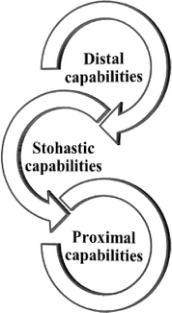
The Impact of an Enterprise Collaborative Thinking 663 knowledge and organizational processes to transform inputs into outputs (innovations) that improve performance and competitive advantage (Pineiro-Chousa et al., 2020). Firm-level capabilities emerge from dynamic interactions, coordination, and synergy within teams and management (Lopez-Cabarcos et al., 2019). A recent study of Lestena and Clausen (2026) explains how to position innovation capabilities in three dimensions based on their proximity to a company’s performance. The dimensions of proximity capture the processes and outcomes of a firm’s innovation efforts (Lestan and Clausen, 2026). The first group of proximity dimensions combines distal capabilities (investments in knowledge acquisition), or prerequisites for actions that support innovation from distant mechanisms. The distal capabilities are critical for building the foundation for innovation, their impact on performance is indirectly linked and may depend on how effectively they are translated into tangible innovation outputs. The next set of proximity dimensions is stochastic mechanism aimed to translate distal capabilities into proximal (Wu et al., 2020). This transition process is represented by stochastic capabilities that reflect the combined effects of distal and proximal mechanisms. Finally, the third group of proximity dimensions, called proximal capabilities, is closely related to measurable innovation outcomes and directly reflects a company’s ability to create value from innovation (Lestan and Clausen, 2026) (see Figure 1).
Figure 1: Proximity dimensions of innovation capabilities (created by author, based on Lestan et al., 2026).
Knowledge recombination theory is a basis according to which the process of combining different information and knowledge can help individuals overcome the limitations inherent in one-dimensional knowledge, practices, and mental models, and such boundary-crossing activities could stimulate creativity and innovation (Balachandran and Hernandez, 2018) and inter- organizational communication (Chen et al., 2023). The ability to combine different information and knowledge is essential, as the competition created by globalization forces companies to increasingly seek innovation, thus offering differentiated products and lower costs to achieve their long-term business goals (Porter, 1998).
A stochastic mechanism (the digital transformation can be considered as such) helps to translate distal capabilities into proximal. Digital transformation promotes the process of combining different knowledge in original ways and to change the innovation system, as a result, it has a positive impact on the enterprise performance (Bresciani et al., 2018; Ferraris et al., 2019; Teng et al., 2024). According Landini et al. (2020) the digitalization has created a shift in the existing innovation paradigm, providing new opportunities, innovation and knowledge learning. This is reflected differently in the two patterns of innovation and knowledge learning widely discussed in the scientific literature. The shift created by digitalization in the existing innovation paradigm is reflected in the Technology and Innovation (STI) pattern. Doing, Using and Interacting (DUI) innovation pattern, a “learning by doing” process is more applicable to existing innovation paradigm, it plays a vital role in research on digitalization and innovative processes in traditional manufacturing companies (see Table 1).
Table 1: Comparison of DUI and STI innovation patterns (Jensen et al., 2007; Teng et al., 2024).
Table available in the original PDF paper.
Pattern Pattern Conditions and Features Technology and Innovation (STI) pattern
the accumulation of scientific knowledge through R&D activities focus on the formal process of R&D aimed to produce explicit scientific and technological knowledge
enterprises acquire technical knowledge outside the existing technology paradigm the main partners of STI firms are researchers, universities and other research organizations
innovation output (product innovation), benefit from higher business connectivity and competences and skills standards dramatically changed products leading to new market creation
the learning and innovation mode of enterprises before digital transformation
Doing, Using and Interacting (DUI) innovation pattern
enterprises accumulate experience through learning-by-doing and then improve their productivity related to a “know how” and “know who” culture accelerates the process of innovation
‘non-technological’ innovation is the basis for DUI pattern, closely related to marketing and organizational innovation after the decision on enterprise digital transformation and the construction of the corresponding facilities are completed, the informal knowledge exchange mechanism in enterprises will change
The Impact of an Enterprise Collaborative Thinking 665 The digital and communication technologies transform knowledge into storable, calculable, and analyzable formats (Cheng et al., 2023). Therefore, knowledge digitization enables efficient cross-domain knowledge flow and creative interaction (Alavi et al., 2024). Digital innovation refers to the creation of new products, services, and innovation processes enabled by the novel integration of digital and physical components (Liu et al., 2024). As the knowledge of each enterprise contains two parameters: technology and experience, the value of knowledge is reflected in its impact on productivity, this is reflected in the technological breakthroughs through innovation and learning in the STI mode and in the accumulation of experience through innovation and learning in the DUI mode. When an enterprise learns the knowledge of different technological paradigms (DUI and STI), the enterprise can achieve breakthroughs in the original technology (Teng et al., 2024).
Total Factor Productivity As the main engine of innovation, enterprises play a decisive role in shaping innovation capacity, having a significant impact on productivity indicators (Sjodin et al., 2020; Zhang et al., 2022; Lv and Xie, 2025). Changes in enterprise productivity refers to movements in productivity performance over time (Yu, 2024). An increase in a firm’s productivity may result from combination of different factors (Yu, 2024). Total factor productivity (TFP) is more suitable for performance measurement for a given firm over time, change of productivity is a total factor productivity (TFP) index (Yu, 2024). Teng et al. (2024) innovative approach to application of the TFP function is based on incorporating knowledge as a variable, thus allowing for the practical application of TFP function to analyze how a company’s productivity changes over time when implementing new digital solutions. This approach to TFP function includes the following: Ejit variable, added to input metrics, means the accumulated experience of enterprises, related to innovation in management systems for production, such as supply chain management systems, business re-engineering, and quality management systems. If the firm learns from the experience of similar technologies, it transforms it into its own experience, which in turn affects Ejit in the TFP function, it suggests the presence of DUI innovation mode (Teng et al., 2024). The firm’s business activities include the process of creative problem-solving as a source of organizational innovation and the ability to learn and utilize new knowledge and technologies, related to DUI practice (Nickerson and Zenger, 2004; Teng et al., 2024). Value of Ejit increases by the value of kjit variable (the newly acquired experience of enterprises through doing) over time. The acquisition of up-to date machinery and technology in combination with a highly educated human capital is likely to lead to a strong impact of the DUI mode on innovation output (Nickerson and Zenger, 2004; Teng et al., 2024). ηji2 variable, added to output metrics, detremines upper level of productivity is affected the STI mode, it emphasizes the importance of scientific human capital and innovation infrastructure. The main partners of STI firms are researchers, universities and other research organizations; innovation output (product innovation) benefit from higher business connectivity and competences and
666 Vaivode skills standards (Teng et al., 2024). The learning and innovation of each enterprise differs after digital transformation investments. Combining the two modes (DUI and STI) of learning and innovation often leads to better results (Apanasovich et al., 2016; Hall, 2004; Teng et al., 2024; Sjodin et al., 2020; Madsen and Berg, 2021; Lv and Xie, 2025).
Industry 4.0 and Enterprise Collaborative Thinking Industry 4.0 has transformed the dynamics of innovation by providing the ability to absorb and recombine diverse knowledge, as the digitalization process encompasses both technological aspects and cultural and organizational issues. Knowledge flows influence technological specialization in transition toward Industry 4.0. Firm-level capabilities emerge from dynamic interactions, coordination, and synergy within teams and management (Lopez-Cabarcos et al., 2019). Smart manufacturing is being shaped nowadays by two different paradigms: Industry 4.0 proclaims transition to digitalization and automation of processes while emerging Industry 5.0 emphasizes human centricity. Since some industries have just recently started their digital transformation towards Industry 4.0, some are planning to move directly towards Industry 5.0, and some are forcing the transformation from Industry 4.0 to Industry 5.0, one may expect a certain period of the two concepts`co-existence (Oztemel, Gursev, 2016). The Industry 4.0 paradigm assumes that robots will be more dominant in manufacturing and most of the communication will take part between machines rather than between humans. Industry 5.0 is annouced by European Commission as a response to the emerging societal challenges appeared as a vision of industry that aims beyond efficiency and productivity towards respect to human values and contributing to vital society needs. It puts the workers’ wellbeing together with other human values at the center of the manufacturing/production processes (Longo et al., 2020; Breque et al., 2021), it is considered as a transition to a human-centric (Nahavandi, 2019), sustainable (Saw et al., 2021), and resilient (Sindhwani et al., 2022) industry. Javaid and Haleem (2022) also believe that modern industry needs the transition from the Industry 4.0 towards Industry 5.0 as human-centred and value-driven concept. The new human role in the technological transition needs to be predominantly focused on sustainable development in economic, environmental, and societal dimensions (Moraru, Popa, 2021; Sarkar et al., 2024). Most of the analyzed papers underline the importance of human aspects as the foundation of Industry 5.0 (Golovianko et al., 2023; Jaime et al., 2026), behavioral assumptions are highlighted as well. Here comes the place for the enterprise collaborative thinking concept. Definition of the concept characterizes the intentional process of breaking down fragmentation to enable employees, teams, and departments across an organization to pool their diverse skills, knowledge, and perspectives, working together on a shared, company-wide vision. It is a mindset and practice that prioritizes the collective success of the entire organization over the individual goals of a single department. Table 2 presents factors affecting enterprise collaborative thinking in the context of transmission to Industry 4.0 followed by looking the path towards Industry 5.0.
Table 2: Factors affecting enterprise collaborative thinking (created by author, based on scientific literature).
Table available in the original PDF paper.
Factor Factor’s Definition (Explanation) Collective intelligence A task-oriented intelligent activity of a group of people or systems with two aspects: the cooperation aspect and the competition aspect. The tasks are referred to making common decisions taking into account the aspects of integration, diversity and cardinality (Sabou et al., 2018; Golovianko et al., 2023)
Thinking style is associated with a mental attitude
Success factor in digitalization process is recognized as digital thinking, which results not only from experience but also from the personality and mindset of the individual. In the context of a constantly changing environment, growth- oriented thinking takes on particular importance, it is a crucial attribute of digital thinking, manifesting as a set of attitudes and behaviours that enable individuals and organizations to see how data and algorithms create new opportunities and pave the way to success in a business landscape (Dweck, 2007; Bredendiek and Knorr, 2020; Leonardi and Neeley, 2022) Systems thinking Has been used to explain and understand the interdependence of sustainability drivers at both global and national levels. Systems thinking has become a novel approach to understanding the structure and behaviour of complex systems (Abonguie et al., 2025)
Collaborative decision-making
By implementing a collaborative decision-making framework, organizations can benefit from a diverse range of perspectives and expertise, resulting in more comprehensive and robust decision- making processes (Iliuta et al., 2023; Dumitrache et al., 2023) Collaborative innovation behaviour The evolutionary process of corporate innovation ecosystem participants and the factors that influence voluntary, interdependent, and proactive actions taken by individuals and organizations to jointly create, share, and apply knowledge, resources, and skills for the purpose of developing new products, services, or processes (Yang et al., 2023; Smolka and Boeschen, 2023; Zen et al., 2023)
Establishing an innovation ecosystem
The parties involved promote cooperation with other structures of the system, and as a result of cooperation, resources for innovation and further development of companies increase (Yang et al., 2023; Smolka and Boeschen, 2023; Zen et al., 2023) Digital awareness The state of a subject (person or enterprise) who understands the opportunities and threats posed by ongoing digitalization, possessing digital knowledge, they can interact effectively using technology and skills closely related to digital competencies (Vidal Ferre et al.,, 2022; Krawczyk-Sokołowska and Caputa, 2023)
Co-Intelligence and digital innovation
Collaboration between humans and AI, which has a significant impact on organizational learning, workflows and development, thus serving as a key source of innovation capabilities. AI is used to compensate for human cognitive limitations, thereby achieving efficient and accurate information processing (Liu et al., 2023; Lin, 2024)
668 Vaivode Thus, the literature review has uncovered the role of enterprise collaborative thinking in the transition to Industry 4.0. Since the enterprise collaborative thinking is a set of factors, the interaction of these factors needs to be studied further.
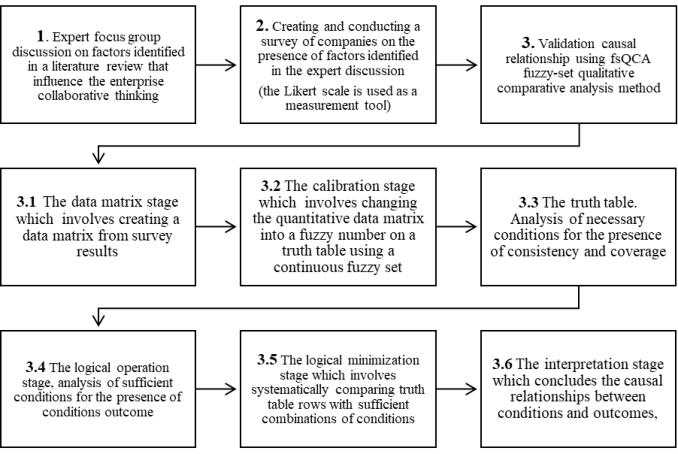
CONCEPTUAL FRAMEWORK FOR FURTHER RESEARCH The further research could start with expert focus group discussion on fac tors affecting the enterprise collaborative thinking, identified in a literature review. As the next step could be the creating and conducting a survey of companies on the presence of factors identified in the expert discussion. The Likert scale could be used as a measurement tool. The results obtained in the Likert scale analysis could be applied as a basis for the further fuzzy-set qualitative comparative analysis (fsQCA). The analysis permits to better un derstand different factors relationships in terms of necessity and sufficiency because necessity presents if outcome occurs but does not produce the out come; the sufficiency as a causal complexity determines the degree to which a condition is present relative to other conditions and the outcome. The next step is the subsett analysis procedure which provides scores of consistency and coverage. Consistency refers to the percentage of causal configurations of similar composition which result in the same outcome value, coverage refers to the number of cases for which a configuration is valid.
Figure 2: Conceptual framework for future research (created by author, based on approach of Shalahuddin et al., 2024).
The application of the research method could be multi-layered, it could be applied further to provide the next research on how enterprise collaborative thinking factors are interact with knowledge factors of DUI
The Impact of an Enterprise Collaborative Thinking 669 and STI innovation modes, their place in TFP function and impact to Ejit as the accumulated experience of enterprises, to the value of kjit variable (the newly acquired experience of enterprises through doing) over time and to the ηji2 variable that detremines upper level of productivity in the STI innovation mode.
CONCLUSION
As mentioned in the beginning, this article provides a small theoretical step in a larger study aimed to investigate the impact of digital transformation on the innovative performance of traditional manufacturing companies. A great number of this companies have started their digital transformation recently continuing to focus on the doing, using and interacting (DUI) innovation pattern, therefore the knowledge factors that determine the growth in the total factor productivity are to be studied further. This small study highlights the role of an enterprise collaborative thinking in the aforementioned process. The conceptual framework for further research is intended for investigation of factors affecting enterprise collaborative thinking during the transition to Industry 4.0. The question of the interaction of enterprise collaborative thinking and knowledge factors affecting innovative performance of enterprises during transition to Industry 4.0 related to DUI and STI innovation modes, could remain open for further research.
REFERENCES
Abonguie, D.F., Nyam, Y.S., Hoeyi, P.K. (2025). A systematic analysis of systems thinking and the sustainability of small and medium size enterprises (SMEs), A global evaluation Scientific African, Volume 28, Article 02738. Alavi, M., Leidner, D. E., Mousavi, R. (2024). Knowledge Management Perspective
of Generative Artificial Intelligence. Journal of the Association for Information Systems, Volume 25, No. 1, pp. 1–12. Apanasovich, N., Heras, H.A., Parrilli, M.D. (2016). The impact of business innovation modes on SME innovation performance in post-soviet transition economies: the case of Belarus. Technovation, Volume 57, pp. 30–40. Balachandran, S., Hernandez, E. (2018). Networks and innovation: Accounting
for structural and institutional sources of recombination in brokerage triads. Organization Science, Volume 29, No. 1. Bernhard, O., Wegmann, M., Wagner, S., Nigg, V., Cochran, D., Rauch, E., Zaeh, M.
F. (2025). Industry 5.0 implementation barriers for manufacturing companies. Procedia CIRP, Volume 134, pp. 723–728. Bredendiek, M., Knorr, J. (2020). Definition. Digitales. Mindset pp. 35–181. Breque, M., De Nul, L., Petridis, A. (2021). Industry 5.0: towards a sustainable, human-centric and resilient European industry, European Commission, Directorate-General for Research and Innovation. Bresciani, S., Ferraris, A., Del Giudice, M. (2018). The management of organizational
ambidexterity through alliances in a new context of analysis: Internet of Things (IoT) smart city projects, Technol. Forecast. Soc. Chang, Volume 136, pp. 331–4. Cevik, S. (2025). Is Schumpeter right? Fintech and economic growth. Economics of Innovation and New Technology, pp. 1095–1106.
knowledge advantage and innovation performance, Journal of Business Research, Volume 163, Article 113915. Dumitrache, S. Caramihai, I., Stanescu A. (2013). From Mass Production to Intelligent Cyber-Enterprise, Proceedings of 19th International Conference on Control Systems and Computer Science, pp. 399–404. Dweck, C.S., Walton, G.M., Cohen, G.L (2014). Academic Tenacity: Mindsets and
Skills that Promote Long-Term Learning. Bill and Melinda Gates Foundation. Ferraris, A., Mazzoleni, A., Devalle, A., Couturier, J. (2019). Big data analytics capabilities and knowledge management: impact on firm performance, Manag. Decis, Volume 7, No. 8, pp. 1923–1936. Golovianko, M., Terziyan, V., Branytskyi, V., Malyk D. (2023). Industry 4.0 vs.
Industry 5.0: Co-existence, Transition, or a Hybrid, ResearchGate. Guerrero, M., Siegel, D. S. (2024). Schumpeter meets Teece: Proposed metrics for assessing entrepreneurial innovation and dynamic capabilities. Entrepreneurial ecosystems in an emerging economy, Research Policy, Volume 53, No. 5, Article 104984. Hall, Bronwyn H. (2004). Innovation and Diffusion, NBER Working Papers Volume
4, pp. 221–229. Available online. https://www.nber.org/papers/w10212 Iliuţa, M., Pop, E., Caramihai, S.I., Moisescu, M.A. (2023) A Digital Twin Generic Architecture for Data-Driven Cyber-Physical Production Systems, Studies in Computational Intelligence, Volume 1083. Springer. Jaime, A., Osorio-Sanabria, M.A., Deysi, Y., Bernal Torres, D. Y. (2025). Similarities
and differences between Industry 4.0 and Industry 5.0: Towards a transitioning model, Journal of Innovation and Knowledge, Volume 13, Article 100921. Javaid, M., and Haleem, A. (2020). Critical components of Industry 5.0 towards a successful adoption in the field of manufacturing, Journal of Industrial Integration and Management, Volume 5, No. 3, pp. 327–348. Jensen, M.B., Johnson, B., Lorenz, E., Lundvall, B.Å., Lundvall, B.A. (2007). Forms of
knowledge and modes of innovation, The Learning Economy and the Economics of Hope, p. 155. Jensen, M.B., Johnson, B., Lorenz, E., Lundvall, B.Å., Lundvall, B.A. (2007). Forms of knowledge and modes of innovation. The Learning Economy and the Economics of Hope, Volume 155. Krawczyk-Sokołowska, I., Caputa, W. (2023). Awareness of network security
and customer value – The company and customer perspective, Technological Forecasting and Social Chang, Volume 190(C). Landini, F., Lema, R., Malerba, F. (2020). Demand-led catch-up: a history-friendly model of latecomer development in the global green economy. Ind. Corp. Chang. Volume 29, No. 5, pp. 1297–1318. Lestan, F., Clausen, T. H. (2026). Innovation Capabilities and Firm Performance:
A Meta-analysis of the Schumpeter’s Hypothesis, Journal of Innovation and Knowledge, Volume 11, Article 100943. Liu, Y., Zhang, Z., Jiang, S. Ding, Y. (2024). Application of big data technology combined with clustering algorithm in manufacturing production analysis system, Decision Making, Applications in Management and Engineering, Volume 7, No. 1, pp. 237–253. Longo, F., Padovano, A., Umbrello, S. (2020). Value-oriented and ethical technology
engineering in industry 5.0: A human-centric perspective for the design of the factory of the future, pplied Sciences, Volume 10, No. 12, pp. 4182.
The Impact of an Enterprise Collaborative Thinking 671 Lopez-Cabarcos, M.´ A., Srinivasan, S., Gottling-Oliveira-Monteiro, S., Vazquez-
Rodríguez, P. (2019). Tacit knowledge and firm performance relationship. The role of product innovation and the firm level capabilities, Journal of Business Economics and Management Volume 20, No. 2, pp. 330–350. Lv, Z. W., Xie, H.Y. (2025). Artificial intelligence development empowering enterprise innovation: theoretical analysis and empirical evidence, Stat. Decis. Volume 41, No. 3, pp. 169–174. Madsen, D.Ø., Berg, T. (2021). An exploratory biblio metric analysis of the birth and
emergence of industry 5.0, Applied System Innovation, Volume 4, No. 4, p. 87. Moraru, G. M., Popa, D. (2021). Potential resistance of employees to change in the transition to Industry 5.0 , MATEC Web of Conferences EDP Sciences. Nahavandi, S. (2019). Industry 5.0—A human-centric solution, Sustainability,
Volume 11, No. 16, Article 4371. Neeley, T., Leonardi, P. (2022). Developing Digital Mindset How to lead your organization into the age of data, algorithms, and AI, Harvard Business Review, Volume 53. Nickerson, J., Zenger, T. (2004). A knowledge-based theory of governance choice–a
problem-solving approach, Organ. Sci. Volume 15, No. 6, pp. 617–632. Oztemel, E., Gursev, S. (2020). Literature review of Industry 4.0 and related technologies, Journal of Intelligent Manufacturing, Volume 3, No. 1, pp. 127–182. Peng, D. H., Zhang, K. Y. (2026). A holistic performance evaluation framework
of enterprise product service innovation based on intelligent collaborative, Engineering Informatics, Volume 69, Article 103944. Pineiro-Chousa, J., Lopez-Cabarcos, M. A., Romero-Castro, N. M., Perez-Pico, A.
M. (2020). Innovation, entrepreneurship and knowledge in the business scientific field: Mapping the research front, Journal of Business Research, Volume 115, pp. 475–485. Porter, M.E. (1998). Competitive Advantage: Creating and Sustaining Superior Performance, Free Press. Sabou, M., Musil, A., Musil, J., Biff, S. (2018). Collective intelligence aspects of
cyber-physical social systems: results of a systematic mapping study, Proceedings of the ACM Collective Intelligence Conference. Sarkar, B. D., Shardeo, V. Dwivedi, A., Pamucar, D. (2024). Digital transition from industry 4.0 to industry 5.0 in smart manufacturing: A framework for sustainable future, Technology in Society Volume 78, Article 102649. Saw, H. S., bin Azmi, A. A., Chew, K. W., Show, P. L. (2021). Sustainability and
Development of Industry 5.0. The Prospect of Industry 5.0 in Biomanufacturing, CRC Press. pp. 287–304. Schumpeter, J. A. (1934). The theory of economic development: An inquiry into profits, capital, credit, interest, and the business cycle. Cambridge, Ma: Harvard University Press (Repr. New Bunswick: Transaction, 1983). Sindhwani, R., Afridi, S., Kumar, A., Banaitis, A., Luthra, S., Singh, P. L. (2022).
Can industry 5.0 revolutionize the wave of resilience and social value creation? A multi-criteria framework to analyze enablers, Technology in Society, Volume 68, Article 101887. Sjodin, D., Parida, V., Kohtamaki, M. (2020). An agile co-creation process for digital servitization: a micro-service innovation approach, J. Bus. Res. Volume12, p. 478. Smolka, M., Boeschen, S. (2023). Responsible innovation ecosystem governance:
socio- technical integration research for systems-level capacity building, J. Responsible Innov., Article 2207937.
paths for industrial clusters: Insights from a simulation, Technological Forecasting and Social Change, Volume 200, Article 123170. Teng, Y., Zheng, J., Li, Y., Wu, D. (2024). Optimizing digital transformation paths for industrial clusters: Insights from a simulation Technological Forecasting and Social Change, Volume 200, Article 123170. Vidal Ferré, R. (2022). Including digital awareness as a competence in a network
engineering degree, Proceedings of SEFI 50th Annual conference of The European Society for Engineering Education “Towards a new future in engineering education, new scenarios that European alliances of tech universities open up”. pp. 2240–2244. Wu, X.Y., Wang, Q., Su, Z.F. (2021). Service innovation research in the digital intelligence era: Review and prospects, Res. Dev. Manag. Volume 33, No. 1, pp. 53–64. Yang, W.X., Hu, Y., Ding, Q.Y., Gao, H., Li, L.G. (2023). Comprehensive evaluation
and comparative analysis of the green development level of provinces in eastern and western China. Sustainability, Volume 15, No. 5, Article 3965. Yu M M, (2024). An introduction to productivity and efficiency analysis. Zen, A.C., dos Santos, C.A.F., dos Santos, D.A.G., da Rosa, J.R., Spindler, E.D. (2023).
Exploring the Theoretical Foundations of Innovation Ecosystems between 2006 and 2020: An Analysis at the Different Approaches. J. Inov. Sci, Int. Zhang, K., Feng, L.J. Lin, K.Y. (2022). UNISON framework of model-based innovation for collaborative innovation of smart product-service system design, Comput. Ind. Eng. Volume 171, Article 108494.
FIND THE COMPLETE VOLUME IN THE AHFE DIGITAL BOOKSTORE
Explore the complete digital volume
Human Systems Engineering and Design (IHSED2026): Future Trends and Applications
Read this individual research paper free through the original publisher, or explore the full digital proceedings book.