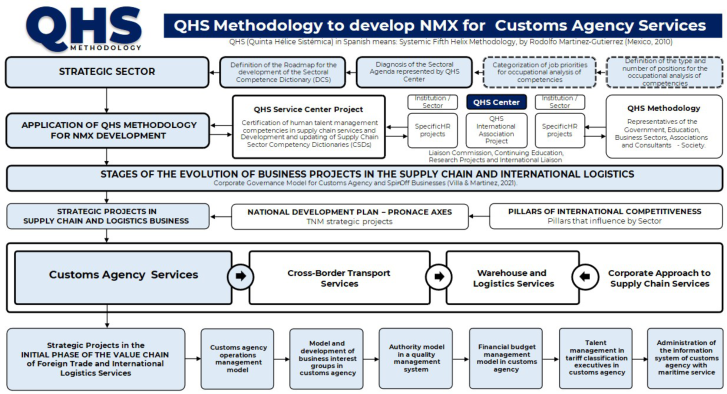
In the business world of the foreign trade supply chain, models of administration, finance and budgeting systems are strategies to ensure mechanisms of the administrative process; Planning, organization, control and direction are factors that must be monitored with performance indicators, human talent management is a key pillar of success. The risks involved in financial management and budgets are sensitive services, which require attention with actions of prior inspections of the merchandise to ensure that the items that are imported agree with the invoice and request. Given the nature of operational complexity, the QHS Methodology is applied with a systemic integration approach of good practices from all sectors involved in combining strategies to strengthen the administration of operational and managerial knowledge management in an organization.
The applied research strategy for the design and methodological development for the integral proposal of new Mexican Standards (NMX) for the Value Chain of Services of the Supply Chain of Foreign Trade Businesses is the pro- duct of a set of Master’s Thesis projects in Administration that are in the development phase at the Tijuana Institute of Technology. Within the frame- work of the link with the supply chain sector through the Postgraduate with the Supply Chain Services Industry; that integrate the services of Customs Agency, Cross-border Transport Services, Merchandise Warehouses, and International Logistics Services.
The design and structure of a Mexican Standard (NMX) has characteri- stics that are presented in Table 1, the proposal of an NMX for Financial Management Services and Human Resources in the Customs Agency and Cross-Border Transport Services Businesses has as its main purpose to con- tribute to the strengthening of the Management of Operations in Value Chain of Foreign Trade Logistics Services.
The Reference Framework that generated the mechanisms for strength- ening Customs Services in Mexico, begins with the Quality Model establi- shed as a reference guide in the Mexican Standard for Quality Services in Customs Agencies (NMX-R-026-SCFI-2016). Which includes mechanisms and technical recommendations to ensure quality in the provision of services.
QHS Methodology as a Supportive Framework for Innovation The Project for the design and development of Mexican Standards initiatives has a qualitative approach through interviews of the QHS Methodology; that integrate the Academic Sector, Government Sector, Business Sector, Business Associations Sector, and the Sector of Specialized Consultants. It also contem- plates the Business Model for a Customs Agency with corporate governance practices proposed by Garcia & Martinez (2021).
Figure 1 presents the roadmap of the QHS Methodology for innovation in the strategic processes of Administration and Finance in Foreign Trade Businesses; that integrate the links of the Value Chain in the initial phase of Foreign Trade and International Logistics; the Customs Brokerage Servi- ces Business. The QHS and DCS Methodological Proposal; includes aspects of the design of the Dictionary of Sectorial Competences (Martinez, 2020, 2023), through linkage and research, mechanisms for in-depth interviews have been defined, focus group activities with specialists and sector experts, and the roadmap for the development of the proposal for Mexican Standards has been defined; The purpose is to encourage the systematic development of the Customs Agencies Business in its transition from Customs Broker to Customs Agency, according to the new regulatory requirements of the Federal Government in Mexico.
Table 1; presents the results of the methodology oriented to the proces- ses of Focus Groups and in-depth interviews with sector representatives of
Figure 1: QHS methodology. (Adapted from Martinez, 2010.)
QHS Methodology for Management and Finance Models 889
Table 1. QHS methodology for foreign trade business administration.
Table available in the original PDF paper.
Value Chain Objectives
Type of Business Approach of Enterprise Resource Planning (ERP) Customs Agency Financial Resource Management Financial Administration Model of Budgets in Customs Agency Supply Chain Management International environment, theoretical perspectives, process, and applicable regulations Customer Relationship Management
Practical budgeting in logistics chain services
the main Customs Agencies Businesses, from the transversal context of the opinion leaders and the expert criteria they provide from the QHS Metho- dology (Gutierrez 2010, 2021); that integrates the Sectors of Government, Academy, Companies, Associations-Chambers and Consultants. Under the premise of documenting the best practices for the management and standar- dization of processes in the initial phase of the Value Chain of Foreign Trade Services; represented by the Customs Agency Business and as the business model matures and the offer of integral services, a Spin-Off model of Cross- border Freight Transport Services is presented, with challenges of developing a talent management model specialized in Operators of border and local crossing tractors.
DEVELOPMENT OF STRATEGIC PROJECTS AS AN INNOVATION TOOL IN THE CUSTOMS AGENCY BUSINESS The results of the applied research lead to the development of objectives in the value chain for the Customs Agency Business, under the approach of Business Requirements Planning; it is recommended to establish a Financial Resources and Budget Management Model, consolidate the Management of Supply Chain processes and systematize the Customer Relationship Mana- gement Model; generating and establishing the main performance indicators in terms of Quality, Service, Cost and Delivery Time; as key aspects of the level of customer satisfaction, such as quality policy and image of business philosophy. Once the Customs Brokerage Business is consolidated, a Spin-Off Model for Cross-Border Transport Services can be generated as a value-added strategy for customer services.
Table 2 presents a breakdown of strategic projects in the supply chain businesses, which includes the integral Value Chain of foreign trade and international logistics. The Corporate Governance Model for Customs Age- ncies proposes a series of actions that must be established in a medium and long-term Strategic Plan, considering initiatives of new Business Units that in parallel consider the strengthening and development of key specialized talent in each department of the business, in the management team and at the management level.
Table 2. Corporate governance model for customs agency (Villa and Martinez, 2021).
Table available in the original PDF paper.
Value Chain Strategic projects in the supply chain business Corporate Governance to Supply Chain Services Design and proposal of corporate strategic plan for supply chain company Supply chain business intelligence model Administration of a social responsibility system in supply chain business Evaluation of the performance of the quality management system in supply chain business Customs Agency Services
Customs agency operations management model Model and development of business interest groups in customs agency Authority model in a quality management system Financial budget management model in customs agency Talent management in tariff classification executives in customs agency Administration of the information system of customs agency with maritime service
CONCLUSION
The development of applied research in the processes of an organization, generates expectations of contributions to the State of the Art of a Strategic Sector, and with-it contributions for the improvement of business performa- nce. The indicators of business competitiveness are addressed with projects that start from the analysis of the efficiency, effectiveness, effectiveness, and productivity of the business team. The methodological development of projects aimed at the development of competency standards, standards as operating guides in each key stage of the business ensures the consolidation of staff empowerment and its respective learning curve, towards standar- dization mechanisms and certification processes of labor, professional and applied research in the strategic processes of organizations (Larenas, 2017). Establishing Performance Indicators strengthens business management in the face of an increasingly strong competitive market (Bernard, 2018).
The development of standards and reference standards are contributions of the success secret of organizations to maintain leadership in the market, the transfer of knowledge to new generations and the business style to recruit, select and update professional (Perilus, 2021). The Mexican Standards are standards for developing Quality Systems as a strategy for strengthening operational performance in Business (Nava, 2019), especially NNX-026-R- SCFI-2016 is aimed at Customs Agencies (Larena, 2017). That is why under the principle of “Knowledge, generates Knowledge”, in the statistics of the project of the Observatory of Integration of Engineering to the Economic Development Ecosystem of the Baja California Peninsula; a trend is identified specialization in logistics engineering studies highlight the focus on employa- bility processes and professional development in the sectors of Supply Chains. The proposal of a new NMX oriented to the Customs Agency Services (Her- nandez, 2012) and its Spin-Off Business Units has been developed, as is
QHS Methodology for Management and Finance Models 891
the case of the Cross-Border Transport Services of goods (Madrigal, 2017). An organization reflects the capabilities and specialized talent systematized through the learning curves established in Human Resources Management (Munger, 2022).
ACKNOWLEDGMENT
Special thanks to Engineer Jorge Vicente Villa Garcia, Supply Chain Services specialists. As well as for Engineer Jose Guillermo Cardenas Lopez Director of the Tijuana Institute of Technology (ITT) for its support to the develo- pment of Specialized Talent Management projects with international scope in the Center for Research and Innovation of the ITT.
Sincerely Dr. Rodolfo Martinez Gutierrez Member of the National System of Researchers SNI Level 2 – CONACYT Mexico
REFERENCES
Bernard M. (2018) Key performance indicators. The 75 keys that the administrator must know. Trillas. Garcia, J., Gutierrez, R. (2021). Corporate Governance Model for Customs Agency
in accordance with Federal Customs Law Article 167-D in Mexico. In: Waldemar Karwowski, Tareq Ahram, Mario Milicevic, Darko Etinger and Krunoslav Zubri- nic (eds) Human Systems Engineering and Design (IHSED2021): Future Trends and Applications. AHFE (2021) International Conference. AHFE Open Access, vol. 21. AHFE International, USA. Website: http://doi.org/10.54941/ahfe1001203 Gutierrez, R. (2021) Methodology of the Fifth Helix Systemic, A Decade of Sectorial Investigations 2010-2020, IOP Conference Series: Earth and Environmental Website: https://ui.adsabs.harvard.edu/abs/2021E%26ES..690a2061M/abstract Hernández, Valentín; Daniel Jafet (2012) Analysis and requirements for the implementation of the standard NMX-R-026-SCFI-2009 (Quality Customs Brokers) in customs agency, Thesis https://repositorio.unam.mx/contenidos/ana lisis-y-requisitos-para-la-implementacion-de-la-norma-nmx-r-026-scfi-2009-qu ality-customs-brokers-en-agencia-aduanal-3536829?c=pn52Ra&d=false&q=*: *&i=1&v=1&t=search_0&as=0 Larenas, R. (2017) Corporate Governance for Medium Enterprises, directory for
profitable and enduring companies. USA. Madrigal-Torres, B. (2017) Management Skills, McGrawHill. Martinez-Gutierrez, R. (2020). Methodology of Dictionaries of Sector Competences (DCS), to Design Standards of Professional Competences, Research and Labor. In: Nazir, S., Ahram, T., Karwowski, W. (eds) Advances in Human Factors in Training, Customs Services- Quality of services provided by customs broker (quality of customs broker) Computing, vol. 1211. Springer, Cham. Website: https://doi.org/10.1007/978-3-030-50896-8_46 Martinez-Gutierrez, R., Carey-Raygoza, C. E., Hurtado-Sanchez, C., Chavez-Ceja,
B., Lara-Chavez, A. (2021). Business Management Engineers: Profile and Compe- tencies of Generations X, Y and Z. In: Trzcielinski, S., Mrugalska, B., Karwowski, W., Rossi, E., Di Nicolantonio, M. (eds) Advances in Manufacturing, Production Management and Process Control. AHFE 2021. Lecture Notes in Networks and
Systems, vol. 274. Springer, Cham. Website: https://doi.org/10.1007/978-3-030- 80462-6_36 Martinez-Gutierrez, R., Esther Ibarra-Estrada, M., Hurtado-Sanchez, C., Galvan- Sanchez, R., & Ernesto Jimenez-Bernardino, A. (2023). Perspective Chapter: Prospective of Sectoral Competences for the Design of Dictionaries of Profes- sional Competences and Research. Education and Human Development. doi: 10.5772/intechopen.109457 https://www.intechopen.com/online-first/85569 Martinez-Gutierrez, R., Ibarra-Estrada, M. E., Carey-Raygoza, C. E., Hurtado-
Sanchez, C., Chavez-Ceja, B. (2022). Observatory of Labor, Professional and Research Competencies of the Economic Sectors in Baja California. In: Ahram, T., Taiar, R. (eds) Human Interaction, Emerging Technologies and Future Systems V. IHIET 2021. Lecture Notes in Networks and Systems, vol. 319. Springer, Cham. Website: https://doi.org/10.1007/978-3-030-85540-6_164 Munger K. (2022) Generation Gap. Why the Baby Boomers Still Dominate, American politics and Culture, Columbia University Press. Nava Nieto, Nayeli (2019) The Mexican Standard NMX-R-026-SCFI-2016 applied
to the Agencia Aduanal del Valle Centro S. C. Thesis http://ri.uaemex.mx/handle/ 20.500.11799/106201?show=full NMX-R-026-SCFI-2016 Customs Services- Quality of services provided by customs broker (quality of customs broker) – Requirements. Website: https://www.dof.go b.mx/nota_detalle.php?codigo=5464149&fecha=06/12/2016#gsc.tab=0 Perilus B. (2021) Four generations under one organization’s roof. A resource for
leading and managing the Baby Boomers, Generation X, The Millennials, and Generation Z.
Read this individual research paper free through the original publisher, or explore the full digital proceedings book.
ISBN 978-1-958651-87-2
Explore this ISBN in the AHFE Bookstore ↗Listed in the July 2026 bookstore catalogue; search by ISBN to confirm current availability · Digital book purchase optional