Rodolfo Martinez Gutierrez, Jorge Vicente Villa Garcia (2023). QHS Methodology to innovate the Value Chain in the Supply Chain. In: Human Factors, Business Management and Society. AHFE Open Access, vol. 97, pp. 356–361. https://doi.org/10.54941/ahfe1003951
In the foreign trade sector, the companies that make up the value chain; They make up its portfolio of services with customs agency, cross-border transport, merchandise warehouses and international logistics. The supply chain integrated by the implicit relationship of suppliers, companies and customers generates large areas of opportunity in the key phases of specialization, innovation and competitiveness in the management and administration of operations, strengthening the learning curve processes in each phase of the value chain in the different strategic sectors of international trade. The QHS Methodology represents a methodological intervention strategy for the analysis of the factors that determine the elements of innovation, systematization of competitiveness through the consolidation of regulatory operation management models, specialized talent management and competency certification mechanisms at each stage of the supply chain.
As a result of a Master’s Thesis Project in Administration at the Technologi- cal Institute of Tijuana, a proposal for a Business Administration Model has been made in the value chain sector of supply chain services in foreign trade and customs. Innovation initiative for small businesses of family origin that have traditionally worked under the figure of the Customs Agent in physical person, facing the challenges in the changes in the Mexican Customs Law (DOF, 2018); that they must rethink their structure towards the formation of a Customs Agency to operate under the concept of “customs agency patent”, concept of legal person. Customs broker: natural person authorized in article 159 of the Customs Law through a patent, to offer the services of customs clearance of goods as third parties. The Official Gazette of the Federation of the Government of Mexico publishes the regulations of legal requirements for the operation of the Customs Agent, which has generated various processes of analysis and research among specialists in view of the need to strengthen business structures, the empowerment of Specialized Talent Management at every stage of the supply chain services of the foreign trade and customs value chain (Madrigal, 2017). One of the reference mechanisms in Mexico for
QHS Methodology to Innovate the Value Chain in the Supply Chain 357
Customs Services - Quality of services provided by the customs broker (qua- lity of customs broker) is the Mexican Standard; NMX-R-026-SCFI, which was developed for the shared interest of the production chain to establish clear and precise technical specifications, As part of the strategies of sectoral and international linkage.
QHS Methodology as a Supportive Framework for Innovation The research project raised the need for the methodological design of qua- litative approach to systematically assess through focus group the opinion of experts from different sectors of Society the necessary actions to consi- der in the design of a Business Model for a Customs Agency (Garcia, 2021). There is a great challenge and regional opportunity for the integration and strengthening of the level of competitiveness and innovation in the Interna- tional Trade, Customs, Logistics and Supply Chain Sector, to promote the development of Competency Standards and their homologation of labor and professional competencies in Mexico, Central America and Panama. Chal- lenges that can be crystallized through the support of the Academic Sector, Government Sector, Business Sector, Business Associations Sector and the Sector of Specialized Consultants.
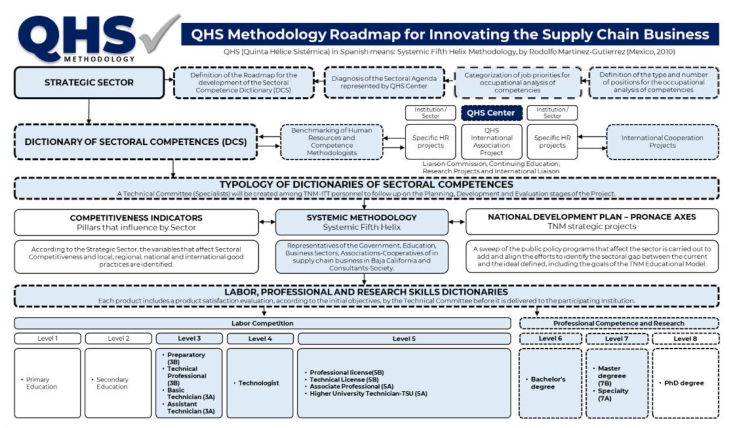
Figure 1 presents the roadmap of the QHS methodology for the innova- tion process of the supply chain business, starting with the definition of the occupational analysis of strategic positions, categorizing the priorities of the sectoral agenda from a systemic approach, developing a Dictionary of Secto- ral Competencies (Martinez, 2020, 2023), to strengthen the competitiveness and innovation of the value chain. The improvement tools contemplate a Project of an International Association on QHS Studies, with links with the area of Human Resources and adoption of good practices of quality management systems in processes, certification of competencies in each posi- tion in the company. The systematic methodology includes the analysis of competitiveness indicators, strategic national programs, through in-depth interviews, focus groups with representatives of the foreign trade supply chain and customs; with the support of the Center for Research and Inno- vation, Master’s Graduate Program in Administration of the Technological Institute of Tijuana.
In the Table 1; the results of the methodological work of the applica- tion of the Fifth Helice System Methodology (Gutierrez, 2010, 2021) are presented; where representatives of the government, business, academia, chambers and associations of the foreign trade and customs sector parti- cipated and finally the sector of consultants specialized in the value chain of the business of the supply chain of international trade and customs. That they analyzed Mexico’s experience of the development of Labor Com- petence Standards of CONOCER (National Council for Standardization and Certification of Labor Competencies) for the International Trade and Customs Sector with which the Human Capital Agenda for Human Talent Management is addressed and its level of specialization (Martinez, 2022), according to Occupations, as well as the regulations according to the Customs Law.
358 Martinez-Gutierrez and Villa-Garcia
Figure 1: QHS methodology. (Adapted from Martinez, 2010.)Table 1. QHS methodology focus group results - supply chain services.
Table available in the original PDF paper.
Code Legal requirement Related Employment EC1301 Risk identification, prevention and mitigation in customs matters and Foreign Trade
Business Operations Agent
Customs broker
Freight forwarder
Traffic coordinators EC1111 Verification of operation in customs matters and of Foreign Trade through a Compliance
Business Operations Agent
Customs broker
Freight forwarder
Traffic coordinators EC0707 Customs Operation in the Business Field
Business Operations Agent
Service Sales Agent
Sales Promoter
Expert in customs operation in the business field
Executive expert in the customs operation of agencies Customs
Legal Representative of Foreign Trade EC0668 Representation of foreign trade actors to promote the direct customs clearance of goods without the intervention of an agent customs EC0634 Security audit in the chain Foreign Trade Supplies
Internal Auditor of security in the supply chain of foreign trade
External Supply Chain Security Auditor of foreign trade EC0432 Tariff classification of goods foreign trade
Customs Broker
Customs Agencies
Tariff classifier
Goods classifier
Customs Classifier NMX-R-026-SCFI Customs Services - Quality of services provided by the customs broker – Requirements Customs Law Official Journal of the Federation (DOF)
Customs Broker
Customs Agencies
QHS Methodology to Innovate the Value Chain in the Supply Chain 359
DEVELOPMENT OF STRATEGIC PROJECTS AS AN INNOVATION TOOL IN THE SUPPLY CHAIN BUSINESS The results of the research to develop a business management model is based on the good practices of a Corporate Governance (Larenas, 2017), when companies in the foreign trade and customs services sector begin their phase with the value chain with a Customs Agency, according to the level of consoli- dation of their operations and the preferences of customers in the market, It is a growth process with additional services in your business strategy portfolio; such as the cross-border transport service, warehouses and logistics manage- ment and advice on integral solutions to exporting and importing companies of goods. The improvement proposal for the strengthening of the transition from the traditional business figure of Customs Broker to a figure of Customs Agency with all the elements of the value chain of services integrated in the supply chain of foreign trade and customs, are presented in Table 2, with strategic projects aimed at strengthening and shaping a Management System towards the design of a Model Reference Standard for Corporate Gover- nance of business administration with generational change processes with training of authority managers, responsibility structures and certification of competencies by levels in each business unit.
Table 2. Corporate governance model for customs agency (Villa and Martinez. 2021.)
Table available in the original PDF paper.
Value Chain Strategic projects in the supply chain business Corporate Approach to Supply Chain Services Design and proposal of corporate strategic plan for supply chain company Supply chain business intelligence model Administration of a social responsibility system in supply chain business Evaluation of the performance of the quality management system in supply chain business Customs Agency Services
Customs agency operations management model Model and development of business interest groups in customs agency Authority model in a quality management system Financial budget management model in customs agency Talent management in tariff classification executives in customs agency Administration of the information system of customs agency with maritime service Transportation Services Administrative management model in foreign trade company Talent management in cross-border transport operators Objectives and indicators in cross-border freight transport Enterprise project management model cross-border transport Logistics Services
Administration of cross-border logistics services Customer service model in logistics services QHS Service Center Project
Certification of human talent management competencies in supply chain services Development and updating of Supply Chain Sector Competency Dictionaries (CSDs)
360 Martinez-Gutierrez and Villa-Garcia
CONCLUSION
The exciting world of studies of global development and the competitiveness of nations, makes it necessary to reflect on the importance and development of competencies in the functions of the different labor and professional functi- ons, in all sectors of society. One strategy to boost sectoral competitiveness is the development of Labor Skills Standards; It must consider the three knowledges for integral development: Knowing how to know (knowledge), Knowing how to do (skills and abilities) and knowing how to be (attitudes and behaviors). A strategy to boost sectoral competitiveness is the develo- pment of Standards of Labor, Professional and Research Competences and KPI’s (Bernard, 2018). Likewise, the standards reflect good practices and become a benchmark to shorten the learning curve and create more effective processes in the transfer of organizational and even generational knowledge management (Perilus, 2021), strengthening productivity in the processes of recruitment, selection and professional updating. The proposal of the design and proposal of a new Mexican standard for the organizational experience of moving from the figure of Customs Agent of natural person, to moral person of Customs Agency, arises with the mechanisms of a strategic pro- ject management system to the strengthening of the organizational structure (Madrigal, 2017) and above all the management of specialized talent through competency standards to ensure the effective operational learning curve, staff, administrative and managerial level (Munger, 2022).
ACKNOWLEDGMENT
Special thanks to Engineer Jorge Vicente Villa Garcia, General Director of the Grupo Atlas, supply chain services specialists in the Cali Baja region. For the confidence to develop a postgraduate program of Master in Admi- nistration for the Management Staff, as well as for Engineer Jose Guillermo Cardenas Lopez Director of the Tijuana Institute of Technology (ITT) for its support to the development of Specialized Talent Management projects with international scope in the Center for Research and Innovation of the ITT.
Sincerely Dr. Rodolfo Martinez Gutierrez Member of the National System of Researchers SNI Level 2 – CONACYT Mexico
REFERENCES
Bernard M. (2018) Key performance indicators. The 75 keys that the administrator must know. Trillas. E. Ahumada-Tello, K. Ramos, R. Martinez-Gutiérrez and R. Ravina-Ripoll, “Know-
ledge Complexity and Collective Intelligence Development in Technology Based- Firms,” 2022 IEEE Technology and Engineering Management Conference (TEM- SCON EUROPE), Izmir, Turkey, 2022, pp. 242-246, doi: 10.1109/TEMSCO- NEUROPE54743.2022.9802016 Website: https://ieeexplore.ieee.org/abstract/d ocument/9802016.
QHS Methodology to Innovate the Value Chain in the Supply Chain 361
Garcia, J., Gutierrez, R. (2021). Corporate Governance Model for Customs Agency in accordance with Federal Customs Law Article 167-D in Mexico. In: Walde- mar Karwowski, Tareq Ahram, Mario Milicevic, Darko Etinger and Krunoslav Zubrinic (eds) Human Systems Engineering and Design (IHSED2021): Future Trends and Applications. AHFE (2021) International Conference. AHFE Open Access, vol. 21. AHFE International, USA. Website: http://doi.org/10.54941/ahfe 1001203. Gutierrez, R. (2021) Methodology of the Fifth Helix Systemic, A Decade of Secto-
rial Investigations 2010-2020, IOP Conference Series: Earth and Environmental Website: https://ui.adsabs.harvard.edu/abs/2021E%26ES..690a2061M/abstract. Larenas, R. (2017) Corporate Governance for Medium Enterprises, directory for profitable and enduring companies. USA. Martinez-Gutierrez, R. (2020). Methodology of Dictionaries of Sector Competences
(DCS), to Design Standards of Professional Competences, Research and Labor. In: Nazir, S., Ahram, T., Karwowski, W. (eds) Advances in Human Factors in Training, Customs Services- Quality of services provided by customs broker (quality of customs broker) Computing, vol 1211. Springer, Cham. Website: https://doi.org/10.1007/978-3-030-50896-8_46. Martinez-Gutierrez, R., Ibarra-Estrada, M. E., Carey-Raygoza, C. E., Hurtado- Sanchez, C., Chavez-Ceja, B. (2022). Observatory of Labor, Professional and Research Competencies of the Economic Sectors in Baja California. In: Ahram, T., Taiar, R. (eds) Human Interaction, Emerging Technologies and Future Systems V. IHIET 2021. Lecture Notes in Networks and Systems, vol. 319. Springer, Cham. Website: https://doi.org/10.1007/978-3-030-85540-6_164. Martinez-Gutierrez, R., Carey-Raygoza, C. E., Hurtado-Sanchez, C., Chavez-Ceja,
B., Lara-Chavez, A. (2021). Business Management Engineers: Profile and Compe- tencies of Generations X, Y and Z. In: Trzcielinski, S., Mrugalska, B., Karwowski, W., Rossi, E., Di Nicolantonio, M. (eds) Advances in Manufacturing, Production Management and Process Control. AHFE 2021. Lecture Notes in Networks and Systems, vol. 274. Springer, Cham. Website: https://doi.org/10.1007/978-3-030- 80462-6_36. Martinez-Gutierrez, R., Esther Ibarra-Estrada, M., Hurtado-Sanchez, C., Galvan- Sanchez, R., & Ernesto Jimenez-Bernardino, A. (2023). Perspective Chapter: Prospective of Sectoral Competences for the Design of Dictionaries of Profes- sional Competences and Research. Education and Human Development. doi: 10.5772/intechopen.109457. https://www.intechopen.com/online-first/85569 Madrigal-Torres, B. (2017) Management Skills, McGrawHill. Munger K. (2022) Generation Gap. Why the Baby Boomers Still Dominate, American
politics and Culture, Columbia University Press. NMX-R-026-SCFI-2016 Customs Services- Quality of services provided by customs broker (quality of customs broker) – Requirements. Website: https://www.dof.go b.mx/nota_detalle.php?codigo=5464149&fecha=06/12/2016#gsc.tab=0. Perilus B. (2021) Four generations under one organization’s roof. A resource for
leading and managing the Baby Boomers, Generation X, The Millennials, and Generation Z.
LISTED IN THE AHFE DIGITAL BOOKSTORE CATALOGUE
Explore the complete digital volume
Human Factors, Business Management and Society
Read this individual research paper free through the original publisher, or explore the full digital proceedings book.
ISBN 978-1-958651-73-5
Explore this ISBN in the AHFE Bookstore ↗Listed in the July 2026 bookstore catalogue; search by ISBN to confirm current availability · Digital book purchase optional