Rodolfo Martinez Gutierrez, Jorge Vicente Villa Garcia, Carmen Carey-Raygoza, Artemio Lara Chavez (2024). SDG 9: Digital Innovation in Foreign Trade through Industry 5.0. In: Human Systems Engineering and Design (IHSED2024): Future Trends and Applications. AHFE Open Access, vol. 158, pp. 344–353. https://doi.org/10.54941/ahfe1005557
The evolution of the service industry, the development and progress in society around the world, has involved strategic decision-making in the management of the different economic sectors, a cross-cutting issue that has become the pillars and precursors of the different stages of growth and development of society. it is the value chain of international trade; It is made up of Customs Agencies, the Freight Transport, Storage and Supply Service, as well as the Supply Chain and Integral Logistics Services. With the QHS Methodology, the chronological stages of evolution, sophistication of digitalization of services from the systemic approach are analyzed; Government, Business, Academia, Chambers-Associations and Consulting Services. Concluding on the impacts on efficiency, effectiveness, productivity and competitiveness of digital innovation in global business intelligence with a local focus.
The purpose of this document is to carry out an analysis of the context of the activities of the value chain of Foreign Trade and Customs in Mexico. The role of Customs Agencies in the services that impact the efficiency, productivity and competitiveness of a country, this document being a point of reference for different sectors of Society. Likewise, for Students who want to know the context of the Foreign Trade and Customs sector as an opportunity to develop professionally, identifying the characteristics of occupational profiles, from the approach of SDG 9 of the 2030 Agenda, which has focused actions for Sustainable Development with innovation actions, generating opportunities for integration and equality of opportunities in Society.
Through the QHS Methodology (Martinez, 2024), an analysis of the foreign trade and customs in the city of Tijuana, Baja California, Mexico, city with the largest number of people crossing between Mexico and the USA, the operation of Customs Agencies is key for economic and industrial activities, which implies the modernization of services and the strengthening of technological capacities and skills in specialized consulting services in foreign trade and customs. Customs is the entry and exit of a country or territory and can be defined as a federal zone where procedures and
SDG 9: Digital Innovation in Foreign Trade Through Industry 5.0 345
operations are supervised, controlled, and carried out to allow goods to be exchanged between countries.
METHODOLOGICAL APPROACH TO FOREIGN TRADE AND CUSTOMS Companies focused on operations in the foreign trade supply chain that include the goods storage stage and logistics services as added value; Due to their great specialization in the context of global trade, they generate security control implications through risk control systems and comprehensive security of all processes in the value chain. For the present study, an eclectic methodology is proposed that combines the QHS methodology elements of the business intelligence methodology (Garcia, 2023) and to analyze the information variables of different information sources. And to generate an overview of the profile of the Foreign Trade and Customs sector.
Customs are a very important part of the economic activity of any country, their officials are responsible for the collection of taxes and customs duties, but also for the protection of public health, the environment, as well as the fight against illegal trafficking of goods, among many other functions. The achievement of the Sustainable Development Goals (SDGs) depends to a large extent on international trade. The Sustainable Development Goals (SDGs) set targets to reduce poverty, improve health, education, and the environment by 2030. Poverty reduction: It has been shown that trade can boost economic growth, especially in developing countries. Trade openness allows for better use of resources and specialization in competitive goods and services. In addition, it reduces prices for the poorest consumers and creates jobs. Sustainable economic growth: Trade enables investment, technology, and access to new markets. The World Trade Organization (WTO) plays an important role in promoting sustainable development and contributing to the 2030 Agenda. Sustainable consumption: SDG 12 is related to trade because it promotes responsible and sustainable consumption practices. Zero hunger: Food trade helps reduce hunger and ensure food security (SDG 2). Production model and equity: SDG 8, which seeks an inclusive and sustainable production model, is related to trade. Promoting a fair-trading system: Goal 10 of SDG 17 is to achieve a fairer and more equitable trading system. International trade is a powerful tool to meet the Sustainable Development Goals (SDGs) and create a more sustainable world. Sustainable Development Goal 9 (SDG 9) focuses on fostering innovation, fostering inclusive and sustainable industrialization, and building resilient infrastructure. Let’s look at more details about this goal:
1. Resilient infrastructure: SDG 9 aims to build infrastructures that are capable of facing challenges such as natural disasters and climate change. This includes roads, maritime connections, access to energy and water, as well as internet access. 2. Inclusive and sustainable industrialization: the objective is to foster an industry that adopts clean technologies and environmentally sound processes. This approach also includes small industries, which generate significant jobs.
346 Martinez-Gutierrez
3. Fostering innovation: Innovation, scientific research, and technology are essential to addressing economic and environmental challenges. In addition, it seeks to achieve equal access to information and knowledge, particularly through the Internet.
SDG 9 helps create a more sustainable world in which infrastructure is of high quality, industrialization is inclusive, and innovation is a key tool for development. Companies also help with research and technology and adopt sustainable practices. Industry 5.0 is an industry perspective that puts workplace well-being and the environment at the heart of the production process. Industry 5.0 seeks sustainable prosperity that goes beyond economic growth and employment, unlike Industry 4.0, which focuses on efficiency and productivity. Its three essential pillars are:
1. Social value: It puts people and the planet first, prioritizing well-being instead of economic benefits. 2. Innovation in the service of sustainability: create a resilient and human- centred European industry through the use of new technologies. 3. Limitations of the planet’s production: it seeks prosperity limited by natural resources.
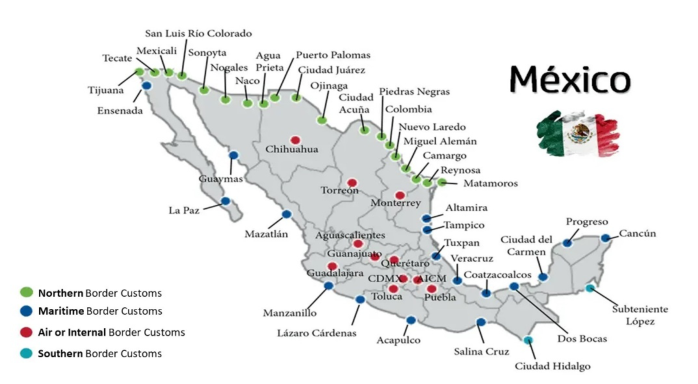
Customs in Mexico The country has 50 customs offices. The Tax Administration Service (SAT) is in charge of these customs offices and its main task is to supervise the entry and exit of goods from the country.
Types of Customs in Mexico
Land: railways in border areas with neighboring countries.
Maritime: They are located in port infrastructures and control traffic by sea. They maintain a large volume of products.
Air: they mainly supervise the transit of people and the freight of passengers and goods at airports.
Interior: they control the entry and exit of goods in strategic places within the country.
The Most Important Customs Offices and Their Locations in the North
Nuevo Laredo: one of the most important customs offices is located on the northern border.
Tijuana: It has an important role in trade with the United States, especially in the automobile sector.
Mexicali: an additional customs port on the border with California.
Nogales: oversees the flow of people on the border with Arizona.
Reynosa is a strategic place for commerce in the northeast of the nation.
SDG 9: Digital Innovation in Foreign Trade Through Industry 5.0 347
Figure 1: Customs in Mexico (adapted from Mexico’s National Customs Agency, 2024).
World’s Busiest Border San Ysidro is the busiest border area in the world, with more than 30 million annual crossings between San Diego and Tijuana. The U.S.-Mexico border has the largest number of legal crossings in the world, with pedestrian bridges since 2002, but also the largest number of illegal crossings, with nearly 12 million people in 2007.
Customs Brokers in Mexico Although the number of active customs brokers in Mexico varies, the most recent information from the SAT is approximately 900. These professionals are essential in international trade by facilitating the import and export of goods by complying with all customs regulations and laws.
Evolution of Customs Agencies in Mexico Throughout history, Mexico’s customs have changed constantly. They have been crucial for the management and control of the country’s foreign trade from colonial times to the present day. Origin; Customs already existed in Rome around 640 BC and customs taxes were used in Greece, although there is no precise data on their origin. Table 1 presents highlight of the Development of Customs in Mexico.
Customs Agency Value Chain The value chain map is a graphical tool that allows you to visualize and analyze a particular process within an organization. It is used in this process to identify inefficiencies and areas for improvement.
a) Procedure to create a value chain map: Select the process you want to analyze at the customs agency. b) Goal Setting: Set the goals you want to achieve through the process.
348 Martinez-Gutierrez
Table 1. The evolution over time of customs agencies in Mexico (Folds et al., 2008).
Table available in the original PDF paper.
Period Historical moments in Customs 1884 Mexico’s first customs office was established in Veracruz in 1884. 1927 The Customs Brokers Act of 1927 states: After World War I, this law was issued, which established the basis for the management of customs officials. 1935 The Customs Law of 1935: during this period, it was sought to simplify management and unify taxes in a single tariff. 1951 The Customs Code (1951) remained in force until 1982 and had an impact on the functioning of customs agencies. Mexico’s 50 customs offices are located throughout the country. These are classified according to the type of transport that crosses them, such as by land, sea or air, among others. The evolution of customs has been linked to changes in laws, technology, and modernization to facilitate global trade. 1994 Joining NAFTA (1994): Mexico’s incorporation into the North American Free Trade Agreement changed the way Mexican customs are managed and operated. 2018 Mexico, Canada and the U.S. agree to modernize NAFTA (T-MEC in Spanish) 2021 On July 14, 2021, the “Decree creating the National Customs Agency of Mexico” (ANAM) was published in the Official Gazette of the Federation (DOF) as a decentralized administrative body of the Ministry
c) Improved logistics: the map helps to visualize the value chain from the moment of purchase to the moment of distribution. d) Greater control: allows you to prioritize actions and make better decisions.
In conclusion, value chain maps are a useful tool for customs agencies because it allows them to improve operations and provide better service to customers.
The Benefits of the Increase in Customs Personnel Increased efficiency: Import and export processes are streamlined when more customs brokers are available, increasing efficiency in foreign trade.
Better customer service: the increase in the number of professionals in the customs sector allows importers and exporters to receive more personalized and specialized attention, improving the customer experience and satisfaction.
Compared to previous years, an increasing trend can be observed in the number of customs brokers in Mexico, which, with proper management, could generate significant benefits for international trade and the country’s economy.
The Modernization of Customs Agencies To improve the efficiency and quality of services related to international trade, it is important to modernize customs agencies. Here are some of the key elements that contribute to its updating (ANAM, 2024):
Digitization and automation: The use of electronic systems for document submission and duty payment makes processes faster and less bureaucratic.
SDG 9: Digital Innovation in Foreign Trade Through Industry 5.0 349
International collaboration and cooperation: Customs collaborate with other institutions and countries to ensure security and trade at borders.
Focus on safety and security: The main objective of customs agencies is to prevent illegal activities and ensure the safety of goods.
In short, customs agency modernization aims to maximize functions, increase efficiency, and promote economic growth. Transparency, staff training, and process standardization are factors that can significantly improve and boost the development and operation of customs. International collaboration and cooperation: Customs collaborate with other institutions and countries to ensure security and trade at borders.
Challenges and Opportunities for Customs Agencies Customs brokers face a variety of challenges, including continuous changes in legislation, the need for constant updating, and strong competition in the sector. However, the growth of e-commerce and the expansion of international markets also provides numerous opportunities, requiring more agile and efficient customs services (AIMO, 2024).
1. Customs Legislation: Current customs legislation is essential for the management and functioning of customs agents. The demand for these professionals may be affected by changes in laws, regulations, and tax provisions. 2. International Trade: Another important factor is the size of Mexico’s international trade. The amount of goods entering and leaving the country will increase the need for customs agents to properly manage procedures. 3. Computing and automation: The number of customs agents required changes due to technological advances and the automation of customs procedures. While more efficient systems can reduce the need for staff for certain tasks, the complexity of new technologies may require specialized agents. 4. Requirements for Certification: Certification and training requirements are essential for the job as a customs broker. Changes in training and experience demands can have an impact on the number of workers working in the sector, either by attracting new talent or limiting the entry of new players into the market.
A variety of factors, from legislation and foreign trade to technology and certification requirements, affect the number of customs brokers in Mexico. To understand the dynamics of this profession in the current context, it is essential to be aware of these aspects.
In Mexico, there has been a steady increase in the number of customs officials over the past three years. For example, in 2016 there were about 1,500 customs officials throughout the country, but by 2020 there were more than 2,000 workers dedicated to facilitating and expediting international trade at Mexican customs.
350 Martinez-Gutierrez
Certifications From Mexican Customs Agencies NMX-R-026 certification sets out the general requirements for a customs agency to be recognized as a reliable company capable of providing high-quality customs services. Legal consistency, medium and long-term vision, and administrative compliance in dispatch operations are benefits of obtaining this certification (CAAAREM, 2024).
ISO 9001:2015 Standard Certification: This certification focuses on the quality and procedures of the customs agency.
The C-TPAT certification focuses on international supply chain security and prevents terrorism. Accreditation of an Authorized Economic Operator (AEO) worldwide: This certification relates to the efficiency and security of customs operations. From its inception in November 2001, CTPAT continued to grow. Today, more than 11,400 certified partners spanning the gamut of the trade community, have been accepted into the program (CBP, 2024).
The Requirements of a Customs Agent in Mexico To become a customs broker in Mexico, it is necessary to meet certain requirements and obtain the proper certifications. Here is the relevant information:
a) Patent granted by the Customs Broker: b) Experience: You must have customs experience of at least five years. c) Federal Taxpayer Registry: To prove that you are up to date in complying with your tax obligations, you must be registered in the federal taxpayer registry. d) Exam: You must pass a psychotechnical exam and a knowledge exam from the customs authority.
Additional certifications (CONOCER, 2024)
1. Diploma in Foreign Trade and Customs Operations (EC0537): This diploma focuses on topics related to foreign trade and customs operations. 2. Diploma in Tariff Classification of Foreign Trade Goods (EC0432): deals with the tariff classification of products. 3. Identification, Prevention and Mitigation of Risks in Customs and Foreign Trade (EC1301): It focuses on security and risks in the customs field. 4. Diploma in Direct Customs Clearance (without the intervention of a customs broker) (EC1524): explores the customs clearance process. 5. Authorized Economic Operator (AEO): To obtain this certification, it must comply with minimum security standards and promote the clearance of goods on behalf of others.
Customs Technology Integration Project Mexico’s SAT is working on the Customs Technology Integration Project (PITA). The objective is to automate, facilitate and streamline the processes of entry and exit of goods in the country’s customs. Producing a DODA
SDG 9: Digital Innovation in Foreign Trade Through Industry 5.0 351
QR-PITA: The Customs Clearance Operation Document (DODA) with an integration number can be generated using this option. The accredited legal representative, the customs agent, the customs representative and the agent have the authority to carry it out. Benefits: Facilitates customs management and reduces time and effort. It allows you to generate integration numbers without the need to create software or hire streaming providers through web services. In short, the PITA System modernizes Mexico’s customs by incorporating new technologies and simplifying international trade processes.
Technology in the Future Smart Customs The evolution of customs has been fundamentally influenced by technology. Here are some important elements:
1. Smart Customs: Smart customs have reduced lead times and costs to maximize global trade. Through technologies such as the Internet of Things (IoT), it is possible to effectively monitor routes and goods. Smart sensors in vehicles and containers improve security by detecting fraud. 2. 2. Automation and digitalization: Automation and artificial intelligence facilitate customs processes. Digitalization improves the security of operations and the accuracy of data. 3. Cybersecurity: Secure customs systems require cybersecurity technologies. They protect the integrity of operations and protect against potential attacks. Technology has changed customs, processes and management, impacting the efficiency and international competitiveness of foreign trade.
Careers Related to Foreign Trade and Customs Within the framework of giving context to the panorama of the different business services and areas of specialization that may represent the opportunity to identify the competencies for Professional Development as an employee or even as an entrepreneur, consultant of services in Foreign Trade and Customs.
The Value Chain of Foreign Trade and Customs; it integrates Customs Agencies, Freight Transport Services, Goods Warehouse, and Integral Logistics Services, local, regional, national and international. Table 2 presents the main technical and professional careers that are required in the sector. It should be considered that the Industry 5.0 trend, the challenges of the Sustainable Development Goals (SDGs) of the 2030 Agenda, are oriented towards digitalization processes, which are revolutionizing logistics. Technologies such as artificial intelligence, machine learning, and robotics are transforming logistics operations from the local context to the global approach (TecNM, 2024).
352 Martinez-Gutierrez
Table 2. Occupational profile in Foreign trade and customs.
Table available in the original PDF paper.
Job Title Job Description / Functions Foreign Trade Technician This professional is in charge of managing import and export operations, customs procedures and international logistics. International Markets Analyst Their role is to analyze trends and opportunities in foreign markets to make strategic decisions. Lawyer for Multinationals These lawyers defend the legal interests of companies with international operations. Global Logistics Engineer Design and implementation of efficient supply chain networks. Create logistics systems that span multiple countries, considering transportation routes, modes, and costs to optimize global distribution. International Shipment Management and Customs Compliance: Oversees international transportation, customs formalities, and regulatory compliance in international trade. Collaboration with suppliers, manufacturers and distributors worldwide. Use of technology. Sustainability and environmental considerations. The Global Logistics Engineer solves complex logistics challenges across different time zones and cultures, contributing to the efficient flow of goods around the world. Bachelor of International Trade Administration
Detects market movements and adjusts production according to international regulations. Financial Advisor It provides financial advice to individuals or companies to make businesses profitable and comply with tax obligations. Director of Sales and Expansion Administration
Lead the commercial strategy of companies or multinationals motivating the team. Sales Delegate It is responsible for promoting products or services in international markets. Strategy and Internationalization Consultant
It helps companies in their operations and activities to expand regionally and globally, overcome obstacles in business and competition.
CONCLUSION
Today’s trade requires more effective customs procedures in the clearance of goods, Mexico is a country that continues to move towards modernization, Mexican customs have made positive progress in this area, but there is still a long way to go to make customs operations more efficient, transparent, expeditious, optimized and truly facilitate foreign trade. It is not an easy task, but it is not a task that only corresponds to the authority, it is the obligation of all foreign trade actors to privilege the use of technology, implement initiatives that strengthen security in supply chains and commit to the transparency and security of customs procedures. The authorities, for their part, must continue to modernize their processes and establish a series of policies and procedures that make it possible to make the customs clearance of goods more efficient, guaranteeing greater security, real trade facilitation and the adequate collection of income for the strengthening of the national economy.
SDG 9: Digital Innovation in Foreign Trade Through Industry 5.0 353
ACKNOWLEDGMENT
To the Board of Directors of Grupo Atlas, a leading company in Foreign Trade Value Chain Services (Customs Agency, Transportation, Warehouse and Logistics) in the Cali-Baja region of the City of San Diego, California, USA, and Tijuana and Ensenada in Baja California, Mexico.
REFERENCES
Association of Customs Brokers of Tijuana and Tecate, AC (AIMO) (July 1, 2024), Customs Activity Services. Website: https://agentesaduanales.org.mx/servicios.as px. Confederation of Associations of Customs Agents of the Mexican Republic
(CAAAREM) (June 29, 2024), Customs regulations in Mexico. Website: https: //www.caaarem.mx/activ-aduanera.html#gsc.tab=0. CTPAT: Customs Trade Partnership Against Terrorism (July 4, 2024) Website: https: //www.cbp.gov/border-security/ports-entry/cargo-security/CTPAT. Garcia, J., Gutierrez, R., Solis, R., Castañeda, G. (2023). QHS Methodology
for Business Intelligence with CRM in Warehouse Services and Foreign Trade Logistics. In: Tareq Ahram and Redha Taiar (eds) Human Interaction & Emerging Technologies (IHIET 2023): Artificial Intelligence & Future Applications. AHFE (2023) International Conference. AHFE Open Access, vol. 111. AHFE International, USA. http://doi.org/10.54941/ahfe1004095 Martinez-Gutierrez R (2024) QHS Methodology Applied to Professional Growth with Impact on Society. Innovation - Research and Development for Human, Economic and Institutional Growth. IntechOpen. Available at: http://dx.doi.org /10.5772/intechopen.112559. Mexico’s National Customs Agency (ANAM) (July 4, 2024, Application criteria in
the operation. Website: https://anam.gob.mx/criterios-de-aplicacion-en-la-operac ion-aduanera/. National Council for Standardization and Certification of Labor Competencies (CONOCER), Competency Standards for Customs Brokers (June 30, 2024) Website: https://www.conocer.gob.mx/contenido/publicaciones_dof/2022/EC 1487.pdf. Tijuana Institute of Technology (TecNM), Logistics Engineer (June 29, 2024)
Human Systems Engineering and Design (IHSED2024): Future Trends and Applications
Read this individual research paper free through the original publisher, or explore the full digital proceedings book.
ISBN 978-1-964867-34-2
Explore this ISBN in the AHFE Bookstore ↗Listed in the July 2026 bookstore catalogue; search by ISBN to confirm current availability · Digital book purchase optional