Jessica Mack, Oliver Scholtz (2025). Methodology for analyzing the resilience capabilities of manufacturing companies. In: Human Error, Reliability, Resilience, and Performance. AHFE Open Access, vol. 173, pp. 20–26. https://doi.org/10.54941/ahfe1006277
In an increasingly interconnected and globalized business world, companies today face the reality that “black swan” events and unpredictable disruptions are occurring more and more frequently. These shocks, which in the past were considered rare exceptions, have now become the rule. In this era of unexpected disruptions, companies are forced to strengthen their robustness and adaptability. The objective of this paper is to identify the resilience capability based on a value stream mapping. To this end, the assessment of external turbulence and the company's own resilience is the basis for developing agile solutions for new types of problems in resilience situations.
In recent years, companies have increasingly had to deal with the accumulation of “black swan” events and disruptive shocks. Examples such as the COVID-19 pandemic, supply chain disruptions due to political uncertainties or sudden fluctuations in demand illustrate the vulnerability of global value networks (Duchek, 2020). This turbulence requires companies to be more resilient and adaptable in order to maintain their operational efficiency and competitiveness (Duchek, 2020).
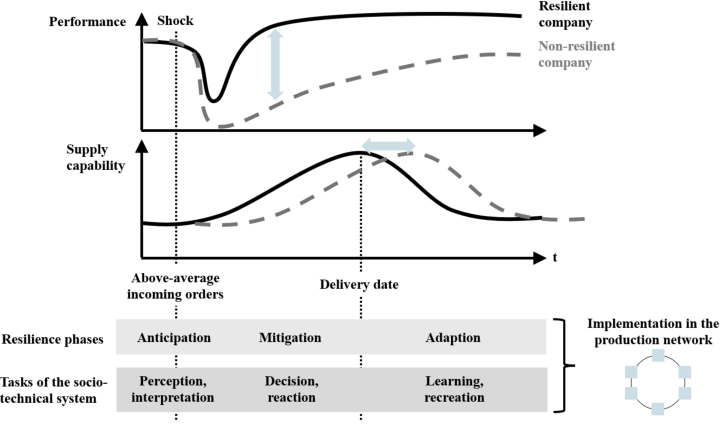
The relevance of resilience in production networks lies in particular in the ability to react proactively to unforeseeable disruptions. Resilience comprises three phases: Anticipation, Mitigation and Adaptation (Duchek, 2020), see Figure 1. However, bottleneck factors, see Theoretical Backround, hinder the ability to be resilient (Wewezow and Günther, 2022). These factors mean that companies have difficulty recognizing warning signals at an early stage, developing quick solutions to new types of problems or deploying resources flexibly.
The objective of this article is to analyze resilience capabilities in value networks based on a value stream mapping. The focus is on the integration of social and technical subsystems to enable coordinated measures in the various resilience phases. The ResiNet project addresses these challenges by developing a data-based platform, agile organizational models and harmonized procedures in the production network. The analysis shows that
Methodology for Analyzing the Resilience Capabilities of Manufacturing Companies 21
a holistic view of resilience is required at both company and network level in order to sustainably strengthen resilience in turbulent environments.
Figure 1: Changing demands on the socio-technical system over the course of the resilience phases, adapted from (Duchek, 2020; Reeves and Candelon, 2021).
THEORETICAL BACKGROUND This section establishes the theoretical foundation by defining key concepts: resilience, resilience drivers, resilience capabilities, and resilience requirements. It further identifies critical bottlenecks hindering resilience.
Resilience is the ability of a system to adjust its functioning prior to, during, or following changes and disturbances, so that it can sustain required operations under expected and unexpected conditions (Grecco et al., 2012). It encompasses the capacity to recover, absorb shocks, and restore equilibrium after a perturbation (Bozza et al., 2017).
Resilience Drivers are events or factors that encourage companies to respond to crisis situations and strengthen their resilience. These drivers can be both external and internal (operational, strategic and market-related) in nature and influence a company’s ability to adapt to changing conditions and overcome disruptions.
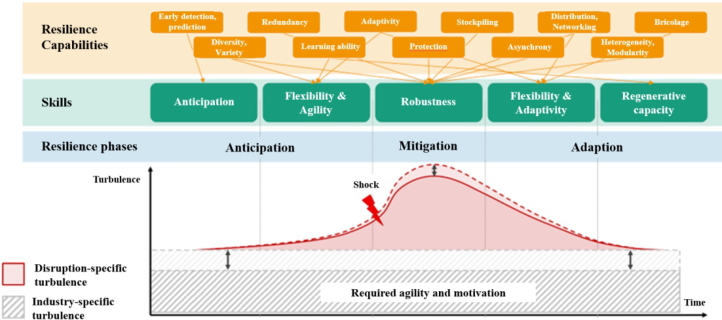
Resilience Capabilities: These are specific attributes or resources that enable an organization to respond effectively to disruptions. Key capabilities include redundancy, stockpillig, asynchrony, protection and diversity/variety see Figure 2 (Dittfeld et al., 2022).
Resilience Requirements: These are the needs or conditions that must be met to ensure a system’s resilience. They include maintaining adequate inventory levels, ensuring resource availability, and minimizing lead times
22 Mack and Scholtz
(Chang and Lin, 2019). Resilience requirements are critical for preparing and responding to disruptions effectively.
Figure 2: Resilience capabilities and skills (adapted from Fraunhofer Austria).
Critical Bottlenecks for Resilience Inventory Levels: Adequate inventory levels are crucial for buffering against supply chain disruptions. Insufficient inventory can lead to production halts and unmet customer demand (Chang and Lin, 2019).
Lead Times: Shorter lead times enhance a system’s ability to respond quickly to changes and disruptions. Long lead times can exacerbate the impact of disruptions and delay recovery (Chang and Lin, 2019; Novotny and Marousek, 2014).
Resource Availability: The availability of critical resources, such as raw materials and labor, is essential for maintaining production continuity during disruptions. Resource shortages can significantly hinder resilience efforts (Mauermann et al., 2024).
Forecasts: A long-term and, above all, accurate forecast for expected orders and delivery call-offs within a supply chain is very important for smooth production. If this forecast is not available, bull-whip effects occur, especially in the front end of the supply chain.
METHODOLOGY
There is not just one capability for developing resilience in value creation networks so that challenging situations can be overcome. Action needs to be taken at different levels to ensure consistent implementation in the company and the network. In addition, resilience measures must be geared towards the different phases of shocks and turbulence, see Figure 2. The resilience phases of anticipation, mitigation and adaptation, see Figures 1–2, each have specific requirements for which companies and value creation networks must identify, develop and activate suitable capabilities (see Duchek, 2019). The
Methodology for Analyzing the Resilience Capabilities of Manufacturing Companies 23
defined resilience capabilities and associated implementation of measures should address the following points of the resilience of production networks:
The accurate and rapid assessment of external turbulence as well as the company’s own resilience capability on the basis of reliable information
The ability to quickly develop suitable solutions for new types of problems in resilience situations
The ability to deploy materials, machines and/or employees flexibly in the event of changes in material availability or market demand, for example
The unity of the production network when implementing resilience measures, based on a shared view of priorities, requirements and processes in resilience situations.
The individual steps of the method developed and used in the ResiNet research project are described in detail below.
Identification of Resilience Drivers in the Company The concept of resilience drivers was introduced in the Theoretical Background chapter. A total of 16 drivers were identified. Based on this theoretical foundation, the drivers are defined individually with the companies in interviews. This is necessary in order to sharpen the focus of the subsequent value stream analysis and to substantiate the identification of the most profitable resilience capabilities.
Company-Internal and Supply Chain-Wide Value Stream Mapping In the second step, a classic value stream mapping is carried out in the company. The central element is the value stream map. This is an illustration of the value stream with defined symbols for the suppliers, processes, process connections, etc. (DIN - Deutsches Institut für Normung e.V., 2022). Cycle and setup times play a subordinate role in this case. Instead, the focus is on identifying resilience-specific risks. These can be divided into five categories (Christopher and Peck, 2004):
Process Risks relate to the direct interruption of individual processes in a value stream.
Control Risks result from the application or misapplication of the assumptions, rules, systems and procedures for controlling the processes of a value stream.
Supply risks are risks relating to the supply of materials and information between the value stream in question and upstream suppliers.
Demand risks are risks associated with product sales to customers.
Enivironmental risks relate to the larger environment of the value stream and can have socio-political, economic or technological backgrounds (Steinmeyer and Metternich, 2023).
During the value stream mapping in the company, the existence of resilience capabilities is checked directly (via interview) and indirectly (via visual inspection).
24 Mack and Scholtz
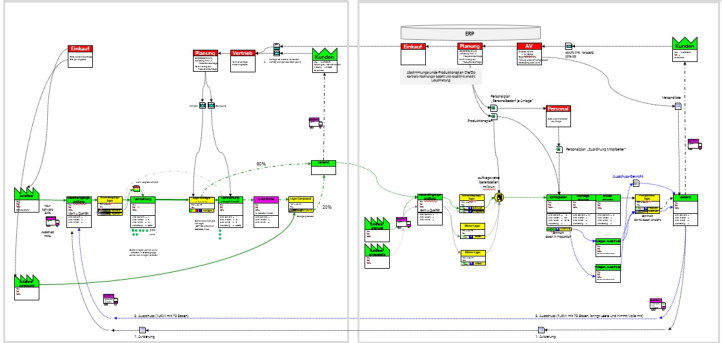
Identification of the Current Status and Weak Points The status assessment reveals weaknesses and the lack of resilience capabilities. These are illustrated graphically in a value stream map of the production network (sequence of several individual value stream maps of companies, see example in Figure 3).
Figure 3: Value stream maps of a production network (own illustration).
Definition of the Target State and Simulation Based on the resilience drivers defined in step 1 and the weaknesses identified in the value stream, a target state is now defined together with all stakeholders involved. Use cases and scenarios are developed to illustrate the target state and its impact on a company’s resilience. A cost-benefit analysis is then used to select the most promising resilience capabilities. This is followed by a simulation of the actual and target state within a simulation game developed in the ResiNet project. This involves simulating relevant shocks for the company and evaluating their impact on output quantity, delivery capability, material availability, overall equipment efficiency, employee productivity, production costs and quality rate. This participative approach facilitates the introduction in step 5.
Introduction and Continuous Improvement Once the most profitable resilience capabilities have been defined, developed and selected, they are handed over to the relevant stakeholders in the company network. This is followed by detailed project management plans for the successful introduction of the measures. Progress, effectiveness and adaptation requests are tracked regularly.
CONCLUSION
In an era marked by frequent and unpredictable shocks, the ability of companies to maintain operational efficiency and competitiveness hinges
Methodology for Analyzing the Resilience Capabilities of Manufacturing Companies 25
on their resilience capabilities. This paper has highlighted the critical importance of integrating resilience capabilities within production networks. The findings underscore that resilience is not a static attribute but a dynamic process, requiring proactive efforts across the phases of anticipation, mitigation, and adaptation.
The introduction of resilience capabilities within production networks yields significant benefits, particularly in addressing bottleneck factors such as inventory levels etc.. By adopting a holistic approach companies can enhance their ability to withstand and recover from disruptions. The ResiNet project exemplifies this approach, demonstrating how and harmonized procedures can collectively strengthen resilience at both the company and network levels.
In conclusion, the implementation of resilience capabilities in production networks is not just a strategic advantage but a necessity in today’s volatile business landscape. Companies that prioritize and invest in these capabilities will be better positioned to navigate disruptions, maintain continuity, and achieve long-term success. Future research should continue to explore methodologies to further enhance resilience, ensuring that production networks remain robust and adaptable in the face of evolving challenges.
ACKNOWLEDGMENT
This content is being developed as part of the “ResiNet - Resilience in agile production networks” research project funded by the German Federal Ministry of Education and Research. We would like to express our gratitude to all project partners and contributors for their valuable insights and support throughout this research.
REFERENCES
Bozza, Anna/Asprone, Domenico/Fabbrocino, Francesco (2017). Urban resilience: A civil engineering perspective. Sustainability (Switzerland) 9 (1). https://doi.org/ 10.3390/su9010103 Chang, Wei-Shiun/Lin, Yu-Ting (2019). The effect of lead-time on supply chain
resilience performance. Asia Pacific Management Review 24 (4), 298–309. https:// doi.org/10.1016/j.apmrv.2018.10.004 Christopher, Martin/Peck, Helen (2004). Building the Resilient Supply Chain. The International Journal of Logistics Management 15 (2), 1–14. https://doi.org/ 10.1108/09574090410700275 DIN ISO 22468: Wertstrommethode (VSM), 2022. Berlin. Dittfeld, Hendryk/van Donk, Dirk Pieter/van Huet, Sam (2022). The effect of
production system characteristics on resilience capabilities: a multiple case study. International Journal of Operations & Production Management 42 (13), 103–127. https://doi.org/10.1108/IJOPM-12-2021-0789 Duchek, Stephanie (2020). Organizational resilience: A capability-based conceptualization. Business Research 13 (1), 215–246. https://doi.org/10.1007/ s40685-019-0085-7 Grecco, Claudio H. S./Vidal, Mario C. R./Carvalho, Paulo V. R. (2012). Using fuzzy set theory to model resilience in safe-critical organizations. Advances in Physical Ergonomics and Safety. https://doi.org/10.1201/b12323
26 Mack and Scholtz
Mauermann, Marc/Weber, Paul/Eisenrauch, Vincent/Mehnert, Kathleen/Vierbauch, Susann (2024). Unexpected Events in Food Production are the New Normal? Results of an Industry Survey on Factors, Influencing Resilience in Food Production and Food Value Chains. International Journal of Food Studies 13 (2), 157–168. https://doi.org/10.7455/ijfs/13.2.2024.a2 Novotny, Petr/Marousek, Roman (2014). Lead time reduction as one of the key factor increasing the supply chain resilience. METAL 2014–23rd International Conference on Metallurgy and Materials, Conference Proceedings. Available online at https://www.scopus.com/inward/record.uri?eid=2-s2.0– 84924943074&partnerID=40&md5=a4c7a675adb1a7295a3f286722161074 Reeves, Martin/Candelon, François (2021). The Resilient Enterprise. De Gruyter. Steinmeyer, Maximilian/Metternich, Joachim (2023). Resilienz aus der Wertstromperspektive. Zeitschrift für wirtschaftlichen Fabrikbetrieb 118 (9), 605–609. https://doi.org/10.1515/zwf-2023-1123 Wewezow, Christian/Günther, Christina (2022). Deutschlands Mittelstand. So
meistern kleine und mittlere Unternehmen erfolgreich Krisen.
LISTED IN THE AHFE DIGITAL BOOKSTORE CATALOGUE
Explore the complete digital volume
Human Error, Reliability, Resilience, and Performance
Read this individual research paper free through the original publisher, or explore the full digital proceedings book.
ISBN 978-1-964867-49-6
Explore this ISBN in the AHFE Bookstore ↗Listed in the July 2026 bookstore catalogue; search by ISBN to confirm current availability · Digital book purchase optional