Jooyoung Park, Torrey Mortenson, Rachael Hill, Casey Kovesdi, Ronald Boring (2025). Important Human Actions for Advanced Reactors: Implications for Risk Analysis. In: Human Error, Reliability, Resilience, and Performance. AHFE Open Access, vol. 173, pp. 118–128. https://doi.org/10.54941/ahfe1006286
Advances in technology have led to development of new reactor designs and significant changes in human-system interfaces used by operators to monitor and control commercial nuclear power plants (NPPs). These advances have led the way to novel concepts of operations (ConOps) that are very different from those used in operations for traditional NPPs, i.e., large light water reactors. Accordingly, in collaboration with Idaho National Laboratory (INL), the U.S. Nuclear Regulatory Commission (NRC) started multiple projects to support the NRC’s guidance for human factors engineering (HFE) reviews of advanced reactor applications. As a part of these efforts, INL staff members are currently working on a project to risk-inform the scope of HFE reviews when there are changes to important human actions (IHAs). Specifically, the purpose of the project is to capture specific regulatory aspects of these novel ConOps proposals and risk-inform HFE reviews related to IHAs.
The U.S. Nuclear Regulatory Commission (NRC) uses NUREG-0711, “Human Factors Engineering Program Review Model” (O’Hara, Higgins, Fleger, & Pieringer, 2012), to review the human factors engineering (HFE) programs of applicants for construction permits, operating licenses, standard design certifications, combined operating licenses, and license amendments. The review model aims to verify whether the applicant’s HFE program embraces HFE practices and guidelines accepted by NRC staff. NUREG-0711 proposes to review twelve elements of an HFE program: (1) HFE Program Management, (2) Operating Experience Review, (3) Functional Requirements Analysis and Function Allocation, (4) Task Analysis, (5) Staffing and Qualifications, (6) Treatment of Important Human Actions [IHA], (7) Human-System Interface [HSI] Design, (8) Procedure Development, (9) Training Program Development, (10) Human Factors Verification and Validation, (11) Design Implementation, and (12) Human Performance Monitoring. These are characterized along four general phases: Planning and Analysis (Elements 1–6), Design (Elements 7–9), Verification and Validation (Element 10), and Implementation and Operation (Elements 11–12).
Important Human Actions for Advanced Reactors: Implications for Risk Analysis 119
Among the twelve NUREG-0711 elements, the sixth one identifies IHAs and considers them in designing the HFE aspects of the plant to minimize the likelihood of plant personnel error, and to help ensure that plant personnel can detect and recover from any errors that occur. Another NRC document regarding IHAs is NUREG-1764, “Guidance for the Review of Changes to Human Actions” (Higgins et al., 2004), which provides guidance on reviewing modifications of human actions. Changes in credited human actions may result from a variety of plant activities such as plant modifications, procedure changes, equipment failures, justifications for continued operations, and identified discrepancies in equipment performance or safety analyses.
Advances in technology have led to the development of new reactor designs and significant changes in the HSIs used by operators to monitor and control commercial nuclear power plants (NPPs). These advances have led the way to novel concepts of operations (ConOps) that are very different from those used in operations for traditional NPPs, i.e., large light water reactors. Representatively, many advanced reactors or small modular reactors are considering adopting a main control room (MCR) type that operates multiple reactor modules, while MCRs in conventional NPPs operate one reactor unit only. An emerging ConOps is a smaller staffing level, e.g., a single operator crew controlling multiple modules in parallel. A reduced crew operating multiple modules will likely require higher levels of automation and a greater number of passive systems.
Current regulatory guidance is still anchored in existing ConOps for traditional NPPs. New and updated guidance for the new reactor technologies and designs is being developed by the NRC for use in reviewing HFE programs for emerging advanced reactor ConOps. Accordingly, in collaboration with Idaho National Laboratory (INL), the NRC has started multiple projects to support the NRC’s guidance for HFE reviews of advanced reactor applications. As a part of these efforts, INL staff members are currently working on a project to risk-inform the scope of HFE reviews when there are changes to IHAs. Specifically, the purpose of the project is to identify relevant risk assessment methodologies and develop the technical basis to support determining an appropriate scope of HFE review for advanced reactor designs.
This paper briefly summarizes INL’s efforts to characterize the treatment of IHAs in advanced reactors. To date, the technical basis review in terms of risk analysis has been carried out via literature survey. In this paper we briefly introduce: (1) the existing processes for identifying IHAs and their challenges and (2) characteristics of advanced reactors and issues on HFE and risk assessment.
THE EXISTING PROCESSES FOR IDENTIFYING IMPORTANT HUMAN ACTIONS AND THEIR CHALLENGES Treatment of IHAs (NUREG-0711)
Treatment of IHAs is introduced in Chapter 7 of NUREG-0711 (O’Hara, Higgins, Fleger, & Pieringer, 2012). According to this chapter, license
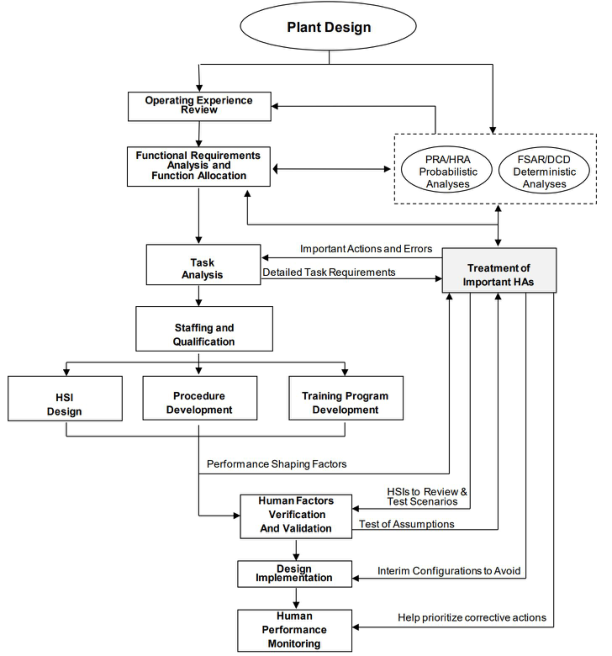
applicants identify human actions most important to safety via a combination of probabilistic risk assessment (PRA), human reliability analysis (HRA) and deterministic analysis, and then address them when conducting the HFE program. The PRA and HRA techniques are used for identifying risk- important human actions. These analyses begin early in the design process to provide insights and guidance for both systems design and for HFE purposes. Specifically, HRA evaluates mechanisms of human error that might affect plant safety and quantifies the human error possibility. It is an essential feature in assuring the HFE program goal of generating a design to minimize human errors, support their detection, and ensure recovery capability. The deterministic analysis is related to instrumentation and controls (I&C) design and transient and accident analyses. IHAs that are (1) necessary for accomplishing required safety functions using backup systems added in preparation for common cause failures of digital I&C or (2) required for mitigating from transients or accidents can be credited via the deterministic analysis. The outputs of the IHA process in Chapter 7 of NUREG-0711 are the final list of IHAs and a description of methods employed to identify and determine IHAs. For the list of IHAs, it is transferred to the other pertinent HFE elements. The IHAs are specifically addressed in many HFE elements as shown in Figure 1.
Figure 1: The role of IHAs in the HFE program proposed in NUREG-0711 (O’Hara, Higgins, Fleger, & Pieringer, 2012).
Important Human Actions for Advanced Reactors: Implications for Risk Analysis 121
Guidance for the Review of Changes to Human Actions (NUREG-1764) NUREG-1764 (Higgins et al., 2004) mainly describes how to review changes to plants that affect human actions, to determine whether the proposed human actions can be reliably performed when needed. Changes in credited human actions may result from a variety of plant activities such as plant modifications, procedure changes, equipment failures, justifications for continued operations, and identified discrepancies in equipment performance or safety analyses. NUREG-1764 provides guidance for reviewing those changes.
The guidance proposed in NUREG-1764 consists of two phases. The first phase is a risk-informed screening process to determine the level of HFE review. In this phase, risk calculations (i.e., core damage frequency and large early release frequency) and risk-importance measures (i.e., risk achievement worth and Fussell-Vesely value) are employed to determine the risk-significance of human actions. This phase also considers factors that the PRA model cannot quantitatively account for, such as personnel functions and tasks, design support for task performance, and performance shaping factors (PSFs). The second phase is an HFE review of human actions that are found to be risk-important in the first phase. In this phase, the NRC staff reviews the proposed changes to human actions to ensure the appropriate conditions are in place so that the change in human action does not significantly increase the potential for risk.
Challenges of Existing Processes for Identifying IHAs Both NUREG-0711 and NUREG-1764 provide key insights into IHAs and have been used effectively to support regulatory review of plant licensing and licensing amendments. However, there are several areas where revised guidance can ensure the consistency and completeness of IHA characterization.
NUREG-1764 has four risk assessment methods used for scaling the human factors reviews of changes to operator manual actions. These methods have been criticized as overly conservative, which is not consistent with the PRA policy that best estimates should be used. During a pilot of the Risk-Informed Process for Evaluations (RIPE) process (Zoulis, 2022) (an accelerated license amendment review process used for amendments that are known to have very low risk), the output of NUREG-1764 was far more conservative than other risk assessments used.
NUREG-1764 employs most PRA techniques such as core damage frequency or risk achievement worth but rarely investigates HRA outputs (e.g., human error probabilities [HEPs] or PSFs) in the review process. It may miss human actions that are critical to safety but have low frequency or importance values. Pre-initiators such as returning valves after testing and maintenance or calibration tasks are good examples.
There is little guidance for the review of operator actions for advanced reactors that is equivalent to NUREG-1764. The strategy for assessing operator actions laid out in NUREG-1764 may not work in a technology
neutral review. Such guidance will be needed to assess the adequacy of HFE principles applied to human actions performed outside of the control room. The NRC’s proposed Part 53 rule for more flexible licensing for advanced reactors has an increased focus on assessing important operator actions wherever they occur (as opposed to existing 10 Code of Federal Regulations Part 50, which focuses on actions in the MCR). Actions outside a typical control room may have increased importance for advanced reactors due to new concepts of operations, limited range of activities conducted in a control room, and potential for remote monitoring and/or operation.
CHARACTERISTICS OF ADVANCED REACTORS AND ISSUES ON HUMAN FACTORS ENGINEERING AND RISK ASSESSMENT O’Hara et al. (2021) (O’Hara et al., 2021) characterized ConOps for advanced reactors by reviewing eight advanced reactor designs under development at the time. The eight advanced reactors investigated in (O’Hara et al., 2021) are:
General Atomics Helium-Cooled Fast Reactor
X-Energy LLC XE-100 Modular High Temperature Gas-Cooled Reactor
Kairos Power Fluoride Salt-Cooled, High Temperature Reactor (KP-FHR)
Terrestrial Energy Integral Molten Salt Reactor (IMSR)
TerraPower, LLC Molten Chloride Fast Reactor (MCFR)
Westinghouse Electric Company eVinci Micro Reactor
Los Alamos National Laboratory MegaPower Reactor
OKLO Power Aurora Reactor.
Table 1 lists characteristics of ConOps for advanced reactors as defined in (O’Hara et al., 2021). As shown in the table, there are fourteen characteristics that would be different from existing large light water reactors.
Table 1: Characteristics of ConOps for advanced reactors (O’Hara et al., 2021).
Table available in the original PDF paper.
Characteristics Details Modular Construction Reactors are constructed in a factory and transported to the needed site via general transportation such as truck, rail, etc. Simpler and Smaller
Reactors rely on simpler and smaller designs. Also, they
Design
include fewer systems and moving parts. Simple Maintenance When maintenance is needed, modules can be replaced. Lifetime Operation Reactors are designed to operate for many years without shutting down, being refueled, or maintained. Inherent Safety
Reactors rely on design features that make them
Characteristics
inherently safe, such as natural physical processes that do not require automatic or human intervention. More Passive Safety
Reactors may have more passive safety systems than
Systems
traditional NPPs.
Continued
Important Human Actions for Advanced Reactors: Implications for Risk Analysis 123
Table 1: Continued Characteristics Details
Table available in the original PDF paper.
Limit Public Exposure Reactors produce public exposure to postulated accidents that is much lower than traditional large light water reactors. New Missions Reactors may operate at higher temperatures than large
light water reactors and thus can support new missions, e.g., the production of multiple products in addition to electricity, such as industrial process heat. New Operating Modes Reactors can be operated in load-following mode. Small Modular Reactor
Reactors can be operated in a small modular reactor
Configuration
configuration and therefore scalable to meet energy demands. For example, reactor modules can be added or moved for maintenance. High Levels of
Reactors are highly automated, including some that
Automation
may operate in a fully autonomous mode, and may not require human monitoring, control, and intervention. No Centralized Main
Reactors may not have a control room. Reactor
Control Room
monitoring and control may be accomplished from simple panels either locally or remotely. Less Number of Staff Reactors may be staffed by few or no onsite personnel. Organizational Structure Staffing organizational structures may be different than those described in current regulations.
Based on the characteristics of ConOps for advanced reactors, O’Hara et al. also investigated potential HFE technical issues of ConOps for advanced reactors, as shown in Table 2. The table includes four HFE issues and corresponding considerations. The issue details are described in (O’Hara et al., 2021).
Table 2: HFE issues and considerations regarding ConOps for advanced reactors (O’Hara et al., 2021).
Table available in the original PDF paper.
HFE Issues Considerations Identification of IHAs
Use of non-traditional risk analysis methods
Lack of supporting analyses used to identify human tasks
Human role in safety function management Autonomous Operations
Allocation of function decisions
Identification of human actions needed to support autonomy
Management of degraded conditions and automation failures
Staffing decisions related to autonomous operations
HSI designs to support automation-related human actions Continued
Table 2: Continued HFE Issues Considerations
Table available in the original PDF paper.
Approaches to Staffing
Alternative staffing approaches
Training and qualification
Beyond control room staffing HSIs for Monitoring and
No HSIs
Simplified HSIs providing limited displays and controls
Controlling the Reactor and Interfacing Systems (This Issue Includes Remote Operations)
Portable or wearable HSIs that are not tied to a specific location
HSIs located at a location remote from the facility
Table 3 summarizes HRA and PRA issues of ConOps for advanced reactors. These issues were derived based on characteristics and HFE issues of ConOps for advanced reactors described in Table 1 and Table 2.
Table 3: Risk assessment issues on ConOps for advanced reactors.
Table available in the original PDF paper.
Method Risk Assessment Issues Details
Reactors may have new systems,
PRA Modeling new systems, structures, and components structures, and components that are different with those used in traditional NPPs. More passive systems are employed in advanced reactors. Digital I&C systems would also be different. Lack of operating
Operating experience data includes
experience data
component type, failure mode, running hours, failure count, etc. Because there is little operating experience for advanced reactors, the data may not be enough to support quantification. Common-cause failure Systems, structures and components in each module may be identical. Multi-unit dependencies Multiple units may be located at a site.
Multi-unit dependencies need to be considered. Risk matrix Existing risk values such as core damage frequency or large early release frequency may not be applicable nor used as the major results for regulation or licensing. HRA New type of human actions There are new types of human actions as
advanced reactors adapt novel operational strategies such as operation with high levels of automation (e.g., autonomous operations), remote operation, load following operation and multi-module operation.
Continued
Important Human Actions for Advanced Reactors: Implications for Risk Analysis 125
Table 3: Continued Method Risk Assessment Issues Details
Table available in the original PDF paper.
Task actor In advanced reactor operations, staffing and organizational structures may be quite different than what is described in current regulations for traditional NPPs. Also, it may include different staff positions including that there could be a reduced number of operators in MCRs. Task location The proposed Part 53 rule, “Risk
Human reliability data that has been
Informed, Technology-Inclusive Regulatory Framework for Advanced Reactors” (U.S. NRC, 2023), has an increased focus on assessing important operator actions wherever they occur (as opposed to Part 50, which focuses on actions in the MCR). Actions outside a typical control room may have increased importance for advanced reactors due to new concepts of operations, limited range of activities conducted in a control room, and potential for remote monitoring and/or operation. Human reliability data (i.e., nominal HEPs or PSF data) collected from traditional NPPs may not be applicable to HRA for advanced reactors. New data collection efforts may be needed. New set of PSFs New set of PSFs affecting human
performance in advanced reactor operations may need to be derived out. PSF levels and multipliers Tasks required in advanced reactors would be much easier or much harder than those in traditional NPPs. For example, the high level of automation (e.g., autonomous control) normally eases operator tasks. However, if the automation fails during operation, operators need to understand what the automation has done, then correct problems manually. It may reduce operators’ situation awareness as well as add complexity to the mitigation process. Thus, new PSF levels and multipliers may need to be investigated.
FUTURE WORK
The goal of this effort is to risk-inform the level of HFE review related to IHAs. In this paper, we introduced: (1) the existing processes for identifying IHAs and their challenges, and (2) characteristics of advanced reactors and issues on HFE and risk assessment. Table 4 shows some of the key literature being reviewed as part of the technical basis. The list includes regulatory and industry documents that should be considered in updating the HFE guidance of IHAs for advanced reactors.
Table 4: A part of literature for technical basis review.
Table available in the original PDF paper.
Document Tittle Publisher Reference Part 53 (SECY- U.S. NRC (U.S. NRC, 23-0021) Risk Informed, 2023)
Technology-Inclusive Regulatory Framework for Advanced Reactors
U.S. NRC (O’Hara,
NUREG-0711 Human Factors Engineering Program Review Model
U.S. NRC (Higgins et al.,
Higgins, Fleger, & Pieringer, 2012) NUREG-1764 Guidance for the Review of 2004)
Changes to Human Actions
U.S. NRC (O’Hara,
NUREG/CR-
7126 Human-Performance Issues
Higgins, & Pena, 2012)
Related to the Design and Operation of Small Modular Reactors
U.S. NRC (O’Hara et al.,
Development of HFE
NRC Technical
2021)
Review Guidance for Advanced Reactors
Letter Report No. F0028-04
U.S. NRC (U.S. NRC,
DRO-ISG-2023-
2023)
03 Development of Scalable
Human Factors Engineering Review Plans
U.S. NRC (U.S. NRC,
Regulatory
An Approach for Using Guide 1.174
2018)
Probabilistic Risk Assessment in Risk-Informed Decisions on Plant-Specific Changes to the Licensing Basis
Regulatory
Acceptability of
U.S. NRC (U.S. NRC,
Guide 1.247
2022)
Probabilistic Risk Assessment Results for Non-Light Water Reactor Risk-Informed Activities
Continued
Important Human Actions for Advanced Reactors: Implications for Risk Analysis 127
Table 4: Continued Document Tittle Publisher Reference
Table available in the original PDF paper.
NEI 18–04 Risk-Informed
Nuclear Energy
(NEI, 2019) Institute
Performance-Based Technology Inclusive Guidance for Non-Light Water Reactor Licensing Basis Development
DISCLAIMER This work of authorship was prepared as an account of work sponsored in part by an agency of the United States Government. Neither the United States Government, nor any agency thereof, nor any of their employees makes any warranty, express or implied, or assumes any legal liability or responsibility for the accuracy, completeness, or usefulness of any information, apparatus, product, or process disclosed, or represents that its use would not infringe privately-owned rights. The views expressed in this paper are not necessarily those of the U.S. Nuclear Regulatory Commission. The United States Government retains and the publisher, by accepting the article for publication, acknowledges that the United States Government retains a nonexclusive, paid-up, irrevocable, worldwide license to publish or reproduce the published form of this manuscript, or allow others to do so, for United States Government purposes. INL is a multi- program laboratory operated by Battelle Energy Alliance LLC, for the United States Department of Energy under Contract DE-AC07-05ID14517.
(2004). Guidance for the Review of Changes to Human Actions, NUREG-1764, Final Report. U.S. Nuclear Regulatory Commission. NEI. (2019). Risk-Informed Performance-Based Technology Inclusive Guidance for Non-Light Water Reactor Licensing Basis Development, NEI 18–04. Nuclear Energy Institute (NEI). O’Hara, J., Fleger, S., Desaulniers, D., Green, B., Seymour, J., & D’Agostino, A.
(2021). Development of HFE Review Guidance for Advanced Reactors. U.S. Nuclear Regulatory Commission. O’Hara, J., Higgins, J., & Pena, M. (2012). Human-Performance Issues Related to the Design and Operation of Small Modular Reactors, NUREG/CR-7126. U.S. Nuclear Regulatory Commission. O’Hara, J., Higgins, J., Fleger, S., & Pieringer, P. (2012). Human Factors Engineering
Program Review Model, NUREG-0711, Revision 3. U.S. Nuclear Regulatory Commission. U.S. NRC. (2018). An Approach for Using Probabilistic Risk Assessment in Risk- Informed Decisions on Plant-Specific Changes to the Licensing Basis, Regulatory Guide 1.174, Revision 3. U.S. Nuclear Regulatory Commission. U.S. NRC. (2022). Acceptability of Probabilistic Risk Assessment Results for Non-
Light Water Reactor Risk-Informed Activities, Regulatory Guide 1.247. U.S. Nuclear Regulatory Commission.
U.S. NRC. (2023). Development of Scalable Human Factors Engineering Review Plans, DRO-ISG-2023-03. U.S. Nuclear Regulatory Commission. U.S. NRC. (2023). SECY-23-0021: Proposed Rule: Risk-Informed, Technology-
Inclusive Regulatory Framework for Advanced Reactors, RIN 3150-AK31. Retrieved from https://www.nrc.gov/docs/ML2116/ML21162A093.html. U.S. Nuclear Regulatory Commission. Zoulis, A. (2022). Expansion and Use of Risk-Informed Process for Evaluations.
Probabilstic Safety Assessment and Management (PSAM) 16. Honolulu, Hawaii.
LISTED IN THE AHFE DIGITAL BOOKSTORE CATALOGUE
Explore the complete digital volume
Human Error, Reliability, Resilience, and Performance
Read this individual research paper free through the original publisher, or explore the full digital proceedings book.
ISBN 978-1-964867-49-6
Explore this ISBN in the AHFE Bookstore ↗Listed in the July 2026 bookstore catalogue; search by ISBN to confirm current availability · Digital book purchase optional