Jooyoung Park, Jisuk Kim, Thomas Ulrich, Ronald Boring, Steven Prescott (2023). Analysis of Tasks in Autonomous Systems Using the EMRALD Dynamic Risk Assessment Tool. In: Human Error, Reliability, Resilience, and Performance. AHFE Open Access, vol. 82, pp. 53–58. https://doi.org/10.54941/ahfe1003553
An autonomous system refers to the system that has the power and ability for self-governance in the performance of system functions. Autonomous systems have been actively pursued in a variety of domains such as automotive, aviation, maritime, medicine, and nuclear fields. As an unmanned concept employing the highest automation level, the autonomous system basically performs most of the work in normal operations or emergency situations. However, despite advances in technology, many researchers have noted these systems still require human actions. The nature of human actions on autonomous systems is different than the human actions that are considered in existing systems. Nevertheless, only a few studies have been conducted on 1) characterizing the different types of errors and risks associated with human actions interacting with autonomous systems and 2) how to evaluate human actions in the autonomous operations. As a starting point, this study aims to investigate differences of tasks in autonomous operation compared to those in existing nuclear power plant operation using the Event Modeling Risk Assessment Using Linked Diagram (EMRALD) software. In this paper, insights aspect of human error and time are derived out and discussed based on the output of the EMRALD models.
An autonomous system refers to the system that has the power and ability for self-governance in the performance of system functions (Lee, et al., 2018). Autonomous systems have been actively pursued in a variety of domains such as automotive, aviation, maritime, medicine, and nuclear fields. Relatively new types of reactors under development in the nuclear field such as Fis- sion Battery and Microreactor Applications Research Validation (Agarwal, et al., 2021) and Evaluation (MARVEL) reactors (Arafat, 2020) have adopted autonomous operations in their reactor designs.
Despite advances in technology, many researchers have noted these systems still require human actions. The nature of human actions on autonomous systems is different than the human actions that are considered in existing human reliability analysis (HRA). Nevertheless, only a few studies have been
conducted on 1) characterizing the different types of errors and risks associ- ated with human actions interacting with autonomous systems and 2) how to evaluate human actions in the autonomous operations.
As a starting point, this study aims to investigate differences of tasks in autonomous operation compared to those in existing nuclear power plant (NPPs) operation using the Event Modeling Risk Assessment Using Linked Diagram (EMRALD) software. The EMRALD software is a dynamic simu- lation tool for probabilistic safety assessment (PSA). It supports realistic and dynamic modeling of human actions as they would be performed at NPPs. It is also favorable to simultaneously model the specific moment at which an action is performed, the time it takes to perform the action, and the failure probability of that action. In this paper, different characteristics of tasks in existing NPP systems and autonomous systems are discussed. Tasks in exi- sting NPP and autonomous systems with relevant procedures are assumed with the two simple scenarios. The EMRALD models for the tasks are deve- loped respectively. Then, insights aspect of human error and time are derived out and discussed based on the output of the EMRALD models.
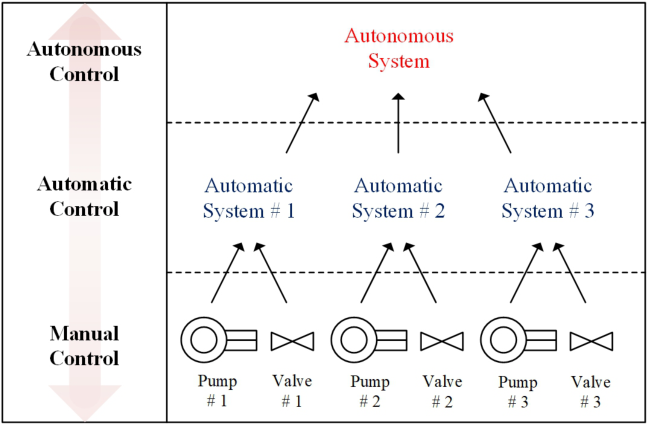
CHARACTERISTICS OF TASKS IN AUTONOMOUS SYSTEMS Autonomous systems employ an unmanned concept with the highest level of automation (LOA) that rarely requires human actions in comparison to exi- sting systems, which require a number of human roles to operate the systems. Figure 1 shows types of system controls depending on LOA: manual, auto- matic, and autonomous controls. The manual control refers to the action that operators directly manipulate components such as pumps or valves in local or main control rooms. The automatic control means that operators mani- pulate a sub-system automatically controlling components using a switch or
Figure 1: Types of system controls depending on LOA.
Analysis of Tasks in Autonomous Systems 55
button in main control rooms. The autonomous control integrately manages all the automatic and manual controls by itself.
Autonomous systems are conceptually responsible to all works in a system, while they do not allocate their work to human. However, if an autonomous system is suddenly failed, it requires any test and maintenance on local com- ponents or the system itself, or there is any problem that the autonomous cannot handle, human operators need to diagnose these situations and solve the problems.
Many researchers have noted that these tasks getting in the middle of auto- nomous operation may show different characteristics compared to tasks in existing systems employing manual and automatic controls. For example, in the existing NPP operation, operators are understanding the overall situation for systems in real time. In other words, although operators take over their mission to the next shift team, the overall situation can be easily synchroni- zed. On the other hand, once any work is given from the autonomous system to operators in the middle of operation, operators may need to pay more time and effort to understand what is going on with the higher workload and the less situation awareness. The followings are representative human performance issues stemmed from literature (Kim & Park, 2018).
Reduced situation awareness due to out of the loop in automated system,
Added complexity for operators to understand,
Change of tasks with respect to automation,
New sources of workload,
Skill degradation and loss,
Excessive passive monitoring raising vigilance and complacency issues,
New type of human error,
Human errors during the loss of automation, and
Trust Nevertheless, only a few studies have been conducted on 1) characterizing the different types of errors and risks associated with human actions intera- cting with autonomous systems and 2) how to evaluate human actions in the autonomous operations.
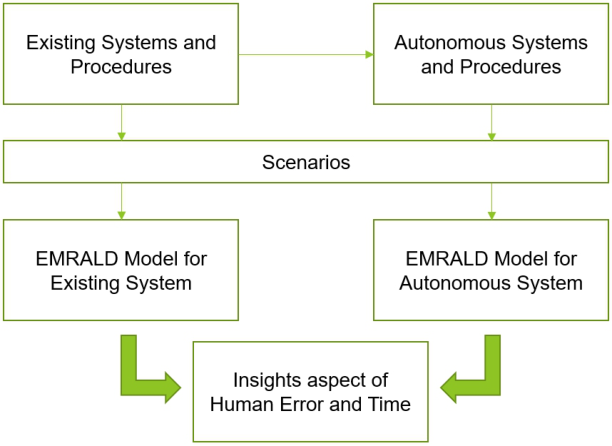
ANALYSIS OF TASKS IN AUTONOMOUS AND EXISTING NPP SYSTEMS This paper aims to investigate differences of tasks in autonomous operation compared to those in existing NPP operation. Figure 2 shows a summary of work scope in this paper. First, this study assumes an existing NPP system from the generic pressurized water reactor (GPWR) (Lew, et al., 2020) and an autonomous system from recent research on the NPP autonomous opera- tion (Lee, et al., 2018). For procedures in the autonomous system, these have been developed based on the GPWR procedures. Second, tasks implementa- ble in the existing NPP and autonomous systems are assumed with two simple scenarios. The tasks are summarized in Table 1, while the two scenarios are below:
Figure 2: Summary of work scope.Table 1. Human actions in the two simple scenarios.
Table available in the original PDF paper.
No. Human Action Details
Verify the setup/configuration is correct,
Verify sensor functionality,
1 Operator fails to confirm the relevant information during the startup process or perform the initial reactor startup.
Verify control system functionality,
Perform initial reactor startup and hold at criticality or target power,
Verify heat sinks functionality,
Synchronize to grid, and
Verify power ramping functionality.
Identify the problem,
Reinsert all control drums, and
2 Operator fails to identify the problem then determine if they can resume the startup.
Request technical support.
A normal startup scenario from operation mode 3 to 2 (i.e., hot standby to startup), and
The same normal startup scenario plus a latent error (a control rod is unexpectedly dropped due to electrical problem).
Third, EMRALD models for these scenarios are developed based on a dynamic HRA method called as the Procedure-based Risk Investigation Method – HRA (PRIME-HRA) (Park, et al., 2022). Lastly, insights aspect of human error and time are derived out by simulating the EMRALD models. Table 2 shows the summary of simulation results. The EMRALD models are simulated for 100,000 trials. The main findings are summarized as below.
Analysis of Tasks in Autonomous Systems 57
Table 2. Summary of simulation results (100,000 trials).
Table available in the original PDF paper.
HEP Time
System Type Scenario Human Action No.
Normal Startup 1 1.32e-3 26:45 +/−07:22 2 N/A N/A
Existing NPP System
Normal Startup + A
1 2.80e-4 07:49 +/−04:26 2 4.13e-3 14:37 +/−01:52
Control Rod Drop Normal Startup 1 9.00e-5 00:20 +/−00:15 2 N/A N/A
Autonomous NPP System
Normal Startup + A
1 8.00e-5 00:40 +/−00:20 2 6.00e-5 01:06 +/−00:28
Control Rod Drop
HEPs for existing systems are 15–70 times higher than those for autono- mous systems.
Time to perform tasks in existing systems takes 10–80 times longer than those in autonomous systems.
Human errors in autonomous systems occur in the early step of scenarios.
CONCLUSION
The result of this analysis indicates that tasks in the autonomous system show the lower HEPs and require the less time to finish scenarios in comparison with those in the existing NPP system. However, it is yet difficult to say that the autonomous system is better than the existing one. There are a couple of challenges needed to be researched to get the more realistic simulation result from this approach.
First, the input data used for the EMRALD models relies on the data expe- rimentally collected from the existing system. HEPs and time required for task units would be different when estimated from the existing and autonomous systems, respectively. Second, there would be new task types only available in the autonomous system. Representatively, the autonomous system may have a task type regarding adjusting LOAs (e.g., the high to low LOAs). It may cause new type of human error. For example, operators may be able to omit some tasks when changing LOAs from high to low by confusing that the system is still in the high LOA mode (e.g., the autonomous control). In addition, there have been human performance issues identified from many researchers introduced in the second section.
It is ongoing research to reasonably evaluate tasks in autonomous systems. In this time, fundamental research is further required to provide the better input data into simulation models.
ACKNOWLEDGMENT
This work was supported by the Risk-Informed System Analysis (RISA) Path- way of the U.S. Department of Energy’s Light Water Reactor Sustainability Program and the Laboratory Directed Research and Development funding of Idaho National Laboratory.
REFERENCES
Agarwal, V., Gehin, J. & Ballout, Y., 2021. Fission Battery Initiative: Research and Development Plan, INL/EXT-21-61275, Idaho National Laboratory. Arafat, Y., 2020. Microreactor Applications Research, Validation & EvaLuation
(MARVEL) Project, GAIN-NEI-EPRI Microreactor Workshop. Kim, Y. & Park, J., 2018. Envisioning Human-Automation Interactions for Responding Emergency Situations of NPPs: a Viewpoint from Human-Computer Intera- ction. Yeosu, South Korea, Transactions of the Korean Nuclear Society Autumn Meeting. Lee, D., Seong, P. H. & Kim, J., 2018. Autonomous operation algorithm for
safety systems of nuclear power plants by using long-short term memory and function-based hierarchical framework. Annals of Nuclear Energy, Volume 119, pp. 287–299. Lew, R., Ulrich, T. & Boring, R., 2020. Simulation technologies for integrated energy systems engineering and operations, Applied Human Factors and Ergonomics (AHFE) 2020 Conference. Park, J., Boring, R. & Ulrich, T., 2022. An Approach to Dynamic Human Reliability
Analysis using EMRALD Dynamic Risk Assessment Tool.
LISTED IN THE AHFE DIGITAL BOOKSTORE CATALOGUE
Explore the complete digital volume
Human Error, Reliability, Resilience, and Performance
Read this individual research paper free through the original publisher, or explore the full digital proceedings book.
ISBN 978-1-958651-58-2
Explore this ISBN in the AHFE Bookstore ↗Listed in the July 2026 bookstore catalogue; search by ISBN to confirm current availability · Digital book purchase optional