Yunyeong Heo, Jeeyea Ahn, Seung Jun Lee, Ronald Boring, Jooyoung Park (2022). Characterization of Recovery Human Action Mechanisms in Nuclear Power Plants. In: Human Error, Reliability, Resilience, and Performance. AHFE Open Access, vol. 33, pp. 75–80. https://doi.org/10.54941/ahfe1001570
Recovery human action is defined as the action that prevents deviant conditions from producing unwanted effects. Analyzing recovery actions has been a critical part in human reliability analysis (HRA). However, there are a couple of limitations to treat recovery actions only depending on the current HRA methods. Representatively, the existing recovery analysis does not specifically consider recovery actions as are occurred in actual nuclear power plants (NPPs). The overall goal of this study aims to develop a novel recovery analysis method to account for human action recoveries in context of scenarios as well as complement the limitations of existing recovery analysis. In this paper, the recovery analysis in current HRA methods and their challenges are introduced. A strategy to achieve the goal is introduced with a modified recovery definition. Then, how we have researched the approach will be introduced in the paper.
Recovery human action is defined as the action that prevents deviant con- ditions from producing unwanted effects (Swain & Guttmann, 1983). It generally indicates a kind of countermeasure performed in response to a fai- lure of human action. The recovery actions especially play an important role in complex systems like nuclear power plants (NPPs), which consist of highly sophisticated controllers to ensure that desired performance and safety must be achieved and maintained. This is because a combination of human error and its recovery failure may be able to cause a catastrophic effect on a system.
Analyzing recovery actions has been a critical part of human reliability analysis (HRA), which is a technique to evaluate human errors and provide human error probabilities (HEPs) for application in probabilistic safety asses- sment (PSA). If recovery actions are not adequately analyzed and applied to PSA models, the PSA results may be under-estimated or be not able to rea- sonably account for the failure of human actions in the context of PSA. For this reason, some regulatory documents such as ASME/ANS RA-Sb-2013 (ASME/ANS, 2008) by the American Society for Mechanical Engineers and
the American Nuclear Society and NUREG-1792 (U.S.NRC, 2005) by U.S. Nuclear Regulatory Commission have emphasized the importance of reco- very analysis within the HRA. Also, a couple of existing HRA methods, such as the Technique for Human Error-Rate Prediction (THERP) (Swain & Gut- tmann, 1983), the Cause-Based Decision Tree (CBDT) (Parry, Lydell, Spurgin, Moieni, & Beare, 1992), and the Korean Standard HRA (K-HRA) (Jung, Kang, & Kim, 2005), have respectively suggested their own approaches to the HRA recovery analysis. However, there are a couple of limitations to treating recovery actions using only the current HRA methods available.
The overall goal of this study is to develop a novel recovery analysis method to account for human action recoveries in the context of scenarios as well as complement the limitations of existing recovery analysis. In this paper, the recovery analysis in current HRA methods and their challenges are introduced. A strategy to achieve the goal is introduced with a modi- fied recovery definition. The strategy consists of three steps, (1) classify the initial task failure types, (2) investigate and characterize the recovery mecha- nisms, and (3) use a dynamic risk assessment tool to quantify these recovery mechanisms. Then, how we have researched the first and second steps will be introduced in the paper.
RECOVERY ANALYSIS IN CURRENT HRA METHODS Most HRA methods have suggested their own recovery approaches by modifying the recovery analysis method of the THERP method (Swain & Guttmann, 1983), but they are slightly different aspects of determination of a basic recovery HEP and adjustment of the HEP. Table 1 summarizes how to determine a basic recovery HEP and adjust the value in the THERP, CBDT, and K-HRA methods.
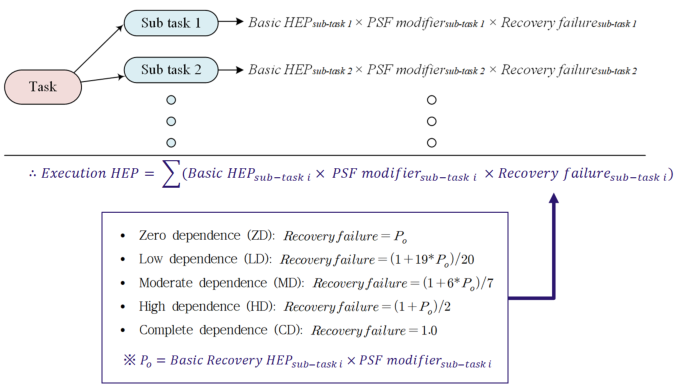
The THERP method has its own basic recovery HEPs in Table 19-1 of the THERP handbook (Swain & Guttmann, 1983). Once a basic recovery HEP is selected, it is adjusted by the THERP dependency equations as shown in Figure 1. The CBDT method (Parry et al., 1992) has defined recovery factors potentially contributable to the recovery process such as self-review, extra-crew, Shift Technical Advisor (STA) review, or shift change. Each factor includes basic recovery HEP options, which are assumed from the THERP data. The CBDT also uses the same approach to adjust the basic recovery HEP. The K-HRA method (Jung et al., 2005) evaluates three PSFs and deter- mines a recovery HEP based on a decision tree, which dominantly depends on expert judgment.
However, there are a couple of limitations to treating recovery actions using only the current HRA methods available. These are summarized below.
First, the biggest limitation is that the existing recovery analysis does not explicitly consider the type of recovery actions as they occur in actual NPPs. In other words, the process to reach out to a recovered state is excessively sim- plified or omitted in the current recovery analysis. A recovery process varies depending on initial task failure types (e.g., tasks performed in a local place and a main control room [MCR]) and accompanies a different combination of multiple tasks. Also, after a task failure is fully recovered, when and where
Characterization of Recovery Human Action Mechanisms in Nuclear Power Plants 77
Table 1. Summary of dependency analysis approaches in HRA methods.
Table available in the original PDF paper.
Determing basic recovery HEP Adjusting basic recovery HEP
THERP (Swain & Guttmann, 1983)
Basic HEPs for checking operations suggested in THERP Table 19-1
THERP dependency equations
THERP dependency equations (i.e., conditional probability estimation equations) CBDT (Parry et al., 1992) Four recovery factors: Self-Review (1.0e-1), Extra Crew (5.0e-1 or 1.0e-1), STA Review (1,0e-1), and Shift Change (5.0e-1 or 1.0e-1)
N/A K-HRA (Jung et al., 2005) Use of a decision tree to determine a recovery HEP Three PSFs (time urgency, man-machine interface, and managing/check)
Figure 1: Recovery method in the THERP method (Swain & Guttmann, 1983).
to recover and return in procedures are totally different according to reco- very processes. Nevertheless, the existing HRA methods have not specifically considered these characteristics of recovery actions to evaluate and quantify them within the HRA.
Second, recovery for diagnostic errors has rarely been considered in the current HRA, while most HRA methods focus on the execution recovery. In actual NPPs, the diagnosis recovery is significant. If operators fail to diagnose an initiating event and transfer to a wrong emergency operating procedure, they need to quickly re-diagnose the event and find a correct one in a couple of minutes. However, if too much time passes after the initiating event occurred, it may be difficult for them to diagnose the event correctly. Thus, the diagnosis recovery is time sensitive and critical to the event mitigation, but it has not been treated as such in the existing recovery analysis.
Third, the current definition of recovery actions makes it difficult to col- lect HRA data for estimating a recovery failure probability. The existing
HRA methods define a recovery failure as the subsequent task failure after a task failure. However, recent HRA data collection studies for supporting HRA data to quantify HEPs depend on simulator-based experiments (Chang et al., 2014; Jung, Park, Kim, Choi, & Kim, 2020). The problem is that the number of recovery failure with this definition is not sufficiently observed in experiment.
Lastly, there are general HRA issues regarding the THERP method such that the THERP dependency equations do not have any technical evidence to be used for adjusting recovery HEPs.
A STRATEGY FOR DEVELOPING A NOVEL RECOVERY ANALYSIS METHOD As mentioned in the Introduction section, the overall goal of this study is to develop a novel recovery analysis method to account for human action recoveries in the context of scenarios as well as complement the limitations of existing recovery analysis.
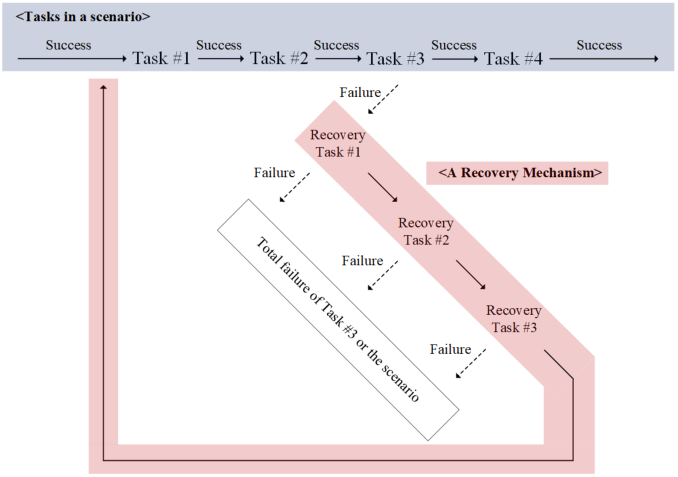
Due to the many challenges stemming from the current recovery concept (see the previous section), this study examined it from a different point of view. Figure 2 shows a new conceptual design for recovery human actions in HRA. This design views recovery within a scenario-based context rather than focusing solely on task recovery. In this concept, a new term, i.e., recovery mechanism, is proposed. The recovery mechanism refers to the entire process returning to a fully recovered state following a task failure. It is considered a branched scenario with the recovery mechanism composed of multiple reco- very tasks. An individual recovery task is a task unit defined in the HuREX framework or GOMS-HRA (Boring & Rasmussen, 2016). The recovery task unit is considered as a typical single task failure, while the legacy recovery analysis has been shown to be subsequent task failure after a task failure. The failure of each recovery task may cause the total failure of the initial task failure (i.e., the failure of Task #3 in Figure 2).
Our research team built up a strategy to develop a novel recovery analysis method based on the new conceptual design. The most important assumption from the design is that recovery mechanisms may be conjugated and generali- zed depending on initial task failure types. In other words, identical recovery mechanisms can be used for different tasks that correspond to the same fai- lure type. Based on this assumption, we suggest three steps for developing the new method: (1) classify the initial task failure types, (2) investigate and characterize the recovery mechanisms, and (3) use a dynamic risk assessment tool to quantify the recovery mechanisms. The first step aims to classify ini- tial task failure types, which are used for defining recovery mechanisms in the second step. The second step defines and characterizes recovery mecha- nisms and recovery tasks in each mechanism. In this step, task information is allocated for each recovery task in a recovery mechanism based on the HuREX database (Jung et al., 2020) or GOMS-HRA (Boring & Rasmussen, 2016). The third step is to quantify recovery mechanisms using a dynamic risk assessment tool, i.e., the Event Modeling Risk Assessment using Linked Dia- grams (EMRALD) software (Prescott, Smith, & Vang, 2018). The EMRALD
Characterization of Recovery Human Action Mechanisms in Nuclear Power Plants 79
Figure 2: New conceptual design for recovery human actions in HRA.
software has been developed to support the increasing need for dynamic PSA models that can respond to evolving plant conditions during the simu- lation. The author’s previous research attempted to conduct dynamic HRA using the EMRALD software, and developed the Procedure-based Investi- gation Method of EMRALD Risk Assessment – Human Reliability Analysis (PRIMERA-HRA) method (Zhang et al., 2021), which will be used in this study to quantify the recovery mechanisms.
The current efforts concentrate on the first and second steps. The seven factors potentially useful to classify initial task failure types have been investi- gated. These are organization (e.g., MCR operators or local operators), work equipment (e.g., MCR board or fixed equipment), work location (e.g., main control room or local place), action type (e.g., diagnosis-based or execution- based tasks), control room type (e.g., analog or digital), error type (e.g., error of omission or error of commission), and procedure type (e.g., Westin- ghouse type or Combustion Engineering type). The cases derived out from these factors are simplified and grouped into the representative initial task failure types. Then, based on them, recovery mechanisms are defined and characterized.
CONCLUSION
This paper mainly pointed out the challenges of the existing recovery analysis and talked about the detailed approach to develop a novel recovery analysis method. The novel method would account for human action recoveries in the context of scenarios as well as complement the limitations of existing recovery analysis. Currently, we are working on classifying initial task failure
types and characterizing recovery mechanisms. The details will be discussed in the conference presentation.
ACKNOWLEDGMENT
This work was partially supported by the Risk-Informed System Analysis (RISA) Pathway of the U.S. Department of Energy’s Light Water Reactor Sustainability Program and the Korea Institute of Energy Technology Eva- luation and Planning (KETEP) and the Ministry of Trade, Industry & Energy (MOTIE) of the Republic of Korea (No. 20203210100150).
REFERENCES
ASME/ANS. (2008). Standard for Level 1/Large Early Release Frequency Probabilistic Risk Assessment for Nuclear Power Plant Applications. American Society of Mechanical Engineers. Boring, R., & Rasmussen, M. (2016). GOMS-HRA: A method for treating subtasks
in dynamic human reliability analysis. Paper presented at the Proceedings of the 2016 European Safety and Reliability Conference. Chang, Y. J., Bley, D., Criscione, L., Kirwan, B., Mosleh, A., Madary, T., . . . Sieben, S.
(2014). The SACADA database for human reliability and human performance. Reliability Engineering & System Safety, 125, 117-133. Jung, W., Kang, D., & Kim, J. (2005). A standard HRA method for PSA in nuclear power plant; K-HRA method. KAERI/TR-2961/2005 268 S. Massaiu et al. Jung, W., Park, J., Kim, Y., Choi, S. Y., & Kim, S. (2020). HuREX–A framew-
ork of HRA data collection from simulators in nuclear power plants. Reliability Engineering & System Safety, 194, 106235. Parry, G., Lydell, B., Spurgin, A., Moieni, P., & Beare, A. (1992). An approach to the analysis of operator actions in probabilistic risk assessment. EPRI Report TR-100259. Prescott, S., Smith, C., & Vang, L. (2018). EMRALD, dynamic PRA for the tra-
ditional modeler. Paper presented at the Proceedings of the 14th International Probabilistic Safety Assessment and Management Conference. Los Angeles, CA. Swain, A. D., & Guttmann, H. E. (1983). Handbook of human-reliability analysis with emphasis on nuclear power plant applications. Final report. NUREG/CR- 1278. U.S.NRC. (2005). Good practices for implementing human reliability analysis.
NUREG-1792. Zhang, S., Zhang, H., Park, J., Liu, T., Ulrich, T.A., Boring, R. L., . . . Jiang, H.(2021).
Risk-Informed Analysis for Enhanced Resilient Nuclear Power Plant with Initia- tives including ATF, FLEX, and Advanced Battery Technology. Idaho National Laboratory, INL/EXT-21-64546.
LISTED IN THE AHFE DIGITAL BOOKSTORE CATALOGUE
Explore the complete digital volume
Human Error, Reliability, Resilience, and Performance
Read this individual research paper free through the original publisher, or explore the full digital proceedings book.
ISBN 978-1-958651-09-4
Explore this ISBN in the AHFE Bookstore ↗Listed in the July 2026 bookstore catalogue; search by ISBN to confirm current availability · Digital book purchase optional