Jeeyea Ahn, Yunyeong Heo, Seung Jun Lee, Ronald Boring, Jooyoung Park (2022). Dynamic Approach to Dependency Analysis in Human Reliability Analysis: Application in a Steam Generator Tube Rupture Scenario. In: Human Error, Reliability, Resilience, and Performance. AHFE Open Access, vol. 33, pp. 81–90. https://doi.org/10.54941/ahfe1001571
Dependence analysis refers to a method for adjusting the failure probability for a human action by considering the impact of the preceding human action in human reliability analysis (HRA). Most of the existing dependence analysis methods have been developed based on the approach suggested in the Technique for Human Error-Rate Prediction (THERP) HRA method. However, the THERP-based approaches may have limitations. For instance, it inevitably presents challenges regarding both the subjectivity of expert evaluation as well as experience using dependence for resource-intensive and time-consuming complex analyses. In addition, the THERP-based quantification approaches rarely explain the adjustment of human error probabilities (HEPs), since the quantification processes do not concretely account for the context at the moment when the action is present. For these reasons, the authors’ previous studies have conceptually suggested a dynamic approach to evaluating dependencies by extending the existing performance shaping factor (PSF) concept used for quantifying HEPs in HRA. The conventional PSF modeling methods are limited to separate modeling for each HFE. However, this study suggests PSFs can affect a set of human actions or a multiple HFE rather than a single HFE. With this assumption, the authors simplified the dependency analysis process to efficiently evaluate dependencies and increase the quantification speed with more explicable backgrounds. In this paper, the authors mainly focus on dependency quantification over time. This study utilizes the eight PSFs suggested in the Standardized Plant Analysis Risk-HRA (SPAR-H) method. The mathematical models and logical algorithms are investigated through literature. Integrating the effects of PSFs to generate HEPs with dependency effects is also investigated. Then, the applicability of the dynamic method is investigated based on a design-based accident scenario, steam generator tube rupture. Lastly, insights from this approach are discussed in the paper.
This paper is follow-up research to conceptually, theoretically propose a per- formance shaping factor (PSF)-based dynamic dependency analysis method for human reliability analysis (HRA) to complement the existing dependency methods (Park & Boring, 2021). A PSF refers to any factor that influences human performance in HRA (Swain & Guttmann, 1983). PSFs have been used to highlight human error contributors and adjust human error pro- babilities (HEPs) within HRA. This paper explores the latest version of the method along with the steps for applying it to an example steam generator tube rupture (SGTR) scenario. A set of procedures for mitigating SGTR sce- narios, an SGTR event tree, and the relevant HRA information—all of which were assumed based on practical experience—were used to implement the method.
Table 1. Dependency elements and their evaluation criteria.
Table available in the original PDF paper.
Dependency elements Evaluation criteria Crew Is the crew for a given human action the same as that of the other human action? (Yes/No) Cognitive Are the cues for the given human action the same as those of the other human action? (Yes/No) Cue demand Are the cues for both human actions included in the same procedure steps? (Yes/No) Timing Does the time gap between the two human actions (e.g., the end of the previous action and the beginning of the next) range from a few seconds to a few minutes? (Yes/No) Location Is the location of the given human action the same as that of the other human action? (Yes/No)
PSF-BASED DYNAMIC DEPENDENCY ANALYSIS METHOD The PSF-based dependency method suggested in this study defines depen- dence differently from existing dependency methods. In this study, the dependence effect is defined as the PSFs for a given human action affecting PSFs for subsequent human actions and indirectly contributing to the fai- lure of those actions. A human action may promote the failure of subsequent human actions, regardless of if whether the initial human action is successful. In other words, this method accounts for every possible relationship among the human actions modeled for a given scenario. Further details on this defi- nition, along with the analytical process behind this method are thoroughly explored in the authors’ previous work (Park & Boring, 2021).
The method consists of three steps: (1) identification of the human failure event (HFE) sequence in light of the initiating event, (2) screening analysis for dependency candidates, and (3) application of mathematical models.
Step #1: Identification of the HFE Sequence in Light of the Initiating Event In this step, HFE sequences are identified via event trees and procedures. Event trees are used to determine where HFEs occur in the model, and to visually identify HFE sequences, which are in turn verified by the proce- dures. In addition, this step additionally finds HFE combinations that are missed by existing dependency methods that focus solely on human failure combinations from cut-sets.
Step #2: Screening Analysis for Dependency Candidates In this step, five dependency elements are used to determine whether depen- dencies between a given pair of HFEs should be evaluated. Table 1 shows the evaluation criteria for each of the five elements. If at least two elements in the table generate a “Yes”response, we assume the existence of a dependency between the HFEs.
Dynamic Approach to Dependency Analysis in Human Reliability Analysis 83
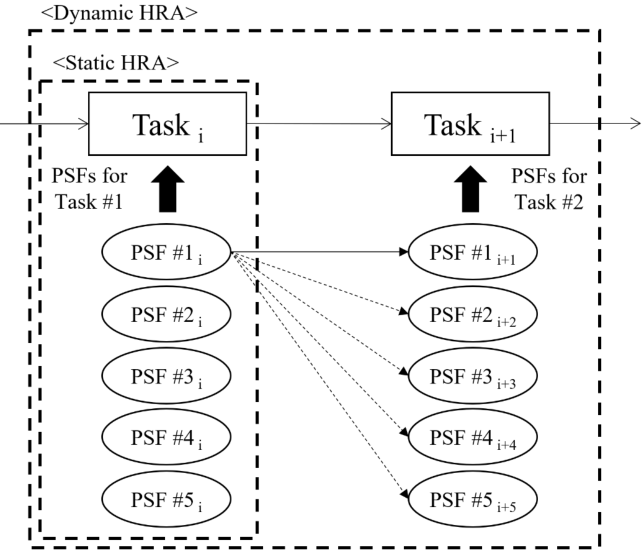
Figure 1: Extension of the PSF concept from static to dynamic HRA.
Step #3: Application of Mathematical Models This step entails the application of mathematical models developed for the Human Unimodel for Nuclear Technology to Enhance Reliability (HUN- TER) software (R. Boring et al., 2021). In the HUNTER project, the PSF concept was extended from static to dynamic HRA, based on the eight PSFs used in the Standardized Plant Analysis Risk-HRA (SPAR-H) method (Gertman, Blackman, Marble, Byers, & Smith, 2005). Figure 1 shows how to conceptually extend the PSF concept from static to dynamic HRA. In static HRA, PSFs have been used for quantifying a task only. On the other hand, in extending them to dynamic HRA, it is assumed that PSFs for a given task affect those in other tasks performed after the task (e.g., subsequent tasks). Two influences are suggested in the concept, the PSF’s influence on that same PSF in subsequent tasks, and the PSF’s influence on different PSFs in subse- quent tasks. An example of the first type of influence is that the stress PSF in Task #1 affects the stress PSF in Task #2, whereas the second type of influe- nce is exemplified by the fact that the complexity PSF in Task #1 influences the available time PSF in Task #2. The current study mainly focuses on the first type of influence. Yet, the second one is not much investigated in this study.
Two of the eight SPAR-H PSFs (i.e., stress/stressors and fitness-for-duty) are applicable to the first type of influence featured in the extended PSF concept, whereas the other PSFs are dominant in each task. For example, the
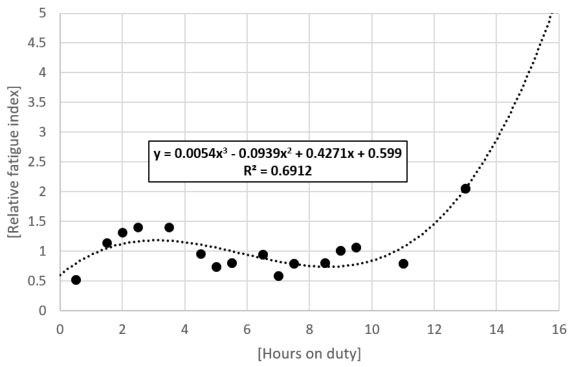
Figure 2: Relative fatigue index over number of hours on duty.
stress PSF for a given task influences that for the next task, while task com- plexity is totally different depending on the tasks. Therefore, this study only includes mathematical models for the aforementioned stress/stressors and fitness-for-duty SPAR-H PSFs, while the existing static approach is employed for the remaining six PSFs.
Stress is defined as the undesirable conditions and circumstances that impede operators from easily completing a task, and can include mental stress, excessive workload, or physical stress (e.g., that imposed by various environmental factors). For modeling the PSF of stress/stressors, PSF lag and linger models (Park, Boring, & Kim, 2019) were used. PSF lag indicates that the PSF’s effect on performance does not immediately materialize in a psych- ological or physical fashion, whereas PSF linger means that the influence of PSFs for an initial human action continue to residually affect subsequent actions. The authors’ previous research conceptually suggested PSF lag and linger effects as an option for treating dependencies between operator acti- ons in a dynamic context (Boring, 2015), thus entailing the development of mathematical models for PSF lag and linger effects (Park et al., 2019), based on experimental results in the field of biology.
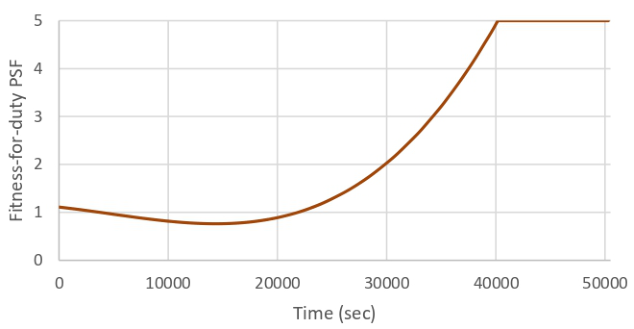
Fitness-for-duty PSF refers to whether or not the individual performing a given task is physically and mentally fit to perform said task at that particular moment. Factors that may affect fitness include fatigue, sickness, drug use, overconfidence, personal problems, distractions, etc. This study developed an equation representing the relative fatigue values (Spencer, Robertson, & Folkard, 2006). Figure 2 shows the relative fatigue index over the number of hours on duty, with the curve-fitted equation given in cubic form. The R-square value of the equation (i.e., 0.69) is statistically adequate. This study employs this equation to imitate the trend of the multiplier value for the fitness-for-duty PSF over time. If a shift is changed, the multiplier value is reset to the value at x = 0, while the maximum value is assumed to be 5, in accordance with the existing SPAR-H method.
Dynamic Approach to Dependency Analysis in Human Reliability Analysis 85
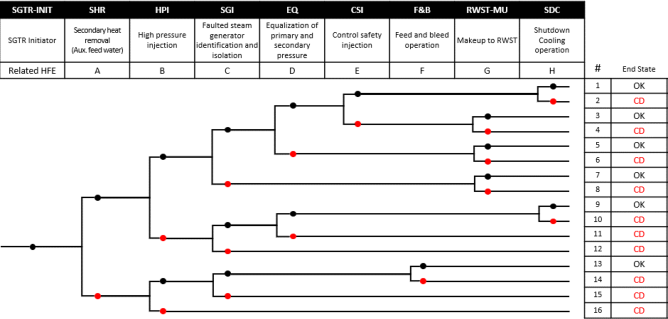
Figure 3: General event tree for steam generator tube rupture accident.Table 2. HFE combinations for each heading in the event tree.
Table available in the original PDF paper.
Scenario # End state Successful HFEs Failed HFEs HEP quantification candidates 1 OK - - 2 CD a, b, c, d, e H P(H | abcde) 3 OK - - 4 CD a, b, c, d E, G P(E | abcd), P(G | abcdE) 5 OK - - 6 CD a, b, c D, G P(D | abc), P(G | abcD) 7 OK - - 8 CD a, b C, G P(C | ab), P(G | abC) 9 OK - - 10 CD a, c, d B, H P(B | acd), P(H | aBcd) 11 CD a, c B, D P(B | ac), P(D | aBc) 12 CD a B, C P(B | a), P(C | aB) 13 OK - - 14 CD b, c A, F P(A | bc), P(F | Abc) 15 CD b A, C P(A | b), P(C | Ab) 16 CD - A, B P(A), P(B | A)
APPLICATION IN A STEAM GENERATOR TUBE RUPTURE SCENARIO Step #1: Identification of the HFE Sequence in Light of the Initiating Event
Since the analyzed reference event (i.e., a SGTR scenario) occur during stop cooling (April 5, 2002, at Hanul Unit 4 in South Korea) instead of during normal operation, it was assumed that the heading related to the reactor trip was left unconsidered (unconditional success). Figure 3 shows the HFE considered for each heading. The HFE combinations in each event tree (ET) scenario are shown in Table 2.
Figure 4: Event sequence, HFEs, and timing information of the reference event.
Step #2: Screening Analysis for Dependency Candidates Candidates for HEP analysis were screened by identifying the dependency relationships between HFEs included among the HEP quantification candida- tes. For example, with respect to P(H | abcde) in scenario #1, the dependencies of H-a, H-b, H-c, H-d, and H-e are checked. If all these HFEs pertain to the same crew and occur in the same place, P(H | abcde) becomes the final calcu- lation target by satisfying the criteria imposed by the dependency elements Crew and Location. However, if the time interval between a~e and H exce- eds the time of the shift, the evaluation criteria will not be satisfied, thus the dependency need not be considered. That is, in this case, only P(H) must be obtained in scenario #1. If no information exists on the dependency elements between HFEs, the existence of dependency is simply assumed in order to make the calculation conservative.
Step #3: Application of Mathematical Models In the case of the dynamic approach to dependency analysis, since the timing data of each HFE are required, we referred to an SGTR event that occurred in a domestic nuclear power plant in order to employ the timing information to our mathematical models. (KINS, 2002) Also, to assume the missing data in this incident investigation report, a SGTR simulation experiment was referred to and utilized as action time data (Jung. et al., 2007). The event sequence, related HFEs, and timing information of the reference event are shown in Figure 4.
As seen in Figure 4, a total of five HFEs appear in this reference event. For the pilot application of this methodology, those HEPs applied the dynamic dependency approach was calculated for each HFE. Due to the lack of infor- mation on the dependency element between each pair of HFEs, dependencies between all the HFEs are assumed to exist. As per the SPAR-H methodology, the basic HEP for the actions involve in each HFE is 1-E3. The basic HEP for diagnoses is 1-E2. The final HEP was calculated by implementing the PSF cor- rection factor. The multipliers for the dynamically considered stress/stressor and fitness-for-duty PSFs were calculated separately from other PSF. Table 3 gives the HEPs for the other six PSFs.
Dynamic Approach to Dependency Analysis in Human Reliability Analysis 87
Table 4. Timing information for the selected HFEs.
Table available in the original PDF paper.
HFEs Timing Information Time Required [sec] T [sec] M [sec] Q [sec] R [sec]
PSF Calculation for Dynamic Elements Application of the dynamic approach necessitates, timing information and time required data for each HFE (Table 4). T is the time at which the corre- sponding HFE begins, and M is the time at which the HFE ends, that is, it can be calculated as T + time required. Q is the time at which the lag effect of the corresponding HFE reaches its maximum, and R is the time at which the linger effect ends. For the time required for HFE #1 and #2, data from the reference literature (Jung et al., 2007) were utilized, and for the time required for HFE #3, the time indicated in the reference event was applied. The times required for HFE #4 and #5 were assumed to be 35 and 50 minutes, respecti- vely, referring to the general amount of time required for the decision-making and action portions of the relevant task. The T of each HFE utilized the event sequence of the reference event.
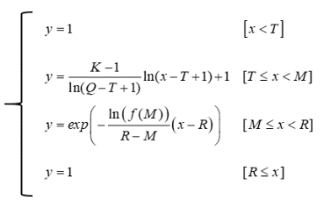
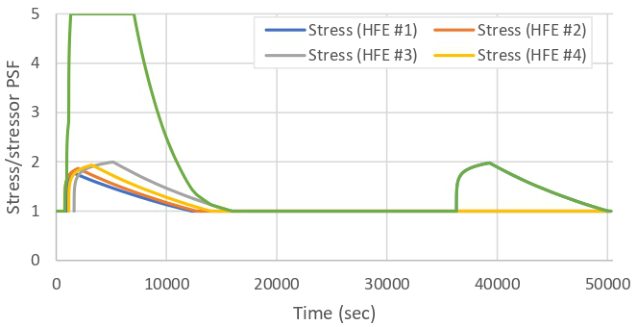
Since M < Q for all selected HFEs, the second formula for the lag and linger model developed during the authors’ prior research (Park et al., 2019) was applied (see Figure 5). Table 5 shows the parameters for calculating the stress/stressor PSF. The dynamic stress/stressor PSF calculated over time is shown in Figure 6, and the dynamic fitness-for-duty PSF is shown in Figure 7.
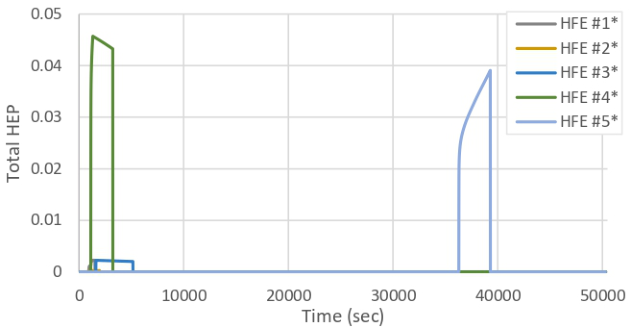
Figure 8 shows the final HFEs in light of all the dynamic elements (i.e., dynamic stress/stressor and fitness-for-duty PSFs). For HFE #4, the utilizable PSF rating data were insufficient, and the positive PSF was relatively less well reflected, so the calculated HEP value was relatively high. HFE #5 occurred after the PSF linger effect was terminated due to a long period of time with HFE #1 to 4, so it is not affected by the residual effect of stress/stressor PSF.
Figure 5: Equations for the second PSF lag and linger model (Park et al., 2019).Figure 6: Dynamic multiplier for the stress/stressor PSF.
CONCLUSION
In this paper, an approach for dynamically considering dependencies betw- een HFEs over time in HRA was applied to a SGTR event that occurred in a domestic nuclear power plant. The fact that shared elements such as shared PSFs generate indirect dependency between HFEs unlocks a new way of considering such dependency. In this study, the stress/stressor and fitness-for-duty PSFs were considered the shared dynamic factors and changes the these dynamic PSFs with respect to the reference event were calculated. Although this application is limited to a specific scenario, HRA of a more
Dynamic Approach to Dependency Analysis in Human Reliability Analysis 89
Figure 7: Dynamic multiplier for the fitness-for-duty PSF.Figure 8: Dynamic HFEs in light of indirect dependencies between HFEs.
explanatory nature is expected to be made possible if the proposed method becomes widely used in future research.
ACKNOWLEDGMENT
This work was partially supported by the Risk-Informed System Analysis (RISA) Pathway of the U.S. Department of Energy’s Light Water Rea- ctor Sustainability Program and by the National Research Foundation of Korea (NRF) grant funded by the Korea government (MSIT). (No.NRF- 2018M2B2B1065653)
REFERENCES
Boring, R., Ulrich, T., Park, J., Mortenson, T., Ahn, J., & Lew, R. (2021). An Adaptable Toolkit for Dynamic Human Reliability Analysis: Progress Toward HUNTER 2. Retrieved from
Boring, R. L. (2015). A dynamic approach to modeling dependence between human failure events. Retrieved from Gertman, D., Blackman, H., Marble, J., Byers, J., & Smith, C. (2005). The SPAR-H
human reliability analysis method. US Nuclear Regulatory Commission, 230, 35. Jung, W., et al. (2007). “Analysis of an operators’ performance time and its application to a human reliability analysis in nuclear power plants.” IEEE transactions on nuclear science 54.5: 1801-1811. KINS, (2002). Incident Investigation Report from the operational performance infor-
mation system for nuclear power plant (OPIS) managed by the Korea Institute of Nuclear Safety (KINS), April 2002 Steam Generator Heat Tube Leakage during Shutdown at Hanul Unit 4. Park, J., & Boring, R. L. (2021). Identification of Performance Shaping Factors Affecting Subsequent Human Actions for Dependence Assessment in Human Reliability Analysis. Paper presented at the International Conference on Applied Human Factors and Ergonomics. Park, J., Boring, R. L., & Kim, J. (2019). An Identification of PSF Lag and Linger Effe-
cts for Dynamic Human Reliability Analysis: Application of Experimental Data. Paper presented at the 2019 12th International Conference on Human System Interaction (HSI). Spencer, M., Robertson, K., & Folkard, S. (2006). The development of a fatigue/risk index for shiftworkers. Health and safety executive report, 446. Swain, A. D., & Guttmann, H. E. (1983). Handbook of human-reliability analysis
with emphasis on nuclear power plant applications. Final report. Retrieved from
LISTED IN THE AHFE DIGITAL BOOKSTORE CATALOGUE
Explore the complete digital volume
Human Error, Reliability, Resilience, and Performance
Read this individual research paper free through the original publisher, or explore the full digital proceedings book.
ISBN 978-1-958651-09-4
Explore this ISBN in the AHFE Bookstore ↗Listed in the July 2026 bookstore catalogue; search by ISBN to confirm current availability · Digital book purchase optional