Ronald Boring, Roger Lew, Thomas Ulrich, Jooyoung Park (2023). Synchronous vs. Asynchronous Coupling in the HUNTER Dynamic Human Reliability Analysis Framework. In: Human Error, Reliability, Resilience, and Performance. AHFE Open Access, vol. 82, pp. 43–52. https://doi.org/10.54941/ahfe1003552
The Human Unimodel for Nuclear Technology to Enhance Reliability (HUNTER) framework for dynamic human reliability analysis (HRA) has recently been developed into standalone software. HUNTER creates a virtual operator that is coupled to a virtual system model, in this case a nuclear power plant model. Asynchronous model coupling is most often found in the use of thermohydraulic codes like RELAP5-3D, which are designed to run in batch mode without interruption to determine the evolution of plant parameters from a particular set of conditions. Within RELAP5-3D, it is possible to schedule changes in the configuration, but conditions are determined a priori and not changed once a particular simulation run is started. In contrast, synchronous model coupling is most commonly found in interactive simulators, which feature a system model linked to real-time inputs from a human user. A model that is executed is a simulation, while a simulator is a simulation designed to interact with human inputs. Simulation is typically asynchronous to other models or humans, whereas simulators are synchronous with regular exchanges to other models or humans. For example, a training simulator at a nuclear power plant operates synchronously in such a manner that an input from the reactor operator at any point in time will change the evolution of the simulation run. The simulator provides an evolving response to dynamic contexts that reflect operator actions. The ability to change the simulation direction mid-course is the hallmark of synchronous coupling. HUNTER, as virtual operator, most accurately reflects human-system interactions when it is coupled synchronously with a plant model. In this paper, we explore synchronous and asynchronous coupling based on implementations in HUNTER.
STATIC VS. DYNAMIC HUMAN RELIABILITY ANALYSIS Human reliability analysis (HRA), since its inceptions in the Technique for Human Error Rate Prediction (THERP; Swain and Guttman, 1983), is work- sheet based. Human reliability analysts consider a scenario by decomposing it into human failure events (HFEs) and associated actions. In most cases, HRAs are linked to overall probabilistic risk assessment (PRA) models, which define HFEs as those human activities that impact the hardware reliability of a system like a nuclear power plant. HRA uses various methods to deter- mine the human error probability (HEP). These quantification methods may consist of approaches such as:
Screening approach—in which a high HEP corresponding to poor per- formance is inserted into the PRA to determine if the HFE is risk significant
Scenario matching approach—in which a predefined scenario or generic task type comes with a predefined HEP
Performance shaping factor (PSF) approach—in which a nominal HEP is multiplied by a number associated with a level of performance
Decision tree approach—in which a path in an event tree is selected with an associated HEP for that end state
Expert estimation approach—in which subject matter experts determine the likelihood of particular HFEs.
These approaches typically appear in paper form, such as HEP lookup tables for the scenario matching and decision tree approaches or as work- sheets for calculating or recording HEPs for the PSF and expert estimation approaches. Software equivalents of the paper forms and worksheets may exist, but the software is simply a digitization of the paper format.
These types of HRA methods can be considered static, because they typi- cally model only a limited, fixed (or static) set of event sequences at one snapshot in time. In contrast, dynamic HRA considers variable courses of action with an open-ended set of sequences:
A Monte Carlo style looping can explore different outcomes due to sto- chastic variations and systematic variability such as through different or changing PSFs
As the term dynamic implies, it will explore the time course of the scenario, allowing novel output functions like HEP intervals or time durations of specific tasks
It allows exploration of what-if scenarios, which can be particularly useful to project different outcomes to resolve the safest course of action among alternatives.
Of course, each dynamic HRA method will vary in its ability to perform these functions (see Boring, 2007, for a review). Additionally, it is possible to perform these types of analyses using static methods, but this would prove prohibitively labor intensive for most analysis purposes.
THE HUNTER DYNAMIC HRA FRAMEWORK
Background
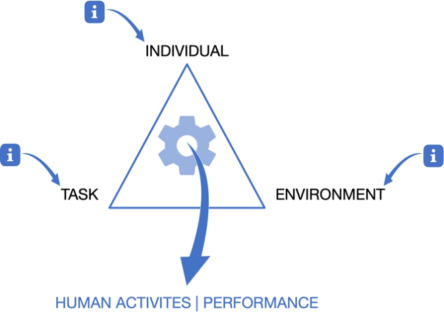
Idaho National Laboratory (INL) has developed the Human Unimodel for Nuclear Technology to Enhance Reliability (HUNTER; Boring et al., 2016, 2022). HUNTER is a standalone software framework for dynamic HRA that considers three different modules (see Figure 1):
The task—which is essentially the operating procedure that the individual uses to guide their actions
The individual—which is a model of those factors that contribute to the success or failure of individual performance, which are considered in terms of PSFs
The environment—which is the system with which the individual interacts.
Synchronous vs. Asynchronous Coupling in the HUNTER 45
Figure 1: HUNTER modules.
Additional modules are used in the software, like the scheduler to coordi- nate between the individual, task, and environment; or HUNTER-Gatherer to assist in translating real world operating procedures into tasks for HUNTER.
HUNTER Task Module A scenario in HUNTER consists of plant operating procedures coded into tasks and logic steps. For example, the rare but risk-significant event of a steam generator tube rupture (SGTR) in a pressurized water reactor requires mitigative actions by operators using at least four procedures:
An annunciator response procedure that triggers a set of immediate actions by the operator when an alarm goes off
When the entry conditions warrant, this will elicit an abnormal operating procedure (AOP) that will prioritize a series of rapid checks to determine the severity of the plant upset condition
If the plant automatically trips (meaning it drops the fuel rods into a gra- phite sheath to neutralize reactivity) or if the conditions escalate to the point of requiring a manual trip by the operators, a post-trip emergency operating procedure (EOP) is referenced, which will prescribe protective measures such as ensuring adequate cooling of the reactor and further diagnosing the source and corrective actions of the problem
Within the post-trip EOP, there will be a branching point to a more specific EOP to mitigate the SGTR once the specific ruptured steam generator is identified.
In HUNTER, these procedures would be coded as a continuous action monitoring procedure that detects alarms, followed by entry into AOP-16, then EOP-E0 for post-trip actions, and finally EOP-E3 for SGTR mitigative actions (using Westinghouse procedure labeling conventions here for pressu- rized water reactors). Each procedure step is coded within HUNTER with key information:
The basic type of action being performed in the procedure step, which is called a task level primitive (Boring et al., 2017a) in HUNTER and carries with it nominal HEPs, nominal task timing (Ulrich et al., 2017a), and task level errors (Boring, Ulrich, and Rasmussen, 2018) that define the types of human errors that are likely
The information such as a plant parameter needed by the operator from the plant to complete the step, e.g., the steam generator level indicator
Any logical steps that are evaluated on the procedure step, e.g., checking if a plant parameter is equal to (=), less than (<), or greater than (>) a reference value in the procedure or if a plant parameter is rising (↗) or falling (↘) over time
Actions that are taken if logic conditions are met or unmet, such a branch- ing to another procedure or step or carrying out an action, which results in changes instigated by the operator on the plant.
While static HRA operates at the HFE level, an important distinction is that dynamic HRA may benefit from analysis at the task or procedure step level (Boring et al., 2018). To determine the true course of human actions, it is important to follow the steps that the actual human operator would take. Each procedure step realistically presents the opportunity for success or fai- lure and can affect the ensuing plant response. For example, failure to open a valve at a particular step in the operating procedure can quickly affect plant dynamics and significantly complicate subsequent plant health and recovery. Additionally, it is worth noting that humans are not always rote followers of procedures, and an emerging research literature on work as imagined vs. work as done holds promise for categorizing deviations from procedure fol- lowing (Hollnagel, 2015), including possible errors of commission that have historically been challenging to account for in HRA.
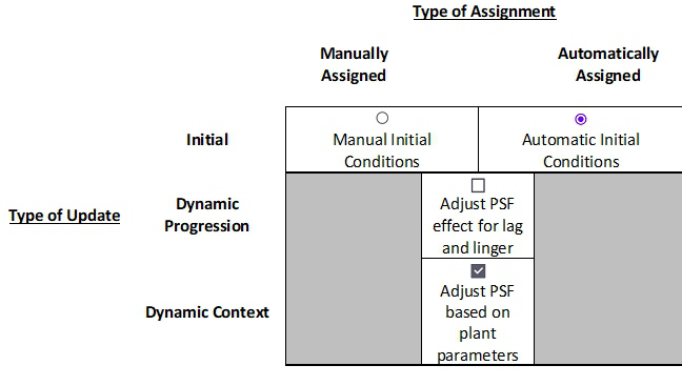
HUNTER Individual Module As HUNTER steps through the procedures, it uses PSFs in the individual module to determine the evolution of the simulated human performance. Using eight PSFs originally specified in the Standard Plant Analysis Risk- Human (SPAR-H) method (Gertman et al., 2005), HUNTER is able to adjust the PSFs as shown in Figure 2. PSFs undergo three phases of adjustment: initial, progressive, and contextual.
Initially, PSFs may be automatically set based on available information (a process called autocalculation in Boring et al., 2017b) such as plant parameters or manually set by the analysts. A default, nominal value is available when no other value is specified.
PSFs may follow a natural progression, such as the lag and linger functions first identified in Boring (2015). Lag corresponds to the speed of onset of the effects of a PSF, e.g., some PSFs may take effect immediately, while oth- ers may take a while to reach full effect. Linger corresponds to the decay of PSF once its effect is withdrawn, e.g., a PSF like stress may take conside- rable time for its effects to decay as cortisol dissipates in the bloodstream (Park, Boring, and Kim, 2019).
Synchronous vs. Asynchronous Coupling in the HUNTER 47
Figure 2: Types of adjustments to PSFs in HUNTER.
PSFs may also be triggered contextually, such as the onset of a plant upset. For example, some plant upsets might result in increased temperatures and reduced ventilation, initiating fatigue.
In HUNTER, the term individual may refer to an individual reactor opera- tor or a crew operating in concert, depending on the modeling level required. New features related to the spatial positioning of modeled operators (Boring, 2023) allow better separation of individual operators as needed. This functi- onality becomes especially important outside the main control room, such as when modeling balance-of-plant activities.
HUNTER Environment Module Humans function within the context of their environment. For a reactor ope- rator, that context is primarily the main control room, which serves as the nexus of information from plant sensors and controls for plant systems. Ini- tial versions of HUNTER have focused on the environment in the form of a plant simulation. While HUNTER represents a virtual operator, the environ- ment represents a virtual plant. These are synonymous with digital human twins for the operators and digital twins for the plant, whereby these latter terms imply the ability to model future outcomes based off current states.
The HUNTER virtual operator has to date used four different environment modules:
A dummy-coded module that provided predefined plant parameters along a timeline based on logs from operator studies
A version tied to the Reactor Excursion and Leak Analysis Program (RELAP5-3D) thermohydraulic modeling code to represent the nuclear power plant (Heo et al., 2022)
An advanced programming interface (API) to the Rancor Microworld, a simplified nuclear power plant simulator (Ulrich et al., 2017b)
An embedded version of HUNTER in the Event Modeling Risk Asses- sment using Linked Diagrams (EMRALD; Lew et al., 2023) dynamic PRA software, whereby EMRALD offers a flexible world model including links to RELAP5-3D.
Each of these environment modules has tradeoffs. For example, dummy coding allows rapid execution of scenarios but limited flexibility to consider deviations from prescripted event paths. The RELAP5-3D interface performs well in a batch mode, whereby HUNTER provides input parameters such as how long a task will take but does not consider step-by-step interactions between the operator and the plant. The Rancor Microworld affords many advantages, not least of which is the fact that the code was developed by the same team as HUNTER and allows seamless integration between the ope- rator and plant models. However, the Rancor Microworld is considered a reduced order model of a higher fidelity plant model and may not capture all nuances of plant performance at scale. Finally, EMRALD-HUNTER provides a PRA-centered approach that is readily usable by PRA practitioners. Howe- ver, it necessarily simplifies several aspects of HUNTER that potentially limit its uses for more detailed analyses.
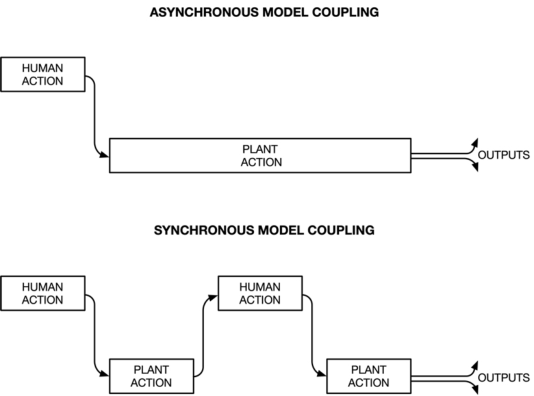
NEED FOR COUPLING The previous discussion on the environment module demonstrates coupling between two types of models. Coupling is defined as how two simulati- ons exchange information and what information they exchange. In the case of coupling between HUNTER and RELAP5-3D, the human and thermo- hydraulic models may be said to operate asynchronously. Asynchronous coupling occurs when each model operates independently such that infor- mation is exchanged only at the beginning or end of model runs. Using the SGTR scenario as an example, this means that the RELAP5-3D SGTR model runs on its own, initiated by the HUNTER scheduler with inputs to RELAP5- 3D related to operator performance such as how long it would take to initiate safety injection. The RELAP5-3D model executes using this information and produces outputs related to plant parameters after the scenario completes. The inputs on human performance could be a distribution, e.g., a range of how long it takes operators to initiate safety injection.
Synchronous coupling incorporates the interactions of the human and the system and runs in response to these changing conditions. Both task and environment modules continuously exchange information in the form of a feedback loop—the operator responds to plant conditions and acts to make changes to the plant, which in turn changes the subsequent plant conditions to which the operator responds. The back and forth between the operator and the plant represents an infinite scope of interactions requiring both modules to respond step-by-step to each other.
Asynchronous and synchronous model coupling are shown in Figure 3. To truly capture interactive dynamics, HUNTER functions best through synchronous coupling. Synchronous coupling allows not only a continuous feedback loop between the task and environment modules, it also allows the
Synchronous vs. Asynchronous Coupling in the HUNTER 49
Figure 3: Human-plant model interaction for asynchronous and synchronous coupling.
individual module to shape the performance of the virtual operator to ensure realistic downstream effects. For example, an operator response to a parti- cular plant condition might vary between 1 and 5 minutes. A distribution to cover the response time could be constructed a priori and fed asynchronously into a thermohydraulic plant model. What such an a priori model might fail to consider is that in the longer time windows, eroded plant margins cause many alarms, which may elevate the stress of the operator. Stress can have the effect of slowing decision making, thereby further slowing the operator response and exacerbating the plant upset. The interplay between the indi- vidual, task, and environment cannot be determined a priori for an evolving event. Each of the modules is dynamic, but none are independent. Thus, reali- stic dynamic HRA requires synchronous coupling in most cases. Multivariate interactions between factors in the individual module, which are linked to the antecedents of the environment model, affect the response of the task model.
The problem of forecasting future (t +1) human actions (h) can be roughly depicted as follows: ht+1= h(ht; st) (1)
This implies that future human actions are dependent on the present (t) actions in relation to the present status of the system or plant (s). Similarly, future states of the system can be approximately expressed as: st+1= s(st; ht) (2)
This implies that future states of the system depend on the current state of the system as influenced by the current human actions. The issue here is the cyclical timeline involved when attempting to anticipate the interactions between human and system models before either actually occurs. Human actions and the state of the system are interdependent—the state of the system
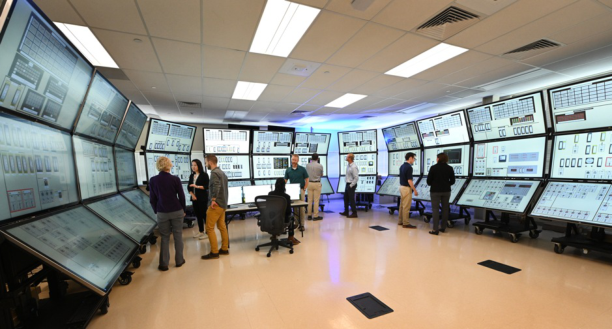
Figure 4: The Human System Simulation Laboratory at INL (Boring, 2020).
affects human actions just as human actions affect the state of the system. Attempting to calculate one without considering the other is impossible in a discrete event simulation.
The most ubiquitous plant model capable of synchronous coupling is a plant simulator. A model in operation essentially forms a simulation, whereas a simulator represents an interactive simulation built to accommodate human inputs. Generally, simulations function independently from other models or human involvement, exhibiting asynchronous characteristics. Simulators, on the other hand, operate synchronously, enabling regular communication with other models or humans. Every nuclear power plant in the world is requi- red to have a full-scope (i.e., high fidelity) plant simulator that is capable of representing realistic plant responses to normal and abnormal operations. Plant simulators are used in training reactor operators for their initial license to operate the plant and for recurring refresher training, including just-in- time training suitable for known challenging scenarios at the plant such as startup after a refueling outage. Because simulators are designed to interface in real-time with actual operators, they accurately reflect this feedback loop and serve as an ideal environment module for coupling with HUNTER.
A typical plant simulator may feature 100,000 plant parameters on the backend, with up to 10,000 indicators and controls displayed in the main control room (see Figure 4). The simplified simulator found in the Rancor Microworld provides an excellent first-order model for validating coupling with HUNTER. The Rancor Microworld has been benchmarked between student and licensed reactor operators and against higher fidelity simulators (Park et al., 2022). Unlike full-scope plant training simulators, it is able to run at considerably faster than real time, making it well suited for the multi- ple thousand scenario runs common in Monte Carlo simulations. Such large numbers of runs are required for HRA, where many HEPs are in the range of 1E-3 or smaller, requiring considerable resampling to evidence errors.
DISCUSSION
New dynamic HRA methods like HUNTER bring with them the promise of greater modeling fidelity and greater flexibility to explore what-if scenarios,
Synchronous vs. Asynchronous Coupling in the HUNTER 51
which may prove especially useful to risk-informing novel designs such as plant upgrades or advanced reactor control rooms. However, dynamic HRA methods are not generally as easy to use as their static HRA forerunners. HUNTER was designed to streamline some of the process of modeling by using plant operating procedures and plant models. In this paper, we have reviewed some of these developments, with a particular focus on the impor- tance of synchronous coupling between dynamic HRA modules. The true advantages of dynamic HRA may only be realized when there is a truly coupled interplay of multiple models working in tandem. HUNTER has demonstrated the value of dynamic feedback loops by coupling to the Rancor Microworld. This simplified simulator shows how a virtual operator can ope- rate a virtual plant by following procedures in a manner that realistically reflects human performance including error tendencies.
Next steps include coupling HUNTER to full-scope simulators and using the operating procedures from actual plants to simulate human performance under a variety of scenarios, thereby validating HUNTER to actual opera- ting experience. Scenarios will also include interactions with upgraded plants featuring new procedures. In this manner, HUNTER can be used in an unco- nventional manner to help anticipate error traps in new procedures before they are deployed at the plant.
ACKNOWLEDGMENT
This work of authorship was prepared as an account of work sponsored by Idaho National Laboratory (under Contract DE-AC07-05ID14517), an age- ncy of the U.S. Government. Neither the U.S. Government, nor any agency thereof, nor any of their employees makes any warranty, express or implied, or assumes any legal liability or responsibility for the accuracy, completeness, or usefulness of any information, apparatus, product, or process disclosed, or represents that its use would not infringe privately owned rights.
REFERENCES
Boring, R. L. (2007). “Dynamic human reliability analysis: Benefits and challenges of simulating human performance,” Proceedings of the European Safety and Reliability Conference (ESREL 2007), pp. 1043–1049. London: Taylor & Francis. Boring, R. L. (2015). “A dynamic approach to modeling dependence between human
failure events,” Proceedings of the 2015 European Safety and Reliability (ESREL) Conference, pp. 2845–2851. Boring, R. L. (2020). “The first decade of the Human Systems Simulation Laboratory: A brief history of human factors research in support of nuclear power plants,” Advances in Artificial Intelligence, Software and Systems Engineering, 1213, 528–535. Boring, R. L. (2023). “The spatial dimension in human reliability analysis,” Pro-
ceedings of the European Safety and Reliabiltiy Conference (ESREL 2023), in press. Boring, R., Mandelli, D., Rasmussen, M., Herberger, S., Ulrich, T., Groth, K., & Smith, C. (2016). Integration of Human Reliability Analysis Models into the Simulation-Based Framework for the Risk-Informed Safety Margin Characteri- zation Toolkit, INL/EXT-16-39015. Idaho Falls: Idaho National Laboratory.
Boring, R. L., Rasmussen, M., Ulrich, T., Ewing, S., & Mandelli, D. (2017a). “Task and procedure level primitives for modeling human error,” Advances in Intelligent Systems and Computing, 589, 30–40. Boring, R., Rasmussen, M., Smith, C., Mandelli, D., & Ewing, S. (2017b). “Dynami-
cizing the SPAR-H method: A simplified approach to computation-based human reliability analysis,”Proceedings of the 2017 Probabilistic Safety Assessment (PSA) Conference, pp. 1024–1031. Boring, R., Rasmussen, M., Ulrich, T., & Lybeck, N. (2018). “Aggregation of autocalculated human error probabilities from tasks to human failure events in a dynamic human reliability analysis,” Proceedings of Probabilistic Safety Assessment and Management. Boring, R., Ulrich, T., Ahn, J., Heo, Y., & Park, J. (2022). Software Implemen-
tation and Demonstration of the Human Unimodel for Nuclear Technology to Enhance Reliability (HUNTER), INL/RPT-22-66564. Idaho Falls: Idaho National Laboratory. Boring, R. L., Ulrich, T. A., & Rasmussen, M. (2018). “Task level errors for human error prediction in GOMS-HRA,” Proceedings of the European Safety and Reliability Conference (ESREL 2018), pp. 433–439. London: Taylor & Francis. Gertman, D., Blackman, H., Marble, J., Byers, J., & Smith, C. (2005). The SPAR-H
Human Reliability Analysis Method, NUREG/CR-6883. Washington, DC: U. S. Nuclear Regulatory Commission. Heo, Y., Ulrich, T. A., Boring, R. L., Park, J., Ahn, J. (2022). “The HUNTER dynamic human reliability analysis tool: Coupling an external plant code,” Pro- ceedings of the 16th Probabilistic Safety Analysis and Management Conference, Paper YY168. Hollnagel, E. (2015). “Why is work-as-imagined different from work-as-done?” In
R. L. Wears, E. Hollnagel & J. Braithwaite (Eds.), Resilient Health Care: The Resilience of Everyday Clinical Work (Vol. 2, pp. 249–263). CRC Press. Lew, R., Kim, J., Park, J., Ulrich, T., Boring, R., Prescott, S., & Mortenson, T.
(2023). EMRALD-HUNTER: An Embedded Dynamic Human Reliability Analy- sis Module for Probabilistic Risk Assessment, INL/ RPT-23-72783. Idaho Falls: Idaho National Laboratory. Park, J., Boring, R. L., & Kim, J. (2019). “An identification of PSF lag and linger effects for dynamic human reliability analysis: Application of experimental data,” IEEE Human-System Interface Conference, pp. 12–16. Park, J., Boring, R. L., Ulrich, T. A., Yahn, T., & Kim, J. (2022b). Human Unimodel
for Nuclear Technology to Enhance Reliability (HUNTER) Demonstration: Part 1, Empirical Data Collection of Operational Scenarios, INL/RPT-22-69167. Idaho Falls: Idaho National Laboratory. Swain, A. D., & Guttmann, H. E. (1983). Handbook of Human Reliability Analysis with Emphasis on Nuclear Power Plant applications. Final report, NUREG/CR- 1278. Washington, DC: US Nuclear Regulatory Commission. Ulrich, T., Boring, R., L., Ewing, S., & Rasmussen, M. (2017a). “Operator timing
of task level primitives for use in computation-based human reliability analysis,” Advances in Intelligent Systems and Computing, 589, 41–49. Ulrich, T. A., Lew, R., Werner, S., & Boring, R. L. (2017b). “Rancor: A gamified microworld nuclear power plant simulation for engineering psychology research and process control applications,” Proceedings of the 61st Human Factors and Ergonomics Society Annual Meeting, pp. 398–402.
LISTED IN THE AHFE DIGITAL BOOKSTORE CATALOGUE
Explore the complete digital volume
Human Error, Reliability, Resilience, and Performance
Read this individual research paper free through the original publisher, or explore the full digital proceedings book.
ISBN 978-1-958651-58-2
Explore this ISBN in the AHFE Bookstore ↗Listed in the July 2026 bookstore catalogue; search by ISBN to confirm current availability · Digital book purchase optional