This research analyzed the effects of two safety management approaches with respect towards teamwork. An approach based on a conventional safety perspective called Safety-I has contributed to improving industrial safety by eliminating failures or mistakes as much as possible. In such a case, any mistake would be punished, even if it’s done trying to help a colleague, for example. One concern, therefore, is that this seemingly harsh Safety-I approach can promote self-protective behaviors to minimize mistakes on an individual level but not on a team level. Considering complex systems require entire teams to function properly, such as in aviation where two pilots work together, teamwork should be promoted to achieve higher levels of safety. Under Safety-I management, there is no incentive promoting team-oriented behavior, but it encourages self-protective behavior making it an unbalanced trade-off. On the other hand, a new safety perspective, termed Safety-II, has been recently developed. Safety-II gives an alternative approach to improve safety by increasing the number of things going well. Under such a perspective, team-oriented behavior might be rewarded by considering it as one of the things that go well. Previous research, however, never gave us experimental evidence showing how the two different safety approaches can affect teamwork. The research focuses on answering the following two research questions: (1) Does the safety-I based approach demonstratively have a negative effect on teamwork?, and (2) How effectively is the Safety-II approach at motivating people to pay attention to each other’s activities. The results from our experiment will give us insights to understand how effective safety management can be utilized on-site.An experiment was designed based on regulatory focus theory to simulate the two safety approaches. The theory has two focuses termed promotion and prevention focus which delineate motivation when people pursue their goals. Prevention focus was considered as utilizing the Safety-I perspective while promotion focus was considered as utilizing Safety-II perspective. In the experiment, participants were required to perform a prevention focus task: to avoid violations; and a promotion focus task: to earn incentives that could lead to supporting their partners. Participants received either positive feedback which would induce promotion focus, or negative feedback which would induce prevention focus during main tasks. We then analyzed how the participants' behaviors changed following the feedback.The experimental results showed that participants who received positive feedback were inclined to make more incentives even though they had to sacrifice a few more violations. As we expected, the number of violations were lower in the prevention focus group. However, the prevention focus feedback didn’t encourage participants to work on the prevention focus task to the degree that the promotion focus feedback encouraged participants to work on the promotion focus task. These results might indicate that emphasizing “Do not make mistakes” is not the most effective approach for achieving higher levels of safety. The results also suggest that safety management with a promotion focus might cause people to focus on teamwork, consequently leading to higher levels of safety.
In order to prevent the occurrence of an incident or accident in large-scale and complex systems such as nuclear power plants and aviation, a conven- tional safety perspective, termed Safety-I (Hollnagel, 2013&2018, Jon et al. 2019), has been widely accepted and adopted. Safety-I defines safety as the state where as few things as possible go wrong, and aims to eliminate fai- lures or mistakes as much as possible. In such case, any mistakes would be punished, even if it’s done trying to help a colleague, for example. One concern, therefore, is that this seemingly harsh Safety-I approach can pro- mote self-protective behaviors to minimize mistakes on an individual level but not on a team level. Considering complex systems require entire teams to function properly (Rhona et al. 2016, Louis, 2013, Amy, 2012), such as in aviation where two pilots work together, teamwork should be promoted to achieve higher levels of safety (American Airline, 2020). On the other hand, a new safety perspective, termed Safety-II (Hollnagel, 2013&2018, Jon et al. 2019), has been recently developed. Safety-II gives alternative approaches to improve safety by increasing the number of things going well. Under such a safety approach, team-oriented behavior might be rewarded by conside- ring it as one of the things that go well. This does not suggest that it’s not important to avoid mistakes. What is addressed here is that the Safety-II approach could provide a more balanced trade-off between self-protected
behavior and team-oriented behavior as compared to Safety-I approach. Pre- vious research, however, never produced experimental evidence showing how the two different safety approaches can affect teamwork under a certain con- dition where tasks are prioritized as well as on site. The research focuses on finding general ideas to answer the following two research questions: (1) Does the Safety-I approach demonstratively have a negative effect on tea- mwork? and (2) How effective is the Safety-II approach for motivating people to pay attention to each other’s activities? The results from the experiments discussed here will shed light on the Safety-II approach and offer basic insi- ghts to better understanding how to effectively utilize safety management on site.
METHOD
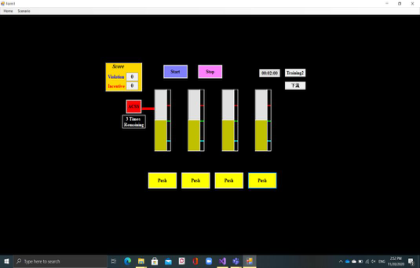
A cognitive experiment was carried out to examine the effects of the two safety approaches. This experiment was designed based on regulatory focus theory (RFT) (Edward, 1997, Lorraine et al. 2000, Jens et al. 2003) to simulate the two safety approaches. RFT has been gathering attention for research on analyzing human motivation and orientation for pursuing his/her goal. The basic principle is that people approach pleasure and avoid pain. RFT distinguishes between the following two sorts of desired end- states: (a) aspirations and accomplishments, which is promotion focus, and (b) responsibilities and safety, which is prevention focus. Thus, people are motivated to approach either promotion focus or prevention focus by the desired end-state. In other words, the presence and absence of positive outco- mes induce the promotion focus since it leads people to seek the presence of the positive outcome. On the other hand, the presence and absence of negative outcomes induce the prevention focus since it leads people to avoid the presence of negative outcome. In this study, performance feedback was used to suggest end-states, which seems one of common methods to moti- vate people (Hattie and Timperley, 2007, Miki et al. 2017). Participants were divided into two groups during the experiment: a prevention focus group and a promotion focus group. Negative feedback (grievances) was given in the prevention focus group, which stressed not to make mistakes, thus fol- lowing the Safety-I approach. This could make the participants focus on whether or not they lose credibility as the overall objective, assuming the prevention focus would be induced. Positive feedback (thanks) for team- work behavior, in contrast, was given in the promotion focus group, thus following the Safety-II approach. This could make the participants focus on gaining thanks or not as the overall objective, assuming the promotion focus would be induced. In brief, prevention focus was considered as utili- zing Safety-I perspective while promotion focus was considered as utilizing Safety-II perspective. A PC-based simulator called “Simplified Gauge Control Simulator”(SGCS) was developed for the experiment, as seen in Fig. 1. In this experiment, a participant was required to handle two tasks continuously: a promotion focus task and a prevention focus task, as in previous research (Miki et al., 2017&2018). The promotion focus task was defined as to make incentives, which was added if a gauge is kept in between red and green
Promoting Team-Oriented Behavior Based on Regulatory Focus Theory 109
Figure 1: Example of the simulator screen.
lines continuously for about 5 seconds. The prevention focus was defined as not making violations, which was counted if a gauge goes below a blue line. The prevention focus tasks, avoiding violations, was set as a primary goal while the promotion focus tasks, gaining incentives, was set as secondary goal, reflecting the actual safety management on site. Regarding the difficulty of each task, it was iterated and designed such that the number of violations made by participants would be proportional to the number of incentives gai- ned by them. Since the purpose of this experiment is to gain general ideas under a certain experimental condition, it was decided that data would be collected from observation of novices. At the beginning of the experiment, the following experiment settings were explained to all participants: (1) Two participants, an upper region operator and a lower region operator take part in the experiment as a team. (2) An upper region operator performs a task scenario first, and then a lower region operator takes over the task scenario which reflects the performance of the upper region operator. (3) The task per- formance of participants is evaluated as the total score of the pair. The score is calculated by adding the incentives of the lower region operator and subtra- cting violations by both the upper region and lower region operators. (4) Only a lower region operator can use an Automatic Control Supporting System (ACSS). The ACSS button, which is a red button on the simulator screen, has a function of pausing the leftmost gauge automatically for 10 seconds in betw- een the red and green line, which enables a participant to gain two incentives. 3 incentives by an upper region operator were needed to make it possible to use ACSS one time for the lower region operator. Regarding (2), participants were led to trust that there is a partner, but the partner did not exist. All participants, therefore, solely played all task scenario. The reason for the simulated team task was to catch the upper region operator in a double bind. Obtaining more incentives by an upper region operator possibly supports a lower region operator, providing the available time of ACSS. This, however, might result in making more violations by an upper region operator, leading to lower scores. The hypotheses of this study to reveal the questioned parts in the previous section are describes as follows: (1) negative feedback ena- bles self-oriented behavior, strongly focusing on avoiding negative outcome, and (2) positive feedback encourages team-oriented behavior with better
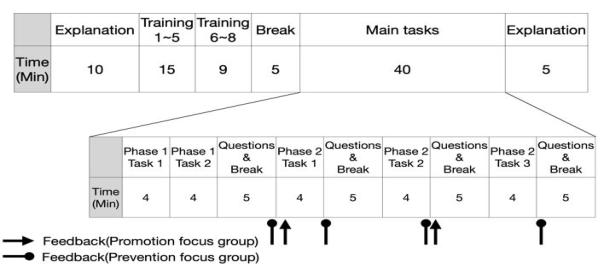
Figure 2: Schedule.
balance, focusing on both avoiding negative outcome and gaining positive outcome.
COGNITIVE EXPERIMENT The participants of this experiment were 45 students at Tohoku University (33 males and 12 females). 23 participants were assigned into a prevention focus group, and the other 22 participants were assigned into a promotion focus group, at random. The timeline of the experiment is shown in Fig. 2. In addition to the explanation mentioned in previous section, a participant was informed that his/her role for training tasks was a lower region operator and would switch to an upper region operator for main tasks, and his/her partner’s role would switch as well. Thus, all participants performed training tasks as a lower region operator, with tasks No. 1~No. 5 performed while ACSS was disabled to get used to the normal operation of the simulator, and tasks No. 6 ~No. 8 performed with ACSS enabled in order to understand operating the lower region while experiencing how effective and useful using the ACSS function was. The main tasks consisted of two phases: Phase 1 to observe their inherent performance, and Phase 2 to observe the regulatory- focused performance. Before going on to Phase 2, participants were given an explanation that their performance would be evaluated by their partner. Then, the feedback for other pairs was shown, which was actually produced by an experimenter. The feedback for the promotion focus group included only positive feedback with appreciation of ACSS feature or teamwork. On the other hand, the feedback for the prevention focus group included only negative feedbacks with grievances. Additionally, during Phase 2 tasks, the number of violations were orally told to the prevention focus group in order to maintain the prevention-focused climate. Fake positive feedback from his/her partner on the experimental setting was delivered to the promotion focus group right after the Phase 2 task 2 to maintain the promotion-focused climate. For analyzing attitude of participants in addition to performance, the participants were asked several questions through a questionnaire after each task in Phase 2 as well as at the time of completing Phase 1. The que- stions included, for example, “What was focus ratio on Goal 1 (primary
Promoting Team-Oriented Behavior Based on Regulatory Focus Theory 111
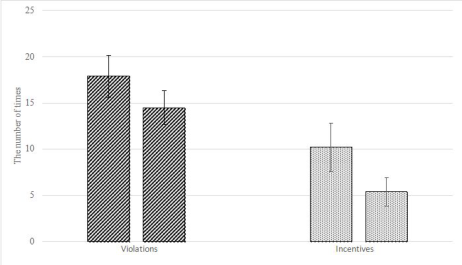
Figure 3: The number of violations (Phase 1(left) and Phase 2 (right)) and incentives (Phase 1(left) and Phase 2 (right)) in the prevention focus group.
goal) out of 10 (10/10 focus on Goal 1 means focusing on only achieving Goal 1)?”.
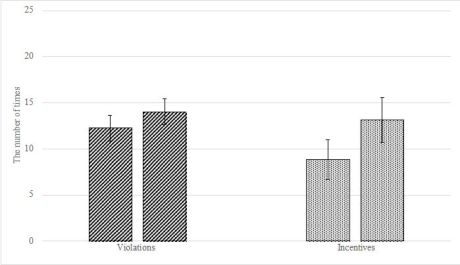
RESULTS AND ANALYSIS To test hypotheses (1) and (2) as mentioned at the end of section 2, the variance of attitude and performing behavior by feedback should be exa- mined. Analyzing attitude would express how feedback functioned as well as analyzing performance. At first, the average of focus ratio on goal 1 during Phase 1 and Phase 2 was calculated. The focus ratio during Phase 1 are quite similar, 6.6 for the promotion focus group and 6.9 for the prevention focus group (W=230.5, p=0.067, r=0.076 (small) (Atsushi and Osamu, 2008)), which was expected to be same since the participants were assigned ran- domly to balance the original focus or mindset of participants, and given same explanation and training experience. Regarding Phase 2, the average focus ration on goal 1 for promotion focus group dropped down to 5.3 (V=155, p=0.013<0.05, r=0.53(large)), indicating the mindset of the participants had become more team-oriented through the positive feedback. The average focus ratio on goal 1 for the prevention focus group, in contrast, increases to 7.8 (V=34.5, p=0.013<0.05, r=0.52(large)). Prevention focus became dominant with a stronger focus on avoiding violations after the negative feedback. In terms of the variance of performance, the average number of violations and incentives during Phase 1 and Phase 2 was analyzed. Fig. 3 and Fig. 4 repre- sent the number of violations and incentives of the prevention focus group and the promotion focus group, respectively.
As seen in Fig. 3, the average of violations significantly declines from 18 to 15 (t(22)=2.2, p=0.038<0.05, d=0.47 (medium) (Atsushi and Osamu, 2008)) as well as the average of incentives decrease from 10 to 5 (t(22)=2.1, p=0.045<0.05, d=0.47 (medium)). The results correspond to the attitude variance analyzed above and can be explained by the perspective of the pre- vention focus under the regulatory focus theory. Thus, the hypothesis (1) was confirmed. The average in Fig. 4, on the other hand, increase from 9 to 13 for the incentives with significant difference (t(21)=-2.6, p=0.017<0.05,
Figure 4: The number of violations (Phase 1(left) and Phase 2 (right)) and incentives (Phase 1(left) and Phase 2 (right)) in the promotion focus group.
d=0.56 (medium)), but from 12 to 14 for the violations without significant difference (t(21)=-1.3, p=0.21, d=0.27 (small)). These results can be parti- ally explained by the perspective of the promotion focus. If the average of violations for the promotion focus increased significantly, they could com- pletely make sense as reversed results of the prevention focus group. The insignificance possibly implies that either (1) participants somewhat maintai- ned focusing on avoiding violations complying with the experimental rules even while their mindset shifted more to team-oriented by the positive feed- back, or (2) gaining more incentives did not produce as many violations due to the simulator setting, resulting in such outcomes. In the case of (2), parti- cipants would have noticed that the number of violations did not rise much while they only focused on gaining incentives. The focus ratio on goal 1 for the promotion focus group, however, is 5.3. In other word, the focus ratio on goal 2 is 4.7, meaning participants still needed to pay attention on avoiding violations. Otherwise, significantly raised number of violations would have been counted during Phase 2. As a result, the case (1) is more likely to be supported. In other words, participants in promotion focus group possibly utilized available resources including time and capability to control four gau- ges, trading-off the promotion focus task and the prevention focus task well while participants in prevention focus group would not have noticed and not even have attempted to look for the way to utilize their recourses to avoid the number of incentives decreasing during Phase 2 significantly. These findings provide support for the hypothesis (2).
DISCUSSION AND CONCLUSION This experiment empirically examined the characteristics of participants behaviors in terms of team performance under two conditions simulating different safety approaches. Participants in the promotion focus group recei- ved positive feedback, thanks, while those in prevention focus group received negative feedback, grievance. Under Safety-I approach (corresponding to the prevention focus group), the participants became more self-protective to pre- vent violations, with little regard towards teamwork. They achieved to
Promoting Team-Oriented Behavior Based on Regulatory Focus Theory 113
decrease the number of violations remarkably, but also ended up declining the number of incentives significantly. This possibly indicates that Safety-I approaches may not be the most effective way to realize a higher level of safety. Certainly, the management is so powerful that participants paid more attention to avoid the negative outcomes in this experiment. However, their situation awareness was narrowed down to only this factor on a personal level, sacrificing team-oriented behavior. The number of incentives decre- ased significantly in the prevention focus group, nevertheless they did not notice it, nor look for the way to balance their strongly biased focus. The results obtained from the promotion focus group, on the other hand, suggest the better potential of Safety-II approaches to realize safety through better teamwork. The insignificant increase in the number of violations for the pro- motion group implies that participants took care of not making violations even while they were more team-oriented. The result, therefore, possibly indicates that Safety-II approaches might provide more balanced trade-off between self-protected behavior and team-oriented behavior than Safety-I approaches. For future work, one possibility is to incorporate domain speci- fic settings in an elaborated experiment to let participants adapt to the actual working environment and gain more practical results for the specific domain since the results of this experiment were gained from observing novice’s per- formance under simplified experimental settings, having some limitation to be widely applied to domain specific environments.
ACKNOWLEDGMENT
This work was supported by JSPD KAKENHI Grant Number 19H02384.
REFERENCES
American Airlines’ Department of Flight Safety. (2020) “Trailblazers into Safety-II: American Airlines’ Learning and Improvement team, A White Pape Outlining AA’s Beginnings of a Safety-II Journey”. Amy, C. E. (2012). Teaming: How Organizations Learn, Innovate, and Compete in
The Knowledge Economy. New Jersey: Jossey-Bass. Atsushi, M., Osamu, T. (2008) “Basics and Consideration for Reporting Effect Sizes in research papers”, Studies in English Language Teaching. 31, pp. 57–66. Edward, T. H. (1997) “Beyond Pleasure and Pain”, American Psychologist. 52(12),
pp. 1280–1300. Hattie, J., Timperley, H. (2007) “The Power of Feedback”, Review of Educational Research. 77, pp. 81–112. Hollnagel, E. (2013) “From Safety-I to Safety-II: A White Paper “, EUROCON-
TROL. Hollnagel, E. (2018). Safety-II in practice. England: Routledge. pp. 663–698. Jens, F., Edward, T. H., Amy, T. B. (2003) “Speed/accuracy Decisions in Task Performance: Built-in trade-off or separate strategic concerns?”, Organizational Behavior and Human Decision Processes. 90(1), pp. 148–164. Jon, B. H., Michael, J. S., Brian, E. S., Lawrence, J. P., Bryan, L. M., Ilya, A.,
Colleen, T. C., Oliver, C. A., Viraj, A., Cynthis, H. N. (2019) Human Performance Contributions to Safety in Commercial Aviation. Hampton : Langley Research Center.
Lorraine, C. I., Nira, L., Edward, T. H. (2000) “Distinguishing Gaines from Nonlosses and Losses from Nongains: A Regulatory Focus Perspective on Hedonic Intensity”, Journal of Experimental Social Psychology. 36(3), pp. 252–274. Louis, D. M. (2013). Turn the Ship Around! England: Portfolio. Miki, T., Masato, N., Atsushi, A. (2017) “Regulatory Focus Moderates Process
Feedback and Motivation”, Japanese Journal of Educational Psychology. 65, pp. 321–332. Miki, T., Masato, N., Shuhei, M. (2018) “Regulatory Focus and Task Performance: Learned Helplessness Paradigm”, Japanese Journal of Educational Psychology. 66, pp. 287–299. Rhona, F., Paul, O., Margaret, C. (2016). Safety at the sharp end: a guide to non-
technical skills. Florida: CRC press.
LISTED IN THE AHFE DIGITAL BOOKSTORE CATALOGUE
Explore the complete digital volume
Human Error, Reliability, Resilience, and Performance
Read this individual research paper free through the original publisher, or explore the full digital proceedings book.
ISBN 978-1-958651-09-4
Explore this ISBN in the AHFE Bookstore ↗Listed in the July 2026 bookstore catalogue; search by ISBN to confirm current availability · Digital book purchase optional