Dennis Bakir, Robin Bakir, Florian Domin, Hermann Fürstenau (2026). External Confirmation, Trust Badges and Public Funding as Organizational Stressors: A Concierge Buffer Framework for Non-Linear Scaling in SMEs. In: Human Interaction and Emerging Technologies (IHIET-AI 2026): Artificial Intelligence and Future Applications. AHFE Open Access, vol. 201, pp. 610–618. https://doi.org/10.54941/ahfe1007214
Public funding and external confirmations are key-factors to catalyze non-linear growth in small and medium-sized enterprises (SMEs), particularly in scaling phases around €2 million revenue where managerial capacity is limited and founders remain primary decision bottlenecks. At the same time, these mechanisms introduce a persistent multi-stressor environment characterized by administrative documentation, complex rules-of-use, audit exposure, clawback risk, publication obligations, cashflow timing uncertainty, and reputational liability. Empirically, such constellations are associated with behavioral patterns analogous to sustained high-load responses described in stress research, including hypervigilance, avoidance of triggering tasks, impaired delegation, and increased decision latency (McEwen, 1998; Adler et al., 2009). We use the term “entrepreneurial PTSD-like” strictly as a bounded functional analogy to describe organizational stress reactions that may act as burnout precursors under insufficient recovery (Hobfoll, 1989; Southwick & Charney, 2012).To preserve the growth leverage of funding while reducing overload, we introduce the Concierge Buffer Framework (CBF), which conceptualizes funding as a resilience engineering problem rather than a paperwork task. CBF buffers stressors through a combined human–system–automation design comprising:(i)a dedicated concierge governance function, (ii)standardized controls and evidence architecture, (iii)document-operations automation and cadence tracking, and (iv)deep rule expertise across funding and prestige regimes. Its core artefact, the Concierge Buffer Matrix, maps stressor dimensions across the funding lifecycle and specifies buffering mechanisms that translate destabilizing demands into stable operating routines.The framework is demonstrated using three pseudonymized SME cases without prior public funding experience. Additionally, a buffer-withdrawal episode reveals rapid rebound effects—reactivation of hypervigilance, avoidance, and decision latency—consistent with trigger-like dynamics described in stress research (McEwen, 1998). While causal inference is limited, the contribution lies in a stressor taxonomy, an actionable buffering artefact, and a measurement plan for future controlled studies.
SMEs, especially this one scaling at about €2M revenue, frequently face some crucial transition points: commercial opportunities grow faster than internal structure and inherent mental capabilities of success. Founders still own critical decisions, risk, and external communications. In this phase, public funding and external confirmations have a strong correlation to catalyze further growth e.g. by subsidizing delivery or training and reducing customer spend from free liquidity.
However, funding regimes simultaneously impose strict accountability and external scrutiny. For inexperienced and/or not business-settled SMEs, funding is rarely a single additional task; it is a coupled system of requirements that amplifies uncertainty, liability, and visibility.
This paper takes a direct position: repeated funding-related demands can become a chronic stress exposure that changes executive cognition and organizational behavior. Under sustained exposure, responsible leaders may even shift into protective patterns—especially hypercontrol, avoidance, excessive checking, lowered resilience and delayed decisions. These patterns mirror, as a bounded analogy (not an equivalence claim), stress-response dynamics documented in military and trauma research (Adler et al., 2009; Southwick & Charney, 2012). The managerial problem is therefore not whether funding works, but whether the SME can absorb the stress load without degrading its decision system and execution capacity.
Recent empirical studies underline that bureaucratic and administrative burdens are perceived by SMEs not only as a financial and time cost but also as a source of psychological strain and dissatisfaction with public services (Matei and Dogaru, 2012; IfM Bonn, 2025; Plum, 2017).
We propose that the only scalable response is structural buffering: a concierge function that translates bureaucracy into operational routines and governance so the enterprise can capture the upside without destabilizing its operating system. In this manner a organizational resilience layer is added – absorbing most of the new stressors, upcoming with the new opportunity of public fundings a sales and decision facilitator. We further describe how buffering has a second-order signature: when the buffer is removed, the underlying stressor field reasserts itself rapidly (a rebound/trigger effect), revealing the previously masked load at one point of a time (McEwen, 1998).
BACKGROUND AND RELATED WORK Stress, Resilience, and Cumulative Load
Stress research distinguishes acute events from sustained exposure and highlights buffering and adaptive capacity. Allostatic load captures cumulative costs of repeated demands and insufficient recovery and can be applied analytically to organizational decision systems: repeated administrative pressure can accumulate into chronic cognitive load, degraded decision quality, aggressivity and reduced executive bandwidth (McEwen, 1998; Hobfoll, 1989).
Stress Buffering The stress-buffering hypothesis explains why supportive structures reduce the impact of stressors on outcomes (Cohen & Wills, 1985). In organizational contexts, buffering is not limited to emotional support; it can be designed structurally via process scaffolding, governance, role clarity, and external support that reduces uncertainty and perceived downside risk.
Trigger and Rebound Effects Under Renewed Exposure In stress and trauma research, renewed exposure to cues associated with high-load environments can provoke rapid reactivation of protective patterns (e.g., hypervigilance or avoidance) (Southwick & Charney, 2012). In organizational settings, an analogous mechanism is plausible: when protective scaffolding is removed while the stressor field remains, executives face immediate re-exposure to uncertainty, liability, and public scrutiny.
Trauma-Research Transfer (Bounded Analogy) Military and trauma research documents how sustained high-threat environments affect cognition and behavior, including hypervigilance and avoidance of triggers (Adler et al., 2009). We use these constructs carefully as an analytical lens to model repeated compliance/audit exposure.
Administrative Burden in Public Programs Public funding introduces accountability regimes, documentation, and verification that can displace value creation, especially in low-maturity SMEs. Recent survey data for German SMEs estimate that firms spend around seven per cent of their total working time on administrative processes related to legal and regulatory requirements, not counting the additional psychological costs from uncertainty, poor guidance, and fear of making mistakes (KfW Research, 2025).
Especially for inexperienced SMEs, this cumulative administrative burden can intensify fear of failure (especially clawback) and increase reputational anxiety through publication and external scrutiny.
STRESSOR TAXONOMY Funding-related stressors: For SMEs with limited prior experience, public funding and external confirmations typically introduce a multi-stressor environment. We distinguish within this paper a set of twelve recurring stressors:
External Confirmation, Trust Badges and Public Funding as Organizational Stressors 613 (S6) Reputational risk from public visibility and claim scrutiny; (S7) Cashflow timing uncertainty (delayed reimbursements, pre-financing); (S8) Opportunity cost (displacement of delivery/sales); (S9) Responsibility diffusion and role conflict (who owns compliance?); (S10) Decision latency under uncertainty (risk-averse delay); (S11) Cognitive overload from parallel deadlines and ambiguity; (S12) Learned avoidance/hypervigilance patterns (overchecking, withdrawal
from growth initiatives).
Exemplary Stressors and Mechanisms We now highlight three stressors to show the coupling logic: (i) clawback risk (S4) increases hypervigilance and over-checking (S12), driving decision latency (S10); (ii) publication duties (S5) and reputational exposure (S6) amplify fear of visible error and can trigger avoidance of scaling moves; and (iii) cashflow timing uncertainty (S7) forces pre-financing under uncertainty, increasing executive load and internal conflict (S9). These mechanisms explain why funding can produce disproportionate psychological load relative to its nominal ‘paperwork’ share.
CONCIERGE BUFFER FRAMEWORK (CBF) CBF is an applied organizational design pattern for funding-enabled growth under sustained administrative load. Its objective is not to remove stressors— because they are structurally tied to accountability and legitimacy—but to buffer them so that SMEs can capture funding leverage without destabilizing their neural and decision system.
CBF Combines Four Components (C1) Human governance: a dedicated subsidy concierge team that owns compliance translation, runs reporting operations, and serves as a funding-stress-absorbing interface. (C2) Systems: standardized controls, objective evidence mechanisms and
architecture, risk registers, and approval gates. (C3) Automations: document operations (version control, retrieval, checklists), cadence tracking, and repeatable artefact generation to reduce manual load to get everything in the right place to the right time. (C4) Rule expertise: deep familiarity with funding regimes and prestige
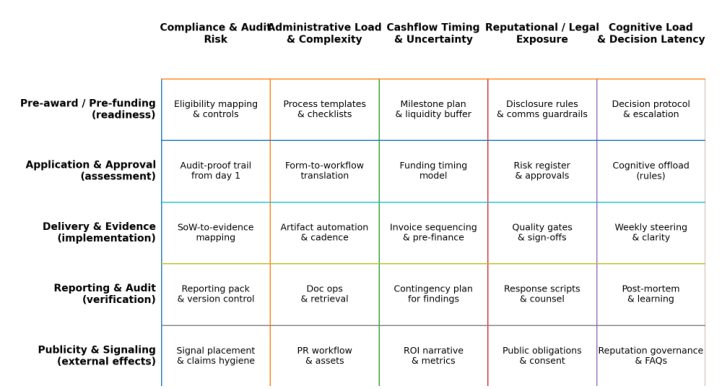
fields (eligibility logic, claim hygiene, program expectations) as well as legally allowed combinations. Core artefact of the Concierge Buffer Matrix are highlighted in Figure 1. The matrix maps stressor dimensions (audit risk, administrative complexity, cashflow uncertainty, reputational/legal exposure, cognitive load) across lifecycle phases (readiness, approval, implementation, reporting/audit, public signaling). Each cell specifies buffering mechanisms that translate
requirements into routines (evidence mapping, templates, cadence, cashflow modeling, risk registers, and decision escalation).
A strong indicator that a structure functions as a buffer is a rebound effect when the structure is removed while stressors relatively remain. Another one is the misuse of the delivered “new” system. In observed episodes, temporary withdrawal of concierge support caused rapid reactivation of hypervigilance and avoidance as well as contra-intuitive behaviors. This observation motivates a practical proposition: buffering should be designed to be robust, transferable, and not dependent on a single individual but a system.
Buffering enables a more resilient, nonlinear scaling. CBF predicts that buffering reduces cognitive overload and decision latency, thereby improving delegation and execution speed. Paradoxically, buffering increases tolerance for the stressors that make funding a high-leverage growth pathway. Funding becomes scalable only when stressors are treated as a system-design problem.
Figure 1 operationalizes the Concierge Buffer Framework by mapping dominant funding-related stressor dimensions against the typical lifecycle phases of public funding. The matrix functions as a design artefact that supports both implementation planning and diagnostic assessment of buffering gaps across the funding lifecycle.
Figure 1: Concierge Buffer Matrix. Stressor dimensions (columns) are mapped across the funding lifecycle (rows). Each cell specifies buffering mechanisms that translate bureaucratic demands into operational routines and governance.
METHODOLOGY
We apply a design science orientation: the primary output is an artefact (CBF and the matrix) grounded in theory and demonstrated through cases. This demonstration uses three observed, pseudonymized SMEs scaling ~€2M
External Confirmation, Trust Badges and Public Funding as Organizational Stressors 615 revenue for about 12 months each and all of them without any prior funding experience.
Data and measurement plan. For each case we capture: (a) stressor profile and triggering events (audit fear, publication duty, legal issues, clawback concerns), (b) behavioural response patterns (avoidance, hyper-control, latency), (c) concierge buffering implementation (human, system, automation components), and (d) outcome indicators: additional cashflow, executive admin hours/week, time-to-decision for growth moves, throughput stability, and perceived downside risk.
Where available, we also document buffer-withdrawal episodes as quasi- natural experiments revealing rebound/trigger dynamics. The cases support mechanism plausibility and measurement feasibility; causal inference remains limited.
CASE STUDIES AND BUFFER-WITHDRAWAL EPISODE Case A (Creative Coaching-Provider). Dominant stressors included administrative load and rules-of-use complexity (S1–S2), publication duties (S5), and reputational fear (S6). The management showed repeated over- checking and avoidance of crucial decisions (S12), leading to latency (S10). CBF buffering introduced evidence templates, a fixed cadence, and claims processual and legal hygiene. This reduced perceived downside risk and enabled a stable offer launch.
Case B (IT Service-Provider). Audit and clawback fears (S3–S4) combined with cashflow timing uncertainty (S7) and responsibility as well as legal conflict (S2, S9), driving hyper-control and blocked delegation. CBF buffering implemented an audit-proof evidence trail mapped to statements of work, milestone-based cashflow planning, and approval gates. Decision and sales speed improved and delegation became feasible.
Case C (Technical Concept & Design-Provider). External scrutiny and reputational exposure (S6) plus opportunity cost (S8) produced cognitive overload (S11) and massive scope drift. CBF buffering professionalized governance via a risk and legal registers, artefact standards, and automation- supported document operations, stabilizing throughput while enabling scaling moves.
Buffer-withdrawal episode: At one moment of each of these partnerships, concierge support was revoked (e.g., resource removal or governance interruption by concierge service provider) while the funding-related stressor field remained unchanged at the beginning. Within days, leaders reported an immediate resurgence of protective patterns: increased loss of focus, delayed and wrong decisions, and avoidance of funding-touching tasks – combined with legal issued through misuse of the new process system.
Operationally, previously stable routines degraded into ad-hoc firefighting, and the perceived downside risk increased sharply. Even heavy misuse of the funding mechanisms has been observed as the leaders decided to be more creative. This dramatic rebound is consistent with a trigger-like response under renewed exposure and suggests that buffering is not merely ‘nice to have’ but structurally necessary for sustained funding-enabled scaling.
Table 1: Three SME cases and one buffer-withdrawal episode showing stressor profiles, overload patterns, and concierge buffering components.
Table available in the original PDF paper.
Case Context / Offer
Key Stressors (Taxonomy)
Overload Pattern (Observed)
CBF Buffer Components (Human / System / Automation)
Operational Shift (Expected/ Observed)
S1,S2, S5,S6, S10,S12
Latency ↓; launch feasibility ↑; anxiety ↓
Avoidance of launch; over-checking; delayed decisions
Rapid rebound of hyper- vigilance; avoidance; latency
Missing/paused governance; routines degrade absence of evidence ops & cadence control
DISCUSSION
The stressor taxonomy clarifies why funding can feel disproportionally heavy, if it is unmanaged applied: it is a coupled system of accountability, liability, and visibility. When stressors accumulate, entrepreneurs may show patterns that resemble sustained high-load responses—hypervigilance (e.g. fear-driven overchecking), avoidance of tasks that re-trigger stressors, impaired delegation, and decision latency. These patterns can be described as “entrepreneurial PTSD-like” in a functional sense and may act as a burnout precursor when recovery is insufficient.
The buffer-withdrawal episode strengthens mechanism plausibility and economy of the additional concierge-service. When the concierge buffer was revoked while stressors remained, protective patterns reactivated rapidly
External Confirmation, Trust Badges and Public Funding as Organizational Stressors 617 and routines degraded tremendously. In stress and trauma research, relapse/ trigger dynamics under renewed exposure are a defining signature of high- load environments. In organizational terms, the rebound indicates that CBF was not merely improving efficiency—it was actively absorbing load and preventing maladaptive response patterns as well as legal issues.
Importantly, stressors are also necessary as growth lever: accountability and evidence demands create legitimacy, allowing the state to co-finance and customers to pay less out-of-pocket (Cantner et al., 2025). The solution is therefore not a neutralizing removal of growth-effects but an effective buffering of stressors. CBF buffers stressors structurally through a human– system–automation design that translates requirements into routines and externalizes compliance ownership. This protects executive decision- making capacity, legal guidelines and enables scaling more precisely because growth-stressors remain present but become manageable.
Because withdrawal may cause a sharp rebound, buffering should be engineered with special care (documentation, automation, and role clarity) so that it neither depends on a single individual nor is company-intern. CBF therefore functions not only as an operational layer but as an organizational resilience layer.
LIMITATIONS AND FUTURE RESEARCH This paper demonstrates mechanisms through cases and does not establish causal effects. The buffer-withdrawal episode is observational and not experimentally controlled. Trauma constructs are used as a bounded analytical transfer; future work should employ standardized measures of stress and burnout risk, longitudinal tracking, and controlled comparisons. The term “entrepreneurial PTSD-like” should be treated as a functional in this manner.
CONCLUSION
External confirmations and public funding may catalyze unusual growth jumps for scaling-willing SMEs, but they also create a sustained multi- stressor environment: additional administrative load, rules-of-use complexity, audit exposure, clawback risk, publication duties, reputational liability, and cashflow uncertainty. As a high-analogy lens the resulting effects can resemble sustained stress responses described in military and trauma research—hyper-vigilance, avoidance, and persistent vigilance—suggesting that an “entrepreneurial PTSD-like” pattern may emerge and may constitute a systematically burnout precursor when unmanaged.
Because these stressors are structurally tied to accountability and legitimacy, the only scalable strategy is buffering rather than avoidance. The Concierge Buffer Framework operationalizes buffering as a combined human–system– automation design centred on the Concierge Buffer Matrix.
The observed buffer-withdrawal rebound provides an additional signature: when buffering is removed while stressors remain, protective patterns reactivate rapidly. This strengthens the practical conclusion that concierge buffering is not optional in funding-enabled scaling; it is a structural requirement for sustaining growth without destabilizing executive decision capacity.
ACKNOWLEDGMENT
The authors would like to acknowledge SME practitioners whose operational experiences and anonymized case material informed the development and refinement of the Concierge Buffer Framework.
REFERENCES
Adler, A.B., Bliese, P.D., McGurk, D., Hoge, C.W. & Castro, C.A. (2009). Battlemind training: Psychological resilience in combat. In: Castro, C.A., Adler, A.B. & Britt, T.W. (eds.), Military Life: The Psychology of Serving in Peace and Combat. Westport, CT: Praeger. Cantner, U., Dauchert, H., Dreier, L., Figge, P. & Haeussler, C. (2025). Technological
sovereignty of an economy: mastery and availability of key enabling technologies. In: Cantner, U., Fornahl, D. & Kuhlmann, S. (eds.), The New Role of the State for Transformative Innovation. Cheltenham: Edward Elgar. Accepted for publication. Cohen, S. & Wills, T.A. (1985). Stress, social support, and the buffering hypothesis.
Psychological Bulletin, 98(2), 310–357. ESKALATOR AG (2025) SVA [Online]. Available at: https://eskalator.ag/ sva (Accessed: 20 January 2026). ESKALATOR AG (2026) Regionalförderung [Online]. Available at: https://eskalator.
ag/regionalfoerderung (Accessed: 21 January 2026). Hevner, A.R., March, S.T., Park, J. & Ram, S. (2004). Design science in information systems research. MIS Quarterly, 28(1), 75–105. Hobfoll, S.E. (1989). Conservation of resources: A new attempt at conceptualizing
stress. American Psychologist, 44(3), 513–524. IfM Bonn (2025) The psychological costs of bureaucratic burdens [Online]. Institut für Mittelstandsforschung Bonn. Available at: https://www.ifm-bonn.org/en/ news/meldung/the-psychological-costs-of-bureaucratic-burdens (Accessed: 21 January 2026). Karasek, R.A. (1979). Job demands, job decision latitude, and mental strain.
Administrative Science Quarterly, 24(2), 285–308. Matei, A. and Dogaru, T.-C. (2012) ‘Administrative burden and business satisfaction with public services’, Transylvanian Review of Administrative Sciences, 35E, pp. 98–113. McEwen, B.S. (1998). Protective and damaging effects of stress mediators. New
England Journal of Medicine, 338(3), 171–179. Plum, E. (2017) Sweating the small stuff: The impact of the bureaucracy burden.
London: Plum Consulting for Sage. Schwartz, M. (2025) SMEs spend seven per cent of their working time on administrative processes. Focus on Economics No. 493. Frankfurt am Main: KfW Research. Southwick, S.M. & Charney, D.S. (2012). Resilience: The Science of Mastering Life’s
Greatest Challenges. Cambridge: Cambridge University Press. WissensReich Academy GmbH (2025) Concierge-Leistungen [Online]. Available at: https://www.wissensreich.academy/concierge-leistungen (Accessed: 21 January 2026). Yin, R.K. (2018). Case Study Research and Applications (6th ed.). Sage.
LISTED IN THE AHFE DIGITAL BOOKSTORE CATALOGUE
Explore the complete digital volume
Human Interaction and Emerging Technologies (IHIET-AI 2026): Artificial Intelligence and Future Applications
Read this individual research paper free through the original publisher, or explore the full digital proceedings book.
ISBN 978-1-964867-77-9
Explore this ISBN in the AHFE Bookstore ↗Listed in the July 2026 bookstore catalogue; search by ISBN to confirm current availability · Digital book purchase optional