Dennis Bakir, Robin Bakir, Maximilian Müller, Patrick Starkmann (2026). Awards and Certifications as Trust Signal Infrastructure -Quantifying Reputation and Prestige Effects for international SMEs and the Leveraging Role of Public Funding-. In: Human Interaction and Emerging Technologies (IHIET-AI 2026): Artificial Intelligence and Future Applications. AHFE Open Access, vol. 201, pp. 435–443. https://doi.org/10.54941/ahfe1007197
Publisher statistics will load when you open Metrics.
AHFE OPEN ACCESS OPEN ACCESS CONFERENCE PROCEEDINGS PAPER
Awards and Certifications as Trust Signal Infrastructure -Quantifying Reputation and Prestige Effects for international SMEs and the Leveraging Role of Public Funding-
Small and medium-sized enterprises (SMEs) routinely lose economically rational B2B transactions not because of insufficient capability, but because prospective—especially international—customers cannot reliably infer whether a provider is trustworthy and fit for purpose. This unresolved uncertainty generates a persistent trust gap driven by information asymmetry, leading to stalled negotiations, proposal ghosting, and default selection of institutionally familiar but economically inferior alternatives. The effect is substantially amplified in cross-border contexts, particularly when providers operate under international legal forms such as LLCs or Ltds while serving German or European markets.This paper conceptualizes awards and certificates as well as proofs of granted public fundings as additional Trust Infrastructure: a structured ensemble of externally conferred signals—including awards, certifications, ministerial recognitions, institutionally conferred roles, and public funding eligibility—that systematically reduce perceived risk and accelerate human decision-making in B2B procurement. Grounded in signalling theory and institutional legitimacy research, award signals are modelled as costly-to-fake indicators that transfer credibility through third-party scrutiny and comparative evaluation. Beyond belief formation, they support internal decision justification, thereby lowering action thresholds in high-uncertainty purchasing situations.To quantify their economic contribution, the paper introduces the Award Reputation Return Framework (ARRF), a measurement-oriented model specifying three primary impact pathways: (A) a Wins Pathway, (B) a Velocity Pathway, and (C) a Price Pathway. The framework further integrates public funding eligibility as an institutional legitimacy multiplier and payment infrastructure alignment as an independent trust dimension. A single-case study demonstrates substantial improvements across conversion rates, decision speed, pricing power, and especially proposal ghosting following trust infrastructure deployment.
ReceiveReceived January 21, 2026; Revised February 24, 2026; Accepted March 10, 2026; Available online April 1, 2026
INTRODUCTION
SMEs operate under persistent information asymmetry: suppliers barely know their own capabilities, while buyers face uncertainty regarding quality, continuity, and downside risk. In markets where services are difficult to verify ex ante, purchasing decisions are shaped less by objective fit and more by perceived risk and internal decision defensibility. The dominant failure mode is therefore not explicit rejection but decision avoidance, expressed as prolonged evaluation, no-decision outcomes, or silent proposal drop-off (ghosting).
Cross-border service delivery amplifies this mechanism. Even when delivery is remote and technically equivalent, buyers perceive additional uncertainty related to standards, enforceability, communication, and transaction execution. For SMEs operating under foreign legal forms such as LLCs or Ltds, this often results in a structural credibility deficit that remains invisible to the supplier.
This paper argues that externally anchored awards and certificates as signal, institutional endorsements, and public program eligibility—can be deliberately designed as additional Trust Infrastructure to reduce perceived risk and support internal decision justification. It further deducts that payment-related trust elements constitute a separate but decisive layer that must be addressed to prevent late-stage transaction failure.
DEVELOPING A TRUST INFRASTRUCTURE TO SUPPORT SME DECISION-MAKING Trust Infrastructure as a System-Level Construct
Trust Infrastructure is defined as a structured, externally anchored set of signals that reduces uncertainty and supports internal decision justification in high-risk purchasing contexts. Unlike marketing claims, these signals derive credibility from third-party scrutiny and institutional embedding.
Trust Infrastructure comprises mainly three interacting layers:
1. Reputational Signals (Awards, recognitions, certifications) 2. Institutional Legitimacy Signals (Public funding eligibility, ministerial programs, institutionally conferred roles, ministerial logos) 3. Transactional Trust Signals (Adress, payment infrastructure, currency, bank jurisdiction, legal framing) Each layer addresses a distinct component of perceived risk and together forms a cumulative trust effect.
Awards as Costly-to-Fake Signals Grounded in signalling theory (Spence, 1973), awards and recognitions function as costly-to-fake indicators. Their acquisition requires external evaluation, comparative assessment, and reputational exposure. From an institutional perspective, they embed SMEs within recognized structures, transferring legitimacy across market boundaries (Suchman, 1995).
Awards and Certifications as Trust Signal Infrastructure-Quantifying 437 Research on status and reputation suggests that externally conferred distinctions shape market expectations and competitive outcomes by creating visible hierarchies of credibility and legitimacy (Podolny, 1993; Rao, 1994). In this sense, awards function not merely as signals of past achievement but as status markers that influence future evaluations under uncertainty.
Crucially, Award Signals operate through a dual mechanism: they reduce uncertainty about capability and provide decision-makers with defensible justification narratives, lowering the personal and organizational risk of supplier selection.
INSTITUTIONAL LEGITIMACY AND PUBLIC FUNDING AS A RISK-REDUCTION MECHANISM Public funding eligibility operates less as a signal of superior quality and more as a high-impact institutional legitimacy mechanism. Buyers do not interpret funding as proof that a solution is “better,” but as evidence that the provider and project have passed external screening, documentation, and accountability thresholds. This screening effect materially reduces perceived downside risk in purchasing decisions.
This mechanism is particularly visible in the German R&D tax incentive (Forschungszulage). Here, externally mediated eligibility assessment and mandatory technical documentation introduce an additional layer of institutional validation. For interested parties, this validation functions as a proxy for seriousness, durability, and procedural reliability, even though it does not certify outcome quality.
The effect intensifies when public subsidies cover a substantial share of project costs. When 50–90% of client expenditure is offset, perceived risk is not merely reduced but economically capped. The buyer’s decision shifts from evaluating potential loss to assessing residual uncertainty, significantly lowering the threshold for action under conditions of incomplete information.
Beyond immediate cost effects, public funding eligibility also enforces structured project design, documented milestones, and auditable outcomes. These features increase award feasibility and simultaneously generate secondary trust effects in downstream markets. In this way, public funding acts as a legitimacy multiplier: it shapes buyer behavior at the point of purchase while reinforcing reputational and market trust after project completion.
PAYMENT TRUST AS A SUPPORTIVE FRAMEWORK FOR TRANSACTION EXECUTION Empirical observation shows that trust does not end with provider selection. Buyers cognitively separate performance risk from transaction risk, and payment-related concerns frequently act as a late-stage veto—particularly in cross-border contexts, where the liability of foreignness amplifies perceived uncertainty regarding enforcement, continuity, and recovery (Dashi et al., 2024). The following concept was widely applied to German and Swiss SME as clients of international suppliers, so these groups will be focus of the further discussions.
Table 1: Payment-related trust parameters in cross-border B2B transactions if customer is German.
Table available in the original PDF paper.
Parameter Risk Dimension Reduced EUR invoicing Exchange and accounting risk
EU-based bank Enforcement and recovery risk Familiar bank institution Fraud and continuity risk
Local language documentation Cognitive and legal ambiguity SEPA / EU legal framework Regulatory uncertainty
For SMEs operating under international, especially offshore structures, alignment on these parameters is essential to prevent silent deal collapse unrelated to service quality.
THE AWARD REPUTATION RETURN (ARRF) FRAMEWORK In organizational purchasing contexts, trust is commonly defined as a willingness to accept vulnerability based on positive expectations regarding the intentions or behaviour of another party (Mayer et al., 1995). The Award Reputation Return (ARRF) Framework builds on this understanding by modelling how Trust Infrastructure reduces perceived vulnerability and decision defensibility costs.
The ARRF Framework operationalizes Trust Infrastructure by translating externally conferred credibility into observable and measurable commercial outcomes. ARRF is not a general reputation index; it is explicitly designed to capture decision-relevant effects under conditions of high ex ante uncertainty, where buyers face both performance risk and internal justification risk.
ARRF models trust effects as behavioural outcome shifts, not attitudinal changes. The framework assumes that Trust Infrastructure primarily reduces perceived downside risk and decision defensibility costs, which in turn alters buyer behaviour along three outcome pathways.
Element of Wins Pathway The Wins Pathway captures the effect of Trust Infrastructure on the likelihood that an initiated opportunity results in a decision in favour of the provider. In high-uncertainty contexts, the dominant failure mode is not rejection but decision avoidance, expressed as stalled processes, “no decision” outcomes, or silent proposal ghosting.
Award Signals and Institutional Legitimacy Signals reduce this avoidance by:
lowering perceived failure probability, and
providing decision-makers with defensible external justification.
Operationally, this pathway manifests as:
increased conversion rates (especially from cold or low-familiarity leads), and
a reduction in no-decision outcomes and proposal ghosting.
Awards and Certifications as Trust Signal Infrastructure-Quantifying 439 The Wins Pathway is therefore particularly sensitive to trust infrastructure in cross-border and low-brand-familiarity contexts, where baseline uncertainty is high and internal risk aversion dominates.
Element of Velocity Pathway The Velocity Pathway captures the effect of Trust Infrastructure on time- to-decision. Even when a provider is perceived as capable, unresolved uncertainty can prolong internal discussions, trigger repeated reassurance requests, and delay commitment.
simplifying internal alignment through externally validated signals.
In practice, this results in:
shorter decision cycles,
fewer clarification loops, and
faster escalation from proposal to commitment.
Importantly, the Velocity Pathway reflects not increased urgency but reduced friction. Decisions are made sooner because fewer cognitive and organizational hurdles remain unresolved.
Element of Price Pathway The Price Pathway captures changes in the buyer’s willingness-to-pay as perceived risk declines. In uncertain purchasing situations, buyers implicitly price a risk premium into their valuation, leading to discount pressure, conservative project sizing, or scope reduction.
Trust Infrastructure affects pricing by:
lowering the perceived probability of negative outcomes, and
reducing the need for informal risk compensation via price concessions.
Observable effects include:
higher average project values, and
reduced discounting pressure during negotiation The Price Pathway does not assume that awards signal superior technical quality. Rather, they reduce perceived downside variance, allowing buyers to accept higher prices without increasing perceived exposure.
ARRF Moderators ARRF explicitly accounts for contextual factors that amplify or attenuate trust infrastructure effects. These moderators do not create ARRF effects on their own but shape their magnitude.
Table 2: Moderators influencing ARRF effect size.
Table available in the original PDF paper.
Moderator Expected Influence Procurement formality Positive Category risk Positive
Procurement formality increases the need for defensible decisions, strengthening the impact of external validation.
Category risk raises perceived downside, increasing sensitivity to trust signals.
Brand / Supplier unfamiliarity heightens reliance on third-party cues.
Cross-border distance compounds uncertainty across legal, institutional, and cultural dimensions, making Trust Infrastructure particularly impactful.
Together, these moderators explain why ARRF effects are most pronounced in international SME contexts and why Trust Infrastructure is disproportionately valuable for providers operating outside familiar institutional environments.
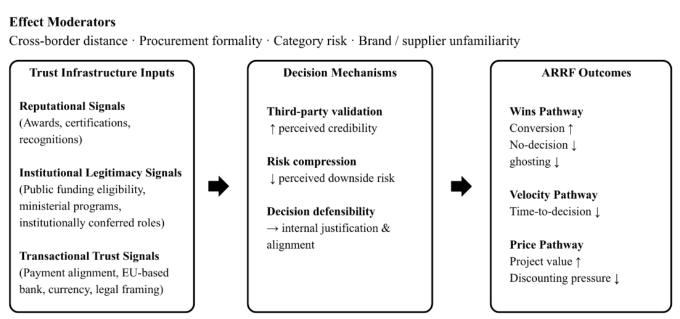
Integrative Framework View Award Signals and Institutional Legitimacy Signals reduce perceived risk through credibility transfer and decision justification. These effects propagate through the Wins, Velocity, and Price pathways, with magnitude moderated by procurement formality, category risk, brand unfamiliarity, and cross- border distance.
This integrative view positions ARRF as a decision-centric measurement framework, directly linking trust infrastructure elements to observable commercial behaviour rather than abstract reputation constructs.
Figure 1: Awards as Trust Infrastructure (ARRF-Framework). Award Signals and Institutional Legitimacy Signals reduce perceived risk via credibility transfer and decision justification, impacting Wins, Velocity, and Price; effects are moderated by crossborder distance, procurement formality, category risk, and brand unfamiliarity.
VERIFICATION AND MEASUREMENT APPROACH ARRF Dashboard
ARRF is implemented as a dashboard using standard SME data and may be used in CRM-logics:
Cold- and warm-lead conversion
Proposal ghosting rate
Decision cycle time
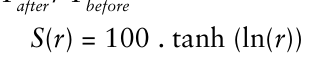
Average project value ARRF Index (Bounded)
Win pathway = w; Velocity pathway = v; Price pathway = p For metric X : rX = Xafter / Xbefore For cycle time T : rT = Tafter / Tbefore
Equation reproduced from the original PDF.
WW+WV+WP At this manner the dashboard remains the primary reporting tool; the index supports comparison across periods and cases.
CASE STUDY: CROSS-BORDER TRUST GAP IN IT PROCESS CONSULTING (MERCOSUR → DACH) The case concerns a German-trained entrepreneur operating an IT process consulting SME from Mercosur-region (lives as perpetual traveller) while serving German-speaking markets. His company is an US LLC, based in Florida and transactions are made with stripe as (rather expensive) payment provider or at the US bank account, which leads to SWIFT and routing numbers instead of an IBAN.
Despite high delivery quality, the firm experienced a persistent trust deficit: prospective DACH clients perceived elevated risk due to cross-border distance and uncertainty about standards, continuity, and enforceability. The dominant failure mode was decision avoidance expressed as proposal ghosting and a rather low acceptance of the pricing.
Effect through Trust Infrastructure intervention. The SME introduced Award Signals and Institutional Legitimacy Signals aligned with DACH expectations, including (i) eligibility within a federally supported consulting context and (ii) an institutional lecturer role at a business academy. These signals were systematically integrated into proposals and decision materials to support internal buyer justification.
Outcomes. Pre/post metrics indicate substantial improvements across Wins, Velocity, and Price (Table 3). Notably, the nature of rejections improved: silent drop-off shifted toward explicit, appreciative, and reasoned decisions, suggesting reduced avoidance behaviour and higher decision confidence even when rejecting.
Table 3: Observed pre/post changes in key commercial metrics.
Table available in the original PDF paper.
Indicator Before After Direction Cold-lead conversion <1% 4% Increase
Warm-lead conversion 11% 35% Increase Average project value €1,850 €3,500 Increase
The case supports the core claim that global delivery can create an unobserved trust deficit that suppresses wins, slows decisions, and erodes pricing power without explicit negative feedback. Trust Infrastructure makes this deficit measurable and treatable. Public funding eligibility and comparable institutional screening cues operate as legitimacy multipliers because they externalize evaluation and provide defensible selection narratives for buyers.
The most crucial practical implication is that cross-border capability is not sufficient. Companies must design and measure Trust Infrastructure to prevent silent trust loss and convert fit into decisions. ARRF provides a very pragmatic measurement layer using existing operational data, enabling iterative optimization of trust elements and their placement in buyer touchpoints.
So the research implication is that ARRF offers a structured basis for future controlled studies, including multi-case replications, matched controls, staggered rollouts, and longitudinal measurement to estimate effect size and decay/reinforcement dynamics.
LIMITATIONS AND FUTURE RESEARCH The demonstration is observational and based on below under cases with structured pre/post design; therefore causal inference is limited. Confounders may include changes in messaging, lead quality, seasonality, or market conditions. Future work should apply ARRF across more SMEs and contexts and incorporate controlled comparisons (e.g., matched firms without Trust Infrastructure, staggered rollout designs) to strengthen causal claims and quantify generalizability.
CONCLUSION
This paper demonstrates that many cross-border SME failures are rooted not in capability deficits but in missing Trust Infrastructure. Awards, institutional legitimacy signals, public funding eligibility, and payment alignment function as complementary system elements that reduce perceived risk and improve measurable outcomes. The ARRF Framework provides a structured, measurement-oriented approach to diagnosing and addressing silent trust loss in international SME markets.
ACKNOWLEDGMENT
The authors would like to acknowledge SME practitioners whose operational data and experiences informed the development of the ARRF framework.
REFERENCES
Dashi, E., Banka, H., Laco, M. and Ardic, O. (2024) Measuring the cost of crossborder business-to-business payments in the Western Balkans. Washington, DC: World Bank Group. David, P. A., Hall, B. H., & Toole, A. A. (2000). Is public R&D a complement or
substitute for private R&D? Research Policy, 29(4–5), 497–529. ESKALATOR AG (2025) SVA [Online]. Available at: https://eskalator.ag/sva (Accessed: 21 January 2026). Eskalator AG (2026) Forschungszulage 2026. Available at: https://forschungszulage.
eskalator.ag/ (Accessed: 21 January 2026). Hevner, A. R., March, S. T., Park, J., & Ram, S. (2004). Design science in information systems research. MIS Quarterly, 28(1), 75–105. Howell, S. T. (2017). Financing innovation: Evidence from R&D grants. American
Economic Review, 107(4), 1136–1164. Lerner, J. (1999). The government as venture capitalist. Journal of Business, 72(3), 285–318. Mayer, R. C., Davis, J. H., & Schoorman, F. D. (1995). An integrative model of
organizational trust. Academy of Management Review, 20(3), 709–734. Podolny, J. M. (1993). A status-based model of market competition. American Journal of Sociology, 98(4), 829–872. Rao, H. (1994). The social construction of reputation. Strategic Management Journal,
15(S1), 29–44. Spence, M. (1973). Job market signaling. Quarterly Journal of Economics, 87(3), 355–374. Suchman, M. C. (1995). Managing legitimacy. Academy of Management Review,
20(3), 571–610. Yin, R. K. (2018). Case study research and applications (6th ed.). Sage.
LISTED IN THE AHFE DIGITAL BOOKSTORE CATALOGUE
Explore the complete digital volume
Human Interaction and Emerging Technologies (IHIET-AI 2026): Artificial Intelligence and Future Applications
Read this individual research paper free through the original publisher, or explore the full digital proceedings book.
ISBN 978-1-964867-77-9
Explore this ISBN in the AHFE Bookstore ↗Listed in the July 2026 bookstore catalogue; search by ISBN to confirm current availability · Digital book purchase optional