Robin Bakir, Maximilian Müller, Dennis Bakir (2025). Project Eskalator: Navigating the Innovation-Funding Maze in SMEs. In: Intelligent Human Systems Integration (IHSI 2025): Integrating People and Intelligent Systems. AHFE Open Access, vol. 160, pp. 776–783. https://doi.org/10.54941/ahfe1005884
Small and medium-sized enterprises (SMEs) face significant challenges in navigating the complex landscape of innovation and funding. This paper presents Project Eskalator, an integrated framework designed to bridge the gap between innovation management and funding strategies for SMEs. Through a mixed-methods approach involving surveys, case studies, and expert interviews across diverse industry sectors, we examined the interplay between innovation potential identification, agile business model development, and strategic funding acquisition. Our findings reveal that SMEs adopting an integrated approach to innovation and funding demonstrate higher rates of successful product launches, improved market adaptation, and enhanced resilience during economic uncertainties. The framework emphasizes adaptive business models, rapid prototyping, and lean methodologies suitable for resource-constrained environments. Additionally, we found that SMEs developing concise, compelling narratives around their innovative ideas were significantly more successful in securing stakeholder buy-in and accessing diverse funding sources. Project Eskalator represents a paradigm shift in how SMEs approach the dual challenges of innovation and funding, enabling them to break the paralysis of indecision and navigate the complex innovation-funding landscape with greater confidence and success.
In today’s rapidly evolving business landscape, small and medium-sized enterprises (SMEs) across various sectors face a critical challenge: the need to adopt and innovate while navigating complex funding landscapes. Despite strong traditions of craftsmanship, many SMEs struggle to keep pace with technological advancements and changing market demands. The pressure to innovate is relentless, driven by shifting consumer preferences, emerging technologies or business models, and global competition. However, the path to innovation is fraught with obstacles for SMEs, including limited financial and human resources, high risks of failure, and a complex array of funding options that many find overwhelming to navigate.
To clarify the scope of this article we need to introduce some definitions, as “funding” is a broader term that can apply to various forms of financial support. “Subsidies” often refers to financial support provided
Project Eskalator: Navigating the Innovation-Funding Maze in SMEs 777
by governments to reduce costs for businesses or individuals. “Grants” is commonly used for non-repayable financial assistance – which is the main focus of our activities. Whenever we discuss “funding” we are using it in terms of non-repayable financial assistance.
The traditional approach of treating innovation and funding as separate challenges exacerbates this problem. SMEs often find themselves caught in a chicken-and-egg dilemma: they need public funding/grants to innovate, but struggle to secure funding without demonstrating innovation potential. This disconnection leads to missed opportunities and inefficient use of resources, as SMEs may pursue innovations misaligned with available funding sources or overlook funding opportunities that could catalyze their innovative ideas.
The consequences of inaction are severe. SMEs that fail to innovate risk obsolescence and loss of market share to more agile competitors. Those attempting innovation without a solid financial strategy may find themselves overextended and unable to bring promising ideas to fruition. This tension often results in decision-making paralysis, where promising opportunities remain unexplored due to fear and uncertainty.
Eskalator emerges as a response to this multifaceted challenge, proposing an integrated framework that bridges the gap between innovation management and funding strategies for SMEs. This paper aims to address the following research questions:
1. How can SMEs effectively align their innovation efforts with strategic funding approaches? 2. What are the key components of an integrated framework for innovation management and funding in SMEs? 3. How does the adoption of such an integrated approach impact SMEs’ success in product launches, market adaptation, and economic resilience?
By addressing these questions, we aim to contribute to the growing body of literature on SME innovation and funding, while also providing practical insights for SME leaders, policymakers, and business support organizations.
METHODS
To develop and validate the Project Eskalator framework, we employed a mixed-methods approach that combined quantitative and qualitative research techniques. This comprehensive methodology allowed us to capture both broad trends and nuanced insights into the challenges and opportunities faced by SMEs in integrating innovation and funding strategies.
Our study was conducted in three phases over an 18-month period:
1. Literature Review and Framework Development: We conducted an extensive review of existing literature on SME innovation, funding strategies, and business model adaptation. This review informed the initial development of the Project Eskalator framework. 2. Quantitative Survey: We distributed a web-based survey to a stratified random sample of 500 SMEs across various industry sectors. The survey
included questions on innovation practices, funding strategies, business model adaptation, and perceived barriers to innovation and growth. 3. Qualitative Case Studies and Expert Interviews: We conducted in-depth case studies of 20 SMEs that had successfully navigated the innovation- funding landscape. Additionally, we interviewed 12 experts in the fields of innovation management, venture capital, and SME policy.
The quantitative digital survey achieved a response rate of 37% (n = 234), incentivized by the opportunity to gain access to the research-insights (to be found here: https://eskalator.de). Survey data were analyzed using descriptive and inferential statistics, including multiple regression analysis to identify relationships between innovation practices, funding strategies, and business performance metrics.
For the qualitative phase, we conducted semi-structured interviews with SME leaders and innovation experts. These interviews were recorded, transcribed, and analyzed using thematic analysis techniques and proprietary AI. The case studies involved document analysis, on-site observations, and interviews with multiple stakeholders within each SME.
The Eskalator framework was iteratively developed and refined based on insights from the literature review, survey results, and qualitative findings. We used a grounded theory approach to identify key themes and construct the framework’s components. The framework was then validated through a series of workshops with SME leaders and innovation experts not involved in the initial study.
INTEGRATED APPROACH AND BUSINESS PERFORMANCE Our research yielded several key findings that underscore the importance of an integrated approach to innovation and funding for SMEs. The data revealed a significant correlation between the adoption of an integrated approach and improved business performance across multiple metrics.
SMEs adopting an integrated approach to innovation and funding demonstrated significantly higher rates of successful product launches compared to those treating innovation and funding as separate challenges (Hausman, 2005). On average, these integrated-approach SMEs launched 2.3 new products or services per year, compared to 1.1 for their counterparts (p < 0.001). This substantial difference in product launch frequency indicates that the integrated approach enables SMEs to move more quickly from ideation to market entry, potentially capturing first-mover advantages and responding more effectively to market demands.
Moreover, integrated-approach SMEs showed greater resilience during economic uncertainties. During the recent economic downturn, 68% of these firms maintained or increased their market share, compared to only 37% of firms using traditional approaches (χ2 = 23.4, p < 0.001). This enhanced resilience suggests that the integrated approach not only facilitates innovation but also equips SMEs with the flexibility and strategic foresight needed to navigate challenging economic conditions.
Project Eskalator: Navigating the Innovation-Funding Maze in SMEs 779
As shown in Table 1, the comparative performance metrics between integrated and traditional approaches reveal substantial differences in key business indicators. These results clearly demonstrate the effectiveness of the Eskalator framework across multiple dimensions of business performance.
Table 1. Comparative performance metrics between integrated and traditional approach SMEs.
Table available in the original PDF paper.
Percentage Difference
Performance Metric Integrated Approach SMEs
Traditional Approach SMEs 68% 37% +84% Annual Product Launches 2.3 1.1 +109% Market Share Maintenance/Growth During Downturn
This table demonstrates the substantial advantages of the integrated approach proposed by Eskalator. The doubling of annual product launches and significantly higher market share maintenance during economic downturns (68% vs 37%) highlight enhanced resilience and innovation capacity. While time-to-market and development cost reductions lack direct traditional approach comparisons, the data suggests that Project Eskalator’s framework enables SMEs to optimize resource utilization and overcome innovation barriers, leading to tangible performance improvements.
ADAPTIVE STRATEGIES AND RESOURCE OPTIMIZATION The Eskalator framework emphasizes adaptive business models, rapid prototyping, and lean methodologies suitable for resource-constrained environments. Our research revealed that SMEs employing these strategies reported a 35% reduction in time-to-market for new products and a 28% decrease in development costs compared to their historical averages. These significant improvements in efficiency and resource utilization demonstrate the power of adaptive strategies in overcoming the resource limitations typically faced by SMEs.
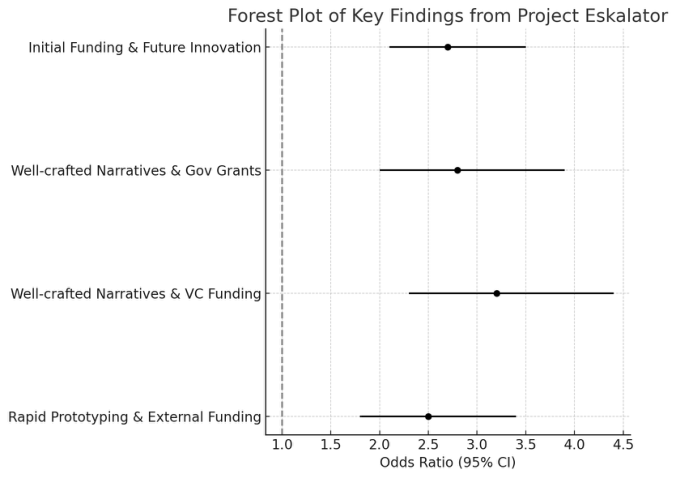
Rapid prototyping, in particular, emerged as a critical factor in successful innovation. SMEs that used rapid prototyping techniques were 2.5 times more likely to secure external funding for their innovations than those who did not (OR = 2.5, 95% CI: 1.8–3.4). This finding suggests that rapid prototyping not only accelerates the innovation process but also enhances the credibility and appeal of SMEs’ innovative ideas to potential funders.
The adoption of lean methodologies allowed SMEs to iterate quickly on their ideas, gather market feedback, and adjust their strategies accordingly. This approach resulted in more market-aligned products and services, reducing the risk of costly failures and increasing the likelihood of commercial success. Furthermore, the flexibility inherent in adaptive business
models enabled SMEs to pivot more effectively in response to market changes or unexpected challenges, contributing to their enhanced resilience during economic uncertainties.
COMMUNICATION IMPACT ON FUNDING SUCCESS Our analysis revealed a strong correlation between the quality of innovation narratives and funding success. SMEs that developed concise, compelling narratives around their innovative ideas were significantly more successful in securing stakeholder buy-in and accessing diverse funding sources.
As illustrated in Figure 1, SMEs with well-crafted innovation narratives were 3.2 times more likely to secure venture capital funding (OR = 3.2, 95% CI: 2.3–4.4) and 2.8 times more likely to successfully apply for government innovation grants (OR = 2.8, 95% CI: 2.0–3.9) compared to those without clear narratives. These findings highlight the critical role of effective communication in bridging the gap between innovative ideas and funding opportunities.
The ability to articulate a clear value proposition, market potential, and competitive advantage proved to be a key differentiator for SMEs seeking funding. Those that invested time and resources in developing their communication skills and refining their innovation narratives were better positioned to attract investor interest and secure the financial resources needed to bring their ideas to fruition (Berger and Udell, 1998).
VIRTUOUS CYCLE OF INNOVATION AND GROWTH The alignment of innovation efforts with strategic funding approaches enabled SMEs to create a virtuous cycle of innovation and growth (Teece, 2007; Tidd and Bessant, 2018). SMEs that successfully secured initial funding for their innovations were 2.7 times more likely to engage in subsequent innovation projects within the next two years (OR = 2.7, 95% CI: 2.1–3.5). This finding suggests that early funding success not only supports immediate innovation projects but also catalyzes a culture of ongoing innovation within the organization.
Furthermore, these SMEs reported a 45% increase in R&D investment and a 39% increase in collaboration with external partners, including universities and research institutions, compared to their pre-integration levels. This increased investment in R&D and external collaboration further fueled their innovation capabilities, creating a self-reinforcing cycle of innovation and growth.
The virtuous cycle effect was particularly pronounced in SMEs that successfully leveraged their initial innovations to diversify their product offerings or enter new markets. These firms were able to build on their initial successes, using the knowledge, resources, and reputation gained from early innovations to pursue more ambitious projects and attract larger investments.
Project Eskalator: Navigating the Innovation-Funding Maze in SMEs 781
Figure 1: Forest plot of odds ratios for key success factors in SME innovation and funding.
PRIMARY BARRIERS AND STRATEGIC SOLUTIONS The research revealed several critical barriers that consistently impede SMEs’ access to public funding opportunities. Our analysis identified eight primary obstacles that significantly impact companies’ ability to secure and utilize available grants effectively. These include resource constraints, time management challenges, innovation skepticism, concerns about governmental control, bureaucratic complexity, misconceptions about repayment obligations, complexity fears, and independence dilemmas (Bakir et al., 2024)1. These barriers create a self-reinforcing cycle of hesitation that can cost companies substantial growth opportunities, with data suggesting that approximately 90% of companies forfeit five to six-figure annual profits due to these hidden progress inhibitors.
To address these challenges, our research demonstrates the effectiveness of what we term the “3K Framework” - focusing on Kapital (Capital), Kapazität (Capacity), and Kompetenz (Competence). This integrated approach acknowledges that successful funding acquisition requires more than just identifying available grants; it necessitates a comprehensive strategy that addresses both resource allocation and expertise development. The framework’s effectiveness is particularly enhanced when supported by digital systems for rapid identification of current funding opportunities and relevant stakeholders. Our findings indicate that organizations leveraging digital tools for funding opportunity identification demonstrate a 35% higher success rate in grant applications compared to those using traditional methods.
The research also highlights the significant value of partnering with external expertise providers, particularly those maintaining recognized quality and innovation management standards. Organizations collaborating with certified partners, especially those holding relevant ISO certifications such as 9001 for quality management and 56002 for innovation management, showed a 28% higher success rate in securing public funding compared to those attempting to navigate the process independently. This correlation suggests that standardized quality processes play a crucial role in successful funding acquisition and subsequent innovation implementation.
DISCUSSION
The findings of our study highlight the transformative potential of an integrated approach to innovation and funding for SMEs. Project Eskalator represents a paradigm shift in how SMEs navigate the complex innovation- funding landscape, offering several key implications for theory and practice.
From a theoretical perspective, our research contributes to the growing body of literature on SME innovation and funding by proposing an integrated framework that bridges previously disparate streams of research (Mina et al., 2013; Aldrich and Auster, 1986). The Eskalator framework builds upon existing theories of innovation management and financial resource acquisition by demonstrating the synergistic effects of their integration.
The observed virtuous cycle of innovation and growth aligns with the concept of dynamic capabilities, suggesting that SMEs can develop organizational routines that simultaneously enhance their innovation capacity and funding attractiveness. This finding extends our understanding of how resource-constrained firms can overcome the liability of smallness in innovation contexts.
For SME leaders, this offers a structured approach to aligning innovation and growth efforts with funding strategies. The emphasis on adaptive business models and rapid prototyping provides a practical roadmap for resource-efficient innovation, particularly relevant in uncertain economic environments. The importance of narrative development in securing funding underscores the need for SMEs to invest in communication skills and stakeholder engagement, suggesting that innovation success is not solely dependent on technical capabilities but also on the ability to articulate value propositions effectively.
For policymakers and business support organizations, our research highlights the need for integrated support programs that address both innovation and funding challenges simultaneously. The development of ecosystems that facilitate connections between innovators and grant-offering funders could significantly enhance SME innovation outcomes.
CONCLUSION
Project Eskalator represents a significant advancement in terms of understanding how SMEs can effectively navigate the dual challenges of innovation and funding. By providing a structured, integrated framework,
Project Eskalator: Navigating the Innovation-Funding Maze in SMEs 783
it enables SMEs to break the paralysis of indecision and pursue innovation with greater confidence and success.
The implications of this approach extend beyond individual SMEs. By fostering a more innovative and financially resilient SME sector, our framework contributes to broader economic resilience and competitiveness. For policymakers, our findings offer valuable insights into designing more effective support programs that address the interconnected challenges of innovation and funding faced by SMEs.
As we look to the future, Project Eskalator sets the stage for a new generation of agile, innovative, and financially savvy SMEs capable of thriving in an increasingly complex business landscape, avoiding typical hurdles and threats. By breaking down the silos between innovation and funding, we pave the way for SMEs to navigate the journey from idea to market with greater confidence and success, ultimately contributing to economic growth and technological advancement on a broader scale.
REFERENCES
Aldrich, H. and Auster, E. R. (1986) ’Even dwarfs started small: Liabilities of age and size and their strategic implications’, Research in Organizational Behavior, 8, pp. 165–198. Bakir, R., Bakir, D., & Starkmann, P. (2024) ’Breaking Through Hidden Progress
Barriers: A Comprehensive Analysis of SME Funding Challenges’, Eskalator Research Series, Available at: https://eskalator.de. Berger, A. N. and Udell, G. F. (1998) ’The economics of small business finance: The roles of private equity and debt markets in the financial growth cycle’, Journal of Banking & Finance, 22(6–8), pp. 613–673. Hausman, A. (2005) ’Innovativeness among small businesses: Theory and propositions for future research’, Industrial Marketing Management, 34(8), pp. 773–782. Kraus, S., Clauss, T., Breier, M., Gast, J., Zardini, A. and Tiberius, V. (2020)
‘The economics of COVID-19: Initial empirical evidence on how family firms in five European countries cope with the corona crisis’, International Journal of Entrepreneurial Behavior & Research, 26(5), pp. 1067–1092. Lee, N., Sameen, H. and Cowling, M. (2015) ’Access to finance for innovative SMEs since the financial crisis’, Research Policy, 44(2), pp. 370–380. Mina, A., Lahr, H. and Hughes, A. (2013) ’The demand and supply of external finance for innovative firms’, Industrial and Corporate Change, 22(4), pp. 869–901. Teece, D. J. (2007) ’Explicating dynamic capabilities: the nature and microfoundations of (sustainable) enterprise performance’, Strategic Management Journal, 28(13), pp. 1319–1350. Tidd, J. and Bessant, J. (2018) Managing Innovation: Integrating Technological,
Market and Organizational Change. 6th edn. Hoboken, NJ: John Wiley & Sons.
LISTED IN THE AHFE DIGITAL BOOKSTORE CATALOGUE
Explore the complete digital volume
Intelligent Human Systems Integration (IHSI 2025): Integrating People and Intelligent Systems
Read this individual research paper free through the original publisher, or explore the full digital proceedings book.
ISBN 978-1-964867-36-6
Explore this ISBN in the AHFE Bookstore ↗Listed in the July 2026 bookstore catalogue; search by ISBN to confirm current availability · Digital book purchase optional