Gianluca D'Agostino, Hilary Serra, Claudio Zavattaro (2023). The emotional impact of cultural heritage on the public: physiological and psychological effects of multisensorial experiences. In: Design for Inclusion. AHFE Open Access, vol. 75, pp. 103–113. https://doi.org/10.54941/ahfe1003331
Accessibility and inclusion are nowadays consolidated concepts in Cultural Heritage management and enhancement. In this regard, attention has long been focused only on audiences with disabilities, translating into projects and actions that involve people with disabilities while excluding a broader approach that takes into account the specificities of each individual. Since Cultural Heritage belongs to every individual, it represents an opportunity to apply “design for all” principles, considering the variety of publics and “non-publics”, each with different interests and needs. With the knowledge that vision is widely considered the primary sense in communication, the paper aim to investigate the role of other senses in creating an enjoyable and emotional experience of the Cultural Heritage that can enrich its perception, knowledge and memory. Though non-visual and multisensorial cultural experiences are conceived to include publics with visual difficulties, they can become enriching and valuable ways of approaching Cultural Heritage for all visitors.The study aims to investigate arousal changes related to the emotional activation of an adequate sample of visitors during Cultural Heritage experiences through different senses, except for vision. Participants will be blinded and will undergo the cultural experience with various sensorial modalities through three counterbalanced conditions that will involve, respectively, one (auditory), two (auditory and tactile) and three (auditory, tactile, and olfactory) senses. Previous international studies have already enlightened physiological measures as a reliable indicator of the visitor’s body reaction related to the emotional state of the experience. Therefore, during all the experimental sessions, non-invasive wearable devices will register cardiovascular and skin conductance measures as quantitative physiological data. Instead, regarding qualitative measures, self-reported evaluation of both emotional state and visit experience will be collected through an online questionnaire.Authors hypothesize that also when vision does not play a significant role, the more the senses involved, the more the participants’ emotional state will enhance positively. Therefore, an increase in both physiological activation and perceived positive emotions is expected in the three-senses condition compared with the one and two-senses conditions. In general, the multisensory experience is foreseen to be associated with greater emotional involvement, enjoyment, and appreciation of the cultural visit. The impacts and results of this study can be helpful in improving cultural enjoyment in a plurality of publics, opening up new scenarios for the knowledge, perception and enhancement of Cultural Heritage to strengthen the binding between heritage and people.
Accessibility and inclusion are nowadays consolidated concepts in Cultural Heritage management and enhancement. In this regard, attention has long been focused mainly on audiences with disabilities, translating into projects and actions dedicated to specific categories of visitors, rather than solutions that could “be usable by all people, to the greatest extent possible” (UN, 2006). Today the public is very heterogeneous, and many cultural institutions are already working on finding new ways to engage and reach diverse audiences through more inclusive and integrated solutions. Thanks to a broader appro- ach, designing cultural experiences considers each individual’s specificities to
create and improve the ways of experiencing cultural heritage and also reach the non-public1. Although attitudes that see accessibility as strictly correlated to disabilities are still popular, new approaches are evolving, opening up the possibility of creating quality cultural experiences for all audiences together. Moreover, since Cultural Heritage belongs to every individual (Council of Europe, 2005), it represents an opportunity to apply Design For All princi- ples, considering the variety of publics and non-publics, each with different interests and needs.
To make Cultural Heritage accessible and inclusive, many barriers, not only physical ones, need to be considered. In fact, many people feel uncomfor- table in museums and cultural places because they do not have the knowledge or instruments to experience them fully (Dal Pozzolo, 2021). Cultural con- tents are, indeed, still mainly experienced through a cognitive dimension, even if studies show that the emotional dimension can positively contribute to learning and cultural experiences (Eidelman et al. 2013). Furthermore, pre- vious international studies have already enlightened physiological measures as a reliable indicator of the visitor’s body reaction related to the emotional state of the experience (Higuera-Trujillo et al., 2021; Tschacher et al., 2012). Taking into account and studying the visitor’s emotional state can contribute to creating new and different ways of enjoying and experiencing Cultural Heritage to ensure an individual and intimate appropriation (Benente et al., 2022).
Use of Senses in Cultural Heritage Experiences Aware that vision is widely considered the primary sense in communication, the paper presents a study aimed at investigating the role of other senses in cultural experiences. Though non-visual and multisensorial tools, such as 3D tactile models, are usually conceived to include audiences with visual difficulties and children, they can become enriching and valuable ways of approaching Cultural Heritage for all visitors. Replicas and 3D models in cultural places are usually made to give people with visual difficulties an opportunity to access art and culture or to entertain kids during the visit. In the first case, specific routes tailored for blind and partially sighted peo- ple have often been created apart from traditional paths to offer 2D and 3D tactile representations2. Many curators and directors then realized that these ‘special’ spaces were not inclusive, since they forced blind people to be separated from their friends and family while visiting museums, while multi- sensorial approaches can support cultural experiences and make them more attractive to a wider range of visitors (Museo tattile statale Omero, 2006).
Museums are known to be places where touch is usually forbidden, mainly for conservation and safety reasons. However, inclusive design solutions have been increasingly used in museums in the last years to promote cultural access
1Terms such as ‘non-publics’ and ‘disaffected public’ refer to people who are not interested in and not used to experiencing cultural heritage for various reasons, someone who lives in marginalized conditions, and those who physically cannot reach cultural places. 2For example, the Petite Galerie at the Louvre Museum in Paris, opened in 2008 and then closed for renovation.
The Emotional Impact of Cultural Heritage on the Public 105
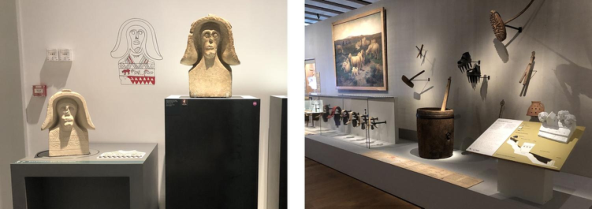
Figure 1: Multisensorial stations and 3D models integrated into museum exhibits to allow people to touch replicas (on the left) and to discover further information about the theme presented (on the right).
for all, through different senses (Figure 1). For example, Tactile Studio is an inclusive design agency that creates educational solutions for cultural pla- ces enhanced by sensory experiences such as touch, sound, and smell3. They promote new forms of engagement in arts and culture, with models and solu- tions made to be more integrated into the traditional routes and available and usable by everyone. Through multisensorial experiences, such as storytelling, tactile explorations, immersive visits, etc., people can discover new and dif- ferent forms of encountering, enjoying, and appreciating Cultural Heritage. Furthermore, physiological and psychological studies can support in under- standing and enhancing its emotional impact. In this regard, the study aims to investigate arousal changes related to the emotional activation of an ade- quate sample of participants during a cultural experience through different senses, except for vision.
METHOD
Participants Authors recruited thirty healthy volunteers (17 females and 13 males; mean age 29, 77 ± 9, 55) to participate in the study. For each participant, demo- graphic data were gathered. The experimental protocol was reviewed and approved by the Ethics Committees of the University of Turin (Italy). All participants signed the informed consent.
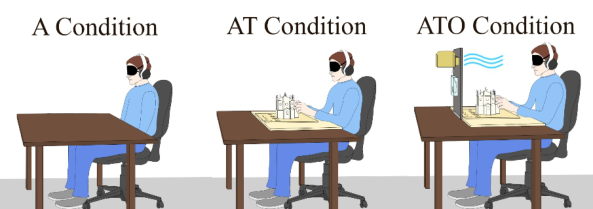
Experimental Conditions Participants were randomly assigned to one of three experimental conditions (Figure 2): audio (A), audio-tactile (AT) and audio-tactile-olfactory (ATO) conditions. In all three conditions participants were blindfolded and wore noise-canceling headphones. In condition A, participants listened to an audi- oguide on the history and architecture of the Chieri Baptistery. In the AT and ATO conditions, information to guide the tactile exploration of the 3D model was added to the audioguide (for example, “Move your hands tow- ards until you reach the stairs of the main entrance”). Furthermore, in the
ATO condition, when the narrative voice mentioned the word “incense”, an essence diffusion system was employed to dispense an incense fragrance for 30 seconds.
Physiological Parameters Heart rate (HR) and heart rate variability (HRV), which are considered two of the most validated indicators for stress response, were measured continu- ously during the experimental procedure through an E4 Empatica wristband. Authors calculated frequency-domain HRV indicators: high frequency (HF) and low frequency (LF). HF was used as an index of the parasympathetic nervous system (PNS) activity, while LF as an index of sympathetic nervous system (SNS) activity.
Emotional State To assess the participants’ emotional state before and after the experimen- tal condition, eight items of the circumplex model of affect were used. This model includes different emotional states ranging from positive to negative, and from high arousal to low arousal emotions. In the survey, participants had to answer questions like “To what extent do you feel this way right now, that is, at the present moment?” using a 5-point Likert scale ranging from “1 (not at all)” to “5 (extremely).
Experience Evaluation Similarly, four adjectives were used for the experience evaluation section of the survey (engaging, boring, pleasant, exhausting), always using a 5-point Likert scale from “1 (not at all)” to “5 (extremely)”. In addition, a question about the pleasantness of the incense fragrance was added only to the online survey administered after the ATO condition.
Information Retention To comprehend the impact of the three experimental conditions (A, AT, ATO) on the retention of information provided during narration, participants answ- ered three questions about some architectural features of Chieri Baptistery
The Emotional Impact of Cultural Heritage on the Public 107
(floorplan typology, its position relative to the Cathedral, tiburium shape) and a question about the use of incense.
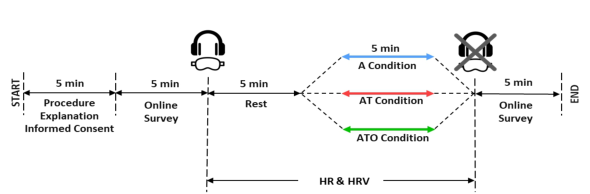
Experimental Procedure At the beginning of the experiment, participants were introduced to the expe- rimental procedure and asked to read and sign the informed consent. After completing the first online survey, they wore the E4 Empatica wristband to collect physiological parameters and were asked to put on a blindfold and headphones. Then, they took a 5-min rest during which their baseline physio- logical status was recorded. Afterward, participants were randomly assigned to one of the previously described experimental conditions.
In the end, they removed the blindfold and headphones and completed the last (second) survey. The experiment lasted approximately 30 minutes. (See Figure 3 for the timeline).
Statistical Analyses Statistical analyses were performed with the software SPSS (IBM, version 26.0). For physiological measures (HR and HRV), a Python code was pro- grammed to calculate for both rest and experimental conditions the mean HR and the HRV frequency domain parameters (LF; HF), also using the pyhrv Python package (Gomes et al., 2019). Furthermore, to compare physiological data across experimental conditions, the differences between experimental and rest conditions for all parameters were used as outcome measures. The same approach was also applied for emotional state responses resulting from surveys, with the difference in scores between the second and the first survey used as outcome measure.
At first, two participants from HR analysis (one from AT and one from ATO conditions), and three more participants from HRV analysis (one from each condition) were excluded from the analyses due to Z-point scores that exceeded 2.8 standard deviations. On the contrary, no outliers were found in the survey scores.
In the second place, to analyze the difference between the three conditions in physiological and psychological data the non-parametric Kruskal-Wallis H test was used followed by pairwise comparisons. Lastly, Bonferroni correction was applied as post-hoc analysis.
Figure 3: Timeline of the experimental procedure. Notes: A condition: audio condition; AT condition: audio-tactile condition; ATO condition: audio-tactile-olfactory condition; HR: heart rate; HRV: heart rate variability.
RESULTS
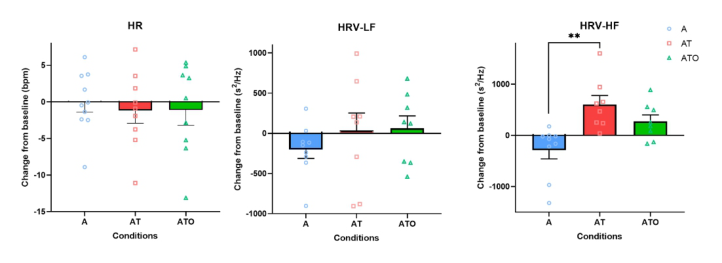
Physiological Measures Regarding HR and HRV-LF measures, the Kruskal Wallis (H) test did not reveal significant differences between conditions, while a significant diffe- rence between conditions was found in HRV-HF parameter (p = 0.001). Pairwise comparisons indicated that HF was significantly higher in AT and ATO conditions in comparison with A condition (p < 0.001 and p = 0.022 respectively), while no effects were found when comparing AT with ATO (p = 0.221). Post-hoc test using the Bonferroni correction confirmed the significant difference only for A-AT comparison (p = 0.001) as shown in Figure 4 and Table 1.
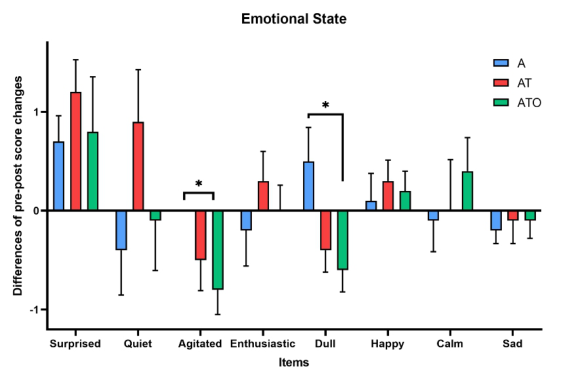
Emotional State Concerning emotional state, the Kruskal Wallis (H) test revealed signifi- cant differences between conditions in the “agitated” (p = 0.02) and “dull”
Figure 4: Physiological data analysis. Notes: A: audio; AT: audio-tactile; ATO: audio- tactile-olfactory; HR: heart rate; HRV: heart rate variability; LF: low frequency; HF: high frequency. ** = p < 0.01, generated by Bonferroni correction. Error bars depict the standard error of the mean (SEM).Table 1. P-values resulting from statistical analyses conducted on the physiological data.
The Emotional Impact of Cultural Heritage on the Public 109
(p = 0.021) adjectives. Pairwise comparisons indicated that AT condition generated significantly less dullness (p = 0.046), while ATO condition gene- rated significantly less agitation and dullness (p = 0.005 and p = 0.007 respectively) compared to A condition. Both adjectives were still significantly different in the ATO condition in respect to the A condition after Bonferroni correction as post-hoc analysis (p = 0.015 and p = 0.022 respectively), as shown in Figure 5 and Table 2.
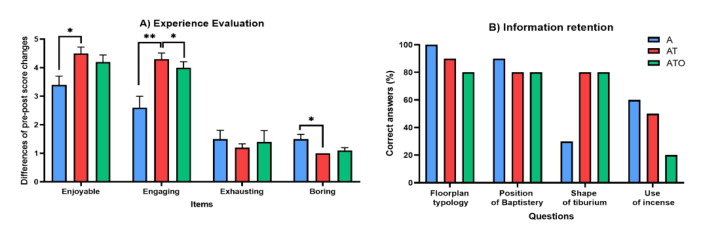
Experience Evaluation Regarding experience evaluation, the Kruskal Wallis (H) test found signi- ficant differences between conditions in “enjoyable”, “engaging”, and “boring” adjectives (p = 0.03, p = 0.004, and p = 0.015 respectively), while no differences were found in the “exhausting”adjective (p = 0.612). Pairwise comparisons indicated that AT condition was considered significantly more enjoyable (p = 0.01), while both AT and ATO conditions were considered significantly more engaging (p = 0.002 and p = 0.016 respectively) and signi- ficantly less boring (p = 0.006 and p = 0.028 respectively) than A condition. All comparisons were still significantly different after Bonferroni correction as post-hoc analysis, with the exception of the adjective “boring” in the A-ATO comparison (see Table 3 and Figure 6A).
Information Retention Regarding information retention data, Authors calculated the percentage of right answers to the four questions about the architecture of Chieri Baptistery and the use of incense. Results showed that participants assigned to all con- ditions answered correctly when asked about the floorplan typology of the
Figure 5: Emotional state data analysis. Notes: A: audio; AT: audio-tactile; ATO: audio- tactile-olfactory. * = p < 0.05, generated by Bonferroni correction. Error bars depict the standard error of the mean (SEM).Table 2. P-values resulting from statistical analyses conducted on the emotional state data.
Table available in the original PDF paper.
EMOTIONAL STATE DATA Conditions Enthusiastic Calm Happy Sad
Figure 6: A) Experience evaluation data analysis. * = p < 0.05, ** = p < 0.01, generated by Bonferroni correction. Error bars depict the standard error of the mean (SEM). B) Information retention data analysis. Notes: A: audio; AT: audio-tactile; ATO: audio- tactile-olfactory.
Baptistery and its position relative to the Cathedral. Interestingly, participants assigned to the conditions involving tactile exploration (AT or ATO) greatly improved in the number of correct answers related to the tiburium shape in relation to those that underwent the audio-only condition. On the contrary, the question about the use of incense showed an inverse trend with ATO con- dition participants, reporting a greater number of wrong answers compared to both A and AT conditions participants (see Figure 6B).
The Emotional Impact of Cultural Heritage on the Public 111
Table 3. P-values resulting from statistical analyses conducted on the experience evaluation data.
Table available in the original PDF paper.
EXPERIENCE EVALUATION DATA Conditions Enjoyable Engaging Exhausting Boring
DISCUSSION AND CONCLUSION The study investigated the physiological and emotional responses of 30 heal- thy participants to a non-visual multisensorial experience of a 3D replica of the Chieri Baptistery.
Data analysis revealed significant differences only between participants in A-AT and A-ATO comparisons, indicating the positive impact of multisenso- rial experiences on both physiological and psychological levels.
In particular, our results show that implementing tactile exploration of a 3D model while listening to an audioguide resulted in higher PNS activity (connected with relaxation), but also higher engagement, enjoyment, and lower boredom.
On the other hand, adding an odor essence during a multisensorial expe- rience did not influence the physiological level. However, the trisensory con- dition positively affected participants’ psychological responses, with reports of less agitation and dullness, and higher engagement. Indeed, previous stu- dies have already demonstrated that multisensorial experiences are associated with positive physiological and psychological effects (Schebella et al., 2020).
Regarding information retention, it seems that adding a tactile exploration congruent to auditory information is useful in enhancing the retention of that information. This result is in line with studies that observe not only that hea- ring perception is also modulated by somatosensation (Wu et al., 2015), but also that different sensory modalities (auditory, kinaesthetic) play a role in the storage of tactile information (Gallace & Spence, 2009). On the con- trary, adding an essence that is congruent to the actual topic of the narration leads to worse information retention. This result contrasts with other studies that implemented odors in multisensorial experiences. Indeed, they found that the presence of constant odors in the environment is not detrimental for engagement and involvement (Ranasinghe et al., 2020), and furthermore increases both concentration and learning performances (Bordegoni et al., 2017). Authors speculate that presenting an odor essence in the middle of an
experience could have been a source of distraction due to the novelty of the stimulus.
In general, results seem to confirm the first hypothesis: multisensorial expe- riences can lead to reduced arousal level, higher engagement, appreciation of the visit, and information retention. The role of different senses should be recognized and included in the design project of cultural experiences. Simply adding multisensorial devices along the visit path is insufficient. It is crucial to integrate them into the museum or cultural space’s proposed narrative, in order to achieve an emotional and intimate appreciation of Cultural Heritage, enriching one’s perception, knowledge and memory.
Limitations and Future Directions This study has limitations that must be considered, such as the small sample size of all three conditions and the noise made by the essence diffuser during its activation. To further substantiate the multisensorial experience effect, future research should replicate this study using different odors, for diffe- rent time periods or as a constant environmental fragrance. It would also be interesting to replicate the same experiment with participants with visual difficulties to investigate differences between sighted and blind people in the physiological and psychological responses to multisensorial experiences.
ACKNOWLEDGMENT
Authors wish to thank Politecnico di Torino (represented by Michela Benente and Cristina Boido) for providing the 3D model of the Chieri Baptistery rea- lized by former students, the University of Turin for hosting the experiment (represented by Annamaria Berti and Raffaella Ricci), and Mario del Piano for constructing the essence diffuser.
REFERENCES
Benente, M., Minucciani, V., D’Agostino, G. (2022). Contents accessibility in archaeological museums and sites: a proposal for a neuropsychological approach. In: Pepetto Di Bucchianico (eds) Design for Inclusion. AHFE (2022) International Conference. AHFE Open Access, vol. 45. AHFE International, USA. Bordegoni, M., Carulli, M., Shi, Y. and Ruscio, D. (2017). Investigating the effects
of odour integration in reading and learning experiences. ID&A INTERACTION DESIGN & ARCHITECTURE (S), 32, pp. 104–125. Council of Europe (2005). Convention on the Value of Cultural Heritage for Society, Treaty Series - No. 199. Dal Pozzolo, L. (2021). Il patrimonio culturale tra memoria, lockdown e futuro.
Editrice Bibliografica. Eidelman, J., Gottesdiener, H. and Le Marec, J. (2013) Visiter lesmusées: Expérience, appropriation, participation. In Culture & Musées. Muséologie et recherches sur la culture, Hors-série: La muséologie: 20 ans de recherches. Gallace, A. and Spence, C. (2009). The cognitive and neural correlates of tactile
memory. Psychological bulletin, 135(3), p. 380. Gomes, P., Margaritoff, P. and Silva, H. (2019). pyHRV: Development and evaluation of an open-source python toolbox for heart rate variability (HRV). In Proc. Int’l conf. On electrical, electronic and computing engineering (icetran) (pp. 822–828).
The Emotional Impact of Cultural Heritage on the Public 113
Higuera-Trujillo, J. L., Llinares, C. and Macagno, E. (2021). The cognitive-emotional design and study of architectural space: A scoping review of neuroarchitecture and its precursor approaches. Sensors, 21(6), p. 2193. Museo tattile statale Omero (2006). L’arte a portata di mano. Verso una pedagogia
di accesso ai Beni Culturali senza barriere. Armando Editore. NEMO Working Group LEM – the Learning Museum (2021). Emotions and Learning in Museums. NEMO. Ranasinghe, N., Jain, P., Thi Ngoc Tram, N., Koh, K. C. R., Tolley, D., Karwita,
S., Lien-Ya, L., Liangkun, Y., Shamaiah, K., Eason Wai Tung, C. and Yen, C. C. (2018). Season traveller: Multisensory narration for enhancing the virtual rea- lity experience. In Proceedings of the 2018 CHI conference on human factors in computing systems (pp. 1–13). Schebella, M. F., Weber, D., Schultz, L. and Weinstein, P. (2020). The nature of reality: Human stress recovery during exposure to biodiverse, multisensory virtual envi- ronments. International Journal of Environmental Research and Public Health, 17(1), p. 56. Tschacher, W., Greenwood, S., Kirchberg, V., Wintzerith, S., van denBerg, K. and
Tröndle, M. (2012). Physiological correlates of aesthetic perception of artworks in a museum. Psychology of Aesthetics, Creativity, and the Arts, 6(1), p. 96. United Nations (2006) Convention on the Rights of Persons with Disabilities, Treaty Series, vol. 2515. Wu, C., Stefanescu, R. A., Martel, D. T. and Shore, S. E. (2015). Listening to another
sense: somatosensory integration in the auditory system. Cell and tissue research, 361, pp. 233–250.
LISTED IN THE AHFE DIGITAL BOOKSTORE CATALOGUE
Explore the complete digital volume
Design for Inclusion
Read this individual research paper free through the original publisher, or explore the full digital proceedings book.
ISBN 978-1-958651-51-3
Explore this ISBN in the AHFE Bookstore ↗Listed in the July 2026 bookstore catalogue; search by ISBN to confirm current availability · Digital book purchase optional