Leticia Marteli, Paula Trigueiros, Fernando Moreira Da Silva, Luis Carlos Paschoarelli (2023). Inclusive clothing design: workshops based on case studies. In: Design for Inclusion. AHFE Open Access, vol. 75, pp. 7–16. https://doi.org/10.54941/ahfe1003322
1 Laboratório de Ergonomia e Interfaces, School of Architecture, Arts, Communication and Design, São Paulo State University, 17033-360, Bauru, Brazil ↗
2 CIAUD, Research Centre for Architecture, Urbanism and Design, Lisbon School of Architecture, Universidade de Lisboa, 1349–063 Lisboa, Portugal ↗
Inclusive clothing design emerges from users' need to use products to their fullest. Despite being a segment with a wide variety of models, the great dysfunctionality of uses for people with movement restrictions still shows. Discussing this situation with designers is necessary to change perspectives toward inclusion when approaching unconventional scenarios in product development. For a preliminary approach to the subject, workshops can generate reflections for inclusive product development from the perspective of dressing-related problems. For this purpose, workshops were held at IDEGUI in Guimarães (Portugal) on practical approaches to discuss ideas and create inclusive alternatives. The results of the discussion were proposals like alternatives for the clothing market. These proposals can already be found in the clothing market, but still, the results are not entirely obsolete since they were not presented as an option from the beginning. The participants' interest, added to previous experiences, brought exciting complements to the discussion and dissemination of inclusive clothing design through a systemic perception of product development.
As a daily use product, clothes can be difficult to manipulate by those who have some restriction of movement caused by illness, disability, difficulty, or even by the aging process itself (Rêgo, Matos & Riobom, 2021). The performance required to complete the phases that include the activity of dres- sing and undressing is diverse and sometimes complex (Neves, 2020). Thus, everyone seeks strategies to carry out the movement independently and effi- ciently; and searches for clothes whose aesthetics are part of their identity and style and for physical and psychological comfort provided by inclusive design (Almeida, 2021; Patrick & Hollenbeck, 2021).
The clothing market still has few options that include different bodies and needs for use. And often, when inclusive brands/stores are found, they are
seen as “specialized products” of which style and appearance are stigmati- zed because they differ from the standards, or the prices are above average. Preserving identity by promoting comfort is vital for acceptance of the use and improving self-esteem (Almeida, 2021). Such factors are relevant so that clothing designers can discuss processes that include more and more people and their differences in the consumption of products.
Investigations (Schneider, Ramirez & Célio, 2017; Rêgo, Matos & Riobom, 2022; Laranjeira et al., 2023) on the inclusive theme in clothing have been addressed to generate discussions for change in product develo- pment. The results of an investigation in Portugal (Marteli et al., 2021, 2022) linked to an ongoing thesis (FAPESP, 2019), which addressed the perception of caregivers and rehabilitators of people with PD about the interaction with clothing, the theme adopted in the workshops. The problem raised by the professionals showed the need to discuss the technical (functional) characte- ristics so that the product is easy to wear and the symbolic and aesthetic attributes so that it is pleasant and awakens the desire to use it. What hap- pens is that even if the product is functional and efficient, there may not be satisfaction and disuse - something that often happens with assistive devices, as they are not part of the user’s cultural universe.
The first workshop (2021) aimed to generate reflections on the contexts of use in symbolic and appearance issues through fashion styles in promoting well-being. This worked in a hybrid model, developing ideas in scenarios/nar- ratives created in panels by the Miro platform. With the workshop’s outcome and after the thesis’s progress, it was considered pertinent to apply the second workshop (2022), which took place in a face-to-face model and intended to develop possibilities for inclusion through the design of t-shirts. As t-shirts are basic products, generally without aesthetic elements, the teams’ challenge was to provide practical, aesthetic, and symbolic interventions, discussing the re(creation) of possible solutions to be applied in the transformation of t-shirts. These two successive events presented manipulation difficulties in the phases that make up dressing and undressing people with motor disabilities, considering appearance in the perception of clothing consumption.
The workshops, developed at the Instituto de Design de Guimarães (IDEGUI), were opportunities to discuss this specific reality with students/designers unfamiliar with the topic to encourage discussion about inclusion through design. The purpose of this article was to describe the pra- ctices and contributions of the workshops, which could foster applicability and discussion to promote independence and provide convenient attributes to the identity and style of users. The course of the design activity through the creative immersion of the workshop aimed at understanding the cha- racteristics of the problems to understand how designers, through various techniques, seek solutions for the development process through concepts and ideas discussed that respond to the narratives presented (Scaletsky, 2008).
METHODS
Given the approaches presented below, the teams’ path and the discussion of collaborative content will be analyzed, guided by observation during the
Inclusive Clothing Design: Workshops Based on Case Studies 9
conduct of proposals focused on generating ideas and discussing issues. Both workshops were promoted, and participants were recruited within IDEGUI’s contacts. All participants had access to the online consent form at the time of registration, and each one lasted four hours.
Six women participated in the Workshop 2021 (undergraduate and gradu- ate students in the fashion design area). After explaining the procedures and contextualizing the theme and its importance for developing inclusive pro- ducts, the teams were divided into Team 1 - three participants who attended remotely; and Team 2 - three participants who attended in person.
Four women participated in the Workshop 2022, two recent graduates in product design and two more experienced clothing designer researchers. Initially, the proposal and its thematic importance for the development of inclusive products were presented. The participants were assigned in pairs so that each team had one product designer and one clothing designer. After explaining the workshop procedures, they gathered to mature ideas and create sketches.
Workshop 2021 Procedures The activity was applied in Miro (2021) in a hybrid way and divided into six stages:
Step 1 - consisted of participants’ familiarization with the subject.
Step 2 - consisted of assigning characteristics to the context shown in a pre-established real narrative. After being presented with the problems, the teams had to complement the characterization of the person, sce- nario, environment, and object. That was based on a real person, a concrete scenario and environment, and the desired product through the demand presented in previous investigations. Ceremonial costumes for a christening and fadista1 outfits were used as an example, in which the par- ticipants could discuss the characteristics that the products should present to meet the demands of use in these contexts. Participants were asked to think about things that exist, are maintained, or change over time. It was emphasized that the proposal was not only to change accessories, fasteners, interfaces, and seams but also to think about the possibilities of interaction and style in the contexts created by the groups. It was inten- ded that the solutions were not obvious and had no conceptual character, allowing the discussion about the functional and fashion aspects.
Steps 3 and 4 consisted of individual idea generation and collaborative idea rounds, from individual brainstorming to “collective” brainwriting applying Prune the Product Tree, which uses a problem roadmap that helps the team think about how to structure and shape their product. From the defined problem, keywords were used to characterize the cur- rent panorama of the limiting context, the following steps to change this limiting perspective, and the idealization of a product that could solve such problems.
1Typical costume of fado singers.
The ideas were reorganized and closed in Step 5 for the final presentation of the defined concept (Step 6). At that moment, the groups were free to use any graphic resource (drawing software, searching for reference images, or even drawing on paper and placing the photo). After this stage, the supervisors should close and conclude the ideas.
Workshop 2022 Procedures The activity was applied in IDEGUI’s room and divided into four stages:
Step 1 - Contextualization of the problem about the difficulty in hand- ling and the need for aesthetic elements in the product. The participants worked on a specific type of clothing, with the T-shirt being the designated product as it is a basic and very usual model. The dressing/undressing pro- cesses studied by Neves (2020) were described in three ways of carrying out the activity, seeking to explore concrete solutions to value this type of basic clothing with a very wide audience.
Step 2 - Discussion of the problem and maturation of ideas in rethinking the ways of dressing and consuming when thinking about the few accessi- ble options (aesthetics, value, model, fabric, etc.) and functional, aesthetic, and symbolic possibilities that would promote comfort for the user, in creating sketches of alternatives.
Step 3 - Product development, based on modifications to its structure in modular ways to provide different forms of consumption. For this pur- pose, some t-shirts were made available - with and without sleeves - as well as materials and sewing machines, fastenings, and fabrics.
Step 4 - Presentation of the proposal, the conclusion of the ideas, and workshop closure.
RESULTS
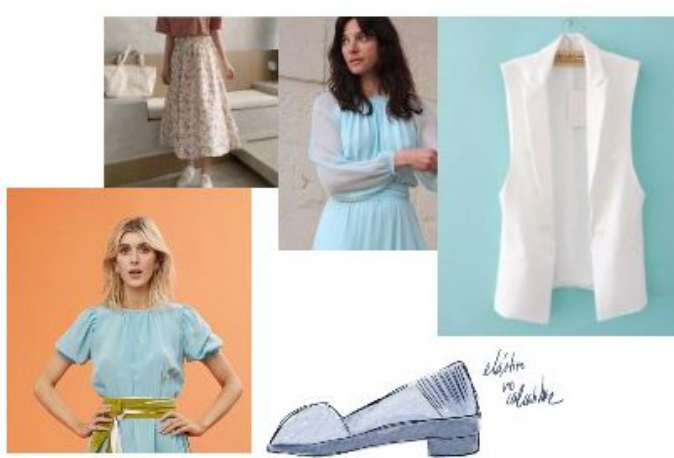
Workshop 2021 After applying the steps described in the methodology, Team 1 (Figure 1) presented the benefits and contributions of the ideas generated. The com- position uses soft and light knits with elasticity so that the neckline molds to the body, a skirt with an elastic belt, a sleeveless blazer that restricts arm and shoulder movement, and comfortable footwear with an elasticated heel. The challenges and limitations were finding ways to make the blazer’s slee- ves removable and easy to assemble in structural changes to existing pieces. The use choices of a model for occasional use (ceremony) and casual allo- wed turning this formal model into a modular solution through extractable sleeves and flexible materials (since rigid materials are predominantly used) capable of being more easily recovered and adjusted to switching profiles and to people’s needs. Internet images were used to compose the briefing idea. In addition, the team presented its illustration of the footwear. One of the pro- blems mentioned by the team was the need for more time to organize ideas in the short time available.
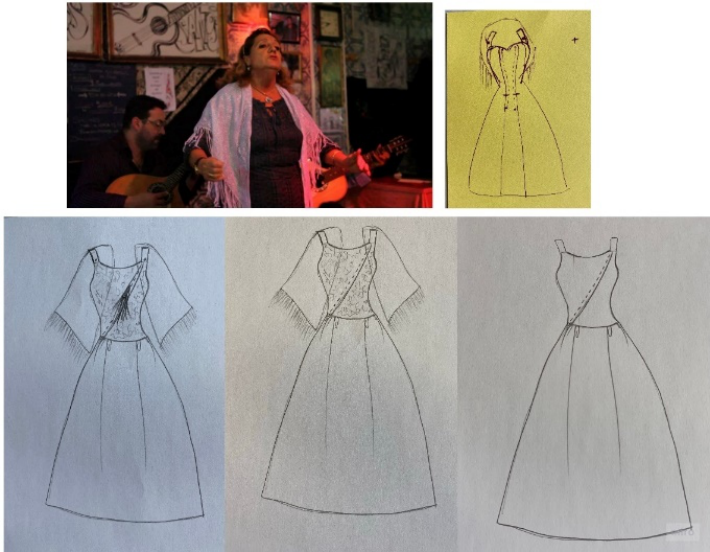
Team 2 (Figure 2) presented the benefits and contributions of the ideas generated from the main idea of creating a dress for a fado singer. They
Inclusive Clothing Design: Workshops Based on Case Studies 11
Figure 1: Workshop 2021 - Team 1 moodboard. Note: The team presents images from the internet as references for explaining the proposed product concept. Footwear was also illustrated as an ergonomic alternative.Figure 2: Workshop 2021 - Team 2 moodboard. Note: The team presents an image from the internet as a reference for explaining the proposed product concept. A shawl dress was illustrated as an ergonomic alternative.
proposed a jersey knit with an antibacterial finishing and intelligent textile functionality for the gradual hormonal release of a strap dress and two front zippers to the hips, lined and invisible. Fasteners with snaps on shawl loops. The challenges and limitations were thinking about developing a functio- nal dress that would address the issue of medication, as well as part of the aesthetics of the fado singer’s traditional costume, with ergonomic and functi- onal comfort. Three sketches were used to compose the idea of the problem briefing. In addition, the team presented an image with a colored shawl - attached with springs to the straps of the dress so that it does not slip and is not necessary to adjust.
The discussions raised in this workshop were relevant to stimulate a critical view on the issues of the development of inclusive clothing. The sketches discussed achieved the workshop’s aim by proposing solutions to improve the use of the garments discussed.
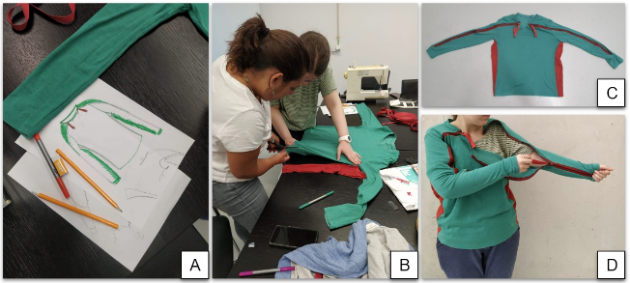
Workshop 2022 Duo 1 was chosen to develop the long-sleeved shirt (Figure 3). The propo- sal consisted of expanding the side of the T-shirt to provide a gap in the width and armhole of the piece. The aim was to provide greater clarity in the structure for larger arms. Two zippers with an extender were added on the upper part of the sleeve as an alternative to facilitate dressing/undressing, bypassing the difficulty of rotating the shoulders. Two t-shirts in contrasting colors were used to reconfigure the new model, with materials that included needle threads, zippers, pins, and ribbons. In the presentation, Duo 1 presen- ted the concept of the model developed, with the front opening resembling a baby’s diaper. This can be an unconventional possibility to dress/undress without de-characterizing the t-shirt model and configuring a familiar appe- arance from other clothing models. The zipper was attached to the extension from the neckline to the cuffs of the sleeves, and its extender facilitates the fine movement performed with the tips of the fingers. The expanded sides aim to increase comfort in the lateral region and armholes, in addition to the visual being composed by matching the color of the zippers. The concern of
Figure 3: Workshop 2022 – Duo 1. Note: pictures of the stages (A) Step 2 - Maturation of the idea. (B) Step 3 - Product development. (C) Product image. (D) Step 4 - Presentation.
Inclusive Clothing Design: Workshops Based on Case Studies 13
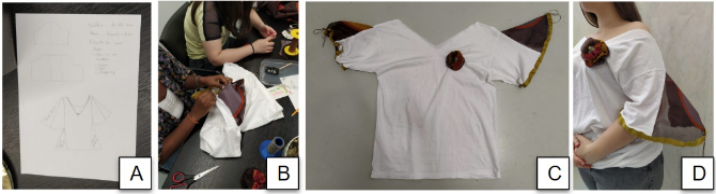
Figure 4: Workshop 2022 – Duo 2. Note: pictures of the stages (A) Step 2 - Idea matu- ration. (B) Step 3 - Product development. (C) Product image. (D) Step 4 – Presentation.
not modifying the model contour and combining colors was essential for the team’s proposal, which did not want to mischaracterize the piece.
Duo 2 was chosen to develop with the short-sleeved shirt (Fig. 4). The proposal was to provide a flexible option - i.e., no right side (front/back). The width of the sleeves was expanded, adding a printed fabric. This was placed on the bar tie to have the option of using it in the bouffant/balloon model and customization with the fuxico2 brooch. o, the user can wear the cloth on both sides without looking like they’re wearing it wrong. The neckline and the widened sleeves make passing the head and arms easier. The fuxico in the brooch would bring the aesthetic aspect of characterization. This gives the possibility of personalization to the user’s choice, and the sleeves have something conceptual that would also get options of use in the two models. The fuxico was made in the same fabric as the sleeves. An oversize T-shirt was used to reconfigure the new model, with materials that included needle threads, pins, ribbons, cords, and fabrics. Duo 2 presented the concept of the developed model, featuring a potential user: a woman over 50, cool, who likes fashion, and the usual occasion is for leisure and walking. According to the team, the piece is functional as it does not have a limited front/backside, so it can be used on both sides. This characteristic chosen for the T-shirt is made possible by the elastic structure of the mesh, which expands and retracts and allows the shape to adapt to different bodies and volumes. The transparency details of the sleeve fabric made it possible to use puffy or wide results in other models. These details add value to the product, and these alternatives can ease dressing/undressing.
DISCUSSION
The workshops were a complementary process to the results of the thesis since, in the usability investigation, gaps in design could be observed in terms of use issues. That is, how design studies make it possible to investigate and apply concepts of inclusion and ergonomics in clothing projects. This ackno- wledgment suggested the need to approach and discuss with teams not linked to the theme but with references to propose solutions to the selected topics.
2Rosette made of fabric, like a yo-yo.
The duos were stimulated through dynamics to discuss ideas and carry out activities and debates on possible solutions for projects involving the problem raised, which were complementary to sights on inclusive alternatives. It was interesting to observe the perception and action of the duos for decision- making on guided strategies for generating ideas. The mentors discussed the practicality of the most abstract design concepts without simplifying them, making them possible to be incorporated into daily use. Understanding the issues raised in previous investigations through workshops was important from the point of view of product development, as it enhances the discussion for improving garments. Adjustments in modeling, fabrics and technological applications, trims, different ways of opening/closing, and model alternatives (use options) were discussed. In the strategy adopted at the Workshop 2022, it may be possible to restructure the modeling to readjust the models.
Such strategies brought up relevant discussions for inclusion through cre- ative immersion in teams and using design tools to respond to the proposed narratives regarding the investigated issues. Those activities were carried out with people immersed in symbolic festive scenarios (as in the workshop 2021) and people who contributed to transforming t-shirts (the workshop 2022) into more engaging, versatile, original, and functional clothes - which may be easier for people with motor restrictions.
In general, the proposed solutions coincide with existing alternatives in the clothing market, but it is only partially obsolete since they were not presented as an example to the participants. Such options are incorporated into sports and children’s wear, mainly due to the practicality of dressing/undressing. Some similarities were found, however, treated inclusively to sensitize/train designers with actions such as in these workshops. The transmission of knowledge about inclusion requirements through design made it possible to overcome stereotypes and stimulate creativity through the technical and human skills of the participants.
The generation of viable alternatives to the context experienced brought discussions about the practical needs of users. Even if there were no innova- tive alternatives, the participants’ process was introductory and crucial for the theme dissemination. Based on the teams’ reflections, the discussion of inclusive design was essential to generate an understanding of inclusive design in the development of future projects.
CONCLUSION
The aim of describing the practices of the workshops on inclusive design, the contributions of the proposals were able to encourage the discussion about independence in dressing and undressing and present technical attributes in aesthetic and symbolic elements to the user’s identity and style scenarios. The teams adopted strategies based on the creation experience, and as the participants were duly informed and clarified - as they were in the activi- ties - they managed to solve inclusive solutions with viable techniques for the development of products. It was possible to highlight the problems and work on them through the knowledge obtained from previous investigations. The participants understood the difficulties that may occur in the usability of
Inclusive Clothing Design: Workshops Based on Case Studies 15
clothing, both in dressing/undressing on functional aspects and in the satisfa- ction of use by aesthetic and symbolic elements. Within the short period of the workshops, they proposed alternatives that would minimize the problems raised and encourage discussion for the development of inclusive products. The results showed generations of ideas and satisfactory proposals within the approaches adopted to solve different problems. It was possible to apply the real scenarios previously investigated to generate ideas, resources, and tech- niques in clothing so that its development was inclusive. Although the teams differ in technical quality due to the differences in the solutions, it was evi- dent that the proposals were easily applied and sought to please users based on functional, aesthetic, and symbolic design issues.
ACKNOWLEDGMENT
The authors would like to acknowledge the financed by the Sao Paulo Resea- rch Foundation (2018/20678-5), CIAUD and FCT – Foundation for Science and Technology.
REFERENCES
Almeida, M. D. (2021) Design de Moda Ageless: Proposições de construçãopara o vestuário feminino. Doctoral thesis in Design, Universidade Estadual Paulista. Faculdade de Arquitetura, Artes e Comunicação, Bauru. FAPESP. Sao Paulo Research Foundation (2019). Aspectos do design e daergonomia no vestuário para pessoas com Doença de Parkinson: análise dausabilidade na interação do vestir e despir. FAPESP Website: https://bv.fapesp.br/en/pesquisador/702842/leticia-nardoni-marteli. Godinho, S. D. S. (2019) Moda, vestimenta y discapacidad: una miradasociológica.
Doctoral thesis in Sociology, Universidad CatólicaArgentina. Laranjeira, M. A., Pereira, J. F., dos Santos, J. E. G., & dos Santos Menezes, M. (2023) Parâmetros de usabilidade para o design de meias compressivas. Modapalavra e-periódico, 16(39), 1–26. Marteli, L., Paschoarelli, L., Silva, F., Trigueiros, P., Barbieri, F. (2022) Care systems
for people with Parkinson’s disease and their interaction with clothing: case study in Portugal. In: Francisco Rebelo (eds) Ergonomics in Design. AHFE (2022) International Conference. AHFE Open Access, vol 47. AHFE International, USA. Marteli, L. N., Barbieri, F. A., Gerizani, G., Das Neves, E. P.das, Paschoarelli, L. C.
(2021) Impact of manual coordination on usability of clothing fasteners in people with Parkinson’s disease. Ergonomics In Design, 1–9. Miro. (2021) Workshop 1. Miro Website: https://miro.com/app/board/uXjVPug_P Gk=/. Neves, E. P.das. (2020) Vestuário e Terceira idade: uma abordagem ergonômica
acerca dos aspectos do vestir/despir do usuário idoso. Doctoral thesis in Design, Universidade Estadual Paulista. Faculdade de Arquitetura, Artes e Comunicação, Bauru. Patrick, V. M., Hollenbeck, C. R. (2021) Designing for all: Consumer response to inclusive design. Journal of Consumer Psychology, Volume 31 No. 2, 360–381. Rêgo, M., Matos, D., Riobom, D. F. (2021) Considerações ergonômicas no design
de vestuário para seniores - caso de estudo. Revista dosencontros internacionais Ergotrip Design, No. 5, 64–73.
Scaletsky, C. C. (2008) Pesquisa aplicada / pesquisa acadêmica: o caso Sander. In: 8th Congresso Brasileiro De Pesquisa & Desenvolvimento, 1132–1145. Centro Universitário SENAC, São Paulo. Schneider, J., Ramirez, A. R. G., & Célio, T. (2017). Etiquetas têxteisem braille: uma
tecnologia assistiva a serviço da interação dosdeficientes visuais com a moda e o vestuário. Estudos em Design, 25(1), 65-85.
LISTED IN THE AHFE DIGITAL BOOKSTORE CATALOGUE
Explore the complete digital volume
Design for Inclusion
Read this individual research paper free through the original publisher, or explore the full digital proceedings book.
ISBN 978-1-958651-51-3
Explore this ISBN in the AHFE Bookstore ↗Listed in the July 2026 bookstore catalogue; search by ISBN to confirm current availability · Digital book purchase optional