Sebastián Toledo, Catalina Astudillo-Rodriguez, Priscila Verdugo, Santiago Cedillo, Jackelín Verdugo (2023). Educational game to stimulate phonological awareness in elementary school children. In: Training, Education, and Learning Sciences. AHFE Open Access, vol. 109, pp. 11–21. https://doi.org/10.54941/ahfe1003146
Phonological awareness (PA) is the ability to analyse, segment, and manipulate language structure consciously. Its development at an early age is crucial for acquiring skills in reading and writing. For the mentioned and considering that we belong to a digitised society where technology constitutes a tremendous educational resource and a source of interest for children, the proposal arises to support learning through the inclusion of digital applications that facilitate differentiated instruction and integrate playful ways and motivate. In this context, educational games have become a modern and precise tool to solve these needs. This work aims to develop a serious game to support literacy learning by stimulating phonological awareness in elementary school children. For this purpose, a methodology based on the SCRUM Framework and User-Centered Design (UCD) principles was applied, emphasising users’ active involvement in developing the game. The method comprised a four-phase process, including scope definition and analysis in the first two phases; translation of user requirements into contextual and prototype design, and subsequent software development in the third phase; and finally, an empirical study was conducted to evaluate the usability of the prototype in the final phase. As a result, a serious game was obtained that allows the creation of linguistic exercises from a series of activities designed by the therapist in the context of a playground to promote playful learning in a familiar environment for the children. The usability study revealed a score of 74.44 based on the System Usability Scale (SUS), indicating that the system was well-received and considered highly usable by the participants. In conclusion, involving therapists in an iterative UCD process brings benefits such as confidence in using digital tools for phonological awareness skills training and identifying needs that require alternative mechanisms of interaction, encouraging children to participate in learning.
Phonological awareness is the ability to consciously analyse, segment, and manipulate language structure, i.e., syllables, intrasyllabic units, and phone- mes (Defior and Serrano, 2011). The development of PA at an early age is
crucial for acquiring literacy skills, yet it can be challenging for young chil- dren to master (Sysoev et al., 2017). In today’s digitised society, technology constitutes an invaluable educational resource and a source of interest for children. According to Rideout and Robb (2020), children are exposed to mobile devices early in their development, spending more than three hours (3:05) per day between the ages of 5 and 8. The most common activity on mobile devices is watching online videos, followed by playing video games. As a result, with games being an integral part of their daily lives, children tend to have a high level of digital and gaming literacy (Blumberg and Fisch, 2013). In elementary school, students who struggle with reading are at greater risk of underachieving in later grades, struggling in other areas of learning, and developing emotional and behavioural problems (Cheung and Slavin, 2013). Fortunately, several studies have proved the effectiveness of traditio- nal methods for stimulating PA through small-group instruction (Foorman and Torgesen, 2001; O’Leary et al., 2010; Cheung and Slavin, 2013). Never- theless, differentiating instruction and conducting small-group activities can be challenging in early childhood centres with inadequate child-educator ratios (Perlman et al., 2017). Given this context, educators and researchers have acknowledged the importance of developing modern, cost-efficient, and versatile pedagogical tools and assessment methods to facilitate individuali- sed and differentiated instruction while also compelling student interest and engagement.
Considering the mentioned above, coupled with the rapid advancement of technology, the incorporation of technology in education has evolved into the widely recognised concept of e-learning; this innovation has offered multiple benefits and has become the choice method for many learners. According to Horachek (2014), e-learning consists of employing technology to facilitate learning, which is achieved by using an internet connection and a web bro- wser to deliver educational material online and asynchronously. Educational technology can provide equal opportunity by giving all students access to the same curriculum, delivered in an optimal environment, regardless of their geographic location (Ojanen et al., 2015).
The utilisation of gamification in e-learning is a practical approach suppor- ted by both traditional pedagogy and the principles of neurobiology. Some of the most notable benefits include immersion, enhancing spatial learning, promoting active learning, reinforcing and conditioning, fostering emotional attachment to the learning experience, and facilitating cognitive flow (Hora- chek, 2014). These are just a few examples of why gamification can be a valuable addition to e-learning.
Serious games, also known as educational games, are subtypes of e- learning (Breuer and Bente, 2010). These are digital applications whose primary objective is not to entertain but to use entertainment as a resource to increase the motivation and engagement of participants, thus fulfilling the goal for which the game was designed (Loh, Sheng and Ifenthaler, 2015). The concept of “serious games” refers to the combination of gaming, simulation, and learning or training to promote serious outcomes, such as health, educa- tion, prevention, physical exercise, and rehabilitation (Wiemeyer and Kliem,
Educational Game to Stimulate Phonological Awareness 13
2012). Studies have shown that using serious games can lead to improved understanding and retention of subject matter and increased motivation and engagement among learners.
This study contributes to the field of education by developing a suite of games that facilitate differentiated instruction and integrate PA content in a playful and motivating way. To this end, we adopted a user-centred design (UCD) so that the user was involved in developing the game (Abras, Malo- ney and Preece, 2004). Studies show that when the target audience actively participates during game development as co-designer, they feel even more motivated and engaged (Kleine, Pearson and Poveda, 2016). In addition, UDC focuses on usability principles and ensuring user satisfaction, even for those with lower computer literacy (Darejeh and Dalbir, 2013).
This paper is organised as follows: Section II describes the related works for serious games focused on phonological awareness training. Then, Section III details the methodology used for developing the proposed game, while Section IV presents the results. Finally, Section V concludes the paper and provides guidelines for future work.
RELATED WORK
Phonological skills encompass a range of phonological processes that deve- lop at varying levels of cognitive complexity. These processes range from recognising sounds that distinguish words to more advanced skills, such as segmenting and manipulating sounds within words by omitting or adding phonemes (Gutiérrez and Díez, 2018). In this context, Jime’nez and Ortiz (2007) designed a PA training program (PECONFO) that includes a sequence of procedures and activities to facilitate reflection on the different phono- logical units of speech. The phonological units studied in PECONFO are presented in the following order: lexical segmentation, syllabic awareness, then intrasyllabic awareness, and finally, phonemic awareness.
Nshimbi et al. (2020) examined the effects of using a mobile-based literacy game called Graphogame to improve literacy skills in children and adults. Three tests were administered to measure letter-sound identification, phono- logical awareness, spelling, and word recognition. The results showed that the study group outperformed the control group on all three tests. There- fore, researchers conclude that educational games can improve children’s and adults’ literacy skills in rural Zambia.
Over the past decade, educational games have been demonstrated to be an efficacious tool for achieving learning objectives across various disci- plines, including mathematics, chemistry, medicine, and language (Ibarra et al., 2016; Zhonggen, 2019; Escudeiro, Escudeiro and Gouveia, 2022). In the realm of educational technology, Sysoev et al. (2017) developed Spe- echBlocks (SB). This mobile application aims to assist children in exploring spelling principles by manipulating letter combinations and the auditory feed- back of their pronunciation. The ultimate goal of this application is to help children acquire text decoding skills and to provide a means for students’ self- expression. The effectiveness of SB was evaluated through a study involving 16 4- and 5-year-old children. The results of this evaluation revealed several
benefits that emerged from the interaction with SB, such as an increase in student engagement in literacy activities, a heightened sense of authorship, and an improvement in self-efficacy.
According to Wiemeyer and Kliem (2012), depending on their purpose, serious games can be classified into one or more competency domains, such as sensory-motor, emotional, personal, social, and cognitive. In line with this approach, Cano et al. (2017) developed a serious game called ABCD-Spanish, which aimed to facilitate the learning and reinforcement of literacy skills in children with cognitive disabilities. To this purpose, the game’s development was guided by a user-centred methodology. The evaluation of the game reve- aled an increase in the children’s interest and motivation when performing the various activities, highlighting the potential of this approach for promo- ting literacy skills in children with cognitive disabilities. Overall, the study provides valuable insights into the application of serious games as an educa- tional tool and the importance of considering the specific needs of the target population in the development process.
Despite the evidence supporting educational technologies’ effectiveness for PA instruction, an effective educational game based on UCD principles to enhance learning in early childhood education has yet to be developed. To address this gap in the literature, we developed KUSI. This web application combines game-based elements with evidence-based techniques to promote early literacy skills. The PA training program (PECONFO) proposed by Jime’nez and Ortiz (2007) was taken as a reference, specifically the activi- ties related to syllable deletion. Using educational games in early childhood can provide children with a fun and engaging way to learn literacy skills and the necessary foundation for reading and writing development. Further- more, smart devices can provide children access to educational resources and activities regardless of location and facilitate personalised learning.
METHOD
This study aims to develop a web-based educational game that promo- tes literacy learning among elementary school children by stimulating their phonological awareness. The proposed methodology to achieve this goal inte- grates UCD principles (Wallach and Scholz, 2012) and the Agile-SCRUM framework (Adi, 2015) following guidelines presented by (Larusdottir, Gul- liksen and Cajander, 2017) through an iterative four phases process: 1) Scope, 2) Analysis, 3) Design, and 4) Validate. This integration allows the study to benefit from both approaches, with SCRUM focusing on team communi- cation and collaboration to achieve timely and consistent software delivery and UCD placing the user at the centre of the development cycle, emphasising usability and user experience.
Scope The scoping phase is a critical component of the UCD process, and its successful execution can significantly influence the final product’s success (Wallach and Scholz, 2012). During this phase, three major activities were
Educational Game to Stimulate Phonological Awareness 15
performed and assessed qualitatively: 1) the selection of the appropriate pho- nological awareness program, 2) the definition of project objectives, and 3) the identification of constraints. These activities were crucial in establish- ing the necessary components to ensure the usability of the game and the achievement of the project’s purposes.
Analysis This phase aims to gather comprehensive information about the user attribu- tes and requirements to define the product and ensure its usability (Wallach and Scholz, 2012). To this end, activities related to the specification of the context of use and requirements were carried out. We employed two qua- litative research methods to gather information: Contextual Inquiry and In-depth Interviews. The former involved observing teachers and students in their daily environment to understand the context in which they interact and how it impacts their experiences. Casado et al. (2020) cited contextual inquiry as a highly effective method for discovering and comprehending the context of users and how their environment influences their interactions. In- depth Interviews, on the other hand, were conducted with teachers to gain a deeper understanding of the users’ needs, preferences, and experiences with interactive learning systems. These interviews provided valuable insights into the requirements of the target audience.
Design The objective of the design phase is to translate the insights and findings from the previous phases into a tangible artefact. This phase comprises two disti- nct components: conceptual design and prototype design. The conceptual design focused on gaining a deeper understanding of the users by employing user profiling and scenario development techniques. In contrast, prototype design allowed us to involve users in crucial interface design, controls, and navigation decisions.
Conceptual Design. Implementing the user profile achieved a comprehen- sive understanding of the interaction between users and the application. The use case method was employed to achieve this goal. The examination iden- tified three user groups: the administrator, the teacher, and the student. The administrator’s responsibilities include maintaining activities and managing account registrations for teachers. The teacher is responsible for registe- ring students, providing guidance throughout the activities, and generating reports for their student group. Finally, the student completes the designated activities within the application.
Using user scenarios involves the creation of simple narrative stories that articulate the actions and motivations of a particular persona within a defi- ned context (Wallach and Scholz, 2012). These scenarios clearly describe how a user aims to achieve a specific goal while leaving room for design solutions to fill in the interaction details. The focus of these scenarios is not on tech- nology but on the user’s perspective. They provide a means of understanding the “what” of user interaction and the “why” behind it. The result of the conceptual design is the product backlog, a list of plans to be accomplished by the team (see Tables 1 and 2).
Table 1. User stories.
Table available in the original PDF paper.
Id. Name Description US01 Web Application As a teacher, I want the software to work as a web application. US02 Activity 1 As a teacher, I want the student to listen and select the image formed by deleting the last syllable. US03 Activity 2 As a teacher, I want the student to listen and select the image formed by deleting the first syllable. US04 Activity 3 As a teacher, I want the student to listen and select the image formed by deleting the mid-syllable. US05 Voice recognition As a teacher, I want all activities to implement a voice recognition system as an alternative method for selecting answers. US06 Sign language recognition As a teacher, I want all activities to implement a sign language recognition system as an alternative method for selecting answers. US07 Feedback As a teacher, I want the system to provide auditory feedback when selecting an answer. US08 Randomisation As a teacher, I want the images to be loaded randomly in the activities. US09 Reports As a teacher, I want to generate reports detailing student performance on each activity. US10 Multimedia content As a teacher, I want to manage (CRUD operations) the multimedia content of all activities, including audio, images, and text. US11 Role management As a teacher, I want to enrol students. US12 Role management As an administrator, I want to enrol teachers. US13 Menu As a teacher, I want the application to include navi- gation buttons. US14 Login As a teacher, I want the application to include a login section.
Table 2. Features list (adapted from Adi, 2015).
Table available in the original PDF paper.
Features List Sprint Planning
No. Backlog Item Description User stories
Weeks Sprint
Total Days Data modelling 1 3
1 Database design
US02-08 2 17
2 Game activities
Activities to develop PA
US09-12 1 5
3 Database management
Activity Resources - User Management
US13-14 1 5
4 System Interface
General graphical user interface
After the product backlog was established, the time required to complete each identified feature was defined. This process is called Sprint Planning (see Table 2).
Wireframes offer a consolidated view of the proposed design, which is cri- tical in the iterative nature of UCD. Creating wireframes makes it possible to
Educational Game to Stimulate Phonological Awareness 17
Figure 1: Wireframes.
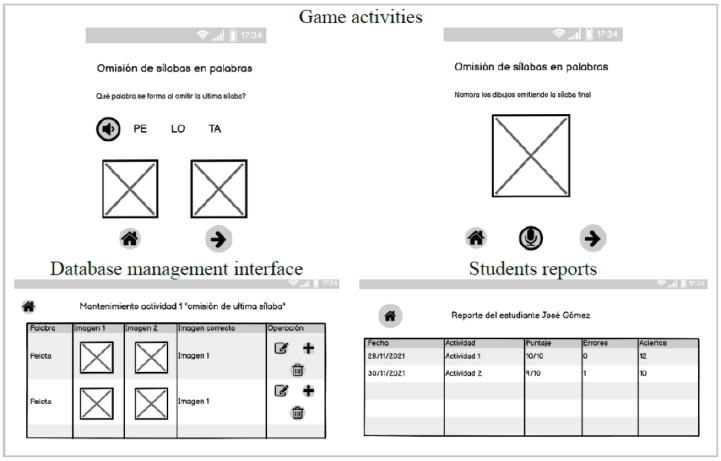
conduct an initial validation of the application design, providing an opportu- nity to involve users in the design process and acquire valuable feedback that can be used to refine and improve the design (Wallach and Scholz, 2012). Based on the specified requirements and user stories, a sequence of wirefra- mes was developed to illustrate the various interfaces of the application (see Figure 1). The feedback gathered from stakeholders was then used to make the necessary modifications to the application’s design.
Develop. The software development process followed the guidelines esta- blished by Larusdottir, Gulliksen and Cajander (2017) to enhance the user- centred approach. To this end, a new activity was incorporated into the process, which implicated scheduling regular face-to-face meetings with users between sprints. Daily Scrum meetings were held with the development team to track the progress of each member. At the end of each sprint, a sprint review was conducted to assess compliance with the defined goals and timeline. This approach ensured that the software development process was aligned with the needs and expectations of the users.
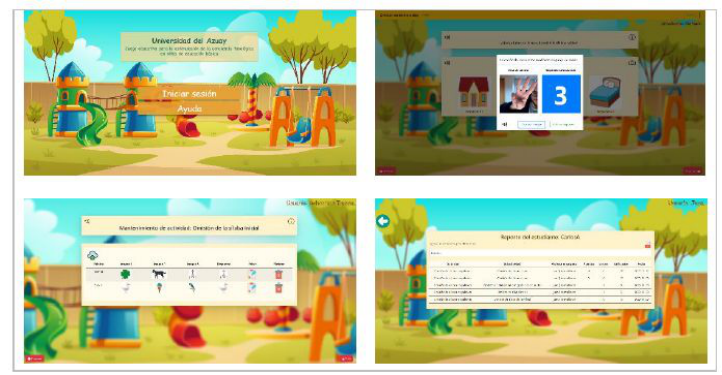
Kusi was engineered using JavaScript and HTML for the front end and PHP for the back end. The activities and users’ information was stored in a MySQL database. This combination of technologies allowed the creation of a dynamic and user-friendly web-based educational game capable of meeting the demands of its intended users (see Figure 2).
Validate The validation of the prototype is an essential step in the UCD process. Participants recruited for this stage were chosen based on their profile as prospective users and their ability to assess the application’s effectiveness
Figure 2: Educational game.
in real-world scenarios (Wallach and Scholz, 2012). The empirical study consisted of two main components: 1) usability tests, which involved the participants engaging with a sequence of task scenarios to identify any issues related to interaction, such as conceptual inconsistencies or learning bar- riers caused by the interface design. 2) A usability questionnaire used the System Usability Scale (SUS) to gather the users’ subjective opinions on the system’s usability (Bangor, Kortum and Miller, 2009). Combining these two components provides a comprehensive evaluation of the prototype’s usability, ensuring that the final product is designed with the end user in mind.
RESULTS
A serious game was obtained that allows the creation of linguistic exerci- ses from a series of activities designed by the therapist in the context of a playground to promote playful learning in a familiar environment for the children. The results of each exercise were stored in a database, allowing the specialist to monitor and evaluate the children’s performance. In addition, the game offers an inclusive design aimed at meeting the needs and preferences of the users, incorporating several interaction mechanisms, such as sign lan- guage captured from the camera and voice commands where the microphone intervenes.
Each participant was asked to complete a 10-question System Usability Scale (SUS) questionnaire after completing the usability test. The question- naire was administered in a digital format using Google Forms and presented to the participants in a standardised manner. The SUS score is calculated based on a 5-point Likert Scale, ranging from 0 to 100, with scores above 73 being interpreted as “excellent” (Bangor, Kortum and Miller, 2009). The study’s results revealed a SUS score of 74.44, indicating that the system was well-received and considered highly usable by the participants.
Educational Game to Stimulate Phonological Awareness 19
CONCLUSION
In conclusion, phonological awareness is the metalinguistic ability that allows the development of language structure. Early stimulation is crucial to acqui- ring reading and writing skills. In this way, in a digitised society where technology constitutes a tremendous educational resource and source of inte- rest for children, it is necessary to support learning by including digital applications that facilitate differentiated and inclusive instruction in play- ful and motivating ways. In this context, educational games have become a modern and precise tool to solve these needs.
The game of this research proposal offers an inclusive design aimed at sati- sfying the needs and preferences of users, incorporating various interaction mechanisms, such as sign language captured from the camera and voice com- mands where the microphone intervenes. These mechanisms will help the gradual incorporation and development of phonological awareness, mainly the result of reading and writing in children.
Hence, the need to involve therapists in an iterative UCD process so that they can identify alternative teaching-learning mechanisms that encourage children to use technology for other purposes.
Thus, this project opens new research lines about applications like this for helping teach other languages and develop linguistic skills like lexical and grammar, among others.
REFERENCES
Abras, C., Maloney, D. and Preece, J. (2004) ‘User-Centered Design’, in. Adi, P. (2015) ‘Scrum Method Implementation in a Software Development Project Management’, International Journal of Advanced Computer Science and Appli- cations, 6(9), pp. 198–204. Available at: https://doi.org/10.14569/ijacsa.2015. 060927. Bangor, A., Kortum, P. and Miller, J. (2009) ‘Determining What Individual SUS
Scores Mean: Adding an Adjective Rating Scale - International Journal of Usa- bility Studies’, Journal of Usability Studies, 4(3), pp. 113–123. Available at: https://www.upassoc.org/upa_publications/jus/2009may/bangor1.html. Blumberg, F. C. and Fisch, S. M. (2013) ‘Introduction: Digital Games as a Context for Cognitive Development, Learning, and Developmental Research’, New Directions for Child and Adolescent Development, 2013(139), pp. 1–9. Available at: https: //doi.org/10.1002/cad.20026. Breuer, J. S. and Bente, G. (2010) ‘Why so serious? On the relation of serious games
and learning’, Eludamos: Journal for Computer Game Culture, 4(1), pp. 7–24. Available at: https://doi.org/10.7557/23.6111. Cano, S. et al. (2017) ‘Towards designing a serious game for literacy in children with moderate cognitive disability’, ACM International Conference Proceeding Series, Part F1311, pp. 1–5. Available at: https://doi.org/10.1145/3123818.3123835. Casado, C. et al. (2020) Interacción persona-ordenador. Second. Barcelona: Funda-
ció Universitat Oberta de Catalunya. Cheung, A. C. K. and Slavin, R. E. (2013) ‘Effects of educational technology applications on reading outcomes for struggling readers: A best-evidence synthesis’, Reading Research Quarterly, 48(3), pp. 277–299. Available at: https://doi.org/10. 1002/rrq.50.
Darejeh, A. and Dalbir, S. (2013) ‘A REVIEW ON USER INTERFACE DESIGN PRINCIPLES TO INCREASE SOFTWARE USABILITY FOR USERS WITH LESS COMPUTER LITERACY’, Journal of Computer Science, 9(11), pp. 1443–1450. Available at: https://doi.org/10.3844/jcssp.2013.1443.1450. Defior, S. and Serrano, F. (2011) ‘La conciencia fonémica, aliada de la adquisición del
lenguaje escrito’, Revista de Logopedia, Foniatria y Audiologia, 31(1), pp. 2–13. Available at: https://doi.org/10.1016/S0214-4603(11)70165-6. Escudeiro, P., Escudeiro, N. and Gouveia, M. C. (2022) ‘A Chemistry Inclusive and Educational Serious Game’, in 2022 31st Annual Conference of the European Association for Education in Electrical and Information Engineering (EAE- EIE). IEEE, pp. 1–6. Available at: https://doi.org/10.1109/EAEEIE54893.2022. 9820516. Foorman, B. R. and Torgesen, J. (2001) ‘Critical Elements of Classroom and Small-
Group Instruction Promote Reading Success in All Children’, Learning Disabilities Research and Practice, 16(4), pp. 203–212. Available at: https://doi.org/10.1111/ 0938-8982.00020. Gutiérrez, R. and Díez, A. (2018) ‘PHONOLOGICAL AWARENESS EVOLUTIO- NARY DEVELOPMENT AND WRITING IN EARLY AGES’, Educación XX1, 21(1), pp. 395–415. Available at: https://doi.org/10.5944/educXX1.13256. Horachek, D. (2014) Creating E-Learning Games with Unity. Packt Publishing Ltd. Ibarra, M. J. et al. (2016) ‘MathFraction: Educational serious game for students
motivation for math learning’, Proceedings - 2016 11th Latin American Confere- nce on Learning Objects and Technology, LACLO 2016 [Preprint]. Available at: https://doi.org/10.1109/LACLO.2016.7751777. Jime’nez, J. and Ortiz, M. del R. (2007) Conciencia fonolo’gica y aprendizaje de la lectura : teori’a, evaluacio’n e intervencio’n. Madrid: Si’ntesis (Aplicacio’n en el aula ; no. 13). Kleine, D., Pearson, G. and Poveda, S. (2016) ‘Participatory methods: Engaging
children’s voices and experiences in research’, Global Kids Online [Preprint]. Available at: https://globalkidsonline.net/wp-content/uploads/2016/05/Guide-8- Participatory-methods-Kleine-Pearson-Poveda.pdf. Larusdottir, M., Gulliksen, J. and Cajander, Å. (2017) ‘A license to kill – Improving UCSD in Agile development’, Journal of Systems and Software, 123, pp. 214–222. Available at: https://doi.org/10.1016/j.jss.2016.01.024. Loh, C. S., Sheng, Y. and Ifenthaler, D. (2015) ‘Serious Games Analytics: Theoretical
Framework’, in Serious Games Analytics. Cham: Springer International Publish- ing, pp. 3–29. Available at: https://doi.org/10.1007/978-3-319-05834-4_1. Nshimbi, J. C., Serpell, R. and Westerholm, J. (2020) ‘Using a phone-based learning tool as an instructional resource for initial literacy learning in rural African fami- lies’, South African Journal of Childhood Education, 10(1), pp. 1–9. Available at: https://doi.org/10.4102/sajce.v10i1.620. O’Leary, P. M. et al. (2010) ‘Head Start Teachers’ Views of Phonological Aware-
ness and Vocabulary Knowledge Instruction’, Early Childhood Education Journal, 38(3), pp. 187–195. Available at: https://doi.org/10.1007/s10643-010-0394-0. Ojanen, E. et al. (2015) ‘GraphoGame - a catalyst for multi-level promotion of literacy in diverse contexts’, Frontiers in Psychology, 6. Available at: https://doi.org/ 10.3389/fpsyg.2015.00671. Perlman, M. et al. (2017) ‘Child-staff ratios in early childhood education and care
settings and child outcomes: A systematic review and meta-analysis’, PLoS ONE, 12(1), pp. 1–24. Available at: https://doi.org/10.1371/journal.pone.0170256.
Educational Game to Stimulate Phonological Awareness 21
Rideout, V. and Robb, M. (2020) ‘The Common Sense Census’, Common Sense Media, p. 65. Available at: https://www.commonsensemedia.org/research/the-co mmon-sense-census-media-use-by-kids-age-zero-to-eight-2020. Sysoev, I et al. (2017) ‘Speechblocks: A constructionist early literacy app’, IDC 2017
- Proceedings of the 2017 ACM Conference on Interaction Design and Children, pp. 248–257. Available at: https://doi.org/10.1145/3078072.3079720. Wallach, D. and Scholz, S. C. (2012) ‘User-Centered Design: Why and How to Put Users First in Software Development’, in, pp. 11–38. Available at: https://doi.org/ 10.1007/978-3-642-31371-4_2. Wiemeyer, J. and Kliem, A. (2012) ‘Serious games in prevention and rehabilitation-a
new panacea for elderly people?’, European Review of Aging and Physical Acti- vity, 9(1), pp. 41–50. Available at: https://doi.org/10.1007/s11556-011-0093-x. Zhonggen, Y. (2019) ‘A Meta-Analysis of Use of Serious Games in Education over a Decade’, International Journal of Computer Games Technology, 2019(3). Available at: https://doi.org/10.1155/2019/4797032.
LISTED IN THE AHFE DIGITAL BOOKSTORE CATALOGUE
Explore the complete digital volume
Training, Education, and Learning Sciences
Read this individual research paper free through the original publisher, or explore the full digital proceedings book.
ISBN 978-1-958651-85-8
Explore this ISBN in the AHFE Bookstore ↗Listed in the July 2026 bookstore catalogue; search by ISBN to confirm current availability · Digital book purchase optional