Oliwia Karasek, Yusuf Arslanparcasi (2023). Conceptualizing an Academic Teaching and Learning Laboratory for Systems Engineering. In: Training, Education, and Learning Sciences. AHFE Open Access, vol. 109, pp. 134–141. https://doi.org/10.54941/ahfe1003159
In an increasingly complex world of goods and services, as well as in the context of digitalization and Industry 4.0, previous product development for intelligent technical systems is reaching its limits. Due to shorter product life cycles, increasing complexity and a growing number of product variants, along with growing demands on the part of stakeholders, etc., new approaches to development are required (Czaja et al., 2017; Haberfellner et al., 2021).However, the use of new development approaches, such as advanced systems engineering (ASE), is accompanied by far-reaching changes for the organization and all people involved. ASE combines methods for system consideration and for requirements management with AI-influenced engineering processes in which all relevant information – from the business idea to market success – is integrated into the development process across disciplines in order to efficiently design the development of complex cyber-physical systems (Dumitrescu et al., 2021).Such new development approaches require a redesign of work organization, as well as versatile competencies and skillsets going beyond classical engineering. Advanced soft skills and new work competencies such as communication, teamwork and agile work methods become more important for example through the introduction of flat hierarchies or cross-functional work structures. Thus, new competencies and qualifications for future engineers are necessary for product development. Against this backdrop, the expansion of targeted competency management and higher education in the engineering sciences must adequately take these developments into account. This is because successful adaptation and transformation of companies in value creation is largely determined by their ability to build up the right competencies as well as to use existing competencies of employees and to develop them in a targeted manner (North et al., 2018).In this paper we outline the required competencies for engineers in the context of advanced systems engineering and derive a novel empirical competency model. Based on this empirical model, possibilities for the conceptualization of competency measures through the framework of constructive alignment at the academic level are presented. Works Cited:Czaja, A., Amon, M., Dumitrescu, R., Lampert, R., & Gaarman, D. (2017). Bedarfsgerechter SE Prozess für einen mittelständischen Hersteller von Automatisierungskomponenten. In S.-O. Schulze, C. Tschirner, R. Kaffenberger & S. Ackva (eds.), Tag des Systems Engineering. Paderborn, 8. -10. November 2017 (pp. 3-12). Carl Hanser Verlag GmbH & Co. KG.Dumitrescu, R., Riedel, O., Gausemeier, J., Albers, A., & Stark, R. (2021). Advanced Systems Engineering Wertschöpfung im Wandel: Engineering in Deutschland - Status quo in Wirtschaft und Wissenschaft. Fraunhofer IEM.Haberfellner, R., de Weck, O., Fricke, E., & Vössner, S. (2021). Systems engineering. Fundamentals and Applications. Springer Nature Switzerland. https://doi.org/10.1007/978-3-030-13431-0North, K., Reinhardt, K., & Sieber-Suter, B. (2018). Kompetenzmanagement in der Praxis. Springer Fachmedien Wiesbaden. https://doi.org/10.1007/978-3-658-16872-8
In an increasingly complex world of goods and services and in the con- text of digitalisation and industry 4.0, traditional product development for intelligent technical systems is reaching its limits. Due to shorter life cycles, increasing complexity and a growing number of product variants, as well as increasing demands from stakeholders, etc., new development approa- ches are needed (Dumitrescu et al., 2021; Haberfellner et al., 2019). One promising approach is Advanced Systems Engineering (ASE). ASE builds on the concepts of Systems Engineering (SE) and Model-Based Engineering (MBSE), and opens up new ways of designing intelligent, networked and socio-technical systems. ASE combines methods for systems analysis and requirements management with AI-influenced engineering processes in which all relevant information - from the business idea to market success - is inte- grated into the development process across disciplines to efficiently shape the
Conceptualizing an Academic Teaching and Learning Laboratory 135
development of complex cyber-physical systems (Dumitrescu et al., 2021). The emergence of this new approach to development goes hand in hand with new demands on higher education in engineering. With the introduction of flat hierarchies or cross-functional working structures in ASE, the develo- pment and training of advanced competencies and skills for future engineers is crucial, for example to adapt to an agile approach or to be able to cope with dynamically changing tasks and teams. In this context, higher educa- tion needs to adapt and respond to these newly required specific skills and competencies of future engineers. Specific learning activities and settings need to be conceptualized and designed to ensure these learning outcomes while incorporating state-of-the-art, learner-centred, active and scalable learning. Therefore, this paper presents current progress in conceptualizing an aca- demic teaching and learning laboratory for ASE through the constructive alignment (CA) framework (Biggs, 2014, 1994; Biggs & Tang, 2011) to address these new demands on the skills and competencies of future engineers.
Teaching and Learning Labs in Engineering Laboratories are an indispensable part of science and engineering education in European universities (Schmidgen, 2011). They have become an integral part of applied and research-oriented teaching and learning environments at all levels (Tekkaya et al., 2016; Terkowsky et al., 2020). The teaching and learning laboratory can be defined as a course, learning venue or lear- ning environment where students learn to carry out empirical research such as observing, measuring, experimenting, testing and analysing under con- trolled conditions as part of their science or engineering studies (Trumper, 2003). However, university practice does not always exploit this potential in the sense that many teaching and learning activities are still based on more traditional inductive-instructive and more subject-oriented approaches to laboratory didactics. As a result, they are designed to impart subject know- ledge (e.g., technical skills) rather than to promote competencies holistically by integrating advanced soft skills that are necessary to adapt to future job requirements (Terkowsky et al., 2020).
The ongoing digital transformation, which calls for competency- promoting agile, self-directed, creative and collaborative research-based lear- ning, holds great potential for the competency-oriented use of teaching and learning laboratories (Tekkaya et al., 2016; Terkowsky et al., 2020). Howe- ver, competency-based laboratory didactics have only been marginally imple- mented to date. Therefore, there is a need for a holistic, competency-based approach to laboratory didactics (Terkowsky et al., 2020).
To meet this need, we propose the concept of CA as a conceptual fra- mework for an academic ASE teaching and learning laboratory for systems engineers.
Constructive Alignment Constructivist learning theory and task alignment with intended learning outcomes are the twin pillars on which CA is based (Biggs & Tang, 2011). CA is a method of outcomes-based teaching (Biggs, 2014, 1993). It focuses on
136 Karasek and Arslanparcasi
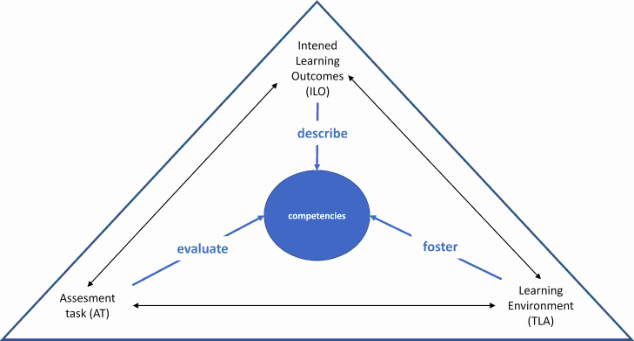
the design and transparent support and assessment of student learning (Map- pes & Klink, 2011). CA involves aligning learning or competency objectives, called intended learning outcomes (ILOs), the design of content and related activities, called teaching/learning activities (TLAs), and the acquisition or demonstration of performance, called assessment tasks (ATs): with the ILOs as a central primary component of the approach. The careful and considered construction of ILOs determines how they are taught (TLAs) and how they are to be assessed (ATs) (Biggs, 2011; Biggs & Tang, 2011). Figure 1 shows these three main aspects of constructive alignment adapted for the teaching and learning laboratory and how the aspects relate to each other.
CA makes it possible to subsequently assess the extent to which the com- petency objectives and levels targeted in the ASE teaching and learning laboratory have been achieved. But how can this be done? CA proposes four stages to enable alignment for any given course (Biggs, 2014; Biggs & Tang, 2011):
1. Describe the ILOs using activity verbs 2. Create a learning environment with TLAs using the activity verbs 3. Use ATs to assess student performance using the activity verbs 4. Translate the performance into standardised grading criteria In order to put the stages of CA into the context of the ASE teaching and learning laboratory, the necessary ASE specific competency requirements must first be defined and formalised as a basis for describing the ILOs.
Identifying and Defining ASE-Specific Competencies The starting point for identifying ASE-specific competency requirements were the 12 SE roles according to Sheard (Sheard, 1996). These were compared and merged with the established INCOSE Competency Framework (Gelosh et al., 2018). Based on this information, a systematic literature review was conducted between September 2020 and February 2021. For this purpose,
Figure 1: Schematics of the constructive alignment concept (Biggs, 1993) for the teaching and learning laboratory.
Conceptualizing an Academic Teaching and Learning Laboratory 137
the identified publications on the topics of Systems Engineering (SE), Model- Based Systems Engineering (MBSE), Integrated Product Development and Concurrent Engineering were analysed and central aspects of ASE were iden- tified, which were then derived into necessary competency requirements for companies and employees. As a first step to develop a unified role descri- ption and a competency model, the collected data material from the literature review was classified and categorised using standardised competency fra- meworks (Heyse, 2017; Heyse & Erpenbeck, 2009). In the next step, the theoretical findings were enriched by an online survey (N = 99) and expert interviews (N = 8) in various industrial projects in the context of systems engineering. The survey material was then coded using qualitative content analysis according to Mayring (Mayring, 2015) and competency catego- ries were deductively formed using the INCOSE competency framework (Gelosh et al., 2018). The competency categories were grouped and bundled into three requirement levels: basic competencies, agile working compete- ncies, and ASE-specific competencies. Based on these findings, a competency model was further developed, which ultimately consisted of seven compe- tency dimensions and 22 associated competency facets (Arslanparcasi & Karasek, 2023).
CONCEPTUALIZING THE ACADEMIC ASE TEACHING AND LEARNING LABORATORY The derived ASE-competency model for systems engineers (Arslanparcasi & Karasek, 2023) was used as a basis for the conceptualization of the learning laboratory. From this, the stages of CA for the academic ASE teaching and learning laboratory are elaborated, focusing only on agile working compe- tencies. As a work in progress, the methodology outlines two of the four proposed stages of alignment.
Describing the Intended Learning Outcomes (ILOs) Before defining the ILOs, all competencies and their facets were reviewed for their applicability in a learning and teaching laboratory environment and for faculty-specific requirements. The selection was then reviewed by higher- education experts and didacticians. Based on the reviewed competencies and facets, 10 ILOs were formulated that address different dimensions of cogni- tive processes (Anderson et al., 2014). For the purpose of this paper, the focus lies on the five identified competencies for agile working. Table 1 shows the derived ILOs and their cognitive process dimension and knowledge type (Anderson et al., 2014) for the selected competencies for agile working to be addressed by the laboratory. The five derived ILOs consist of one or at most two signalling verbs (Biggs, 2014; Biggs & Tang, 2011), which allows students to understand the scope and expected complexity level of the ILO (knowing what to do and at what level). The verbs used therefore also imply specific teaching/learning activities (TLAs) that facilitate the achievement of the ILOs (knowing how to do). In addition, the specificity of the verb used in the ILOs, for example its cognitive process dimension, defines the boundaries
138 Karasek and Arslanparcasi
Table 1. Overview of ILOs, cognitive process and knowledge dimension for the ASE laboratory.
select and implement different methods of agile and team-based working methods in the work process
Apply Procedural
implement and design work planning and communication in the team in a constructive and goal-oriented way
Apply Procedural
structure and process project tasks independently through the appropriate use of division of labour and cooperative collaboration
Analyse/Evaluate Procedural/Meta- Cognitive
evaluate and reflect on the methods of agile and team-based working methods used in the work process
Create Meta-Cognitive
present the results of project work in a target group-specific and prepared manner during a final presentation
of appropriate assessment tasks (ATs) of student performance (knowledge of assessment criteria), thus demonstrating the centrality of the ILOs.
Furthermore, the ILOs were designed taking into account the type of kno- wledge expected (Anderson et al., 2014; Biggs & Tang, 2011). The cognitive process dimension targeted by the ILOs were selected from among lower-level dimensions (e.g., ‘understand’, ‘apply’) and higher-level dimensions (e.g., ‘evaluate’, ‘analyse’ or ‘create’) and were assigned to different knowledge dimensions. The selected and applied cognitive process dimensions refle- cted the recommendations for academic teaching and learning laboratories, focusing mainly on the dimensions ‘apply’.
Teaching and Learning Activities (TLAs) As mentioned earlier, learning and teaching laboratories offer an opportunity to provide holistic skills training that meets the demands of the (future) work- place. However, specific faculty and curriculum regulations had to be taken into account when translating ILOs and creating TLAs within the chosen learning environment. These predetermined regulations were:
duration of two weeks
group setting (min. 3 to max. 12)
must meet the specific curricular criteria of a ‘tutorial’
prerequisites: master’s students in engineering or related disciplines
fixed workload/credit-point ratio
Conceptualizing an Academic Teaching and Learning Laboratory 139
Based on recommendations from academic didactics and in order to meet the requirements of the faculty, global TLAs were first formulated that are most likely to enable students to interact with the verbs listed in the respective ILOs that operate on the specific process dimension assigned to them (Biggs & Tang, 2011). Table 2 shows the global TLAs assigned to each ILO for agile working competencies. The formulated global TLAs reflect the nature of the laboratory setting, which gradually shifts from teacher-managed TLAs to student- or individually-managed activities. Many of the teacher-managed activities more closely resemble teaching and learning environments than actual teaching and learning activities, depending on whether or not the required student learning-related activities take place. The environment, that is, the teaching and learning laboratory, merely defines the general framew- ork within which learning takes place, whether it is a lecture, a group task or reflective learning.
Table 2. ILOs and global TLAs for the academic ASE laboratory.
Table available in the original PDF paper.
ILOs Global TLAs select and implement different methods of agile and team-based working methods in the work process (understand/apply)
Teacher managed with little to active student participation (e.g., lecture, teaching study skills in context) Student managed (e.g., working groups/group assignment)
implement and design work planning and communication in the team in a constructive and goal-oriented way (apply)
Teacher managed with little to active student participation (e.g., keynotes, teaching study skills in context) Student managed (e.g., working groups/group assignment) Student managed (e.g., working groups/group assignment)
structure and process project tasks independently through the appropriate use of division of labour and cooperative collaboration (apply/analyse)
Individually managed (e.g., reflective learning)
evaluate and reflect on the methods of agile and team-based working methods used in the work process (analyse/evaluate)
Student managed/Individually managed (e.g., reflective learning, working groups, group assignment)
present the results of project work in a target group-specific and prepared manner during a final presentation (create)
140 Karasek and Arslanparcasi
Next Steps In order to further develop the ASE teaching and learning laboratory, spe- cific and diverse learning initiatives targeting the ILOs will be selected and implemented in specific contexts to allow for appropriate alignment between activities and TLAs. Thus, the proposed global TLAs will be further specified and carefully considered for applicability within the regulatory and didactic framework. In addition, aligned ATs will be derived to allow transparent and criteria-based assessment of student performance, reflecting the ILOs and the holistic competency focus of the laboratory setting. Due to the novel nature of the ASE learning and teaching laboratory concept, evaluation and proof- of-concept measures will be implemented, such as formative and summative evaluation formats. This will allow for ad hoc adjustments, e.g., adaptation of learning activities to student needs, as well as overall evaluation of the laboratory approach.
CONCLUSION
University practice often relies on rather traditional inductive-instructive and purely subject-oriented approaches to laboratory didactics, designed to impart subject knowledge, and thus does not always make use of this potential of a competency-oriented teaching and learning laboratory. As a result, many teaching and learning activities potentially fail to adapt to new demands on the skills and competencies of future engineers. A pro- mising concept to address future needs and competencies is the proposed constructively oriented ASE teaching and learning laboratory. By utilising empirical evidence and combining it with the didactic concept of constru- ctive alignment, the proposed learning and teaching laboratory concept aims to demonstrate the potential of combining constructive alignment with competency-promoting laboratory didactics in academia.
ACKNOWLEDGMENT
This research and development project is funded by the German Fede- ral Ministry of Education and Research (BMBF) within the Innovations for “Tomorrow’s Production, Services, and Work” Program (02J19B012, CyberTech) and implemented by the Project Management Agency Karlsruhe (PTKA). The author is responsible for the content of this publication.
REFERENCES
Anderson, L. W. & Bloom, B. S. (Eds.) (2014) A taxonomy for learning, teaching, and assessing: A revision of Bloom’s. Pearson: Harlow. Arslanparcasi, Y., & Karasek, O. (2023, March 1-3) Kompetenzentwicklung in
Systems Engineering [conference paper]. 69th GfA-Frühjahrskongress – Nachh- altig Arbeiten und Lernen, Hannover (GER). Biggs, J. (1996) Enhancing Teaching through Constructive Alignment. Higher Education, 32(2), 347–364. Biggs, J. (2014) Constructive alignment in university teaching. Reviews of Higher
Education, 1, 5–22.
Conceptualizing an Academic Teaching and Learning Laboratory 141
Biggs, J. & Tang, C. S. (2011) Teaching for quality learning at university: What the student does, 4th edition. McGraw-Hill/Society for Research into Higher Education/Open University Press: Maidenhead. Dumitrescu, I. R., Anacker, I. H., Grote, E.-M., Rasor, R., Tekaat, J. & Meyer,
M. et al. (2021) Erfolgspotentiale für die Zukunft des Engineeringstandorts Deutschland: Ein Beitrag zum Advanced Systems Engineering. Vorausschau und Technologieplanung, 11. Gelosh, D. S., Heisey, M., Nidiffer, K., Snoderly, J. R. & Beasley, R. (2018) Version 1.0 of the New INCOSE Competency Framework. INCOSE International Sym- posium, 28(1), 1778–1786. Available from: https://doi.org/10.1002/j.2334-5837. 2018.00583.x. Haberfellner, R., Weck, O. L. de, Fricke, E. & Vössner, S. (2019) Systems engineering:
Fundamentals and applications. Birkhäuser: Cham, Switzerland. Heyse, V. (2017) KODE® und KODE® X–Kompetenzen erkennen, um Kompetenzen zu entwickeln und zu bestärken. In: Erpenbeck, J., Rosenstiel, L., Grote, S. & Sauter, W. (Eds.) Handbuch Kompetenzmessung: Erkennen, verstehen und bew- erten von Kompetenzen in der betrieblichen, pädagogischen und psychologischen Praxis, 3rd edition. Schäffer-Poeschel Verlag für Wirtschaft Steuern Recht GmbH: Freiburg. Heyse, V. & Erpenbeck, J. (2009) Kompetenztraining: Informations- und Training-
sprogramme, 2nd edition. Schäffer-Poeschel: Stuttgart. Krumm, S. (2016) Kompetenzmodelle. Hogrefe Verlag: Göttingen. Mappes, T. & Klink, K. (2011) Constructive Alignment interdisziplinär – Ein Beispiel aus dem Maschinenbau. In: Berendt, B., Fleischmann, A., Schaper, N., Scczyrba, B., Wiemer, M. & Wildt, J. (Eds.) Neues Handbuch Hochschullehre. Mayring, P. (2015) Qualitative Inhaltsanalyse. Grundlagen und Techniken, 12th edn.
Beltz Pädagogik. Beltz. Schmidgen, H. (2011) The Laboratory. Available from: https://d-nb.info/ 1031910484/34 [Accessed 03 January 2023]. Sheard, S. A. (1996) Twelve Systems Engineering Roles. INCOSE International Symposium, 6(1), 478–485. Available from: https://doi.org/10.1002/j.2334-5837. 1996.tb02042.x. Tekkaya, A. E., Terkowsky, C., Radtke, M., Wilkesmann, U., Pleul, C. & Maevus,
F. (2016) Das Labor in der ingenieurwissenschaftlichen Ausbildung: Zukunftso- rientierte Ansätze aus dem Projekt IngLab. Herbert Utz Verlag. Terkowsky, C., May, D., Frye, S., Haertel, T., Ortelt, T. R. & Heix, S. et al.
(2020) Labore in der Hochschullehre: Didaktik, Digitalisierung, Organisation, 306. Available from: https://doi.org/10.3278/6004804w. Trumper, R. (2003) The Physics Laboratory: A Historical Overview and Future Perspectives. Science and Education, 12(7), 645–670. Available from: https://doi.org/10.1023/A:1025692409001.
LISTED IN THE AHFE DIGITAL BOOKSTORE CATALOGUE
Explore the complete digital volume
Training, Education, and Learning Sciences
Read this individual research paper free through the original publisher, or explore the full digital proceedings book.
ISBN 978-1-958651-85-8
Explore this ISBN in the AHFE Bookstore ↗Listed in the July 2026 bookstore catalogue; search by ISBN to confirm current availability · Digital book purchase optional