Yusuf Arslanparcasi (2023). The Importance of Well-Being for Organisational Culture. In: Social and Occupational Ergonomics. AHFE Open Access, vol. 106, pp. 137–143. https://doi.org/10.54941/ahfe1003084
The culture of an organisation is an abstraction that unfolds in social and organisational situations. Following Schein’s (1984) 3-level-model, organisational culture reflects the behaviour of all members of an organisation. However, an important concept in organisational culture research that is often neglected is well-being in the work context, which is often conceptualised in a hedonic and context-free way (Taris & Schaufeli, 2014). This paper argues that well-being allows the exploration of individual aspects of organisational culture and serves to capture an overall picture. To do so, a different approach to thinking about well-being in the work context is needed, based on an adaptation of Carol Ryff's (1989) Psychological Well-Being Model and Bakker and Demerouti's (2018) Job Demands-Resources Model as a theoretical framework. Such a holistic approach to researching organisational culture will allow to identify and explore interdependencies and interactions between individual aspects.
Today’s work is undergoing drastic changes. Demographic change and geopolitical conflicts pose major challenges to work and society as a whole as they have functioned so far. At the same time, ongoing digitalisation is giving rise to new technologies that are profoundly changing organisa- tional and management structures (Franken & Franken, 2020; Helmold, 2022). In light of these changes, organisational culture (or corporate cul- ture) is becoming increasingly important. On the one hand, it influ- ences performance factors, success and a company’s ability to survive. On the other hand, it plays a decisive role in overcoming challenging factors external and internal to the company (e.g. economic or poli- tical factors, socio-cultural development, global warming) (Sackmann, 2017). Given these developments, there is a significant need for research on indi- vidual aspects of organisational culture. Unlike better-researched aspects (such as leadership and work engagement), in-depth studies of well-being’s role within organisational culture are as yet lacking, even though it allows the simultaneous exploration of several aspects of organisational culture
(Ostroff & Schulte, 2014). The work-related changes that came with the COVID-19 pandemic have brought workers’ well-being to the centre of attention. Technology-driven changes in the sphere of work and the ari- sing urgent questions of “how, where and when do we work?” are further drivers for the increasing importance of well-being in the work context (Johnson et al., 2020). However, to date, there is no comprehensive defi- nition of well-being in the work context that includes for instance job characteristics, job attitudes and other outcomes (Hannah et al., 2020; Johnson et al., 2018; Warr & Nielson, 2018). Thus, there is a wealth of context-free measurement tools, which are often conceptualised in a hedonic way insufficient for an investigation of well-being that takes the above into consideration (Dagenais-Desmarais & Savoie, 2012; Sandilya & Shahnawaz, 2018; Taris & Schaufeli, 2014). Dealing with well-being as pro- posed in this paper requires a holistic approach to the study of organisational culture.
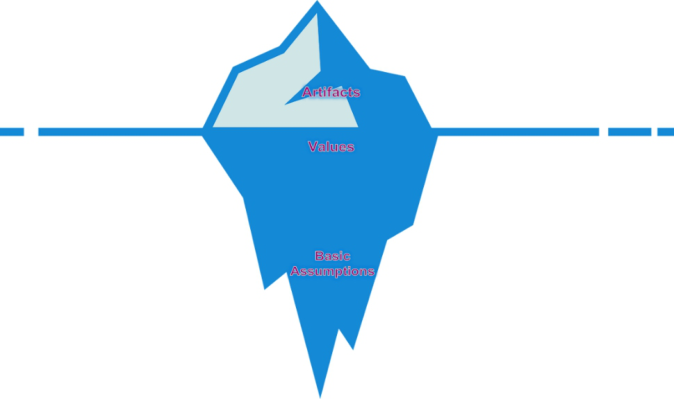
ORGANISATIONAL CULTURE Organisational culture is an “emergent phenomenon” (Schreyögg, 2016, p. 177). It is fed by values and attitudes of the members of an organisation and is directly reflected in their behaviour (Schreyögg, 2016). According to Schein (2010), culture is an abstraction that unfolds in social and organi- sational situations. Following the cultural anthropological view of Kroeber & Kluckhohn (1952) and Hall’s (1976) model of cultures and intercultu- ral communications, Schein (1984) defines the culture of an organisation on three levels. This can be best illustrated by the example of the iceberg: The visible part of the iceberg sticking out of the water represents the level of artefacts (e.g. manufactured products, architecture, clothing style, verbal and non-verbal behaviour). However, by far the largest part of the iceberg remains barely visible. This includes proclaimed values of the organisation in the form of policies and standards (e.g. working time and holiday regulati- ons). The deepest level of the iceberg, which is below the surface of the water and thus not directly accessible, includes assumptions and beliefs that have been learned and internalised and of which the members of an organisation are not aware. These basic assumptions relate to the environment, the under- standing of truth and time, human nature, human action and interpersonal relationships. Figure 1 depicts the iceberg model of organisational culture on three levels.
From an organisational perspective, the area below the surface is a cru- cial factor for determining behaviour, because norms, standards and values in daily work practice are significantly influenced by the deeper levels of cul- ture (Sackmann, 2017). Together with the basic assumptions of the deepest level of organisational culture, they function as a burning glass that focuses and guides organisational action. Thus, these deeper levels indirectly affect organisational and leadership structures, e.g. in the leadership style of mana- gement, decision-making, relationships with colleagues or with customers and suppliers (Schreyögg, 2016).
The Importance of Well-Being for Organisational Culture 139
Figure 1: 3-level model of organisational culture according to Schein (1984, p. 4).
RELEVANCE OF WELL-BEING FOR ORGANISATIONAL CULTURE Scientific research on organisational culture has been conducted since the late 1970s. Two tendencies can be distinguished: on the one hand, culture research qualitatively examines individual aspects (e.g. myths, symbols, lea- dership and subcultures) in order to assign an organisational culture to a certain culture type (especially in cultural anthropological research); climate research, on the other hand, uses quantitative surveys to look at individual dimensions and defines them so narrowly that the entire phenomenon (“the whole elephant”) is often overlooked (Schneider et al., 2017, p. 477). The lat- ter is particularly common in psychological research (Ashkanasy et al., 2000). Therefore, it is insufficient to look at individual parts in isolation. Resea- rch into individual aspects of organisational cultural must follow a holistic approach, so that the individual dimensions can be tied together and confi- gured like a bundle in order to identify and investigate interdependencies and interactions (Ostroff & Schulte, 2014; Schneider et al., 2017).
Well-being in the work context is an important concept that is often neglected in organisational culture research and allows the simultaneous exploration of several aspects of organisational culture (Ostroff & Schulte, 2014). James and James have already identified it as a key element of the assessment of the work environment in 1989. Using confirmatory factor analysis, the authors examined the construct validity and designed a theo- retical model (higher-order factor model with one general factor and four first-order factors) of psychological climate, which includes various dimen- sions: (1) Leader Support and Facilitation, (2) Role Stress and Lack of Harmony, (3) Job Challenge and Autonomy, (4) Workgroup Cooperation, Warmth and Friendliness. According to their theory, people evaluate their work environment depending on degree to which they perceive this work environment as favourable or detrimental to their well-being.
140 Arslanparcasi
WELL-BEING AT WORK Well-being and work are inextricably linked: work is important for well-being and well-being is important for work (Johnson et al. 2018). In Human Factors and Ergonomics (HFE) research, well-being is considered one of three essential components. Improving well-being and performance at once is the most important design aspect in HFE. This means, the better employees feel at work, the better they are able to do their job (Dul et al., 2012). According to Margolis et al. (2021), well-being is usually defined as what is fundamentally good for a person. There is no clear and distinct definition of well-being in the literature, as previous attempts have focused on the indi- vidual dimensions of the concept rather than on a unified definition (Dodge et al., 2012). Well-being debates revolve around five concepts that can be categorised into two major philosophical trends: hedonic and eudaimonic well-being (Hannah et al., 2020). The hedonic (subjective) approach draws on concepts such as happiness, affects and satisfaction of one’s desires, whe- reas the eudaimonic (psychological) approach focuses on self-determination, self-development and meaningfulness (Ryff et al., 2021). Both types of well- being are closely related, as hedonic well-being is a necessary component of eudaimonic well-being. In order to feel really good, other components such as purpose and meaning of one’s actions are crucial in addition to experiencing positive emotions (the core of hedonic well-being) (Johnson et al., 2018). Ryff’s (1989) Psychological Well-Being Model takes this idea and draws on a rich theoretical foundation. It is composed of six dimensions: (1) Self- Acceptance, (2) Personal Growth, (3) Positive Relationships, (4) Autonomy, (5) Environmental Mastery and (6) Purpose in Life.
As mentioned above, well-being in the work context has so far been rese- arched almost exclusively according to the hedonic approach and thus has often been conceptualised in a context-free way – less domain-specific at the organisational level, including workplace factors (Hannah et al., 2020; Johnson et al., 2018; Taris & Schaufeli, 2014). Thus, there is a wealth of context-free measurement tools that address the lives and experiences of workers in general and are maladaptive to the organisational context (Dagenais-Desmarais & Savoie, 2012; Sandilya & Shahnawaz, 2018).
This leads to the question of how a comprehensive definition of well-being can be adapted for the work context, which includes for instance job chara- cteristics, job attitudes and other outcomes (Hannah et al., 2020; Johnson et al., 2018; Warr & Nielson, 2018). To address this question and consider the role of well-being from an organisational point of view, it is important to detect the workplace factors that influence well-being in order to focus on improving them. Corroborating this proposition of a workplace adaptation of well-being, two core aspects of the job – known as job demands and job resources – are primary determinants of employee health and well-being. Job demands are aspects of work and the work environment that require sustai- ned effort, whereas job resources help employees to minimise job demands, achieve goals, and foster learning and self-development (Searle & Tuckey, 2017). The most famous model and ideally suited for this purpose is the Job Demands-Resources (JD-R) Model by Bakker and Demerouti (2018). As
The Importance of Well-Being for Organisational Culture 141
a framework for the conceptualisation of workplace factors, it is based on both job design and workload strain models and combines these two research approaches. The JD-R Model looks at job demands and resources and explains how the interplay between stressors and resources can affect workers’ well-being. The model is not limited to specific stressors and resou- rces, so it is applicable to different contexts and can provide guidance for work design (Bakker & Demerouti, 2018).
Reconciling Ryff’s (1989) eudaimonic approach to well-being with the JD-R Model as framework for the conceptualisation of workplace factors might be prolific for designing work as beneficial for employees’ health and well-being. Specifically, the dimensional structure of the Psychological Well- Being Model could be enriched with job demands and resources. In order to ensure the goodness of fit, this new model should be an elaboration of for- mer job design models by incorporating a much wider variety of potentially crucial job demands and resources. Aside from autonomy, competency and skill utilisation and belongingness (referring to Self-Determination Theory; Deci & Ryan, 1985), the model should also embrace such job characteristics as social support by leaders and co-workers (referring to the Job Demands- Control Model; Karasek et al., 1982) in addition to performance feedback and task significance (referring to the Job Characteristics Model; Hackman & Oldham, 1975). Beyond that, it should build on several other psycholo- gical needs, or states, that have emerged as important psychological factors, for instance purposeful and meaningful work. A novel measurement follow- ing the proposed theoretical approach is under development and is currently being tested. Such a measurement could be a first step in identifying and exploring interdependencies and interactions between individual aspects of organisational culture.
CONCLUSION
A majority of people spend most of their daily lives at work, hence it is essen- tial to understand how working conditions contribute to well-being and to organisational culture as a whole. Developments in recent years – mainly due to the COVID-19 pandemic – have brought questions of meaning and values as well as the influence of stress and well-being on the individual into focus (Johnson et al., 2020). This leads to greater individualisation of work, flat- ter hierarchies and an increased need for autonomy, self-actualisation and self-development in the workplace (Busold, 2019; Helmold, 2022). These aspects affect organisational culture and require the development of design approaches with well-being at their core. Therefore, it is necessary to tran- sfer the eudaimonic well-being approach to the work context and to outline a multi-dimensional construct specific to the work context. At the same time, a theoretical basis such as the JD-R Model is needed as a framework for the conceptualisation of workplace factors in order to develop a suitable and comprehensive measurement for well-being. The derivation of such a wor- king model for well-being transferred to the work context can serve as a basis for empirical surveys. It gives us important insights into the construct of organisational culture and enables us to examine, change and positively shape it on different levels using empirical data.
142 Arslanparcasi
REFERENCES
Ashkanasy, N. M., Broadfoot, L., Falkus, S. (2000). Questionnaire measures of organizational culture. in: Handbook of organizational culture and climate, Ash- kanasy, N. M., Wilderom, C. P. M., Peterson, M. F. (Eds.). Thousand Oaks, CA: Sage Publications, 131–145. Bakker, A. B., Demerouti, E. (2018). Multiple levels in job demands-resources theory:
implications for employee well-being and performance. in: Handbook of well- being, Diener, E., Oishi, S., Tay, L. (Eds.). DEF Publishers, 593–604. Busold, M. (2019). War for Talents: Erfolgsfaktoren im Kampf um dieBesten (2. edition). Springer Gabler. https://doi.org/10.1007/978-3-662-57481-2 Dagenais-Desmarais, V., Savoie, A. (2012). What Is Psychological Well-Being,
Really? A Grassroots Approach from the Organizational Sciences. Journal of Happiness Studies: An Interdisciplinary Forum on Subjective Well-Being, 13(4), 659–684. https://doi.org/10.1007/s10902-011-9285-3 Deci, E. L., Ryan, R. M. (1985). Intrinsic motivation and self-determination in human behaviour. New York: Plenum. Dodge, R., Daly, A. P., Huyton, J., Sanders, L. D. (2012). The Challenge of Defining
Wellbeing. International Journal of Wellbeing, 2(3), 222-235. https://doi.org/10. 5502/ijw.v2i3.4 Dul, J., Bruder, R., Buckle, P., Carayon, P., Falzon, P., Marras, W. S., Wilson, J. R., van der Doelen, B. (2012). A Strategy for Human Factors/Ergono- mics: Developing the Discipline and Profession. Ergonomics, 55(4), 377–395. http://dx.doi.org/10.1080/00140139.2012.661087 Franken, R., Franken, S. (2020). Wissen, Lernen und Innovation im digitalen Unter-
nehmen. Mit Fallstudien und Praxisbeispielen. Springer Fachmedien. https://doi. org/10.1007/978-3-658-30178-1 Hackman, J. R., Oldham, G. R. (1975). Development of the Job Dia- gnostic Survey. Journal of Applied Psychology, 60(2), 159–170. https://doi.org/10.1037/h0076546 Hall, E. T. (1977). Beyond culture. Doubleday. Hannah, S. T., Perez, A. L. U., Lester, P. B., Quick, J. C. (2020). Bolstering Workplace Psychological Well-Being Through Transactional and Transformational Leader- ship. Journal of Leadership & Organizational Studies, 27(3), 222–240. https: //doi.org/10.1177/1548051820933623 Helmold, M. (2022). Leadership: Agile, virtuelle und globale Führungskonzepte in
Zeiten von neuen Megatrends. Springer Gabler. https://doi.org/10.1007/978-3- 658-36364-2 James, L. A., James, L. R. (1989). Integrating work environment perceptions: Explorations into the measurement of meaning. Journal of Applied Psychology, 74(5), 739–751. https://doi.org/10.1037/0021-9010.74.5.739 Johnson, A., Dey, S., Nguyen, H., Groth, M., Joyce, S., Tan, L., Glozier, N.,
Harvey, S. B. (2020). A review and agenda for examining how technology-driven changes at work will impact workplace mental health and employee well-being. Australian Journal of Management, 45(3), 402-424. https://doi.org/10.1177/ 0312896220922292 Johnson, S., Robertson, I., Cooper, C. L. (2018). Well-Being. Productivity and Happiness at Work (2. edition). Palgrave Macmillan. https://doi.org/10.1007/978- 3-319-62548-5 Karasek, R. A., Triantis, K. P., Chaudhry, S. S. (1982). Coworker and supervisor sup-
port as moderators of associations between task characteristics and mental strain.
The Importance of Well-Being for Organisational Culture 143
Journal of Organizational Behavior, 3(2), 181–200. https://doi.org/10.1002/job. 4030030205 Kroeber, A. L., Kluckhohn, C. (1952). Culture: A critical review of concepts and definitions. The Museum. Margolis, S., Schwitzgebel, E., Ozer, D. J., Lyubomirsky, S. (2021). Empirical
Relationships Among Five Types of Well- Being. in: Measuring Well-Being - Inter- disciplinary Perspectives from the Social Sciences and the Humanities, Lee, M. T., Kubzansky, L. D., VanderWeele, T. J. (Eds.). Oxford University Press. 377–407. https://doi.org/10.1093/oso/9780197512531.003.0014 Ostroff, C., Schulte, M. (2014). A Configural Approach to the Study of Organizational Culture and Climate. in: The Oxford Handbook of Organizational Climate and Culture, Schneider, B., Barbera, K. M. (Eds.). Oxford: University Press. 532–552. Ryff, C. D. (1989). Happiness Is Everything, or Is It? Explorations on the Meaning
of Psychological Well-Being. Journal of Personality and Social Psychology, 57(6), 1069–1081. Ryff, C. D., Morozink Boylan, J., Kirsch, J. K. (2021). Eudaimonic and Hedonic Well-Being: An Integrative Perspective with Linkages to Sociodemogra- phic Factors and Health. in: Measuring Well-Being -Interdisciplinary Perspe- ctives from the Social Sciences and the Humanities, Lee, M. T., Kubzan- sky, L. D., Vander Weele, T. J. (Eds.). Oxford University Press. 92–135. https://doi.org/10.1093/oso/9780197512531.003.0005 Sackmann, S. (2017). Unternehmenskultur: Erkennen – Entwickeln –Verändern.
Springer Fachmedien.https://doi.org/10.1007/978-3-658-18634-0 Sandilya, G., Shahnawaz, G. (2018). Index of Psychological Well-being at Work – Validation of Tool in the Indian Organizational Con- text. Vision: The Journal of Business Perspective, 22(2), 174–184. https://doi.org/10.1177/0972262918766134 Searle, B. J., Tuckey, M. R. (2017). Differentiating challenge, hindrance, and threat in the stress process. in: The Routledge Companion to Well- being at Work, Cooper, C. L., Leiter, M. P. (Eds.). Routledge. 25–26. https://doi.org/10.4324/9781315665979 Schein, E. H. (1984). Coming to a New Awareness of Organizational Cultur. Sloan Management Review, 25(2), 3–16. Schein, E. H. (2010). Organizational Culture and Leadership (4. edition). John Wiley
& Sons. Schneider, B., González-Romá, V., Ostroff, C., West, M. A. (2017). Organizational climate and culture: Reflections on the history of the constructs in the Journal of Applied Psychology. The Journal of applied psychology, 102(3), 468–482. https: //doi.org/10.1037/apl0000090 Schreyögg, G. (2016). Grundlagen der Organisation. Springer Fachmedien. https://doi.org/10.1007/978-3-658-13959-9 Taris, T. W., Schaufeli, W. (2014). Individual well-being and performance at work:
A conceptual and theoretical overview. in: Well-being and Performance at Work, van Veldhoven, M., Peccei, R. (Eds.). Psychology Press. 15–34. https://doi.org/10. 4324/9781315743325 Warr, P., Nielsen, K. (2018). Wellbeing and work performance. in: Handbook of well-being, Diener, E., Oishi, S., Tay, L. (Eds.). DEF Publishers. 686–707.
LISTED IN THE AHFE DIGITAL BOOKSTORE CATALOGUE
Explore the complete digital volume
Social and Occupational Ergonomics
Read this individual research paper free through the original publisher, or explore the full digital proceedings book.
ISBN 978-1-958651-82-7
Explore this ISBN in the AHFE Bookstore ↗Listed in the July 2026 bookstore catalogue; search by ISBN to confirm current availability · Digital book purchase optional