Toshihisa Doi (2023). Relationship between user characteristics regarding ICT devices and acceptability of new systems in Society 5.0. In: Social and Occupational Ergonomics. AHFE Open Access, vol. 106, pp. 128–136. https://doi.org/10.54941/ahfe1003083
This study aimed to obtain a clue to consider the acceptability of the new system of Society 5.0 when conducting HCD for the new system expected to be utilized in Society 5.0. Specifically, this study examined the effects of the stress toward ICT equipment use, experience/skills in computer use, and involvement in ICT equipment use on the acceptability of the new Society 5.0 system. The participants were divided into clusters according to their ratings of their characteristics for ICT equipment use, and compared between clusters in terms of the acceptability of the new system in Society 5.0. The acceptability was examined by intention to use and difficulty in using the equip-ment. The results suggest that users with high computer experience/skills and positive attitudes toward ICT devices are relatively more receptive to new technologies and systems that utilize them in Society 5.0.
In Japan, the realization of Society 5.0, which aims to achieve both econo- mic development and solutions to social issues by incorporating advanced technologies utilizing AI, robotics, and network technologies as indicated in the “Science, Technology, and Innovation Basic Plan” by the Japan Cabi- net Office, is being promoted. Society 5.0 is a concept of future society proposed in Japan, which is a new society following the hunting society (Society 1.0), agricultural society (Society 2.0), industrial society (Society 3.0), and information society (Society 4.0). Society 5.0 is a society that ach- ieves highly automated, highly networked, and highly information-oriented systems through technological innovation utilizing AI, robots, IoT, big data analysis, etc., to realize a comfortable and active society for a diverse range of people. Society 5.0 aims to realize a human-centered society in which every person is comfortable and can play an active role.
Although it is said that the benefits of Society 5.0 are intended to be enjo- yed by all, there is concern that not everyone will be able to accept the new highly automated, highly networked, and highly information-oriented
Relationship Between User Characteristics Regarding ICT Devices 129
systems. In particular, since the goal of Society 5.0 is a society where “no one is left behind,” it is important that a wide variety of users accept the new systems used in this society and that all people can enjoy the benefits. In other words, it is necessary to consider this perspective of acceptability when designing the realization of Society 5.0 and the systems used.
A technology acceptance model (TAM) helps consider users’ acceptance of technology (Marangunic and Granin, 2015). This model was proposed to explain whether end users would use a new information system when it is introduced into an organization. The model was initially proposed by Davis (1986) which considers the influence of “perceived usefulness” and “perceived ease of use.” Here, external variables are other factors that affect them. The TAM has been applied to the study of the acceptability of various systems, for example, by Rafique et al. (2020) and Portz et al. (2019), and it is considered to be a helpful perspective when considering the acceptability of new systems in Society 5.0.
Society 5.0 aims for a human-centered society, and since human values and experiences are important, system design with HCD is expected to remain important. The typical approach used in HCD is to consider user segmenta- tion and the corresponding persona. At this time, “ability and tolerance to handling equipment (whether it is easy to use)” and “degree of involvement with the product (whether the user actively wants to use the product)” are often considered from the user segmentation perspective. These perspectives are similar to the two perspectives of the technology acceptance model descri- bed earlier and are considered to be related to acceptability. In the HCD for the new systems expected to be used in Society 5.0, it may be possible to examine the acceptability characteristics of each user group segmented from these perspectives. In other words, by clarifying the relationship between the user characteristics of ICT equipment (“tolerance for ICT equipment use” and “involvement with ICT equipment”) and the acceptability of the new system expected to be used in Society 5.0, we can obtain knowledge that will be useful when examining user characteristics in the HCD process.
In this study, we aim to obtain a clue to consider the acceptability of the new system of Society 5.0 when conducting HCD for the new system expected to be utilized in Society 5.0. Specifically, we examine the influence of “tole- rance to ICT equipment operation” and “involvement in ICT equipment” on the acceptability of the new system of Society 5.0. In particular, we aim to clarify the characteristics of acceptance of the new system of Society 5.0 for each user segment when the user segment is divided in terms of “tolerance to ICT equipment operation” and “involvement in ICT equipment.”
METHODS
(1) Participants and procedure The participants of the survey were 133 students (112 males and 21 females, mean age: 20.2±1.0) who belonged to the mechanical systems depar- tment of the engineering faculty of a university in Japan. Therefore, this study aims to develop a new system that can be used in Society 5.0. Therefore, in
130 Doi
this study, we surveyed engineering students who are relatively interested in ICT devices and are considered to have a high ability to use ICT devices. The survey was an online questionnaire using Google Forms. The survey content and ethical considerations were explained orally using a videoconferencing tool (MS Teams), and consent was obtained through Google Forms.
(2) Questionnaire The questionnaire survey consisted of 27 items, including four scales rela- ted to computer experience/skills and perceptions of ICT equipment. The “tolerance for operating ICT equipment” included questions on stress tow- ard ICT equipment and computer experience/skills. Regarding “involvement in the operation of ICT equipment,” we used a question on the degree of involvement in interactive products. Each of these is described below. The items are shown in Table 1. (a) Stress toward ICT equipment
The ICT Stress Scale developed by Ito et al. (2018) was used as a reference, and eight items related to willingness and dislike of ICT equipment were rated on a seven-point scale from “1: not at all” to “7: very much”. The higher the score, the more stressful the use of ICT equipment. (b) Computer experience/skills Seven items related to computer use and experience (e.g., programming using a computer) were rated on a seven-point scale from “1: I have no expe- rience at all” to “7: I have abundant experience”. The higher the score, the more experienced and skilled the student was in using computers. (c) Involvement in ICT equipment
The five items related to product involvement with new ICT equipment (e.g., feeling that using new ICT equipment is fun) were rated on a seven- point scale from “1: I do not feel so at all” to “7: I feel so very much so” with reference to Ando (2008). The higher the score, the higher the level of involvement with ICT equipment. (d) Acceptability of new systems expected to be used in Society 5.0 The new systems that are expected to be utilized in Society 5.0 cannot be measured in terms of frequency of use or level of satisfaction because the responses are based on future assumptions and expectations rather than spe- cific products or systems that are being considered for specific introduction in the respondents’ work or daily lives. For this reason, this survey asked two questions to examine acceptability: “I would like to use it (intention to use)” and “I think I could use it without support (difficulty of use).”
The survey targeted self-driving cars, unmanned delivery systems using drones and self-driving cars, and smart houses using IoT home appliances, which are expected to be utilized in Society 5.0. It asked two questions each on whether they “want to use” and “think they can use without support. The results were rated on a seven-point scale from “1: Not at all” to “7: Very much” for each of the two items. Besides, the overall acceptability of “I think that the use of advanced technologies such as computers, IoT, AI, robots, etc. will bring positive changes in society.” was rated on a seven-point scale from “1: Not at all” to “7: Very much”.
Relationship Between User Characteristics Regarding ICT Devices 131
Table 1. Questionnaires of this study.
Table available in the original PDF paper.
Stress toward ICT equipment A1 I feel stressed about the hassle of ICT equipment. A2 I think that the time required to prepare and operate ICT equipment is troublesome. A3 I feel frustrated when handling ICT equipment because they don’t know how to operate it. A4 I feel it is troublesome to use ICT equipments. A5 I can cope with the situation when something goes wrong while operating ICT equipment. A6 I feel the value of using ICT equipments in their work, life and school. A7 I would like to actively use ICT equipment at work and school. A8 I feel anxious about the rapid changes in the world due to the development of science and technology.
Computer experience/skills S1 I use computers to do calculations. S2 I use computers to analyze data. S3 I use online services and/or network communication with other devices to improve the efficiency of my work environment. S4 I do programming using a computer. S5 I control a robot using a computer. S6 I use semi-automated vehicles (assist with accelerating, braking, and steering on highways, etc.). S7 I use a smart speaker (voice control by an AI assistant).
Involvement in ICT equipment I1 I feel it is fun to use new ICT equipment. I2 I am very interested in new ICT equipment when it is available. I3 I cannot imagine the effect of using new ICT equipment. I4 I do not know how to use new ICT equipment or how to use it. I5 I cannot imagine how to use new ICT equipment for their own benefit.
Acceptability of new systems expected to be used in Society 5.0> O1 I would like to use self-driving cars. O2 I think I could use a self-driving car without support. O3 I would like to use unmanned delivery systems with drones or self-driving cars. O4 I think I could use an unmanned delivery system without support. O5 I would like to use a smart house where IoT appliances in the house are controlled by voice. O6 I think I could use a smart house without support O7 I think that the use of advanced technologies such as computers, IoT, AI, robots, etc. will bring positive changes in society.
132 Doi
(3) Data analysis For (1) stress toward ICT equipment, (2) computer experience/skills, and (3) involvement with ICT equipment, the total score for each scale was calcu- lated after re-versing the scores for the reversed items, and the scores were used in the analysis. The Cronbach’s alpha was calculated for each item, and they all exceeded 0.7. Therefore, we considered that there was no problem with the internal consistency of each item, and there was no problem with treating the total score as an index for each scale. Then, we analyzed how the differences in these scores affect each item of acceptability to the Society 5.0 technology. First, a cluster analysis was conducted based on three vari- ables: (1) stress toward ICT equipment, (2) computer experience/skills, and (3) involvement with ICT equipment, and participants were classified into clusters with different ways of perceiving ICT equipment. Next, in order to examine whether there were differences in acceptance of Society 5.0 tech- nology among the clusters, a Kruskal-Wallis test was conducted using each of the seven items related to acceptance of Society 5.0 technology as the dependent variable.
RESULTS
(1) Descriptive Statistics and Correlation Coefficients for Each Variable
Table 2 shows the mean and standard deviation of participants’ answers to each of the questions in the questionnaire, as well as the correlation coeffi- cients among the questions. Negative correlations were found between stress and involvement. Stress, experience/skill, and involvement showed weak cor- relations with some acceptability questions. No correlation was found for any of the items related to self-driving cars.
(2) Clustering of the participants according to their perception of ICT equipment The participants were divided into four groups by cluster analysis (Eucli- dean distance, Ward’s method) based on three scores: stress toward ICT
Table 2. Correlation coefficients among each question (**: p <0.01, *: p <0.05).
Relationship Between User Characteristics Regarding ICT Devices 133
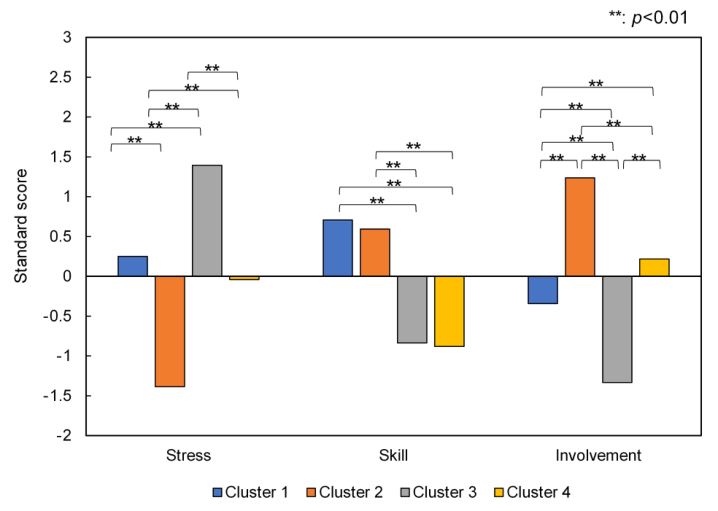
equipment, computer experience/skills, and involvement with ICT equi- pment. Figure 2 shows the mean scores of the three scales in each cluster. The Kruskal-Wallis test was significant for all scales, and significant differences by Scheffe’s multiple comparisons were found among many items (Figure 1).
(3) Differences in acceptability across clusters The Kruskal-Wallis test was conducted to examine differences among the four clusters for the seven items related to acceptance of the Society 5.0 technology. Scheffe’s multiple comparisons were conducted when there were significant differences. The results are shown in Table 3 below. Table 3 shows significant differences in five items except for two related to self-driving cars.
Figure 1: Characteristics of each cluster (**: p <0.01).Table 3. Results of the Kuruskal-Wallis tests and multiple comparison.
First, we discuss the characteristics of each cluster classified based on how they perceive ICT devices. As for the stress toward ICT devices, cluster 3 was the most stressful, and cluster 2 was the least stressful. Cluster 1 and 4 were moderately stressed, and there was no significant difference between these two clusters, suggesting that they felt the same level of stress. In terms of experience and skills, cluster 1 and cluster 2 had higher levels of experience and skills, and there was no significant difference between these two groups, while cluster 3 and cluster 4 had lower levels of experience and skills. As for the involvement with ICT equipment was the highest in cluster 2, and gradually decreased from cluster 4, cluster 1, and cluster 3, with no significant differences among the clusters.
Based on the mean values of the scales shown in Figure 1 and the results of the multiple comparisons described above, the characteristics of each cluster were interpreted as follows. Cluster 1 (n = 51) have high computer experience and skills but do not actively want to use ICT equipment. Cluster 2 (n = 24) have high computer experience and skills that does not feel stressed about ICT equipment and has high product involvement. On the contrary, Cluster 3 (n = 16) feels stressed about ICT equipment and has low involvement in the product. Cluster 4 (n = 42) have low experience and skills, feel some stress toward ICT equipment, but high product involvement.
Next, we discuss the differences in acceptability ratings among the clu- sters. First, there were no significant differences among the clusters in either the intention to use or the difficulty of using “self-driving cars. Although the situation was different from the present study, in most cases, some kind of difference between users was observed in the studies on the acceptability of automated driving. In this study, there were no significant differences among users of automated vehicles, even though significant differences were found for all other items. This may be due to the unique experience of the partici- pants in this study. The participants in this study were engineering students, and the survey was conducted during class. The participants were learning about the fundamentals of automated vehicles, technical issues, and ergo- nomic issues in a different class. This common and unique experience may have homogenized the knowledge levels and attitudes of the subjects, which may have influenced the results of their responses.
In contrast, for “unmanned delivery systems using drones and self-driving cars” and “smart houses that control IoT appliances in the house by voice,” cluster 2 had higher scores than the other clusters for both intention to use and difficulty of use, while clusters 3 and 4 had relatively low scores. Cluster 2 has high experience and skills and a positive attitude toward ICT devi- ces and thus seems highly receptive to the new technology of Society 5.0. This tendency is similar for both the intention to use and perceived difficulty. On the other hand, the acceptability of Clusters 3 and 4 is low. Compared to Cluster 2, both clusters have relatively low experience/skills and negative impressions of ICT equipment, which is reflected in their acceptability. Com- paring Cluster 3 and Cluster 4, there were significant differences in the degree of involvement with ICT equipment and the stress of using ICT equipment.
Relationship Between User Characteristics Regarding ICT Devices 135
However, both clusters had low computer experience/skills. This suggests that low experience /skills may have affected acceptability as a common factor.
Cluster 2 was significantly higher than all other clusters in question O7. In other words, Cluster 2 is considered to have a more positive view of social changes in Society 5.0 in general. This is in line with an existing study (Kusumi and Nishikawa, 2018), which found that stress on ICT equipment use negatively affects acceptability, while computer experience and technical skills positively affect acceptability.
Based on the above, it can be said that users with high computer expe- rience/skills and positive attitudes toward ICT devices are relatively more receptive to new technologies and systems that utilize them in Society 5.0.
Finally, we discuss about the limitations of this study. This study targeted engineering students who are relatively familiar with ICT devices. However, the results are expected to be different when targeting different user groups, such as the elderly who do not use ICT devices very often. Based on the results of this study, the acceptability of the Society 5.0 system may be even lower for users unfamiliar with ICT devices, such as the elderly. Future research should be conducted on users in other segments.
In this study, we evaluated the acceptability of a specific system category in general in terms of the intention to use the system and the difficulty of using the system rather than the acceptability based on the actual use of the specific product. In the future, as the social implementation of new systems in Society 5.0 progresses, more precise results will be obtained by evaluating acceptability assuming actual usage situations.
Furthermore, in this study, we focused on specific factors such as stress, experience/skill, and product involvement to examine their influence on acceptability. However, the correlation coefficients and multiple regression analysis results indicate that these factors do not dominate the influence on acceptability. There is room to examine other factors and their interactions, as suggested by studies on technology acceptance models.
CONCLUSION
This study examined the effects of the stress toward ICT equipment use, experience/skills in computer use, and involvement in ICT equipment use on the acceptability of the new Society 5.0 system. The participants were divided into clusters according to their ratings of their characteristics for ICT equipment use, and compared between clusters in terms of intention to use (whether they want to use the equipment) and difficulty in using the equipment (whether they think they can use the equipment without sup- port). The results suggest that users with high computer experience/skills and positive attitudes toward ICT devices are relatively more receptive to new technologies and systems that utilize them in Society 5.0.
REFERENCES
Ando, M. (2008) “A role of product involvement in use of interactive product,” IPSJ SIG Technical Report, 2008-HCI-130, 69–74.
136 Doi
Davis, F. D. (1986) “A technology acceptance model for empirically testing new enduser information systems: theory and results, Doctoral dissertation,” MIT Sloan School of Management, Cambridge, MA. Ito, D., Tezuka, K., Nakahara, H., Ichihara, Y. (2018) “Development of the ICT
stress scale in the teacher training,” JSSE Research Report, 33(2), 35–38. Kusumi, T, Nishikawa, K. Perception of human-AI collaboration; The impact of computer experience and anxiety, Proc. of 16th annual conference of the Japanese Society for Cognitive Psychology, 2018, p. O6-004. Marangunic, N., Granin, A. (2015) “Technology acceptance model: a literature
review from 1986 to 2013,” Universal Access and Information Society, 14, 81–95. Portz, J. D., Bayliss, E. A., Bull, S., Boxer, S., Bekelman, D. B., Gleason, K., Czaja, S.
(2019) “Using the technology acceptance model to explore user experience, intent use, and use behavior of a patient portal among older adults with multiple chronic conditions: Descriptive qualitative study,” Journal of Medical Internet Research, 21(4), e11604. Rafique, H., Almagrabi, A. O., Shamin, A., Anwar, F., Bashir, A. K. (2020) “Investigating the acceptance of mobile library applications with an extended technology acceptance model (TAM),” Computers & Education, 145, 103732.
LISTED IN THE AHFE DIGITAL BOOKSTORE CATALOGUE
Explore the complete digital volume
Social and Occupational Ergonomics
Read this individual research paper free through the original publisher, or explore the full digital proceedings book.
ISBN 978-1-958651-82-7
Explore this ISBN in the AHFE Bookstore ↗Listed in the July 2026 bookstore catalogue; search by ISBN to confirm current availability · Digital book purchase optional