Peng Liu, Yi Wang (2023). Abandoned Tibetan and Qiang Villages Cause Analysis: A Case Study of Li County. In: Social and Occupational Ergonomics. AHFE Open Access, vol. 106, pp. 144–154. https://doi.org/10.54941/ahfe1003085
This paper takes Li County, Aba Tibetan and Qiang Autonomous Prefecture, Sichuan Province, China as an example in order to study the phenomenon and causes of vil- lage abandonment from a multi-ethnic perspective. Oblique photogrammetry and semi-structured interviews were used to collect spatial and abandonment data in 219 villages. The characteristics of the abandoned villages of the Qiang and Tibetans were compared and analyzed through site selection indicators such as altitude, spa- tial indicators such as scale, and abandonment indicators such as abandonment rate. The main factors affecting village abandonment were screened by Pearson correla- tion analysis and linear regression analysis. The results show that the site selection of Qiang villages is gentle, and the villages are larger in scale, more compact in shape, and more concentrated in distribution. The abandonment phenomenon in Tibetan vil- lages is more serious, and the abandonment rate, relocation distance, and relocation height difference are greater. The main influencing factors of Qiang and Tibetan vil- lage abandonment are different, but the most influencing factors are the same. The main factor affecting the abandonment of Qiang villages is terrain, and the main factor affecting the abandonment of Tibetan villages is terrain, resources, economy. Terrain is the most factor affecting the abandonment of Tibetan and Qiang villages.
Villages are one of the earliest forms of production and life organization for- med in human society, and they are precious natural wealth and cultural resources. However, with the process of urbanization and industrializa- tion, the phenomenon of vacant and abandoned villages is common in all countries in the world. About 6000 villages were abandoned in Italy (Gorgo and Riggi, 2018), about 20000 uninhabited settlements in Russia (Rumjancev et al., 2019), about 1000 villages disappeared in the Czech Republic (Bartolomucci, 2020), about 800 villages have disappeared in Ukraine over the past three decades (Roman and Andriy, 2022). In the past 20 years, more than 600000 villages in China have disappeared. Abandoned villages have caused multiple problems, including waste of land resources (Long et al., 2009), decreased community cohesion (May, 2016), and loss of village history (Latocha, 2020).
Abandoned Tibetan and Qiang Villages Cause Analysis: A Case Study of Li County 145 Existing studies have focused on issues such as the causes, development mechanisms, and revitalization methods of village abandonment. In the study of causes, the phenomenon of village abandonment is related to resource factors such as natural resource depletion (Duhaime et al., 2005), natural disasters (McLeman, 2011), economic factors such as agricultural production reduction (Rumjancev et al., 2019), demographic factors such as population reduced size (Bartolomucci, 2020), and social factors such as war and viole- nce (Sela, 2009). Fewer studies have compared village abandonment across multiple ethnic groups. This paper takes Li County, Aba Tibetan and Qiang Autonomous Prefecture, Sichuan Province, China as an example, to study the phenomenon and causes of village abandonment from a cross-cultural perspective.
METHODOLOGY
Study Area The geographical location of Li County is 30
54tN-31
12tN, 102
32tE- 103
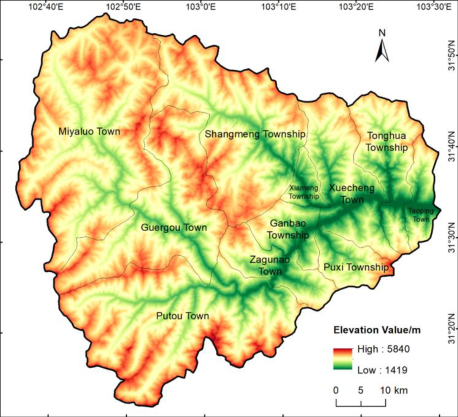
30tE (Figure 1), located in the southeast of Aba Tibetan and Qiang Autonomous Prefecture in Sichuan Province, 200km away from Chengdu, the capital of Sichuan Province. The total area of Li County is about 4318km2. Located on the southeast edge of the Qinghai-Tibet Plateau, it is rich in natural resources but complex in landform types; it is located in the Longmenshan earthquake fault zone, and natural disasters frequently occur in Li County; belonging to the Tibetan-Yi Corridor, the cultures of various ethnic groups in Li County collide fiercely, Tibetan and Qiang are the main ethnic groups in Li County.
Sample and Data Collection The study selects 219 Tibetan and Qiang villages in Li County as the research sample. Based on the old place names recorded in the Li County Gazetteer in
Figure 1: Geographical location and elevation map of Li County.
146 Liu and Wang
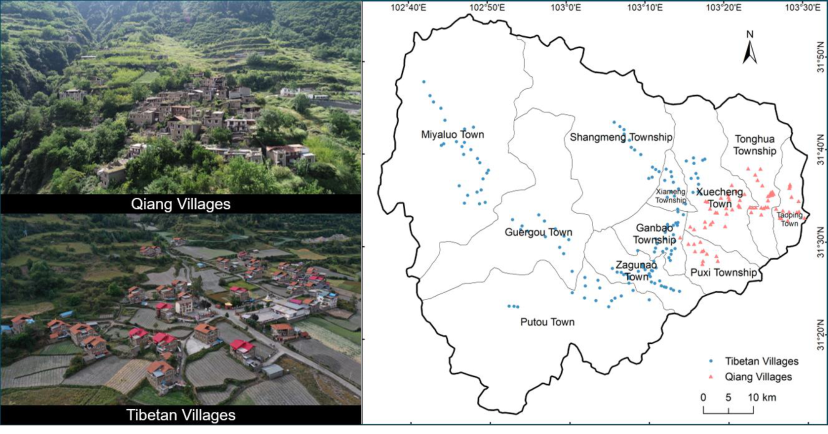
Figure 2: Research sample location.
1980, the research sample consisted of 219 Tibetan and Qiang villages after screening, including 145 Tibetan villages and 74 Qiang villages (Figure 2).
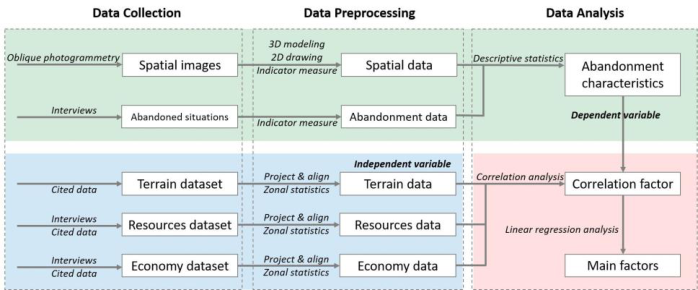
The data collected for the study include village abandonment data, ter- rain data, resource data, and economic data. The data sources are as follows (Figure 3): (1) Village abandonment data include village spatial images col- lected by Oblique photogrammetry and abandoned situations collected by survey interviews. (2) Terrain data include altitude, relief amplitude, and slope, and the source is ASTER GDEM V2 provided by Geospatial Data Cloud (http://www.gscloud.cn/). The source of administrative division data is the 1:1 million national basic geographic database provided by the National Catalogue Service For Geographic Information (http://www.webmap.cn). (3) Resource data include reference data and self-collection data. Meteoro- logical elements, NDVI, Agricultural production potential, and Ecosystem service value data come from the Resource and Environment Science Data Center (http://www.resdc.cn/DOI). The data source of water distance is ASTER GDEM V2. Distance to the township center, elevation difference to the township center, distance to the county center, elevation difference to the
Figure 3: Research flow analysis diagram.
Abandoned Tibetan and Qiang Villages Cause Analysis: A Case Study of Li County 147 county center, and whether geological disasters have occurred come from survey interviews. (4) Economic data include cited data and self-collected data. The GDP and population density data come from the Resource and Environment Science Data Center (http://www.resdc.cn/DOI). The data of annual per capita income and the proportion of agricultural income come from survey interviews.
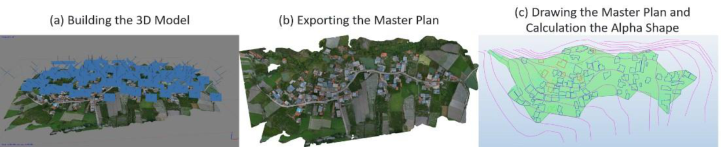
Data Preprocessing Data preprocessing methods are as follows: (1) Process village spatial data (Figure 4). Firstly, based on Metashape, the village aerial image is built into a 3D model. Second, export the general floor plan of the village. Then, based on Rhino, the general plan of the village was drawn, and the Alpha Shape algorithm (Wilson et al., 2009) was used to calculate the village boundary. Finally, indicators are used to measure the spatial form of villages. The sum of projected areas of residential buildings (S) is used to measure the village scale (Formula 1), the BC index(BC) (Boyce and Clark, 1964) is used to measure the boundary shape (Formula 2), and the distribution density of residential buildings (D) is used to measure the degree of agglomeration (Formula 3). (2) Process village abandonment data. Abandonment rate (AR) is uesd to measure the degree of village abandonment (Formula 4). Houses that are unoccupied for more than half a year are considered abandoned. Calculate the relocation distance and relocation height difference between the new and old villages after the villages are abandoned to represent the separation degree of the new and old villages after abandonedment. (3) Based on ArcGIS, the CGCS2000 3 Degree GK CM 102E Projected Coordinate System was used to project and align terrain, resource, and economy data sets, and zonal statistics of village values.
Equations and mathematical formulas are available in the original paper PDF.
Si (1) i = 1 In the formula, S is the scale of the village, n is the number of houses in the village, and Si is the projected area of the i-th house.
Y,n
× 100 − n (2)
In the formula, BC is the Boyce-Clark shape index, n is the number of radiation lines emitted from the centroid in a certain contour, and ri is the i- th radius length from the centroid of the surface to the edge of the figure.
Figure 4: Preprocessing of village spatial data.
148 Liu and Wang
S D (3) S0 In the formula, D is the degree of agglomeration, S is the scale of the village, and S0 is the area of Alphashape.
(4)
In the formula, AR is the abandonment rate, N is the number of abandoned houses, and N0 is the number of village houses.
Data Analysis The research carried out the following analysis: (1) Analysis of the abandoned phenomenon of Tibetan and Qiang villages, including village site selection characteristics, spatial characteristics, and abandoned characteristics. The study uses altitude, relief amplitude, and slope to measure site selection characteristics, uses scale, shape, and agglomeration to measure spatial cha- racteristics, and uses abandonment rate, relocation distance, and relocation elevation difference to measure abandonment characteristics. (2) Based on the results of existing literature, research and interviews, 24 terrain, resources and economic factors (Table 1) were selected for causal analysis, and Pearson correlation was used to analyze the factors that were significantly related to the abandonment rate of Tibetan and Qiang villages. (3) Carry out stepwise
Table 1. Explanatory variables and assumed direction of influence.
) SL. + Resources Annual average ground temperature (
C) GST - Annual average air temperature (
C) TEM - Annual average air pressure (hPa) PRS - Annual average wind speed (m/s) WIN + Annual average sunshine duration (h) SSD - Annual average precipitation (mm) PRE - Annual average evaporation (mm) EVP + Annual average relative humidity (%) RHU - Normalized difference vegetation index NDVI - Distance to water source (km) DTW + Agricultural production potential (kg/ha) APP - Ecosystem service value (10000 yuan/km2) ESV - Distance to town center (km) DTC + Elevation difference to town center (km) EDTC + Distance to county center (km) DCC + Elevation difference to county center (km) EDCC + Whether geological disasters have occurred WGDO + (yes = 1, no = 0) Economy Annual per capita income (10000 yuan) APCI - Proportion of agricultural income (%) PAI - Gross Domestic Product (10000 yuan/km2) GDP - Population density (people/km2) PD -
Abandoned Tibetan and Qiang Villages Cause Analysis: A Case Study of Li County 149 regression analysis and hierarchical regression analysis on the factors with significant correlation, and screen out the main influencing factors and the most influencing factors.
RESULTS
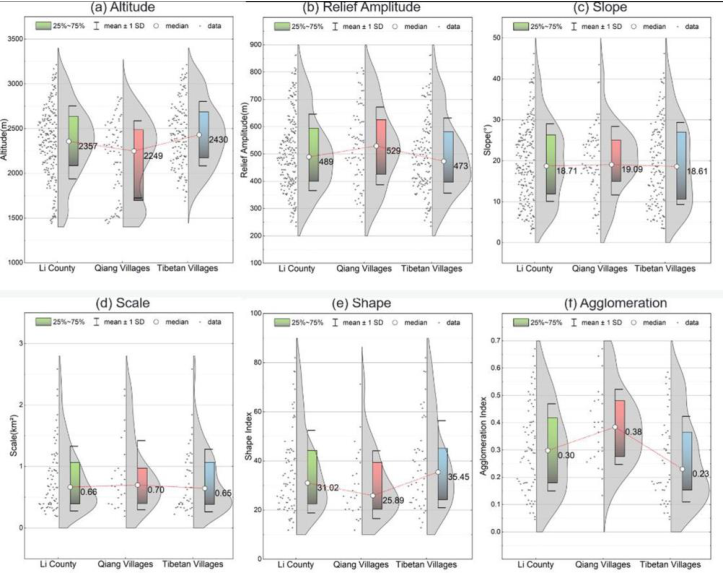
Descriptive Statistics Results of Abandonment Phenomenon The results of elevation data analysis show that there are significant diffe- rences in the site selection of Tibetan and Qiang villages. Compared with Tibetan villages, Qiang villages are located at lower altitude, with higher relief amplitude and steeper slope (Figure 5 a-c). Specifically, the median elevation of Qiang ethnic villages is 2249m, which is lower than the median elevation of Tibetan ethnic villages at 2430m. The undulation height of Qiang ethnic villages is 529m, which is higher than the 473m of Tibetan ethnic villages. The slope of Qiang ethnic villages is 19.09
, which is steeper than the 18.61
of Tibetan ethnic villages.
The results of oblique photogrammetry show that the spatial characteri- stics of Tibetan and Qiang villages is significantly different. Compared with Tibetan villages, Qiang villages have a larger scale, more compact boundary shape, and denser distribution of dwellings (Figure 5 d-f). The data shows that the median size of Qiang villages is 0.70 km2, which is larger than
Figure 5: The descriptive statistics of the site selection and spatial characteristics of Tibetan and Qiang villages.
150 Liu and Wang
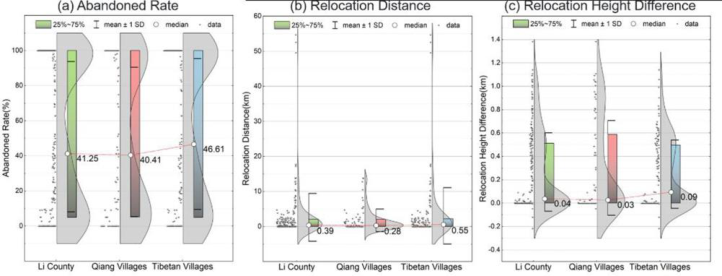
Figure 6: The descriptive statistics of abandoned characteristics of Tibetan and Qiang villages.
that of Tibetan villages (0.65 km2); the BC shape index of Qiang villages is 25.89, which is smaller than that of Tibetan villages (35.45). When the BC index is closer to 0, the boundary shape is closer to a circle, so the boun- dary shape of Qiang villages is more compact; the density of Qiang villages is 0.38, which is about twice the density of Tibetan villages (0.23).
Combining the above-mentioned fieldwork and semi-structured intervi- ews, the research further analyzes the abandoned characteristics of Qiang and Tibetan villages. It can be seen that the phenomenon of abandonment in Tibetan villages is more serious. Compared with the Qiang villages, the aban- donment rate, the relocation distance of the new and old villages, and the relocation height difference of the Tibetan villages are larger (Figure 6). The data show that the median abandonment rate of Tibetan villages is 46.61%, which is higher than that of Qiang villages (40.41%); the relocation distance of Tibetan villages after abandonment is 0.55km, about twice that of Qiang villages (0.28km); The height difference of relocation of Tibetan villages is 0.09 km, which is about three times that of Qiang villages (0.03km).
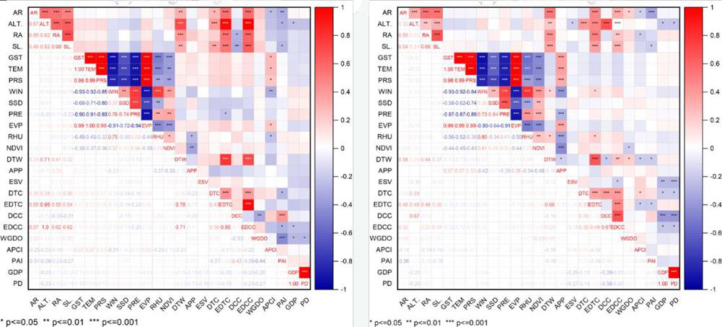
Correlation Analysis Results of Abandonment Rate Abandonment rate and 24 factors were selected for correlation analysis. The results show that the composition of factors significantly correlated with the village abandonment rate of Tibetan and Qiang people is similar. The same thing is that the eight factors of altitude, relief amplitude, slope, distance to water, elevation difference to town center, elevation difference to county center, annual per capita income, and proportion of agricultural income are significantly related to the abandonment rate of Qiang and Tibetan villa- ges. Among them, terrain factors, resource factors and abandonment rate were significantly positively correlated, and economic factors were signifi- cantly negatively correlated with abandonment rate. The difference is that the distance to the township center is significantly positively correlated with the abandonment of Qiang villages (Figure 7 a), whether geological disasters have occurred is significantly positively correlated with the abandonment of Tibetan villages (Figure 7 b).
Abandoned Tibetan and Qiang Villages Cause Analysis: A Case Study of Li County 151
Figure 7: Correlation analysis results of abandonment rate.
Regression Analysis Results of Abandonment Rate The stepwise regression results show that the main factors affecting the aban- donment rate of Qiang and Tibetan villages are different. The main factors affecting the abandonment rate of Qiang villages are terrain, and the main factors affecting the abandonment rate of Tibetan villages are terrain, resou- rces, and economy. Altitude and relief amplitude were the best predictors of abandonment rates in Qiang villages (Table 2), explaining 36.7% of the variability. Altitude, relief amplitude, slope, distance to water source, and proportion of agricultural income are the best predictors of the abandon- ment rate of Tibetan villages (Table 3), explaining 49.6% of the variability of the abandonment rate.
Hierarchical regression results show that terrain is the most factor affe- cting the abandonment rate of Tibetan and Qiang villages. The variation of R2 in the terrain group is the largest (Table 4), indicating that terrain factors have the greatest impact on the abandonment rate of Tibetan villages. The main influencing factors of the Qiang villages are only the terrain group, that is, the terrain has the greatest impact on the abandonment of the Qiang villages.
Table 2. The best predictor variables affecting the abandonment rate of Qiang villages.
Table 3. The best predictor variables affecting the abandonment rate of Tibetan villages.
Table available in the original PDF paper.
Variable Unstandardized coefficients VIF Altitude 0.156* 1.129 Relief amplitude 0.698** 2.015 Slope 0.009* 1.984 Distance to water source 0.211*** 1.306 Proportion of agricultural income -0.414*** 1.057 Constant -0.301 / Adjust R2 0.496 DW 1.525 P 0.000
Table 4. L'lR2 after the input of variable groups affecting the abandonment rate of Tibetan villages.
Table available in the original PDF paper.
Variable group L'lR2 F Terrain 0.157 29.314*** Resources 0.063 29.314*** Economy 0.052 29.314***
DISCUSSION
The spatial differences of Tibetan and Qiang villages are obvious, and the phenomenon of abandonment is common. The villages of the Qiang people are flat, large in scale and compact in layout, while the Tibetan villages are the opposite. This difference is related to history. During the Qin Dynasty, the Qiang people moved from the northwest to Lixian County and other places to escape the war (Ji, 2000), and built compact and adjacent villages to resist the enemy. Tibetans have a large population, and for the convenience of life, residential buildings are mostly scattered. Although villages are generally abandoned, the relocation distance and height difference of Qiang villages are small, making it easy to use old villages. However, the degree of separation between old and new Tibetan villages is high, which is not conducive to the revitalization of old villages.
The composition of factors significantly correlated with the village aban- donment rate of Tibetan and Qiang people is similar. The distance to township was significantly positively correlated with the abandonment rate of Qiang villages, but not with the abandonment rate of Tibetan villages. This difference was caused by the reconstruction policy after the Wenchuan earthquake in 2008. The construction assistance policy requires the use of reinforced concrete materials. To facilitate construction, some Qiang villagers build new houses in the town center. At the same time, whether geological disasters have occurred was significantly positively correlated with the aban- donment rate of Tibetan villages, but not with the abandonment rate of Qiang villages. The protection of Qiang culture led to this difference. In order to
Abandoned Tibetan and Qiang Villages Cause Analysis: A Case Study of Li County 153 protect the Qiang culture, the Qiang villages in geological disaster areas such as Puxi Township have not been relocated.
The main influencing factors of the abandonment rate of Tibetan and Qiang villages are different, but the largest influencing factors are the same. The topographical environment that is convenient for production and living (Di Figlia, 2016), water and education and other resources, and competi- tive wages in industry and service industries (Long et al., 2009) promote the abandonment of Tibetan villages. The difference is that the cherries planting industry in the Qiang villages has developed well, which has alleviated the impact of economic and resource factors. Moreover, the Qiang people believe in the worship of nature, and their reverence for nature makes terrain factors prominently affect the Qiang people’s relocation decisions. At the same time, as the primary feature that distinguishes mountain villages from plain villa- ges, terrain is the most factor affecting the abandonment rate of Tibetan and Qiang villages.
CONCLUSION
This study analyzes the abandonment phenomenon and causes of Qiang and Tibetan villages, obtains and analyzes the spatial characteristics of Qiang and Tibetan villages, compares the abandoned characteristics of Qiang and Tibetan villages, and analyzes how terrain, resources, and economic factors affect village abandonment. The results show that the Qiang villages in the study area are located in a flatter area than the Tibetan villages, and the Qiang villages are larger in scale, with tighter boundaries and denser dwellings. The abandonment phenomenon of Tibetan villages is more seri- ous, and the village abandonment rate, relocation distance, and relocation height difference are higher than those of Qiang villages. The main influe- ncing factors of Qiang and Tibetan village abandonment are different, but the most influencing factors are the same. The abandonment of Qiang vil- lages is significantly affected by terrain factors, and the abandonment of Tibetan villages is affected by terrain, resources, and economic factors, and terrain has the greatest impact on the abandonment of Tibetan and Qiang villages.
ACKNOWLEDGMENT
This study was supported by China National Arts Fund and the People’s Government of Li County, Aba Tibetan and Qiang Autonomous Prefecture, Sichuan Province, China.
REFERENCES
Bartolomucci, C. (2020). Depopulation and Abandonment in the Mountain Villages of Abruzzo: Degradation and Resource. A Reversible Process? Archistor- Architecture History Restoration 1694–1721. Boyce, R. R., Clark, W. A. V. (1964). The Concept of Shape in Geography.
Geographical, 54, pp. 561–572.
154 Liu and Wang
Di Figlia, L. (2016). Turnaround: abandoned villages, from discarded elements of modern Italian society to possible resources. International Planning Studies 21, pp. 278–297. Duhaime, G., Bernard, N. and Comtois, R. (2005). An inventory of abandoned
mining exploration sites in Nunavik, Canada. Can. Geogr.-Geogr. Can. 49, pp. 260–271. Gorgo, L., Riggi, G. (2018). Urban traces: revitalization strategies for abandoned villages. 24th Isuf International Conference: City and Territory in the Globalization Age 843–849. Ji, F. (2000). Chinese Qiang Nationality Architecture. Chengdu. Latocha, A. (2020). Modern transformation of deserted settlements in the Sudetes
Mountains, SW Poland. Geoscape 14, pp. 80–95. https://doi.org/10.2478/geosc- 2020-0008 Long, H., Li, Y., Liu, Y. (2009). Analysis of Evolutive Characteristics and Their Driving Mechanism of Hollowing Villages in China. Acta Geographica Sinica 64, pp. 1203–1213. May, E. (2016). Community-led approaches and interventions for the regeneration
of abandoned towns in Southern Italy. Ecocycles 2. McLeman, R. A. (2011). Settlement abandonment in the context of global environmental change. Global Environmental Change-Human and Policy Dimensions 21, pp. S108–S120. Roman L., Andriy Z. (2022). Transformation of the Rural Settlement Network
in the Carpathian Region of Ukraine (1989–2020). European Countryside 14, pp. 281–301. Rumjancev, I. N., Smirnova, A. A. and Tkachenko, A. A. (2019). RURAL SET- TLEMENTS «WITHOUT POPULATION» AS A GEOGRAPHICAL AND STATISTICAL PHENOMENON. Vestnik Moskovskogo universiteta. Seriya 5, Geografiya 0, pp. 29–37. Sela, R. (2009). Presence and Absence in “Abandoned” Palestinian Villages. History
of Photography 33, pp. 71–79. Wilson, J. A. et al. (2009). Alpha Shapes Applied to Molecular Shape Characterization Exhibit Novel Properties Compared to Established Shape Descriptors. J. Chem Inf. Model. 49, pp. 2231–2241.
LISTED IN THE AHFE DIGITAL BOOKSTORE CATALOGUE
Explore the complete digital volume
Social and Occupational Ergonomics
Read this individual research paper free through the original publisher, or explore the full digital proceedings book.
ISBN 978-1-958651-82-7
Explore this ISBN in the AHFE Bookstore ↗Listed in the July 2026 bookstore catalogue; search by ISBN to confirm current availability · Digital book purchase optional