Yueying Chu, Zihui Yuan, Peng Liu (2023). Privacy Concern and Acceptability of Driver Monitoring System. In: Emerging Technologies and Future of Work. AHFE Open Access, vol. 117, pp. 195–205. https://doi.org/10.54941/ahfe1004419
Driver monitoring systems (DMS) are designed to track drivers’ attention status, accumulate real-time data, and intervene when symptoms of fatigue or distraction are observed, thereby enhancing driving safety [1]. In vehicles equipped with partial driving automation [2], the driver’s role necessitates constant attention to road conditions and monitoring of dynamic driving task (DDT). These vehicles usually feature an advanced driver-assistance system (ADAS), but due to limited understanding of ADAS functionalities, drivers might develop an overreliance on these systems. This could potentially lead to misuse or distractions [3]. Consequently, DMS assists in preventing traffic accidents by supporting drivers in their responsibilities, which includes providing responses in instances of driver negligence.The effectiveness of a DMS is directly related to the user’s willingness to share data such as facial images and vehicle behavior. Moreover, it’s often seen that privacy concerns inversely affect the readiness of users to disclose personal information [4]. Unlike technological domain, users’ perspective regarding DMS utilization has been under-explored. This study aims to gather insights into Chinese drivers’ attitudes towards DMS privacy issues and their willingness to adopt this technology. These findings will help evaluate the future prospects of DMS implementation. To facilitate this goal, the existing DMS systems are categorized into four types based on their primary features: facial image-based DMS, electroencephalogram signals-based DMS, electrocardiogram signals-based DMS, and vehicle behavior-based DMS.A one-way between-subjects design was conducted to investigate the influence of various DMS types on psychological perception and behavioral intention using an online survey (N = 486). Each participant was randomly assigned to one of four DMS type conditions. The questionnaire commenced with a succinct introduction to the relevant DMS type, including its name, functions, and methods of data collection. Subsequently, participants were asked to express their agreement or disagreement with 19 items across seven dimensions (data sensitivity, collection concern, secondary use, perceived insecurity, perceived usefulness, trust, and behavioral intention) about the involved DMS on a Likert scale ranging from 1 (totally disagree) to 7 (totally agree). The questionnaire ended up with demographic questions.All demographic variables did not differ significantly among different DMS type conditions. An exploratory factor analysis was conducted on the 19 items, revealing that three factors emerged, named “privacy concern,” “general acceptance,” and “data sensitivity.” Privacy concern is composed of the predetermined factor collection concern, secondary use, and perceived insecurity; general acceptance is composed of perceived usefulness, trust, and behavioral intention. Subsequently, we examined if DMS types influenced participants’ ratings on privacy concern, general acceptance, and data sensitivity. These analyses yielded no significant effects for DMS types on privacy concern and data sensitivity. Regarding general acceptance, participants displayed a positive attitude and significantly preferred vehicle behavior-based DMS. Further, we investigated the effect of DMS types on predetermined factors. The results showed that there was no significant effect for DMS types on collection concern, secondary use, and perceived insecurity. Participants believed that vehicle behavior-based DMS was more useful and trustworthy. Regression analysis indicated that data sensitivity was a positive explanatory variable for general acceptance, however, the privacy concern was a negative one. This study examined data sensitivity, privacy concern, and general acceptance of various DMS among drivers, and explored the factors influencing general acceptance. It was observed that Chinese drivers, in general, hold a favorable view of DMS and express a degree of willingness to use them. They are less worried about privacy and data insecurity. Further exploration is necessary to ascertain the readiness to use DMS in real-world scenarios.References:1. Dong, Y., Hu, Z., Uchimura, K., Murayama, N.: Driver inattention monitoring system for intelligent vehicles: A review. IEEE Trans. Intell. Transport. Syst. 12(2), 596–614 (2011)2. SAE International: Taxonomy and definitions for terms related to driving automation systems for on-road motor vehicles. Society of Automotive Engineering, USA (2021)3. de Winter, J. C. F., Petermeijer, S. M., Abbink, D. A.: Shared control versus traded control in driving: A debate around automation pitfalls. Ergonomics (in press) 1–43 (2022)4. Hoffman, D., Novak, T. P., & Peralta, M.: Building consumer trust online. Commun. ACM. 42(4), 80–85 (1999)
It is reported that a predominant proportion of traffic accidents, over 90% in both the United States (Dingus et al., 2016) and China (Huang et al., 2018), are attributable to human-related factors. While vehicle automation tech- nology continues to advance, most vehicles on the market still necessitate that drivers monitor the vehicle, road, and surrounding environment to ensure safety. The driver monitoring system (DMS) is developed to track driver’s attention status. If it detects signs of fatigue or distraction, it imple- ments countermeasures, such as playing music, to enhance driving safety (Dong et al., 2011).
DMS can be categorized into three types. The first type involves monitor- ing drivers using driver-facing cameras. This DMS type (e.g., Nakamura et al., 2013) identifies driver states by analyzing factors such as eye movements (e.g., eye closure and blink frequency), facial expressions (e.g., frowning), and head movements (e.g., frequent nodding and head rotation). The second type utilizes contact-based, non-invasive equipment or wearable devices to gather
physiological data, like electroencephalogram (EEG) signals (Chen et al., 2015) or electrocardiogram (ECG) signals (Vicente et al., 2016). These sig- nals can reflect a driver’s drowsiness, fatigue, and stress levels. The third type relies on vehicle motion and utilizes road-facing cameras to monitor driver states. Indicators like irregular steering-wheel angles and erratic vehicle track- ing might suggest driver fatigue (Zhong et al., 2007). Vehicle motion assists in determining if the vehicle is under effective control, thereby indirectly identifying driver states.
Current technology facilitates the monitoring of driver’s behavior. It is cru- cial to ascertain whether drivers accept this technology. Picco et al. (2023) investigated user acceptance among Dutch drivers, revealing moderate enthu- siasm and low sensitivity towards data collection. These drivers express a relative preference for data collection methods based on speed and forward- facing video footage (Picco et al., 2023). A survey on the basis of Universal Theory of Acceptance and Use of Technology framework explored the accept- ability of DMS, and the behavioral intention of this technology is influenced by effort expectancy, performance expectancy, social influence, attitudes to using new technology, and anxiety (Smyth et al., 2021). Notably, a primary determinant of acceptance is privacy concern (Picco et al., 2023). Privacy- invasive conditions can discomfort users (Bloom et al., 2017), and data collection may lead to privacy breaches and potential security risks.
The current study aims to understand Chinese drivers’ perceptions regard- ing privacy concern and acceptance, thereby aiding in evaluating the potential adoption of DMS. We classified DMS into four categories based on their pri- mary characteristics: facial image-based DMS, EEG signals-based DMS, ECG signals-based DMS, and vehicle motion-based DMS. We conducted an online questionnaire to explore drivers’ data sensitivity, collection concern, sec- ondary use, perceived insecurity, perceived usefulness, trust, and behavioral intention.
METHOD
Materials and Procedure The questionnaire consists of two parts. The first collects the participants’ degree of (dis)agreement with DMS-related items and the second section gathers demographic information.
In the first part, participants were asked to express their (dis)agreement with each item about the involved DMS. A Likert scale ranging from 1 (totally disagree) to 7 (totally agree) was used to measure seven dimensions of data sensitivity (DS), collection concern (CC), secondary use (SU), perceived insecurity (PI), perceived usefulness (PU), trust (Tru), and behavioral inten- tion (BI) with 19 items (see Table 1). Collection concern and secondary use were derived from the Concern for Information Privacy scale developed by Smith et al. (1996), with modifications made based on the specific context of this study. The items related to perceived usefulness, trust, and behavioral intention to use were adapted from the questionnaire used by Xu et al. (2018).
Demographic information was collected in the second section. Partici- pants were asked to provide their gender, age, education level, occupation,
Privacy Concern and Acceptability of Driver Monitoring System 197
monthly income, level of knowledge about DMS, years of driving experience, and average annual driving distance in the last two years. After answering demographic questions, participants answered an attention-check question about the type of DMS they had read about earlier and those who failed the attention check would be removed.
Each participant was randomly assigned to one of the four DMS type con- ditions. The questionnaire commenced with a succinct introduction to the relevant DMS type, including its name, functions, and methods of data col- lection. For example, for the facial image-based DMS condition, participants read that “This system employs on-board cameras to continuously gather facial data, including the eye closure, blinking, gaze direction, and yawning. This data is subsequently processed and analyzed to assess the driver’s level of distraction and fatigue. If the system detects that the driver has a certain degree of distraction or fatigue, it issues a warning.” Subsequently, partic- ipants were required to answer how much they agreed with the 19 items. The questionnaire ended up with demographic questions. An example of the questionnaire items for the facial image-based DMS condition is shown in Table 1.
Table 1. An example of the questionnaire items for the facial image-based DMS condition.
Table available in the original PDF paper.
Seven dimensions and corresponding items Data sensitivity (DS) (Kehr et al., 2015) DS1: I think facial image data is very sensitive. Collection concern (CC) (Smith et al., 1996)
CC1: I am worried that this system is recording my facial image data in real time. CC2: It bothers me that this system is recording my facial image data in real time. CC3: I am concerned that this system is collecting too much personal information about me. Secondary use (SU) (Smith et al., 1996) SU1: I am concerned that the manufacturer of this system will sell my facial image data to other companies. SU2: I am concerned that my facial image data will be used for other purposes while using this system. SU3: I am concerned that the manufacturer of this system will share my facial image data with a third party without my authorization. Perceived insecurity (PI) (Cichy et al., 2021)
PI1: I believe that hackers can easily break into this system and get my facial image data. PI2: I am concerned that my facial data will be leaked. PI3: I believe that using this system poses a real risk to the protection of personal information. Perceived usefulness (PU) (Xu et al., 2018) PU1: I think using this system can make my driving easier. PU2: I think using this system can improve my driving safety performance. PU3: Overall, this system is useful for me. Trust (Tru) (Xu et al., 2018)
Tru1: I think this system is dependable. Tru2: I think this system is reliable. Tru3: Overall, I can trust this system. Behavioral intention (BI) (Xu et al., 2018) BI1: I intend to buy this system. BI2: I intend to use this system. BI3: I will recommend family members and friends to use this system.
Note: “this system” refers to the facial image-based DMS.
Participants We run this study via an online survey platform in China (Sojump; https: //www.sojump.com). In total, 654 participants completed the survey. How- ever, 133 failed the attention check, 29 did not possess a driving license, and the gap between age and driving experience (in years) for six partici- pants was less than 18 years (a person under 18 years old cannot apply for a driving license according to Chinese traffic law). Among the remaining 486 participants (303 female; mean age = 30.2 years), 125 were under the facial image-based DMS condition, 121 were under the EEG signals-based DMS condition, 122 were under the ECG signals-based DMS condition, and 118 were under the vehicle motion-based DMS condition. The distribution of all demographic variables did not differ significantly among the four conditions (ps > .05).
RESULTS
Material, data, code, and results are publicly available (https://osf.io/86txu/? view_only=1dc6196d16444394b81f2aafc4b91229).
Factor Analysis These 19 items were subjected to an exploratory factor analysis. The Kaiser- Meyer-Olkin measure of sampling adequacy, KMO = .94, and Bartlett’s Test of Sphericity, χ2(171)= 6126.86, p < .001, suggesting that correlations between these items were sufficiently large for factor analyses. Unexpectedly, a scree plot and parallel analysis (Horn, 1965) indicated that three factors should be retained. We conducted a weighted least squares factor extraction method and oblique rotation. The results showed that factor I was comprised of nine items from pre-assumed collection concern, secondary use, and per- ceived insecurity, and it explained 30% of the variance, which was named privacy concern by us; factor II was comprised of nine items from perceived usefulness, trust, and behavioral intention, and it explained 26% of the vari- ance, which was named general acceptance following a similar observation by de Winter and Nordhoff (2022); factor III was comprised of one item and it explained 4% of the variance, named data sensitivity (Kehr et al., 2015). Factor loadings of each item on each factor are listed in Table 2. There is no common method bias issue, as indicated by the results of the unrotated factor analysis, which show that no single factor accounts for more than 50% of the variance (Podsakoff et al., 2003).
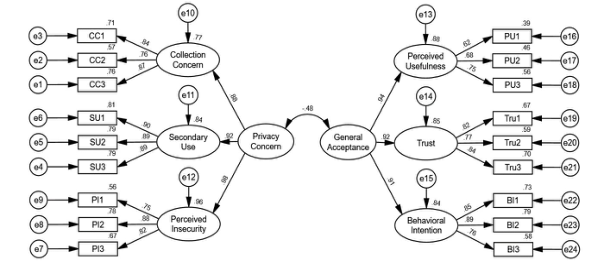
The exploratory factor analysis indicates that our three pre-assumed fac- tors (collection concern, secondary use, perceived insecurity) was factored into a single factor (privacy concern). Thus, we assumed privacy concern to be a second-order construct and the three factors as first-order con- structs. Similarly, this assumption applied to general acceptance and its relevant three factors. To validate our assumptions, we then constructed a second-order factor model with a confirmatory factor analysis (see Figure 1). Several fit indices were examined in assessing the goodness-of-fit of the model (χ2/df = 1.78, Root Mean Square Error of Approximation = 0.04, Goodness of Fit Index = 0.95, Adjusted Goodness of Fit Index = 0.93, Tucker-Lewis
Privacy Concern and Acceptability of Driver Monitoring System 199
Table 2. Factor matrix of exploratory factor analysis.
Note. DS = data sensitivity; CC = collection concern; SU = secondary use; PI = perceived insecurity; PU = perceived usefulness; Tru = trust; BI = behavioral intention.
Index = 0.98, Normed Fit Index = 0.96, Comparative Fit Index = 0.98) and indicated an acceptable fitness (Schumacker and Lomax, 2004).
Figure 1: A second-order factor model with a confirmatory factor analysis.
In Table 3, all factor loadings were greater than .60, indicating acceptable indicator reliability. All factors had acceptable internal consistency (Cron- bach’s α and Composite Reliability greater than .70) (George and Mallery, 2003). Most factors’ average variance extracted (AVE) were above .50, except for perceived usefulness with .46 (close to .50), indicating that the ques- tionnaire achieved acceptable convergent validity (Hair et al., 2014). The square roots of AVE (Privacy concern: .93; General acceptance: .92) were
greater than the absolute value of the associated inter-construct correlation coefficient (r = −.48), indicating acceptable discriminant validity. Thus, the second-order factor model was adequate.
Table 3. A second-order factor model structure fit index.
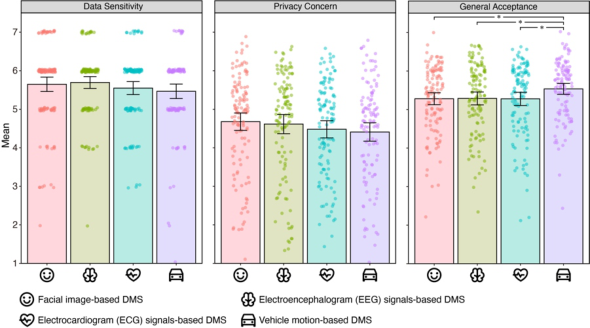
Impact of DMS Type on Data Sensitivity, Privacy Concern, and General Acceptance Average scores of data sensitivity, privacy concern, and general accep- tance were 5.59 (SD = 0.96), 4.55 (SD = 1.29), and 5.34 (SD = 0.88), respectively. On average, participants’ opinions towards data sensitivity and general acceptance were between “somewhat agree” and “agree”, indicating that they thought data collected by DMS were sensitive and they intended to accept DMS. As for privacy concern, attitude between “neutral” and “somewhat agree” showed moderate privacy concern.
Then, a one-way between-subjects analysis of variance (ANOVA) test was conducted to compare the effect of DMS type on data sensitivity, privacy con- cern, and general acceptance. The results revealed no significant main effects of DMS type on data sensitivity (F(3, 482) = 1.35, p = .257, η2p = .008), privacy concern (F(3, 482) = 1.09, p = .354, η2p = .007), and general acceptance (F(3, 482) = 2.48, p = .060, η2p = .015), indicating that data
Privacy Concern and Acceptability of Driver Monitoring System 201
required by the four types were statistically equally sensitive for participants, and DMS type did not significantly affect participants’ privacy concern and general acceptance.
Pairwise comparisons through Fisher’s least significant difference (LSD) method revealed that general acceptance of vehicle motion-based DMS was significantly higher than the other three types (see Figure 2; vehicle motion- based DMS vs. facial image-based DMS: 1M = 0.26, t(482) = 2.27, p = .024, Cohen’s d = 0.291; vehicle motion-based DMS vs. EEG signals-based DMS: 1M = 0.25, t(482) = 2.18, p = .030, Cohen’s d = 0.281; vehicle motion- based DMS vs. ECG signals-based DMS: 1M = 0.26, t(482) = 2.27, p = .024, Cohen’s d = 0.293).
Figure 2: Mean values of the data sensitivity, privacy concern, and general acceptance on each DMS type. Error bars = ± 2 standard errors. *p < .05 (two-tailed).
In addition, we also focused on the impact of DMS type on pre-determined factors, which constitute privacy concern and general acceptance. A one-way between-subjects ANOVA revealed that there were no significant main effects of DMS type on collection concern, secondary use, and perceived insecu- rity (ps > .05). Similarly, as for perceived usefulness, trust, and behavioral intention, which compose general acceptance, there were also no significant main effects of DMS type (ps > .05). Pairwise comparisons through LSD method suggested that vehicle motion-based DMS was perceived more use- ful than facial image-based DMS (1M = 0.27, t(482) = 2.37, p = .018, Cohen’s d = 0.304) and ECG signals-based DMS (1M = 0.22, t(482) = 1.98, p = .049, Cohen’s d = 0.255). In addition, participants trusted vehicle motion-based DMS more than the other three types of DMS (ps < .05).
Data Sensitivity and Privacy Concern Influence General Acceptance Linear regression analysis was conducted to explore whether demographic variables, data sensitivity, and privacy concern impact general acceptance (see Table 4). Data sensitivity was a positive predictor of general acceptance (b = 0.24, t = 7.01, p < .001), indicating that participants who perceived the
Table 4. The regression coefficient (unstandardized beta, b) of linear regression model.
Note. aMale = 0, female = 1; bUndergraduate or graduate = 1, others = 0; cCivil servant or public-sector employee = 1, others = 0; d≤10, 000 Chinese Yuan per month = 0, others = 1; eNever heard = 0, have theoretical knowledge about the operating principles of DMS = 1, have used = 2; f>10,000 km/year = 1, others = 0. Other variables are continuous. *p < .05, **p < .01, ***p < .001.
data used in DMS as more sensitive had a higher acceptance level for DMS. Participants who were concerned their privacy more had a lower acceptance for DMS (b = −0.28, t = −10.81, p < .001). The influence of data sensitiv- ity and privacy concern on general acceptance showed the same trend across four conditions. In terms of demographic variables, linear regression anal- ysis revealed that participants who had lower education level (b = −0.25, t = −2.53, p = .012), more monthly income (b = 0.19, t = 2.57, p = .010), heard of or even used DMS before (b = 0.34, t = 4.52, p < .001), had less driving experience (the year held driving license) (b = −0.04, t = −2.90, p = .004), and drove more per year (in the last two years) on average (b = 0.29, t = 3.76, p < .001) had higher acceptance.
DISCUSSION
This study examined data sensitivity, privacy concern, and general acceptance of four DMS types among Chinese drivers through an online survey. The find- ings suggest that participants viewed the data collected by DMS as sensitive and had moderate concern about privacy. However, they were inclined to accept DMS. Notably, participants perceived DMS based on vehicle motion, an indirect monitoring method, as more useful and trustworthy. Concerning the factors that influenced acceptance, participants who perceived the data as being more sensitive tended to be more receptive to DMS, while those with more privacy concern showed lower acceptance.
Drivers displayed moderate privacy concern, indicating that while they are not excessively anxious about privacy, they do recognize potential risks. Nev- ertheless, they generally have a positive attitude towards DMS, mirroring the findings of Picco et al. (2023). One possible reason is that the safety benefits
Privacy Concern and Acceptability of Driver Monitoring System 203
drivers might gain from DMS could lead them to tolerate some risks associ- ated with privacy leakage. However, positive attitudes do not necessarily lead to actual purchases. In real-world scenarios, the decision to buy is influenced by factors such as actual driving experience, the effectiveness of the DMS, and trust in its manufacturer.
Compared to collecting data from facial images, EEG, and ECG, drivers are more receptive to the collection of vehicle motion information. However, the efficacy of vehicle motion-based DMS is debatable. While vehicle motion data can be analyzed to obtain speed, acceleration, or deceleration patterns, it has limitations in identifying risky driving behaviors. Such data might not adequately address instances of driver inattention inside the vehicle (Jannusch et al., 2021).
Participants who perceived the data as more sensitive demonstrated a higher acceptance level for DMS. At first glance, this may appear counter- intuitive, as one might expect that individuals who view the data as sensitive would exercise more caution towards DMS. However, a plausible interpre- tation is that drivers who perceive the data as sensitive also understand that such data can accurately reflect their driving behavior. Consequently, DMS could potentially discern the genuine driver states from a plethora of person- alized data, leading to effective, tailored countermeasures. We also studied the impact of demographic factors on overall acceptance. Drivers with a lower educational background, higher monthly income, previous awareness or use of DMS, less driving experience, and higher annual mileage displayed greater acceptance. Drivers with less education might lack familiarity with DMS and, therefore, be more inclined to embrace this new technology. Affluent drivers tend to be more open to trying out new products (Gilsenan, 2021). Drivers who have heard of or previously used DMS are likely less appre- hensive about its use and effectiveness due to their past experience. Novice drivers with fewer years of driving experience might be more receptive to DMS, especially since the technology is advertised as enhancing driving safety. Moreover, frequent drivers, who face more risks on the road, may be inclined to seek technologies that improve safety.
This study has practical implications. Overall, the acceptance of DMS by Chinese drivers highlights the potential applications of this technology. How- ever, drivers’ privacy concern suggest a need to develop policies that enhance the protection of private information collected by DMS. This study also has limitations. The online survey we conducted lacks ecological validity and should be supplemented by field experiments.
ACKNOWLEDGMENT
This research was supported by the National Natural Science Foundation of China (Grant No. 72071143 and T2192932).
REFERENCES
Bloom, C., Tan, J., Ramjohn, J. and Bauer, L. (2017). “Self-driving cars and data collection: Privacy perceptions of networked autonomous vehicles”, Proceedings of the Thirteenth Symposium on Usable Privacy and Security, Santa Clara, CA.
Chen, L., Zhao, Y., Zhang, J. and Zou, J. (2015). Automatic detection of alertness/ drowsiness from physiological signals using wavelet-based nonlinear features and machine learning, Expert Systems with Applications Volume 42, No. 21, pp. 7344–7355. Cichy, P., Salge, T. O. and Kohli, R. (2021). Privacy concerns and data sharing in the
internet of things: Mixed methods evidence from connected cars, MIS Quarterly Volume 45, No. 4, pp. 1863–1892. de Winter, J. and Nordhoff, S. (2022). Acceptance of conditionally automated cars: Just one factor? Transportation Research Interdisciplinary Perspectives Volume 15, 100645. Dingus, T. A., Guo, F., Lee, S., Antin, J. F., Perez, M., Buchanan-King, M. and
Hankey, J. (2016). Driver crash risk factors and prevalence evaluation using naturalistic driving data, Proceedings of the National Academy of Sciences Volume 113, No. 10, pp. 2636–2641. Dong, Y., Hu, Z., Uchimura, K. and Murayama, N. (2011). Driver inattention monitoring system for intelligent vehicles: A review, IEEE Transactions on Intelligent Transportation Systems Volume 12, No. 2, pp. 596–614. George, D. and Mallery, P. (2003). SPSS for Windows Step by Step: A Simple Guide
and Reference. 11.0 Update (4th ed.). Boston: Allyn & Bacon. Gilsenan, Katie. (2021). Affluent consumers: Tapping into the wealthiest segment.
GWI Website: https://blog.gwi.com/trends/targeting-affluent-consumers/ Hair, J. F., Black, W. C., Babin, B. J. and Anderson, R. E. (2014). Multivariate Data Analysis (7th ed.). London: Pearson. Horn, J. L. (1965). A rationale and test for the number of factors in factor analysis,
Psychometrika Volume 30, No. 2, pp. 179–185. Huang, H., Chang, F., Schwebel, D. C., Ning, P., Cheng, P. and Hu, G. (2018).
Improve traffic death statistics in China, Science Volume 362, No. 6415, pp. 650–650. Jannusch, T., Shannon, D., Völler, M., Murphy, F. and Mullins, M. (2021). Cars and distraction: How to address the limits of driver monitoring systems and improve safety benefits using evidence from German young drivers, Technology in Society Volume 66, 101628. Kehr, F., Kowatsch, T., Wentzel, D. and Fleisch, E. (2015). Blissfully ignorant: The
effects of general privacy concerns, general institutional trust, and affect in the privacy calculus, Information Systems Journal Volume 25, No. 6, pp. 607–635. Nakamura, T., Maejima, A. and Morishima, S. (2013). “Detection of driver’s drowsy facial expression”, 2013 2nd IAPR Asian Conference on Pattern Recognition, Naha. Picco, A., Stuiver, A., De Winter, J. and De Waard, D. (2023). The use of monitor-
ing and feedback devices in driving: An assessment of acceptability and its key determinants, Transportation Research Part F: Traffic Psychology and Behaviour Volume 92, pp. 1–14. Podsakoff, P. M., MacKenzie, S. B., Lee, J.-Y. and Podsakoff, N. P. (2003). Common method biases in behavioral research: A critical review of the literature and recommended remedies, Journal of Applied Psychology Volume 88, No. 5, pp. 879–903. Schumacker, R. E. and Lomax, R. G. (2004). A Beginner’s Guide to Structural
Equation Modeling. New Jersey: Lawrence Erlbaum Associates. Smith, H. J., Milberg, S. J. and Burke, S. J. (1996). Information privacy: Measuring individuals’ concerns about organizational practices, MIS Quarterly Volume 20, No. 2, pp. 167–196.
Privacy Concern and Acceptability of Driver Monitoring System 205
Smyth, J., Chen, H., Donzella, V. and Woodman, R. (2021). Public acceptance of driver state monitoring for automated vehicles: Applying the UTAUT framework, Transportation Research Part F: Traffic Psychology and Behaviour Volume 83, pp. 179–191. Vicente, J., Laguna, P., Bartra, A. and Bailón, R. (2016). Drowsiness detection using
heart rate variability, Medical & Biological Engineering & Computing Volume 54, No. 6, pp. 927–937. Xu, Z., Zhang, K., Min, H., Wang, Z., Zhao, X. and Liu, P. (2018). What drives people to accept automated vehicles? Findings from a field experiment, Transportation Research Part C: Emerging Technologies Volume 95, pp. 320–334. Zhong, Y. J., Du, L. P., Zhang, K. and Sun, X. H. (2007). “Localized energy study
for analyzing driver fatigue state based on wavelet analysis”, 2007 International Conference on Wavelet Analysis and Pattern Recognition, Beijing.
LISTED IN THE AHFE DIGITAL BOOKSTORE CATALOGUE
Explore the complete digital volume
Emerging Technologies and Future of Work
Read this individual research paper free through the original publisher, or explore the full digital proceedings book.
ISBN 978-1-958651-93-3
Explore this ISBN in the AHFE Bookstore ↗Listed in the July 2026 bookstore catalogue; search by ISBN to confirm current availability · Digital book purchase optional