Yusuke Jupiter Guard, Keiko Yamamoto, Yu Shibuya (2023). Behavioral Design Focusing on Personal Distance to Elicit Attachment to Pet Robots. In: Emerging Technologies and Future of Work. AHFE Open Access, vol. 117, pp. 107–115. https://doi.org/10.54941/ahfe1004410
What is the difference between a companion animal and a pet robot? In recent years, many pet robots with the theme of healing have been proposed in Japan. Although those pet robots are designed in various ways to be loved by humans, the number of pet robot owners is still far fewer than that of companion animal owners. This is partly because pet robots still cannot withstand long-term use because their interactions become obsolete at an early stage.Therefore, for the long-term use of pet robots, this research aims to build a long-term relationship between owners and pet robots by eliciting attachment to the pet robot from its owner, and to realize interactions that will prevent boredom with the pet robot.In particular, this paper focuses on the pet robot's “personal distance”. We evaluate whether the pet robot can elicit the owner’s attachment to the pet robot by shortening the personal distance as it interacts with its owner over a longer period.The experiment lasted for 14 days and involved 16 participants. The participants wore HMDs and observed the robot on the stereoscopic display during a certain period each day. Robots which behaved in 4 different patterns were presented, 3 of which shortened the personal distance each day, i.e., the robot gradually approached the participant each day, and the remaining 1 pattern is the one which the personal distance was constant and short, i.e., the robot always stayed at a close distance. The three types of robots that shortened their personal distance day by day were those that approached the participant remarkably in the first half of the experiment, those that approached the participant remarkably in the second half of the experiment, and those that approached the participant gradually and to a certain degree throughout the experiment.The participants were asked to answer a daily questionnaire to measure the degree of attachment they felt toward each robots daily. At the end of the experiment, participants were asked which robot they liked best.The results showed that the attachment scores of the robot with constant and short personal distance were significantly higher than those of the other robots for each of the 14 days, but the scores did not change significantly throughout each day of the experiment. On the other hand, among the robots whose personal distance varied, the evaluation value tended to increase throughout the experiment for the robot that approached the participant remarkably in the first half of the experiment. In addition, the results of the questionnaire asking which of the robots the participants liked best, showed the robot that approached the participant remarkably in the first half of the experiment was the most preferred among the four types of robots.These results suggest that by lengthening the experiment period, the attachment scores of the robot that approached the participant remarkably in the first half of the experiment might exceed that of the robot whose personal distance was constant and short, and elicit the owner's attachment to the robot.
In 2000s, the role of pets has been changing as they are now referred to as partners or companion animals and treated as family or friends. Furthermore, due to the voluntary restraint of going out after 2019 due to the COVID-19 pandemic, there is now a demand for pets that promote mental and physical health while staying at home. For this reason, people who used to relieve stress and change their mood by going out are now adopting pets to ease their feelings, and pets are attracting renewed attention as a form of healing that can be enjoyed in the home (Judith, 2004).
Pet-type robots are one of the ways to enjoy the experience of pet owner- ship. A pet-type robot is a robot with a design that mimics the characteristics of a pet and is designed to entertain and communicate with humans. Some people choose pet robots because they are not living beings, and therefore do not have issues of feeding, hygiene, or death, and thus pet loss is less likely to occur. With pet-type robots, it is therefore possible to obtain the benefits of pets more easily and at less cost.
To obtain the same effect as a real pet from a pet robot, it is also necessary to form a long-term relationship with the robot. This is because the healing obtained from short-term interactions, such as in a pet cafe, is superficial and has only a fraction of the effect obtained from pet ownership. To facilitate long-term interactions, it is necessary for people continue to interact with their pets beyond the initial period of superficial cuteness without becom- ing bored. To maintain such interactions, it is necessary to elicit the user’s attachment to a robot. For owners to maintain their robot pets in this way, it is necessary to elicit attachment to the robots and continue having interac- tions. However, it is unclear what kind of robot behaviors can elicit greater user attachment. Specifically, it is unknown what kind of robot behaviors will sustain the relationship with the user when the robot and user interact.
In this study, we investigate the behaviors that are necessary to sustain a long-term relationship with a robot and the factors that contribute to such relationship.
CLASSIFICATION OF BEHAVIOR AND RELATED STUDIES Behaviors that cause user attachment to pets and pet robots include yawn- ing and being happy when patted. In this paper, we classify such behaviors according to their duration and autonomy. First, we can classify behaviors into “short-term”and “long-term.” Short-term behaviors are those that users can observe within a short period of time. By contrast, long-term behav- iors can only be observed after a long period of time. Next, we can classify robot behaviors as either “reactive” or “autonomous.” Reactive behaviors are reactions to user actions. Autonomous behaviors refer to the behaviors of a pet robot according to its internal state, regardless of the actions taken by the user. Combining short- and long-term behaviors with reactive and autonomous behaviors, the results can be classified as shown in Table 1.
Table 1. Classification of behaviors that elicit attachment.
Table available in the original PDF paper.
Reactive Autonomous
Scratching body
Short-term
Happy when it is patted/stroked
Yawning
Respond when talked to
Licking body
Eat when fed
Moving around
Play with the toy when holding it
Seems apologetic after a prank
Long-term
If the robot is patted every day, the distance between the pet and owner decrease
Makes sounds when it wants to be patted
If called by its name daily, it starts responding to its name
Licks the floor when lonely
Performs tricks if you practice them daily
Behavioral Design Focusing on Personal Distance to Elicit Attachment to Pet Robots 109
(1) As short-term reactive behavior, e.g., when patting the robot, it wags its tail happily. (2) Short-term autonomous behavior includes the pet robot scratching itself. (3) As long-term reactive behavior, e.g., if the robot is patted every day, the distance between the pet and owner gradually decreases. (4) Long-term autonomous behavior includes the licking the floor because of loneliness.
In this study, we classified these behaviors eliciting attachment into four types and positioned our research based on the lifelikeness of the robot behavior and motion Research on Short-Term Reactive Behaviors
Kanayama et al. developed a robot that can express various emotions by learning arm movements according to the purpose of the expression and evaluated the impressions of each learned arm movement (Kanayama et al., 2020). This robot gets up when nudged by a person and is trained to perform arm movements of different magnitudes, which are divided into six levels of energy (A through F) when it gets up. The impression of the trained robots was evaluated for six items: sensitivity, emotion, proficiency, attachment, vigor, and lifelikeness. Although no differences were observed between B and E, there was a difference in sensitivity and emotion between A through F.
Research on Short-Term Autonomous Behaviors Kimura et al. focused on eating motions, which are important for the for- mation of human attachment, and then evaluated which parts of the robot’s eating behaviors humans perceive as lifelike (Kimura et al., 2014).
The following 4 items that are thought to affect the perception of life- like behaviors in eating, i.e., food color (red/blue), grinding conditions (shearing/shredding), the motion of the grinding device (response to food/- continuous motion), and whether the behavior of the grinding device matches the external environment (coordinated/separate), as well as videos of 16 types of robots performing eating behaviors were used for the survey. More than half the survey respondents felt that the robot was lifelike under the follow- ing conditions: red food color, shearing, responsive to food, and coordinated with the external environment.
Research on Long-Term Reactive Behaviors AIBO (Fujita, 2004) is the world’s first entertainment robot with built-in sensors and cameras placed in various locations allowing it to recognize the people and places around it. It was designed to imitate a dog and has various behaviors to that end. As one of its most distinctive features, AIBO’s person- ality and behavior change depending on how its owner raises and treats it. If the owner frequently pats it, AIBO will become pampered, and if the owner teaches it tricks, AIBO will perform them.
Positioning of This Research Previous research has studied the change of user impressions of the robot’s short-term behaviors (Kanayama et al., 2020 and Kimura et al., 2014). Com- mercialized pet robots also implement long-term reactive behaviors (Fujita, 2004). However, little research has been conducted on long-term autonomous behaviors. Therefore, this study focuses on long-term autonomous behavior and examines the possibility of eliciting an attachment from such behavior. Specifically, we examine whether pet robots can elicit an attachment by grad- ually and nonmonotonically approaching the user through daily behaviors. Gradual daily behaviors correspond to the “long-term autonomous behav- iors”from among the four behavioral categories given above. The reason why we focus on “gradually and nonmonotonically approaching the user through daily behaviors” is based on the fact that personal distance is one of the indi- cators of intimacy and depth of the relationships between people. Personal distance is the distance at which people feel comfortable depending on their relationship with a new acquaintance, friend, or lover. Personal distance is believed to reduce as relationships become deeper, such as between lovers and family members (Kanada, 2008).
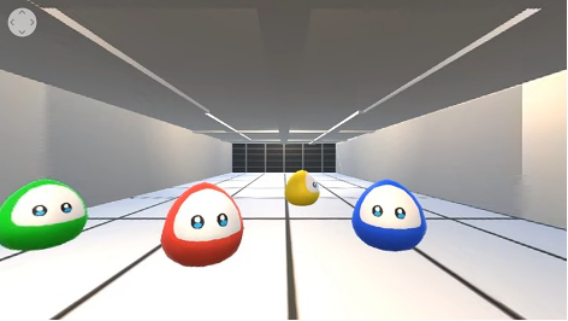
Figure 1: Four robots used in the experiment.
EXPERIMENTS Overview
The following experiments are carried out to verify whether a human–robot attachment increases by reducing the normal distance over time. Normal dis- tance is the distance to the robot when the user is not physically interacting with the robot. Each participant attach their smartphone to a pair of VR goggles (VR Shinecon), watched a 5-min VR video featuring four robots, and respond to a questionnaire once a day for fourteen days (XUNIJP). The four robots appear in a virtual space, as shown in Fig. 1. One of the robots approaches the participants remarkably during the first half of the experiment (the “First-Half approaching robot”), one remarkably during
Behavioral Design Focusing on Personal Distance to Elicit Attachment to Pet Robots 111
the second half of the experiment (“Second-Half approaching robot”), one approaches gradually and to a certain degree throughout the experiment (hereafter, “Gradual approaching robot”), and one remains at a short dis- tance from the beginning (“Proximal keeping robot”). The colors red, blue, green, and yellow are used to identify the four robots, as shown in Fig. 1. A questionnaire is given to the participants to survey their impressions of the robots appearing in the video, which take approximately 5 minutes. The duration is set to fourteen days to investigate whether the robot is eliciting long-term attachment that will lead to a continued interaction rather than an instantaneous attachment.
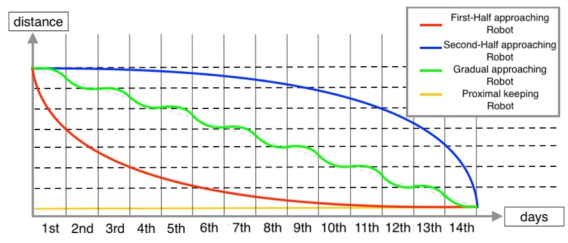
Video Over the fourteen days of the experiment, the four robots appear in the movie in the following manners: The First-Half approaching robot approaches remarkably during the first half of the experiment towards the participant, as shown by the red line in Fig. 2; the Second-Half approaching robot approaches remarkably during the second half of the experiment towards the participant, as shown by the blue line; the Gradual approaching robot approaches gradually and to a certain degree throughout the experiment towards the participant, as shown by the green line; and the Proximal keep- ing robot stays close to the participant from the beginning, as shown by the yellow line. The Proximal keeping robot’s behavior of being close to the participant permanently presents a behavior common to pet robots. All four robots in the video conduct common gestures of moving sideways and looking around.
Figure 2: Distance between participant and each robot.
Participants The participants are 16 people (9 men, 7 women; all in their 20s).
Evaluation Index We use a questionnaire to evaluate the strength of attachment. The question- naire consists of 30 questions about the passion, intimacy, and commitment to the robot, based on the triangular theory of love proposed by Sternberg, as shown in Table 2 (Sternberg, 1986). The triangular theory of affection
considers love as a concept consisting of three elements, i.e., intimacy, pas- sion, and commitment, and considers various types of love depending on the strength of each element and the balance of the three elements.
Intimacy with a robot refers to the degree to which the user wants to be close to the object. For example, it refers to the degree to which a user wants to play with their pet and communicate with it and the closeness of the rela- tionship. Passion for a robot is the degree to which the user likes the robot. Commitment to a robot refers to the degree to which the user is willing to take an action for the benefit of the robot and not just their own gain or loss. In other words, it is the degree of affection based on the sense of responsibility.
We conduct a questionnaire survey where the participants answer each of the 30 questions in Table 2. The participants answer which of the robot in the video fit best for the question, and the total score for each robot is used as the attachment score (hereafter referred to as the “evaluation score”). On the fourteenth day, a preference item will be added: “Which color robot (red, blue, green, yellow) did you like the best in the end?”
RESULTS AND DISCUSSION
Result
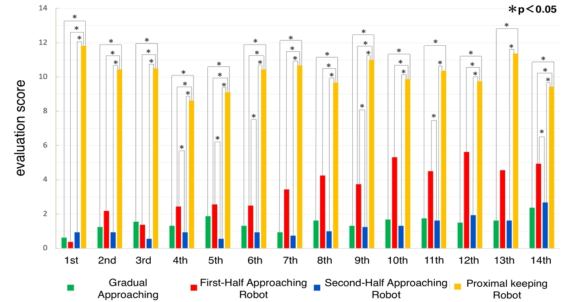
Results from the evaluation scores showed that the Proximal keeping robot had significantly higher evaluation scores compared to the other three robots throughout the experiment except for the 11th and 13th day, but the First- Half approaching robot showed a greater tendency to increase its evaluation score. In other words, it can be said that the behavior of the First-Half approaching robot was evaluated more highly than that of the other robots as each day passed. On the other hand, the Second-Half approaching robot and the Gradual approaching robot showed a gradual increase overall, although some days showed an increasing trend.
The First-Half approaching robot showed an upward trend in evaluation score except on the third, nineth, eleventh, and thirteenth day. The Second- Half approaching robot showed an upward trend in evaluation score except on the fourth, sixth, seventh, nineth, and twelfth day. The Gradual approach- ing robot showed an upward trend in evaluation score except on the third, fifth, seventh, and thirteenth day. To investigate whether this trend was sta- tistically significant, we conducted a two-way analysis of variance among the subjects, using the type of robot and the date as factors. The results showed the main effect of the robot type (F(3, 45) = 2.62, p < 0.01) as a factor, but not for day (F(13, 195) = 1.73, n.s.) as a factor. We couldn’t observed an interaction between the type of robot and day (F(39, 585) = 1.41, n.s.).
Next, as a post hoc analysis, we conducted multiple comparisons using the Holm method to clarify the relationship between robots. Significant differences were found between the First Half approaching robot and the Second-Half approaching robot(p < 0.05), and the First-Half approaching robot and the Gradual approaching robot (p < 0.05). Also, the Proximal keeping robots’ evaluation score was significantly higher than that of the First-Half approaching robot (p < 0.05), the Second-Half approaching robot (p < 0.05), and the Gradual approaching robot (p < 0.05).
Behavioral Design Focusing on Personal Distance to Elicit Attachment to Pet Robots 113
Figure 3: Graph of daily average evaluation points for each robot.Table 2. List of why participants preferred each robot at the end of the experiment (Robot colors from the original responses have been replaced with the terms used in the paper).
Table available in the original PDF paper.
Reasons for why the participants preferred the First Half approaching robot (N = 7) “At first, I was afraid of all the robots except for the close robots because they were too far away and I couldn’t see their expressions. However, the more times I watched the first half of the robots, the more I became interested in them because I could understand their expressions and felt that they were the most familiar to me personally, and that they were cute and calming to look at.”
“I felt a closer relationship from being gradually approached than if being stayed in a close distance.” “As it got closer and closer, I became more and more interested.” “At first it was far away, but it was getting closer and closer, and that drew my interest in it.” “The First-Half approaching robot began to stare at me from the middle of the series of experiment, and I felt that the awkward timing of its gaze averting seemed to attract my affection. On the other hand, the Gradual approaching robot gradually followed the Second-Half approaching robot’s avoidance movement, which made me feel as if the robot was still a young child easily influenced by its surroundings, and I felt as if I could not leave it alone. Although I feel a sense of responsibility for the current situation in which the Second-Half approaching robot is being avoided, and I would like to work on the Gradual approaching robot’s attitude, I think it was the First-Half approaching robot that drew my attention the most. The Proximal keeping robot seemed to be cold to the Second-Half approaching robot, but it often moved away from the other three until they were just out of sight, giving the impression of some autonomy.” Reasons for why the participants preferred the Second-Half approaching robot (N = 1) “Because it came by at the end. Reasons for why the participants preferred the Gradual approaching robot (N = 1) “I felt closer and more intimate by the shortening of the distance.” Reasons for why the participants preferred the Proximal keeping robot (N = 7) “I have become attached to it because it has always been closest to me. Even if other robots are getting closer, the robot closest to me is the one I look at most often, and as a result, I think my attachment to it is particularly strong.”
“I could look at it clearly from the very beginning.” “It had always been the closest.” “Because it was in the closest position from the participant’s point of view from the first experimental video.”
“It had always been the closest and I felt like it’s attached to me.” “I was attached to it because it was the first robot that existed closest to me, and even after that, it was closer to me than other robots.”
“Because it was close to me all the time”
The participants impressions of the robots they preferred in the end are provided in a descriptive format in Table 2. In the question about prefer- ences, 7 participants preferred the First-half approaching robot, 1 preferred the Second-Half approaching robot, 1 preferred the Gradual approaching robot, and 7 preferred the Proximal keeping robot, showing that the First- Half approaching robot and the Proximal keeping robot were preferred the most.
DISCUSSION
The Proximal keeping robot had significantly higher evaluation scores com- pared to the other three robots on almost all of days in the experiment. However, the results of the analysis of the factors of robot type and day showed that the First-Half approaching robot had significantly higher eval- uation scores on almost all of the days compared to that on the first day, and its evaluation tended to increase more than those of the other three robots throughout the experimental period. On the other hand, the First- Half approaching robot did not show significantly higher scores than the Second-Half approaching robot and the Gradual approaching robot on the 14th day, when the distance between each robot and the participant was the closest, suggesting that the First-Half approaching robot’s scores did not increase due to gradual and non-monotonous behavior, but because it spent more time at a closer absolute distance from the participant. This can also be explained by the fact that the Proximal keeping robot, which was always in the vicinity of the user throughout the experiment, always obtained a higher evaluation score than the other three robots.
Although the evaluation score of the Proximal keeping robot did not increase significantly from day to day, that of the First-Half approach- ing robot tended to increase significantly, and the fact that the First-Half approaching robot received the same number of evaluations as the Prox- imal keeping robot as the robot that the participants finally preferred in the free description questionnaire suggests that robots such as the First-Half approaching robot, which shortens the distance with the user of it when the user observes it for the first time, may be useful in increasing attachment to the pet robot. Therefore, if the duration of the experiment is extended and the evaluation continues over a longer period, it is possible that the First-Half approaching robot may exceed the evaluation score of the Proximal keeping robots.
The results of the preference varied, suggesting that users might have a preference for behaviors of pet robots, as biological pet owners have prefer- ences for cats and dogs. Further investigation and analysis to determine what kind of pet robot’s behavior is preferred among pet robot users is needed.
CONCLUSION
In recent years, many pet robots have been proposed to provide the healing and relationship that comes from owning a pet. However, biological pets still outnumber pet robots by far. This might be due to current pet robots
Behavioral Design Focusing on Personal Distance to Elicit Attachment to Pet Robots 115
tending to give the impression of being mechanical because of their repetitive movements and stereotypical behavior, and boredom occurs during long-term use. To solve this problem, it is necessary to make the user want to interact with the pet robot over a long period of time by making the robot become attached to the user, as users get attached to biological pets. In this study, among the factors that elicit attachment, we focused on the non-monotonic reduction of personal distance, which is an index for evaluating the depth of interpersonal relationships. Four types of behaviors which shortens the distance between the participant nonmonotonically were presented in a VR video, and the participants were asked to evaluate their level of attachment every day for fourteen days.
The results showed that the robot which was close to the user throughout the experiment had been evaluated the highest overall. However, the results also showed that the evaluation scores of the three robots which approached to the user nonmonotonically had an increasing tendency, and especially the increasing tendency of the evaluation score of the robot which approached remarkably in the first half of the experiment suggests that by extending the experimental period, this robot’s evaluation score might exceed that of the robot which was close to the user throughout the experiment. To support this suggestion, extending the duration of the experiment is needed.
In addition, the result of preferences varied, suggesting that users might prefer certain behaviors of pet robots based on their personality. Therefore, we will investigate and analyze what kind of behaviors of pet robot’s users prefer.
REFERENCES
Donath, J. and Greenwood, M. (n.d.). Artificial Pets: Simple Behaviors Elicit Complex Attachments. [Online] Available at: https://vivatropolis.com/judith/Artificial Pets.pdf Fujita, M. (2004). On activating human communications with pet- type robot AIBO, in Proceedings of the IEEE 92, 11, 1804–1813, doi: 10.1109/JPROC.2004.835364. Kanada, T. (2008). Human information processing research through robot media: 4
Human-Robot Communication Distance, Information Processing. 49, 1, 25–29. (in Japanese). Kanayama, M. Kanazawa, Y and Yamanaka, S. (2020). Interaction design study on sense of life of artifacts caused by unstable motion, Correspondences on Human Interface, 22, 6, SIG-DeMO-10 (in Japanese). Kimura, Y. Nagahama, S. Sugano, S. (2014). A study on human impressions of
robots with feeding motions, Annual Conference of Japanese Society for Artificial Intelligence (in Japanese). Stanberg, R. J. (1986). A triangular theory of love, Psycho-logical Review 93, 2, 119–135. XUNIJP: VR SHINECON. https://direct.sanwa.co.jp/ItemPage/400-MEDIVR2
LISTED IN THE AHFE DIGITAL BOOKSTORE CATALOGUE
Explore the complete digital volume
Emerging Technologies and Future of Work
Read this individual research paper free through the original publisher, or explore the full digital proceedings book.
ISBN 978-1-958651-93-3
Explore this ISBN in the AHFE Bookstore ↗Listed in the July 2026 bookstore catalogue; search by ISBN to confirm current availability · Digital book purchase optional