Meina Tawaki, Ichi Kanaya, Keiko Yamamoto (2026). Geometric Simplification in Humanoid Robot Facial Design: A Cross-Cultural Study of Emotion Recognition. In: Human Systems Engineering and Design (IHSED2026): Future Trends and Applications. AHFE Open Access, vol. 237, pp. 915–920. https://doi.org/10.54941/ahfe1008229
This study investigates facial expression recognition in humanoid robot design, aiming to clarify cultural differences in emotional perception and to establish design guidelines for effective nonverbal communication. As robots are increasingly expected to coexist with humans in daily environments, the face functions as a crucial interface for conveying emotional states and social intentions. However, highly humanlike appearances often evoke psychological discomfort, known as the Uncanny Valley phenomenon. To address this issue, this research advocates a design approach that prioritizes artifact-like familiarity and psychological comfort through simplification rather than direct human imitation. We argue that robots should embody forms appropriate to their own functions, instead of replicating human appearance without critical adaptation.Drawing on the concept of characterization, this study focuses on simplified geometric facial designs. Characterization involves abstracting and deforming distinctive features while maintaining recognizability. In this research, facial elements are reduced to minimal components: eyes and a mouth constructed from geometric shapes derived from perfect circles. By systematically manipulating parameters such as aspect ratio, inclination, and curvature, we generated multiple symbolic expression patterns. These variations enabled controlled examination of how geometric deformation influences emotional interpretation.Previous research consisted of a comparative questionnaire experiment conducted with university students in Denmark and Japan. Participants classified perceived emotions according to Ekman’s six basic categories—happiness, anger, sadness, disgust, fear, and surprise—along with two neutral conditions. Results showed minimal cultural variation in the recognition of happiness, anger, sadness, and neutral expressions. In contrast, significant differences emerged for disgust, fear, and surprise, indicating that these emotions may depend more strongly on cultural or contextual factors. The findings suggest that simplified geometric expressions can communicate primary emotions across cultures, whereas secondary emotions require more context-sensitive design strategies.Building on these results, the present study conducts a detailed follow-up investigation focusing exclusively on Japanese university students. This phase analyzes the relationship between specific geometric parameters and emotional cognition in greater depth. By examining how variations in eye slant, mouth curvature, and proportional balance affect perceived emotional intensity, the study clarifies culturally specific tendencies in Japanese emotion recognition. Statistical analyses provide insight into how subtle geometric adjustments influence viewers’ psychological responses and categorical judgments.The ultimate objective of this research is to propose practical facial expression design guidelines for humanoid robots that reflect cultural nuances while maintaining universal interpretability. By extending established emotion models to symbolic and abstract facial representations, this study contributes to foundational discussions on robot morphology and human–artifact interaction. The findings offer designers empirically grounded principles for creating approachable robotic faces that foster psychological safety and intuitive communication. As robots transition from industrial machines to social partners integrated into everyday life, such design strategies will be essential for ensuring comfortable and sustainable human–robot coexistence.Furthermore, the study discusses implications for cross-cultural validation frameworks and iterative prototyping processes in robot design. Integrating quantitative findings with qualitative feedback enables designers to refine symbolic expressions systematically, balancing clarity, subtlety, and cultural resonance in real-world deployment scenarios. This approach strengthens evidence-based creative decision-making in practice.
When human beings communicate with each other, their faces convey the most important and richest information, and their facial expressions are by far the most essential element for understanding the other’s emotion. Various elements such as the eyes, mouth, and nose are contained in the face, and these are transformed to form facial expressions. For many primates Received June 1, 2026 Revised June 14, 2026 Accepted June 29, 2026 Available online September 25, 2026
including human beings, the eyes are one of the most important factor used to recognize a face as a face. Visual preference for facial figures and research on perceptions of upside-down faces are well known regarding facial recognition. These researches have also suggested that the eyes and the mouth are the most important elements for the primates (Darwin, 1872) (Diamond, 1986) (Ellis, 1979) (Keating, 1975) (Shepherd, 1981) (Slater, 1993) (Yin, 1969) (Young, 1985). There have been two theories regarding the recognition of facial expressions: the category perception theory and the dimension theory. The category perception theory states that human beings judge the meaning of facial expressions through 7 ± 2 universal categories common to all human beings. This theory is based on an idea stemmed from evolutionary theory. This theory indicates that facial expression is a discrete (not continuous) status. In terms of emotional categories, the six basic emotions (happy, angry, sad, disgust, fear, and surprise) advocated by Ekman and many other researchers are the most typical. Basic emotions synchronize with physiological responses and signals to the body such as facial expressions, and it is proposed that facial expressions can be classified under one of the six basic emotions without exception irrespective of culture (Ekman, 2005) (Smith, 1985) (Yamada, 2000) (Yin, 1969).
The dimension theory proposes that facial expressions are points in a continuous space of possible facial expressions, and people recognize the emotions after they locate the points. Dimension theory begins with Schlosberg’s theory of the dimension of emotion, for example the circular ring model comprising two dimensions, namely pleasant vs. unpleasant and attention vs. rejection, and the circular cone model comprising the previous two dimensions plus tension vs. sleep. Since this research, many researchers have discussed such affective meaning dimensions and have repeatedly encountered three dimensions: the pleasantness dimension (pleasant vs. unpleasant), the attention vs. rejection dimension, and the activeness (awareness) dimension (aware vs. asleep). The circumplex model comprising a pleasantness dimension and an awareness dimension suggested by Russell has been validated in terms of its universality and robustness by many previous researches (Russell, 1997) (Schlosberg, 1954) (Shah, 2003) (Smith, 1985) (Takehara, 2001) (Yamada, 2000). Yamada conducted a study to clarify visual information (the physical variable) related to the cognition of facial expressions using a line- drawing figure in which eight points of the eyebrows, eyes and mouth are manipulated. From the results, two physical variables have been found: slantedness, meaning the curve and indication of face elements; and openness and curvedness, meaning the level of curve and openness of facial elements. Based on this knowledge, they proposed that there are three processes used to cognize facial expressions: (1) acknowledgement of visual information (the physical variable) of the face, (2) evaluation of affective meaning based on the physical variable, and (3) judgment of the emotional category based on affective meaning (Watanabe, 2001) (Yamada, 2000).
MINIMAL FACIAL EXPRESSIONS We validate the relationship between the physical variable and the affective variable discovered by previous researches using geometrical faces, and to apply the existing knowledge to robot facial design. Clarification of this relationship is one of the most important aspects for research on cognition of facial expression. The geometrical face used for this article is comprised of the minimum necessary elements for recognizing the face, and the elements are transformed geometrically to form the various facial expression patterns. We introduce the physical variables, slantedness and openness, to the geometrical transformation. These facial patterns are classified by basic emotions, and evaluation of the relationship between the physical and affective variables is conducted by applying principal component analysis to the facial expression space centered on physical variables. Based on the results of the research, we finally developed a model to create facial expressions. By using simplified faical design, and employing geometrical transformation, the relationship between the facial expression will be shown clearly. In addition, the result will be easily used for design of humanoids and other human-like robotic designs.
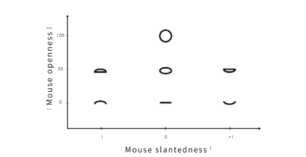
The elements composing the face are limited to just three: the two eyes and the mouth, composed of precise circles and placed on the top of the upside-down triangle, the face figure (Fig. 1). Facial expression patterns are made by adding transformations to the three elements within the two parameters of slantedness and openness, comprising the physical variable for cognition of facial expressions. Slantedness of the eyes is a parameter that expresses the curve according to the opening of the eyes by their rotational deformation, while slantedness of the mouth expresses the rise or fall of the corners of the mouth. Openness is a parameter that expresses the change in the opening state of the eyes and mouth by the change in the vertically scaling transformation of the precise circle. Fig. 2 Left and Right show the changes to the eyes and mouth according to the value of the parameters. The eyes make 19 patterns and mouth makes 7 patterns as shown in Fig. 2 Left and Right, making a total of 133 expression patterns. The facial expression is assumed to be completely facing the observer, and all faces are symmetrical.
Figure 1: Left: basic face before transformation; right: transformation of eyes by each parameter.
Figure available in the original PDF paper.
Figure 2: Left: transformation of eyes by each parameter; right: transformation of mouth by each parameter.
Thus, each facial expression is defined by four values: two parameters of the eyes and two of the mouth, namely slantedness and openness respectively.
CLASSIFICATION OF FACIAL EXPRESSION PATTERNS The obtained expression patterns are classified by emotional category. For the emotional categories, we use the six basic emotions (happy, angry, sad, disgust, fear, and surprised) advocated by Ekman and many other researchers. In this article, we additionally utilizes a neutral (pleasant) emotion, displaying no emotion but showing a pleasant expression, and a neutral (unpleasant) emotion, showing no emotion but displaying an unpleasant expression, to research the facial expressions of neutral emotions. Clarification of the neutral face is important for robot faces, especially for humanoid robots without the function of forming facial expressions. In total, the eight emotional categories are defined.
Classification of facial expression patterns is conducted through an identification task. There are three rules for this task as follows: (1) the answerer must choose one emotion category for one face; (2) the answerer may adopt the same emotion category for more than one face; (3) the answerer does not need to select an emotion category if no category fits the face.
RESULTS
Our previous study was a comparative survey experiment involving university students in Denmark and Japan. The results indicated that there were virtually no cultural differences in the recognition of expressions of happiness, anger, sadness, and neutral emotions. In contrast, significant differences were observed in the recognition of disgust, fear, and surprise, suggesting that these emotions are more strongly influenced by cultural or contextual factors.
In this study, we conducted a follow-up investigation of our previous research and further analyzed the results.
We tallied responses that accounted for at least half (2/M) of the maximum number of emotions selected. We conducted a new survey of Japanese college students (B) and junior high school students (C). We compared these results with those from the previous survey, which included Japanese college students (A).
There was significant overlap in the responses from (A), (B), and (C).
Regarding fear, it was not included in the tally for any of the response groups (A, B, C), as no emotion received the most frequent responses.
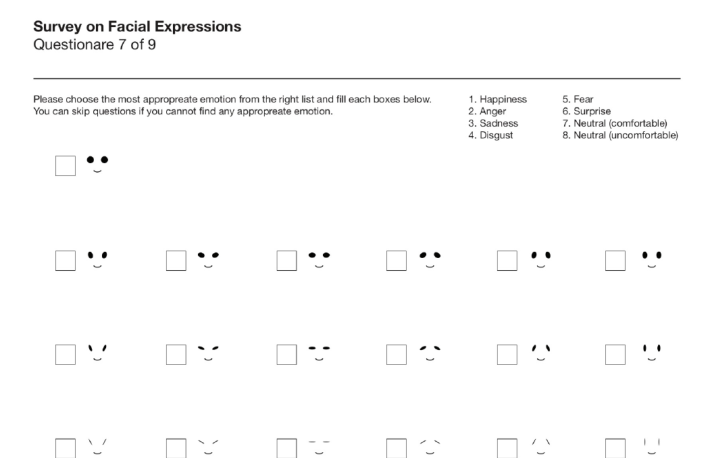
Regarding page 7 of the questionnaire, “happiness” was selected most frequently in all response groups (A, B, and C).
Figure 3: Page 7 of the survey form.
CONCLUSION
These results appear to align with the arousal levels described in Russell’s two-dimensional psychological space.
Across all respondent groups, the seventh expression was selected as representing happiness. This is likely because the mouth is smiling.
Regarding fear, the insufficient number of responses can be attributed to the fact that, within Russell’s two-dimensional psychological space, this expression is similar to anger and surprise, which are in the same quadrant (arousal–dislike).
In this study, we conducted a supplementary survey in addition to the previous findings and compared the results among Japanese respondents.
The results showed that there were no significant differences between junior high school students and college students in Japan.
ACKNOWLEDGMENT
This work was supported by JST SPRING, Japan Grant Number JPMJSP2172.
REFERENCES
Alan Slater, Mark H. Johnson, and John Morton. (1993). Biology and cognitive development: The case of face recognition. Blackwell Scientific Publications, Oxford, UK. doi: 10.1002/edp.2430020408. Caroline F. Keating and E. Gregory Keating. (1975). Visual scan patterns of rhesus
monkeys viewing faces. Perception 11 (1975), 133–140. doi: 10.1068/p110211. Charles Darwin. 1872. The expression of the emotions in man and animals. John Murray, London, UK. Craig A. Smith and Phoebe C. Ellsworth. (1985). Patterns of cognitive appraisal in
emotion. Journal of Personality and Social Psychology 48, 4 (1985), 813–838. doi: 10.1037//0022-3514.48.4.813. Hadyn Ellis, John Shepherd, and Graham Davies. (1979). Identification of familiar and unfamiliar faces from internal and external features: Some implications for theories of face recognition. Perception 8 (02 1979), 431–9. doi: 10.1068/ p080431. Harold Schlosberg. (1954). Three dimensions of emotion. Psychological Review 10,
5 (1954), 81–88. doi: 10.1037/h0054570. James A. Russell. (1997). Reading emotions from and into faces: Resurrecting a dimensional-contextual perspective. Cambridge University Press, 295–320. doi: 10.1017/CBO9780511659911.015. John W. Shepherd, Graham Davies, and Hayn D. Ellis. (1981). Studies of cue saliency.
In G. Davies, H. Ellis, & J. Shepherd (Eds.), Perceiving and remembering faces. Nobuyuki Watanabe. (2001). Research of distribution of facial expressions in emotional space by using affect grid method [in Japanese]. Japanese Psychological Research 65 (2001), 274. Paul Ekman. (2005). Basic Emotions. John Wiley & Sons, Ltd, New York, US, 45–60.
doi: 10.1002/0470013494.ch3. Rebecca Shah and Michael Lewis. (2003). Locating the neutral expression in the facial-emotion space. Visual Cognition 10, 5 (2003), 549–566. doi: 10.1080/13506280244000203a. Rhea Diamond and Susan Carey. (1986). Why faces are and are not special: An
effect of expertise. Journal of Experimental Psychology 115 (1986), 107–117. doi: 10.1037/0096-3445.115.2.107. Takuma Takehara and Naoto Suzuki. (2001). Robustness of the two-dimensional structure of recognition of emotionality. Perceptual and Motor Skills 93, 3 (2001), 739–753. doi: 10.2466/pms.2001.93.3.739.
FIND THE COMPLETE VOLUME IN THE AHFE DIGITAL BOOKSTORE
Explore the complete digital volume
Human Systems Engineering and Design (IHSED2026): Future Trends and Applications
Read this individual research paper free through the original publisher, or explore the full digital proceedings book.