Liliana Cunha, Daniel Silva, Daniela Monteiro, Sara Ferreira, António Lobo, António Couto, Anabela Simões, Catarina Neto (2022). Who really wants automated vehicles? Determinant factors of acceptability profiles in Portugal. In: Intelligent Human Systems Integration (IHSI 2022): Integrating People and Intelligent Systems. AHFE Open Access, vol. 22. https://doi.org/10.54941/ahfe1001018
The perspective of automated vehicles (AVs) entering the public space is at the center of the current debate about the “mobility of the future”. Several studies have focused on drivers’ perceptions related to the use of AVs, exploring the “acceptability” and acknowledging that this is not an individual process [1]. Acceptability is constructed in a particular socio-organizational context, whose underlying conditions pose different determinant factors of usage [2]. The debate on the acceptability vs. acceptance of technologies requires the assumption of a psychological standpoint: “acceptability” is a cognitive representation that users have before using technology, i.e., it is an a priori phenomenon [3], whereas “acceptance” is an a posteriori pragmatic evaluation, inasmuch as it is “situated” in a real activity [4]. Hence, the “acceptance” is associated with an “operative representation” developed in and by the action. Bearing in mind such conceptual frontiers between the two constructs, it should be noted a point in common: they are subjective representations related to different sociodemographic characteristics and inscribed in specific conditions (e.g., driving preferences, benefits/concerns associated with AVs). Considering the fact the use of fully AVs is not yet possible, the study we present sought to explore the acceptability of AVs in the frame of a Portuguese research project. The AUTODRIVING project combines an extensive survey on the viewpoints of representative groups of drivers with a driving simulator study to evaluate driver-vehicle interaction under automated driving scenarios. A self-administrated questionnaire was developed aiming at exploring Portuguese users’ representations about the AVs, considering their expectations (e.g., the possibility to perform secondary tasks during automated driving), concerns (e.g., loss of control over the driving), levels of trust, and the benefits and risks users most associate with AVs. 500 portuguese participants (49.3% female), aged 18-81 years (M=42.16, SD=41.39), responded to the questionnaire.AVs acceptability was assessed through four items: “consider to using a fully AV”; “would prefer a fully AV to a non-automated vehicle”; “comfortable with family using an AV”; and “consider using a fully automated bus”.A two-phase cluster analysis approach was used to identify patterns of AVs acceptability. Firstly, a hierarchical method was used to identify possible appropriate solutions for the number of clusters. Secondly, the suitability of the different solutions for the number of clusters was tested with non-hierarchical cluster analyses. Four distinct clusters were identified and named based on the pattern of acceptability and their characterization regarding demographics, self-perception of technology use, driving and AVs experience. The clusters we found are: - Resigned: AVs are convenient… but are they safe? These participants consider using AVs and a fully automated bus more than average, but don’t prefer AVs to non-automated vehicles and are less comfortable than average with family using an AV. - Suspicious: AV… maybe not, we still need to know better this technology These respondents present all acceptability variables slightly below average, but a predominance of automated bus rejection; - Enthusiasts: AV, certainly yes, and benefit to its full potentialParticipants whose acceptability is above average for all the variables; this group has a predominance of higher income participants, that live in predominantly urban areas, are willing to experiment with new technologies and would like to perform all secondary tasks while driving (e.g., reading); - Objectors: No AV… we want to keep driving pleasureRespondents who score below average in all acceptability variables; this cluster has a predominance of participants 50 years old or older, who live in predominantly rural areas, prefer to wait some time to try new technologies and whose car doesn’t have any driving aid system.These quantitative findings were complemented with 7 focus groups, involving both professional and regular drivers, in order to set a “user model” that could be mobilized in the current debate about the conditions that may contribute to the acceptance of AVs. [1] Barcenilla, J., & Bastien J. (2009) L’acceptabilité des nouvelles technologies: Quelles relations avec l’ergonomie, l’utilisabilité et l’expérience utilisateur? Le Travail Humain, 72, 311–331.[2] Dubois, M., & Bobillier Chaumon, M. (2009). L'acceptabilité des technologies : bilans et nouvelles perspectives. Le travail humain, 72, 383-395.[3] Renaud, J. (2020). Évaluer l’utilisabilité, l’utilité et l’acceptabilité d’un outil didactique au cours du processus de conception continuée dans l’usage. Éducation & didactique, 14, 65-84. [4] Bobillier Chaumon, M. (2016). Acceptation située des TIC dans et par l’activité : Premiers étayages pour une clinique de l’usage. Psych Trav. et Organisat., 22, 4-21.
The perspective of automated vehicles (AVs) entering the public space is at the center of the current debate about the “mobility of the future”. Several studies focused on drivers’ perceptions related to AVs, exploring the acceptability and acknowledging that this is not an entirely individual process. Acceptability is constructed in a particular socio-organizational context, whose underlying conditions pose different determinant factors of usage (Dubois and Bobillier Chaumon, 2009).
This debate around perceptions on technology and intentions to use it requires the assumption of a psychological standpoint: “acceptability” is a cognitive representation that users have before using technology, i.e., it is an a priori phenomenon (Bobillier Chaumon, 2016), whereas “acceptance” is a posteriori pragmatic evaluation, inasmuch as it is “situated” in a real activity (Bobillier Chaumon, 2016, Alexandre et al. 2018). To assess the acceptance of a new technological tool, real activity is required, since it is in and by the use that the users’ acceptance is constructed (Dubois and Bobillier Chaumon, 2009, Alexandre et al. 2018). Bearing in mind such conceptual frontiers between the two constructs, it should be noted a point in common: they are subjective representations related to sociodemographic variables and inscribed in specific conditions.
Different studies explored the relations between sociodemographic variables and acceptability or behavioral intention. On the whole, research has shown that, amongst men, the younger, living in urban areas and more educated men constitute the population segment that appears to exhibit higher levels of acceptability towards AVs (Charness et al. 2018, Nordhoff et al. 2018). The interaction between sociodemographic characteristics and perceptions, including both perceived benefits (e.g., possibility of doing non-driving tasks during journeys) and concerns about AVs (e.g., safety; technical unreliability in unexpected situations), plays a major role in the acceptability of AVs (Kyriakidis et al. 2015).
Lemonnier et al. (2020) developed an extensive literature review about the acceptability of AVs and noted a lack of clarification of what is actually measured, which makes it difficult to compare the results of studies regarding the determinants of acceptability. On the one hand, the authors revealed that the determinants of acceptability vary according to the measures used; on the other hand, users’ preferences for AVs also vary depending on the image of AVs held by the respondents (Lemonnier et al. 2020).
This study aims to explore the acceptability of AVs in the frame of a Portuguese research
Intelligent Human Systems Integration (IHSI 2022): Integrating People and Intelligent Systems https://openaccess.cms-conferences.org/#/publications/book/978-1-7923-8988-7 project. The AUTODRIVING project combines an extensive survey on the viewpoints of representative groups of drivers with focus groups, and a driving simulator study to evaluate driver-vehicle interaction under automated driving scenarios (Lobo et al. 2020). In Portugal, the acceptability towards AVs is a topic relatively under-explored, with the exception of two recent studies (Rodrigues et al. 2021, Vicente et al. 2020). For this reason and given the fact that the use of AVs in Portuguese roads is not yet possible, we focused on the determinants of acceptability by identifying possible adoption patterns.
METHOD
AUTODRIVING SURVEY A self-administrated questionnaire was developed to explore Portuguese users’ representations about AVs, considering their expectations (e.g., the possibility to perform secondary tasks during the journey), concerns (e.g., loss of control; technical unreliability), trust, and the perceived benefits of AVs. The questionnaire contained 72 items, including items referring to sociodemographic characteristics (gender, age, education, employment status, income, location), self-perception on the use of technology, driving status (regular driver; professional driver; or non-driver) and driving conditions (car ownership, driving frequency, most frequent reason to use the car), the pleasure of the driving task, knowledge about AVs, and perceived benefits and concerns about AVs. We have chosen to focus the questionnaire items on fully automated vehicles (FAV), insofar this level is likely to induce the greatest reconfiguration in mobility system.
For this study, the acceptability was assessed through four items: In the future, I consider using a FAV; In the future, given the choice between a FAV or a non-automated vehicle (NAV), I would opt for the former; In the future, I think it will be comfortable for me to have my family using a FAV; In the future, I consider using an automated bus. These items are ordinal and a five-point Likert scale from 1 (‘Completely disagree’) to 5 (‘Fully agree’) was used. Ethics approval for this study was obtained from the Ethics Committee of the FPCEUP.
PARTICIPANTS A sample of 501 participants living in Portugal, and gender-balanced (50.7% male; 49.3% female), completed the online survey. The minimum age threshold was defined according to the youngest age at which in Portugal it is possible driving on public roads (18 years old).
DATA ANALYSIS Cluster analysis was employed to determine the presence of patterns of acceptability using the IBM SPSS (v25.0). A two-phase cluster analysis approach was carried out. Firstly, a
Intelligent Human Systems Integration (IHSI 2022): Integrating People and Intelligent Systems https://openaccess.cms-conferences.org/#/publications/book/978-1-7923-8988-7 hierarchical method was used to identify possible appropriate solutions for the number of clusters. Thus, we first aimed for an exploratory analysis, with an agglomerative (Ward Method) clustering procedure. Then, in a second stage, the K-means algorithm was used to form the clusters. The distance measure used was Euclidean Distance and Ward’s criterion was the chosen aggregation method. The dendrogram was visually examined and validation measures included inertia investigation and the Calinski–Harabasz Pseudo-F Index.
The suitability of the different solutions for the number of clusters was tested with K-means. ANOVA, post hoc pairwise comparisons and chi-square tests were used to characterize cluster membership based on the pattern of acceptability and their characterization regarding demographics and self-perception on the use of technology.
RESULTS
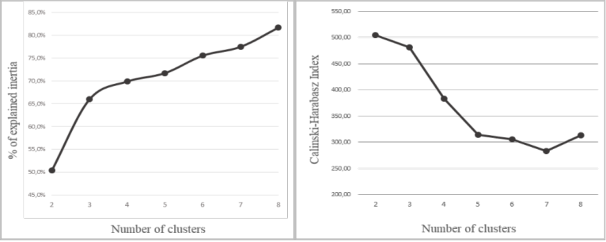
Table 1 presents the composition of the sample (N = 501). A first analysis suggested that solutions of 2, 3, 4 and 8 clusters would be feasible. The Calinski-Harabasz (CH) index, is defined as the ratio concerning Between-class dispersion (B) and Within-class dispersion (W). The desired result would be to have the well-separated clusters, that is, higher B(k), and the elements within the clusters close to each other, implying a lower W(k). As this index is a ratio between B(k) and W(k), a high value for the index is the best solution. As presented in Fig. 1, the CH Index is higher for the first three solutions.
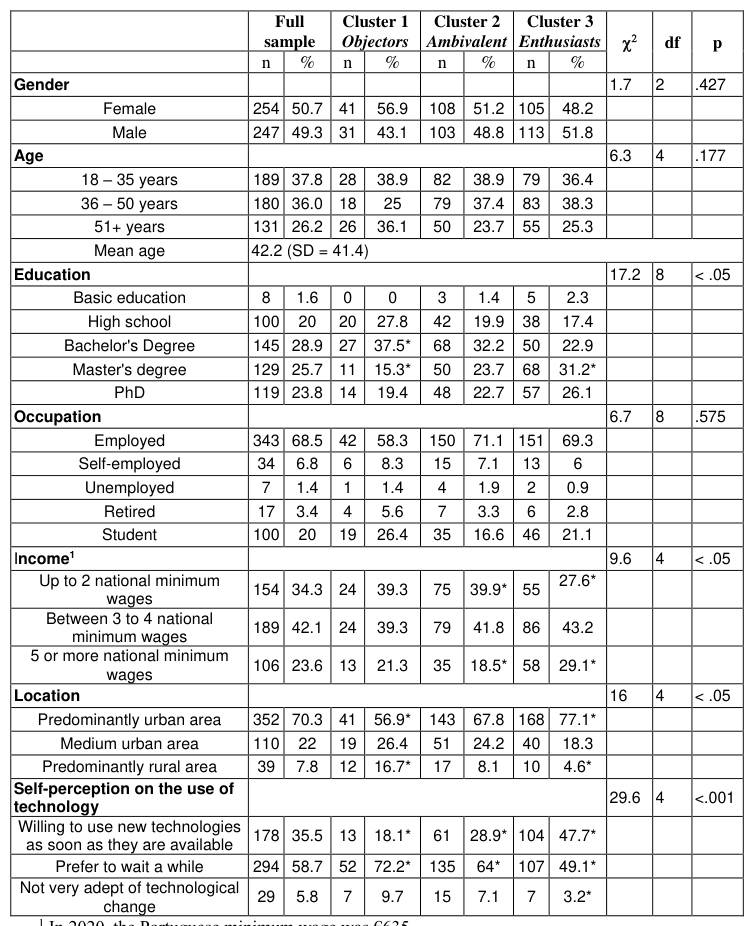
Figure 1. Explained inertia and Calinski-Harabasz Index A three-cluster solution seems the best balance between explained inertia (66%) and the CH Index (481.6), acceptable cluster dimensions (C1: n = 72; C2: n = 211; C3: n = 218) and interpretability. Table 1 presents the sociodemographic characteristics of each cluster.
Intelligent Human Systems Integration (IHSI 2022): Integrating People and Intelligent Systems https://openaccess.cms-conferences.org/#/publications/book/978-1-7923-8988-7
Table 1: Demographic characteristics and self-perception on the use of technology of the sample and differences ([Equation or mathematical symbol available in the original paper PDF]) between the clusters
Intelligent Human Systems Integration (IHSI 2022): Integrating People and Intelligent Systems https://openaccess.cms-conferences.org/#/publications/book/978-1-7923-8988-7
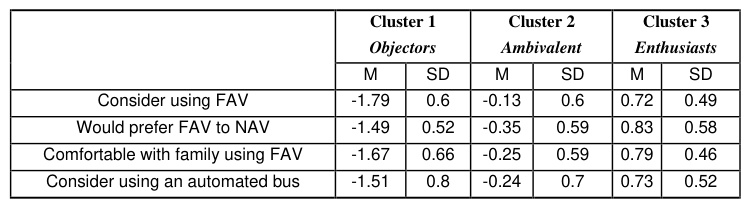
Cluster 1, titled “Objectors”, presents the lower values for the four intentions variables, while cluster 2, titled “Ambivalent”, shows near average values and cluster 3, titled “Enthusiasts”, demonstrates the highest means (Table 2).
Table 2: Mean and SD (z-scores) for the four acceptability variables on the three clusters
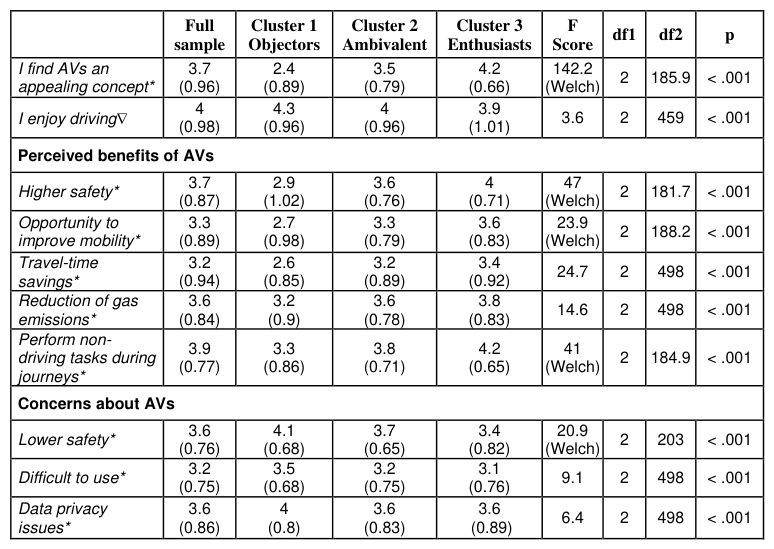
Table 3 presents differences in these clusters concerning AVs appeal, perceived benefits, concerns and the pleasurability of the driving task.
Table 3: Description of the three clusters: Mean (SD) and One-Way Analyses of Variance
(Games-Howell post hoc test)
Intelligent Human Systems Integration (IHSI 2022): Integrating People and Intelligent Systems https://openaccess.cms-conferences.org/#/publications/book/978-1-7923-8988-7
* Significant differences (p < .05) between all clusters [Equation or mathematical symbol available in the original paper PDF] Significant differences (p < .05) between clusters C1 and C2
DISCUSSION
PATTERNS OF ACCEPTABILITY Three clusters were identified based on the respondents’ intentions to use a FAV, preferences for FAV to NAV, degree of comfort to entrust the safety of a family member to a FAV, and intentions to use an automated bus. Some noteworthy features should be underlined. First, to consider AVs an appealing concept distinguishes all the clusters identified. Second, the participants allocated to the AVs Ambivalent cluster report a higher level of pleasure in manual driving and, at the same time, consider AVs as an appealing concept. Yet, these participants demonstrate more concerns about AVs than AVs enthusiasts. The debate about acceptability appears to be more expressive among the members of this group. Pettigrew et al. (2019) underlined the need to explore other variables influencing the membership of this group. Third, the pleasurability of the driving task plays a crucial role in determining acceptability. Here lies a possible explanation for the fact that Portuguese participants allocated to cluster 1 (Objectors) showed less overall acceptability: these respondents could expect that AVs will be on average less enjoyable than manual driving. Hartwitch et al. (2018) stressed that such results tend to be obtained without participants having had the opportunity to experience an automated driving situation. Notwithstanding, research has emphasized the need to include the pleasure of manual driving when addressing the acceptability of future AVs (Hartwich et al. 2018, Payre et al. 2014).
Finally, one of the main distinguishing characteristics between the two extreme clusters (Objectors and Enthusiasts) is related to the perceived concerns and benefits about AVs (see Table 3), mainly in terms of perceived safety.
BEYOND THE SOCIAL ACCEPTABILITY: THE SITUATED ACCEPTANCE
Intelligent Human Systems Integration (IHSI 2022): Integrating People and Intelligent Systems https://openaccess.cms-conferences.org/#/publications/book/978-1-7923-8988-7
The results of the AUTODRIVING survey were complemented with five focus groups, with 38 participants (Simões et al. 2021): 7 professional drivers (taxi drivers; driving instructors) and 31 regular drivers. The exploration of the participants’ views made it possible to emerge a debate regarding their “experience” as drivers. It is this experience that constitutes a reference to the cognitive representation about a possible future situation, which in this case (AVs) is largely unprecedented. The participants within focus groups gave to know other views, i.e., the intention to use AVs is situated in the context of their current experience. The professional drivers put forward concerns about (i) loss of pleasure of driving (“The higher level of automation, the higher level of pleasure is taken away from the driver”); (ii) drivers’ status (“The driver moves from an active to a passive driver, and in the last level [of automation] he/she’ll be a mere passenger”); (iii) loss of ability to perform some driving tasks (“Today’s AVs already limit driving, these vehicles almost drive for themselves”); and (iv) job losses among professional drivers (“With AVs, driving schools would go under (…) At this point, I immediately link [the AVs] to unemployment in different sectors, namely taxi drivers, right? And bus drivers, long-haul truck drivers, etc.”).
CONCLUSIONS
Although there are different acceptability paradigms (Barcenilla and Bastien, 2009, Bobillier Chaumon, 2016), in the field of work psychology, addressing the higher, or lower, acceptability of technology ought not to overlook the “activity point of view” (Silva and Cunha, 2022) and the specificities of each context where these technologies are used. The absence of this view in the discussion about a future activity could lead to considering the responses less favorable to technology somehow as a result of “resistance to change”. On the contrary, the analysis of technology acceptability should be situated in relation to the experience in using such technologies and the experience and contexts of driving (Cunha et al. 2021). Precisely, the focus groups enabled to bring to the fore the experience of the participants as drivers (professional and non-professional drivers), contextualizing their expectations and concerns about AVs in relation to the current experience of driving. In this vein, instead of seeking to change perceptions about AVs, the identification of acceptability levels should seek to assist the design of technology, which will be then practical assessed. For instance, to gauge situated acceptance, simulation studies are important to approach the probable future activity of the users (Daniellou, 2007). It is precisely what is currently underway within the AUTODRIVING project, with the design of simulation scenarios of automated driving. This is an intentional methodological path, which is consistent with the perspective of creating conditions to sustain a practice-based acceptability.
ACKNOWLEDGMENTS
This work is supported by the Project PTDC/ECITRA/28526/2017 “AUTODRIVING - Modelling the Driver Behaviour in Autonomous Driving Using a Driving Simulator” (POCI-
Intelligent Human Systems Integration (IHSI 2022): Integrating People and Intelligent Systems https://openaccess.cms-conferences.org/#/publications/book/978-1-7923-8988-7
01-0145-FEDER-028526) funded by FEDER funds through COMPETE2020 - Programa Operacional Competitividade e Internacionalização (POCI) and by national funds (PIDDAC) through FCT/MCTES.
REFERENCES
Alexandre, B., Reynaud, E., Osiurak, F., and Navarro, J. (2018), “Acceptance and acceptability criteria: a literature review”. Cognition, Technology & Work, 20, 165−177. Barcenilla, J., and Bastien J. (2009), “L’acceptabilité des nouvelles technologies: Quelles
relations avec l’ergonomie, l’utilisabilité et l’expérience utilisateur?”. Le Travail Humain, 72, 311–331. Bobillier Chaumon, M-E. (2016), “The situated acceptance of ICT in/for the activity: towards a clinical use”. Psychologie du Travail et des Organisations, 22, 4−21. Charness, N., Yoon, J., Souders, D., Stothart, C., and Yehnert, C. (2018), “Predictors of
attitudes toward autonomous vehicles: the roles of age, gender, prior knowledge, and personality”. Frontiers in Psychology, 9, 2589. Cunha, L., Barros, C., Baylina, P., and Silva, D. (2021), “Work intensification in road transport industry: an approach to new working scenarios with automated vehicles”. Work: A Journal of Prevention, Assessment & Rehabilitation, 69(3), 847–857. Daniellou, F. (2007), “Simulating future work activity is not only a way of improving
workstation design”. Activités, 4, 1–8. Dubois, M., and Bobillier Chaumon, M-E. (2009), “L'acceptabilité des technologies: bilans et nouvelles perspectives”. Le Travail Humain, 72, 383−395. Hartwich, F., Beggiato, M., and Krems, J. (2018), “Driving comfort, enjoyment and
acceptance of automated driving – effects of drivers’ age and driving style familiarity”. Ergonomics, 61(8), 1017−1032. Kyriakidis, M., Happee, R., and de Winter, J. (2015), “Public opinion on automated driving: results of an international questionnaire among 5000 respondents”. Transportation Research Part F: Traffic Psychology and Behaviour, 32, 127−140. Lemonnier, A., Adelé, S., and Dionisio, C. (2020), “The determinants of acceptability and
behavioural intention of automated vehicles – a review”. Le Travail Humain, 83(4), 297−342. Lobo, A., Ferreira, S., Silva, D., Cunha, L., Simões, A., and Couto, A. (2020), “On the road to automated vehicles: from perception to use”, proceedings of the 8th Congress of the Transport Research Arena (TRA 2020). Helsinki, FI. Nordhoff, S., de Winter, J., Kyriakidis, M., van Arem, B., and Happee, R. (2018),
“Acceptance of driverless vehicles: results from a large cross-national questionnaire study”. Journal of Advanced Transportation, 5382192. Payre, W., Cestac, J., and Delhomme, P. (2014), “Intention to use a fully automated car: attitudes and a priori acceptability”. Transportation Research Part F: Traffic Psychology and Behaviour, 27, 252−263. Pettigrew, S., Dana, L., and Norman, R. (2019), “Clusters of potential autonomous vehicles
users according to propensity to use individual versus shared vehicles”. Transport Policy, 76, 13−20.
Intelligent Human Systems Integration (IHSI 2022): Integrating People and Intelligent Systems https://openaccess.cms-conferences.org/#/publications/book/978-1-7923-8988-7
Rodrigues, R., Moura, F., Silva, A., and Seco, A. (2021), “The determinants of Portuguese preference for vehicle automation: a descriptive and explanatory study”. Transportation Research Part F: Traffic Psychology and Behaviour, 76, 121−138. Silva, D., and Cunha L. (2022), “The Challenges of Automated Driving: Contributions
Towards a Human-Automation Research Agenda from the Lens of the Activity”, in: Occupational and Environmental Safety and Health III, Arezes, P., Santos Baptista, J., Carneiro, P. et al. (Eds.). pp. 591−602. Simões, A., Cunha, L., Silva, D., Ferreira, S., Lobo, A., Tavares, J., Cotrim, T., and Neto, C.
(2021), “A Focus Group Research in the Frame of the AUTODRIVING Project Under Lockdown Conditions”, in: AHFE 2021, Stanton, N. (Ed.). pp. 339−347. Vicente, J., Rolim, C., and Baptista, P. (2020), “Acceptance of shared, electric and autonomous mobility in Lisbon, Portugal”, in: The Role of Sharing Mobility in Contemporary Cities, Smorto, G., and Vinci, I. (Eds.). pp. 69−90.
Intelligent Human Systems Integration (IHSI 2022): Integrating People and Intelligent Systems https://openaccess.cms-conferences.org/#/publications/book/978-1-7923-8988-7
LISTED IN THE AHFE DIGITAL BOOKSTORE CATALOGUE
Explore the complete digital volume
Intelligent Human Systems Integration (IHSI 2022): Integrating People and Intelligent Systems
Read this individual research paper free through the original publisher, or explore the full digital proceedings book.
ISBN 978-1-7923-8988-7
Explore this ISBN in the AHFE Bookstore ↗Listed in the July 2026 bookstore catalogue; search by ISBN to confirm current availability · Digital book purchase optional