Sérgio Pedro Duarte, Liliana Cunha, Luciano Moreira, Sara Ferreira, António Lobo (2023). Requirements and expectations for truck platooning - a multidisciplinary perspective. In: Safety Management and Human Factors. AHFE Open Access, vol. 105, pp. 75–83. https://doi.org/10.54941/ahfe1003072
1 CITTA – Research Centre for Territory, Transports and Environment, Faculty of Engineering of the University of Porto, Rua Dr. Roberto Frias, 4200–265 Porto, Portugal ↗
2 Centre for Psychology at University of Porto, Faculty of Psychology and Educational, Sciences of the University of Porto, Rua Alfredo Allen, 4200–135 Porto, Portugal ↗
3 CETAPS – Centre for English, Translation, and Anglo-Portuguese Studies, Faculty of Arts and Humanities of the University of Porto, Porto, Portugal; CIQUP, Institute of Molecular Sciences (IMS), Porto, Portugal ↗↗
Recent developments in vehicle automation are leading a paradigm change in respect to mobility of goods and people. Pushed by environmental concerns, researchers and practitioners seek new and innovative solutions. Nevertheless, the challenge of sustainable transport does not end with the use of clean fuels, as faster, cheaper, and more efficient transport is still desired by operators. The concepts behind truck automation and truck platooning technologies present potential for operations management efficiency and cost reduction. On the other hand, as drivers are still the main piece on a safe and efficient transport system, their working conditions must be ensured. Therefore, a multidisciplinary perspective on truck platooning is required, comprising the view of all the stakeholders involved in the development of safe and easily adopted technologies. In the context of the project TRAIN, we have developed exploratory research towards understanding and mapping the requirements for deploying truck platooning technology. Through a qualitative research, based on focus groups, we have identified three main areas of requirements from logistics companies: (i) labor, (ii) safety and liability, and (iii) transport and logistics. The analysis also showed that these areas are related to three research domains: (i) human factors and human-machine interaction, (ii) operations research and management, and (iii) policy and regulation.
Technology is shaping the future of mobility of both people and goods. Fully automated vehicles (AV), in general, are presented together with promises of improving fuel consumption, reducing emissions, and reducing congestion (Rejali et al., 2023). Nonetheless, being a disruptive technology, its success is highly dependent on the acceptance from potential users. Even though, in a technological perspective that AV can increase road safety, other factors,
such as the users’ perception, will influence the acceptability towards AV implementation (Fagnant and Kockelman, 2015; Cunha et al., 2022).
In the case of freight transport, complexity issues arise as there are multiple actors and perspectives to be considered and analyzed. On the one hand, there are the drivers’ concerns towards their working conditions and safety (Simões et al., 2022). On the other hand, companies may see vehicle automation as an opportunity to innovate business models (Ferrell et al., 2020). Other perspe- ctives may come from other road users, like car drivers, road operators, and policymakers. Therefore, a thorough survey in this topic requires analysis of the main research domains associated with automation in freight transport, from the perspective of different actors.
The need for integrating different perspectives comes from the intrinsic characteristics of the sector, deeply rooted in the supply chain strategies ado- pted by companies. Recent focus on horizontal collaboration expands the boarders of an already complex system, thus demanding more systems’ inte- gration. Options for horizontal collaboration comprise integrating data, sha- ring infrastructure, multimodality, and integrating other available resources (ERTRAC, 2019). Despite of being an emerging need, integration does not come easy, as there are multiple sub-sectors in the heavy vehicle transport, each one with its own specificities (ACEA, 2016).
Besides, concerns regarding climate change and business sustainability push the industry to adapt its services and business models. As road transport represents more than 50% of freight transport (ERTRAC, 2019), increasing truck automation and connectivity emerge as valuable solutions for reaching the 2050 goals in terms of emissions and road safety (European Commission, 2019; ERTRAC, 2022). To contribute to a safe and well accepted implementation of truck pla- tooning technologies, the TRAIN project aims at mapping risks and requi- rements through a comprehensive research that includes: (i) focus groups with users and experts to access requirements, (ii) questionnaires to assess acceptance, and (iii) driving simulator experiments to assess safety.
Considering all the above-mentioned challenges, needs, and concerns, the first step of the research was to analyze the road freight transport ecosy- stem to better understand its complexity and the interconnections between different actors and activities. That was accomplished by building the actor network map, adopting the principles proposed by Morelli and Tollestrup (2006), identifying and the actors’ groups according to their functions in the ecosystem, and the relationships between them. Moreover, different research domains were found based on the actors’ perspectives and activities identi- fied. To build the actor network map for the road freight transport ecosystem, we have conducted a series of focus groups and interviews.
In this paper, we present the results from the focus groups from the per- spective of logistics companies. The paper is organized as follows: the next section presents the design of the focus group-based survey; after, the actor network map is presented and the multidisciplinary research domains are identified; in the end, some requirements and expectations are presented. The paper finishes with lessons learned and future research as concluding remarks.
Requirements and Expectations for Truck Platooning – A Multidisciplinary Perspective 77
A MULTI-ACTOR QUALITATIVE SURVEY A systemic perspective of complex ecosystems such as the road freight tran- sport’s requires engaging all relevant actors, mainly in rapidly changing paradigms such as the introduction of automated driving and truck plato- oning technologies. As part of the project TRAIN, actors were called to participate through focus groups and interviews, as a form of gathering data that supported the design of the actor network map. In total, we have performed 11 focus groups and semi-structured interviews (Table 1).
The initial plan only included focus groups with drivers and key represen- tatives from logistics companies (e.g., carriers), but during the first contacts, the complexity of the ecosystem became visible and road operators and regu- lators were included in the research. Each focus group session and interview aimed at addressing four main topics:
1. Own representations of automated driving systems; 2. Impacts of truck platooning implementation on own activity; 3. Impacts of truck platooning implementation on others’ activity; 4. Expectations of road freight transport for the near future.
Due to the interest in the safety and working conditions, drivers were the group with higher representativeness, with a total of 30 male participants. During the planning of the focus groups, it was mentioned by practitioners that there is still a lack of women in the driver’s role in freight transport, when compared with passenger transport. Logistics companies were represented by 16 assistants and managers responsible for tasks that can be impacted by, and can impact, technological changes in the driving activities. Considering the importance of regulators and road operators in facilitating implemen- tation, two regulating entities and three road operators were contacted to participate.
For the remainder of this paper, our focus will be on the perspective of logistics companies, putting key actors at the center of the ecosystem, as it will be explained further ahead.
Actors and Their Roles in the Freight Transport System The role of a group of actors in the network is determined by the relationship established with the other groups, and the use given to technology. In the case of road freight transport, we have identified three types of actors, each one with different responsibilities and with different influence levels towards the implementation of truck platooning.
Table 1. Focus group and interviews distribution by groups of actors.
Table available in the original PDF paper.
Actors Focus group / interviews (quantity) Drivers focus group (4) Industry (carriers, logistic service providers) focus group (2) road operators focus group (2), interview (1) Regulators interview (2)
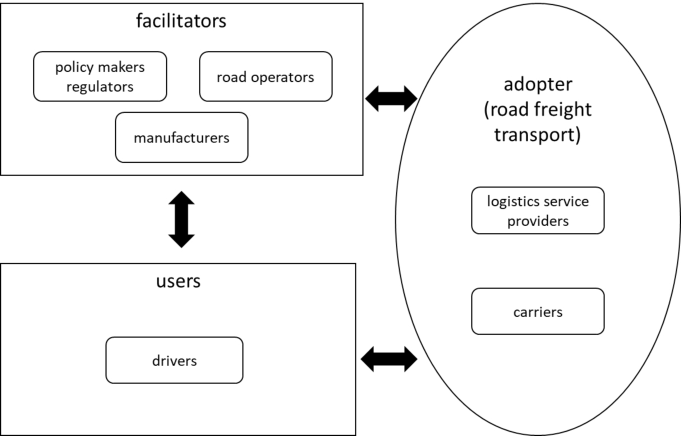
Logistics companies appear as the adopters of truck platooning, as they are truly responsible for its implementation. Nevertheless, those companies are dependent on the availability of infrastructure, vehicle technology, and legislation. Therefore, road operators, manufacturers and regulators appear as facilitators of truck platooning implementation. At the lower level, we place the drivers, not as an unimportant group, but as the group that has less decision power regarding the integration of technology in companies’ operations. Drivers are considered the true users of the technology, as they are the group whose activities will be most affected by the increasing automation levels. Figure 1 presents the roles and relationships of the three actors’ groups.
The different groups will bring different concerns, desires, and needs to the development of the technology. While regulators are expected to focus more on safety, companies are more likely to ponder the costs of the implementa- tion versus the benefits it will bring. On the other hand, drivers are the ones that need to adapt to the new tasks imposed by technology.
The position of logistics companies in the network allows them to nego- tiate their own conditions and provide favorable conditions to the drivers as well. Therefore, freight logistics companies are crucial during the deve- lopment, testing and adoption of truck platooning with automated vehicles. For such reasons, these companies were the focus of this paper.
The focus groups for logistics companies were conducted with two Portu- guese logistics service providers and aimed at discussing transport operations. One company is based in the main metropolitan areas of Porto and Lisbon and operates across Europe, with a focus in the Iberian market; the other company has its facilities in the Aveiro region and provides services for Por- tugal, Spain and central Europe. All the facilities have easy access to highways
Figure 1: Actors and their roles in the road freight transport ecosystem.
Requirements and Expectations for Truck Platooning – A Multidisciplinary Perspective 79
or main national roads. Both companies offer a diversified set of services and own a diversified and modern fleet, including gigaliner vehicles.
Considering all the participants, different roles were represented: human resources, vehicle maintenance, traffic management, quality and occupatio- nal safety, sales, operations management and logistics, and driver assistance.
Data collected during these sessions provided insights regarding the bar- riers, risks, benefits, and expectations for the implementation of truck platooning in a near future in Portugal. That data was then structured in a set of requirements organized in different tiers. From those requirements, we identified a set of factors that must be addressed, in the eyes of a logistics company, before a possible implementation. In the next section, we analyze expectations and requirements, in the perspective of logistics companies, and identify key factors for implementation.
RESULTS AND DISCUSSION
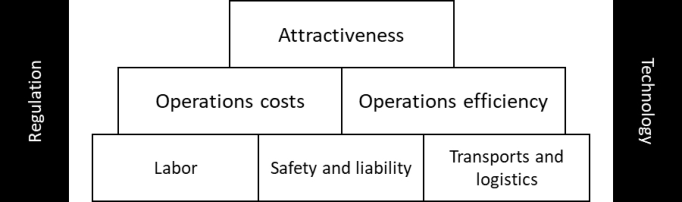
Requirements and Expectations for Logistics Companies Logistics companies appear as a middle actor in the implementation process, depending on the imposed regulation and service offered by road opera- tors, and offering different working conditions to truck drivers. Moreover, companies have their own objectives regarding operations’ optimization to improve their services offering. In the end, all the requirements derive from a fundamental one: truck platooning must be attractive. The attractiveness of the technology is measured by how much value it creates and how much adaptation effort it imposes on the business model. Regardless of how open- minded companies are to invest and to change current business processes, if technology does not offer an overall operation improved efficiency, through cost reduction, schedule optimization, and/or route optimization, technology offers no value to current businesses. Furthermore, companies face the chal- lenge of training and educating drivers to adapt to automated driving. All of this would be required while complying with legislation, creating attra- ctive working conditions, and managing a competitive business. Based on this analysis, requirements presented by logistics companies were structured as illustrated by Figure 2.
At a higher level, there are two main dimensions to consider that are directly related to the attractiveness of the technology: operations costs and
Figure 2: Groups of requirements from logistics companies.
operations efficiency. The estimated cost reductions presented in the litera- ture are still uncertain (Bhoopalam, Agatz and Zuidwijk, 2018; Zhang et al., 2020), and participants mentioned more information is needed to better esti- mate the fuel cost savings. Naturally, cost reduction depends on operations efficiency, that is the second large topic of concern. The efficiency of the ope- rations is associated with the optimization of routes and schedules that can be imposed by infrastructure limitations, since truck platooning may most likely be allowed only in certain roads. Therefore, operations optimization will depend on existing regulation on road safety that can include the number of trucks in a platoon, the distance between trucks, and others. Issues such as the maximum distance traveled by a driver in a shift impacts, of course, both operations efficiency and labor issues, as it all depends on how much can a driver travel without stopping, which in turn is imposed by shift duration, mandatory resting periods, and truck fuel/battery capacity. Regarding infra- structure adaptation, there is some uncertainty on whether truck platooning will require vehicle to infrastructure (V2I) communications or not, and if so, what type of communication protocols manufacturers will adopt.
In sum, requirements for truck platooning are associated with safety and liability issues, labor requirements, and transport and logistics businesses. Regulation and technological developments are the two external drivers that tie in the requirement areas identified.
Despite their differences, the connection between all the requirements becomes visible when answering the question “what will come first?”, as every actor pushes the responsibility to other actors. For instance, companies state that adoption is dependent on technological developments and regula- tion, while road operators say they will offer the technology that companies are prepared to adopt.
Key Factors for Truck Platooning Implementation The analysis of the requirements presented above unveiled a few barriers and challenges that must be addressed before an implementation in the real world. Those were identified as key factors to be tackled before market introduction.
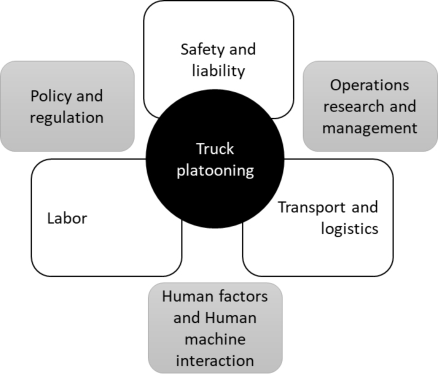
Key factors result from the three dimensions of requirements of the lower tier: safety and liability issues, labor requirements, and transports and logi- stics businesses characteristics (Figure 2). Moreover, the identified factors are strongly linked to three research domains that emerge as drivers for a better design of truck platooning solutions (Figure 3).
Policy and Regulation Requirements related to safety and liability, and labor will possibly be answ- ered by new policy and regulation. At this moment, there is a gap between regulation in countries such as the US, where regulation tends to be more flexible, and European countries, where regulation is stricter. Besides, some European countries have already developed regulation for testing automated vehicles, while other did not. This causes a gap between European countries and may delay cross-country implementation.
Requirements and Expectations for Truck Platooning – A Multidisciplinary Perspective 81
Figure 3: Key factors for truck platooning implementation.
From the perspective of logistics companies, regulation is expected to point the path that companies should follow regarding new labor constraints, mostly focusing on drivers’ working conditions. Other policy aspects relate to safety issues that can facilitate or hinder operations. These can affect, not only, logistics companies but vehicle manufacturers and road operators as well.
Operations Research and Management Changes resulting from truck platooning are, at a first glance, challenges that companies later can turn into opportunities to improve efficiency. Operati- ons research and management offers the tools for testing different solutions before implementation to ensure optimal use of the new resources while addressing safety concerns. Tackling operations management issues in the design of the new solutions fosters solutions that answer to multi-criteria sce- narios arising from the multidisciplinary characteristics of the road freight transport ecosystem. Therefore, operations research and management rela- tes to the requirements from transport and logistics, as well as safety and liability.
Human Factors and Human-Machine Interaction Drivers are, without any doubt, one of the most important pieces of the future of freight transport. Ergo, any issues related to drivers’ working conditions, drivers’ safety and security, and drivers’ ability to adapt to the new tech- nology will determine the success of truck platooning and automated heavy vehicles. For those reasons, research associated with human factors becomes crucial to the design of the truck platooning solutions, answering to require- ments from the labor perspective (e.g., driving hours versus rest periods in a shift), and the logistics perspective (e.g., distance traveled, number of drivers required, etc.).
As drivers will be asked to change their skills for a more digital driving paradigm, the interaction drivers have with the truck is also essential. This includes the usability and safe interaction with the trucks’ controls and easi- ness of access to information inside and outside the vehicle (V2I). The design of the information channels and the control console puts drivers in the center of the success of the truck platooning solutions.
CONCLUSION
Truck platooning promises a variety of benefits, not only for logistics com- panies, but for the society in general. Conceptual studies have analyzed the impact this technology can have in mitigating climate, traffic, and road safety issues, together with improving logistics companies’ operations.
Thus, the design of truck platooning solutions calls for a deeper under- standing of the road freight transport ecosystem. For this reason, we have developed a qualitative survey involving different groups of actors. This has contributed to mapping the requirements and expectations from those groups, while considering the links and mutual influence each group of actors has on the other groups.
As a result, this paper presents high-level requirements and expectations in the perspective of logistics service providers and carriers, placing them at the center of the network. Hence, logistics companies have been considered the adopters of the technology. Regulators and road operators are the facilitators that provide support to the implementation of the technologies. The network is completed with drivers, who are the users, as they will truly be dealing with the new technical and digital tasks.
Notwithstanding the fact that adoption may be facilitated by monetary incentives, or regulatory obligations, a smooth transition will occur if logi- stics companies find truck platooning attractive. This can be accomplished if operations’ costs and efficiency can be improved. As a result, major require- ments from logistics companies can be grouped in three main areas: (i) labor, (ii) safety and liability, and (iii) transport and logistics.
From the analysis of the requirements, we have identified key factors for truck platooning implementation, which are in turn associated with three research domains: (i) human factors and human-machine interaction, (ii) operations research and management, and (iii) policy and regulation.
Although they are presented as separated factors, they are strongly conne- cted to each other, reinforcing the systemic and multidisciplinary characte- ristics of our study. This is also confirmed by the two-way influence actors have on each other.
This suggests that the study can be complemented with a similar analy- sis, placing other actors and the center of the network, with a focus on the new tasks drivers must perform. Besides a qualitative survey for other actors’ perspectives, the project TRAIN will include a series of driving simulation tests with real drivers to assess the safety of automated driving and truck platooning in face of different risky situations.
Requirements and Expectations for Truck Platooning – A Multidisciplinary Perspective 83
ACKNOWLEDGMENT
This work is financially supported by national funds through the FCT/MCTES (PIDDAC), under the project PTDC/ECI-TRA/4672/2020.
The authors express their gratitude to all the focus group participants, interviewees, companies and institutions that accepted the invitation to associate with the project.
REFERENCES
ACEA, E. A. M. A. (2016) ‘Reducing CO2 Emissions from Heavy-Duty Vehicles (Position paper)’, pp. 1–15. Bhoopalam, A. K., Agatz, N. and Zuidwijk, R. (2018) ‘Planning of truck
platoons: A literature review and directions for future research’, Transpor- tation Research Part B: Methodological. Elsevier Ltd, 107, pp. 212–228. doi: 10.1016/j.trb.2017.10.016. Cunha, L. et al. (2022) ‘Who really wants automated vehicles? Determinant factors of acceptability profiles in Portugal’, Proceedings of the 5th International Confe- rence on Intelligent Human Systems Integration (IHSI 2022) Integrating People and Intelligent Systems, February 22–24, 2022, Venice, Italy, 22(Ihsi 2022). doi: 10.54941/ahfe1001018. ERTRAC (2019) ‘Long Distance Freight Transport A roadmap for System integration
of Road Transport’, pp. 1–44. Available at: https://www.ertrac.org/uploads/doc umentsearch/id56/ERTRAC-Long-duty-Freight-Transport-Roadmap-2019.pdf. ERTRAC (2022) ‘Connected, Cooperative and Automated Mobility Roadmap Status: final for publication’. Available at: www.ertrac.org. European Commission (2019) EU Road Safety Policy Framework 2021–2030 - Next
steps towards ‘Vision Zero’. Fagnant, D. J. and Kockelman, K. (2015) ‘Preparing a nation for autonomous vehicles: opportunities, barriers and policy recommendations’, Transportation Research Part A: Policy and Practice, 77, pp. 167–181. doi: https://doi.org/10. 1016/j.tra.2015.04.003. Ferrell, W. et al. (2020) ‘Horizontal collaboration: opportunities for improved logi-
stics planning’, International Journal of Production Research. Taylor & Francis, 58(14), pp. 4267–4284. doi: 10.1080/00207543.2019.1651457. Morelli, N. and Tollestrup, C. (2006) ‘New representations techniques for Desigining’, Proceedings of the Engineering and Product Design Education Conference, (September), p. 6. Rejali, S. et al. (2023) ‘Comparison of technology acceptance model, theory of
planned behavior, and unified theory of acceptance and use of technology to assess a priori acceptance of fully automated vehicles’, Transportation Resea- rch Part A: Policy and Practice. Elsevier Ltd, 168(December 2022), p. 103565. doi: 10.1016/j.tra.2022.103565. Simoes, A. et al. (2022) Mapping Risks and Requirements for Truck Platooning: A Human-Centred Approach, Lecture Notes in Networks and Systems. Springer International Publishing. doi: 10.1007/978-3-030-85540-6_65. Zhang, L. et al. (2020) ‘Fuel Economy in Truck Platooning: A Literature Ove-
rview Zhang, L. et al. (2020) “Fuel Economy in Truck Platooning: A Literature Overview and Directions for Future Research”, Journal of Advanced Transpor- tation, 2020. doi: 10.1155/2020/2604012.w and Directi’, Journal of Advanced Transportation, 2020.
LISTED IN THE AHFE DIGITAL BOOKSTORE CATALOGUE
Explore the complete digital volume
Safety Management and Human Factors
Read this individual research paper free through the original publisher, or explore the full digital proceedings book.
ISBN 978-1-958651-81-0
Explore this ISBN in the AHFE Bookstore ↗Listed in the July 2026 bookstore catalogue; search by ISBN to confirm current availability · Digital book purchase optional