Viktorijo Malisa, Georg Effenberger (2023). Prevention ecosystem integrated into digitalized manufacturing. In: Safety Management and Human Factors. AHFE Open Access, vol. 105, pp. 94–101. https://doi.org/10.54941/ahfe1003074
New technologies, machines and processes in manufacturing companies are also changing jobs. The increasing integration of information technology into all areas of the economy also has an impact on workers' health and occupational safety. The proportion of electronic components and software in production facilities is constantly increasing, but this also means that the service life of machines and equipment is decreasing. In addition, processes have to be changed and employees have to be retrained or further trained. The networking of plants, machines, databases, departments and companies is progressing ever faster and the collection of data as well as its storage and evaluation is becoming an ever greater challenge. Increasing networking requires continuous investment in the latest tools, hardware and innovative strategies to protect their networks. Very often, departments have to be restructured, new departments created and new employees hired. It can be observed that the training of new professionals cannot be adapted to the new technological developments at the same pace, so that companies have to invest more and more in the training of their own employees. In this environment, prevention services must continuously follow technological developments and contribute to designing safe technologies, developing new models and providing operators and safety professionals with fast and targeted information on machine safety and OSH. All communication channels should be used to exchange information with workers and employers. Industry 4.0 (new technologies) with integrated galloping digitalisation accordingly also requires digital prevention. The establishment of a prevention ecosystem should enable the networking of all service providers and provide information and updates on occupational safety and health directly to companies and workers. The concept of a prevention platform is described here, an ecosystem that continuously adapts prevention services to the technological change of digital production. Artificial intelligence (AI) assistance systems that have been successfully used to date are to be integrated into the ecosystem and support data analysis, enable automatic answers to the most frequently asked questions, identify hazards at specific workplaces and recommend anticipatory measures. The ecosystem is to be supported by national expert teams, networking with international partners is to be steadily expanded, interfaces are to be continuously developed and the latest technologies for increasing safety in the workplace are to be promoted. Because when technology changes rapidly, prevention must keep pace, and when the industry of things networks machines globally, prevention must also network globally.
Predominantly large and medium-sized production companies have their own production facilities or partner companies in various countries. The produ- ctions are set up according to the nationally applicable legal and normative provisions. However, the national legal framework can change, which can lead to changes in the industrial production processes and systems.
National normative and legal regulations affect production systems by set- ting minimum standards for working conditions, health protection, emission control and waste management. The design of workplaces depends on sector- specific national standards, which can have both positive (occupational safety and environmental protection) and negative effects (higher acquisition costs). The national education system and the education level of workers have a direct impact on production: Well-developed education systems ensure a well-trained workforce, but can also lead to a shortage of skilled workers in some sectors. Available local infrastructure, such as the availability of energy and raw materials, transport links and internet, also influences production processes.
Prevention Ecosystem Integrated Into Digitalized Manufacturing 95
The proportion of electronic components and software in production systems is steadily increasing, making cyber security ever more important. The globalisation of the economy means internationally distributed produ- ction sites whose processes and machines comply with different standards and whose workplaces are designed according to different norms. The ver- tical networking of plants, machines, databases, departments within the company as well as the horizontal networking of raw material suppliers, logi- stics and customers is progressing. Increased interconnectedness also means that cybersecurity is increasingly impacting workplace safety and requires continued investment in the latest tools, hardware and innovative strategies to protect their networks and overall production.
Since the Industry 4.0 initiative, many new technologies have developed in parallel. Recent years have been characterized by a focus on environmental and climate protection. Thus, large investments have been and will be made in renewable energies, e-cars and sustainability of products in the coming years. This has created many jobs in the field of electronics and digital tech- nology, so that prevention services are increasingly concerned with “digital” jobs. The share of electronics and software in machines and workplaces is constantly increasing. It has become accepted that software must be constan- tly updated. On the whole, the trend in equipment and machines is towards more functionalities and, at the same time, shorter and shorter life cycles.
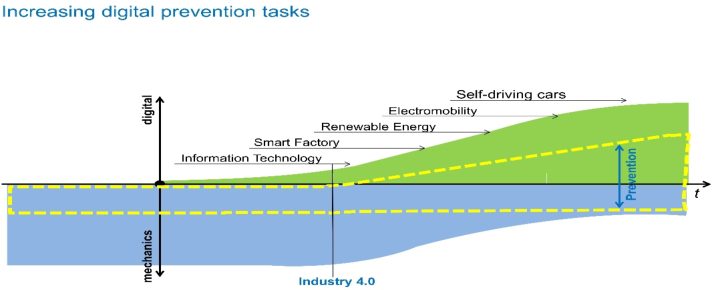
The shorter lifespan of work equipment leads to frequent changes at work- places, which requires adaptation or the development of new prevention measures. Prevention as a service is becoming more intensive and increasingly complex. Figure 1 shows an internally conducted forecast of how the tasks of the prevention department are likely to change in connection with the new technologies. New technologies (Industry 4.0) lead to more digital prevention services.
When workshops are located in different countries and are subject to nati- onal normative and legal regulations, machines have to be manufactured according to different standards and workplaces have to be designed differen- tly. In addition to language barriers, national regulations lead to differences in setting up the same production.
Figure 1: New technologies (Industry 4.0) lead to more digital prevention services (adapted from Malisa, 2022).
96 Viktorijo and Georg
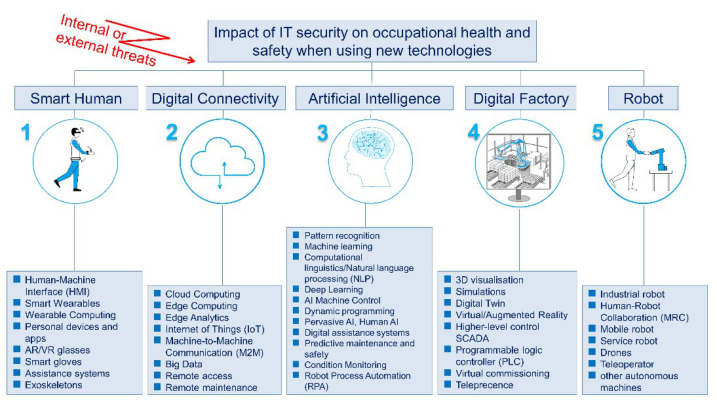
In this environment, prevention services must continuously monitor tech- nological developments and help to safely integrate technologies, develop new models and quickly provide targeted health and safety information to manufacturing companies in all workplaces. From an occupational health and safety perspective, it is important that no hazards arise for people in the new workplaces. By connecting work equipment to the internet, connecting external devices or manually entering data, targeted cyber-attacks are possi- ble in the workplace, so these threats must also be included in a risk analysis and a workplace assessment that is carried out regularly. In Fig. 2, new tech- nologies have been grouped according to the threats posed by cyberattacks on machines and devices, according to (Malisa, 2018) and (Malisa, 2019).
From the perspective of machinery safety and occupational health and safety, as well as the impact of cyberattacks, technologies can be divided into five groups, as shown in Figure 2: (Malisa, Effenberger, 2022)
1. Smart Human Devices, measuring instruments or displays that are attached and worn directly on the human body. (Figure 2, Pos. 1) 2. Digital Connectivity Machines, controls, simulations, databases dislocated from each other but connected via the Internet for data exchange. (Figure 3, Pos. 2) 3. Artificial Intelligence Artificial intelligence, machine learning and other intelligent algorithms for production systems. (Figure 3, Pos. 3) 4. Digital factory Models of individual real machines or entire production systems inte- grated with simulations and interacting with real machines. (Figure 3, Pos. 4)
Figure 2: Grouping new technologies based on the impact of IT-security on occupatio- nal health and safety (Malisa, 2018, 2019).
Prevention Ecosystem Integrated Into Digitalized Manufacturing 97
5. Robots Industrial robots, mobile platforms or multicopters, used for the auto- mation of production systems. (Figure 3, Pos. 5) This grouping helps on the one hand to bundle the necessary prevention measures and other information, and on the other hand to facilitate com- munication between the departments of the company, in particular betw- een occupational safety and OT/IT. Digitalization is changing all areas of industry, and technological developments are advancing very quickly, so pre- vention must be adapted in step. Technological change requires prevention to be flexible and dynamic. For each new digital technology in the work- place, safety has to be assessed with regard to cyberattacks and, if necessary, measures for secure use have to be developed.
The prevention service needs a platform that covers new technologies, including cyber security with information, rendering a sound and clear pre- sentation. In addition, communication with industry must take place using all conventional and digital communication channels in order to be able to communicate technology-adequate updates efficiently and promptly.
This paper is the basis for an ongoing project that invites all readers - com- panies, institutes and large enterprises from different countries - to participate in the subprojects.
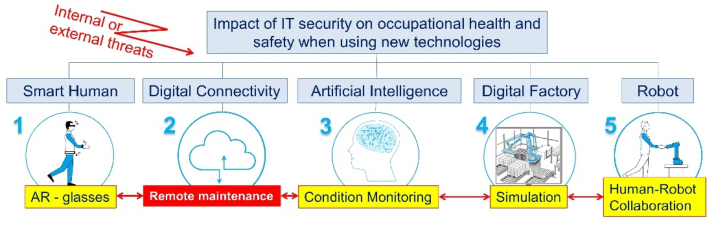
DEVELOPMENT OF AN ECOSYSTEM FOR PREVENTION Challenges are manufacturing systems in which many new technologies are integrated. One possible system is shown in Figure 3, where remote mainte- nance is performed on a human-robot collaboration system in such a way that the maintenance person is in front of the robot wearing AR glasses and the remote expert is connected to the robot controller via simulation and the process is monitored via condition monitoring.
To perform a risk assessment of such complex systems, teamwork with different experts is required.
The prevention service needs a platform that covers the new technologies, including cyber security, with information and presents it in a sound and clear manner. In addition, communication with the industry needs to take place through all conventional and digital communication channels in order
Figure 3: Example “remote maintenance” – on a complex system for risk assessment.
98 Viktorijo and Georg
to communicate technology-appropriate updates in an efficient and timely manner. (Leah, 2022) The prevention platform must adapt to the rapid changes in the manufa- cturing industry and globally and include the following features:
keep pace with new technologies
shorter life cycles of machines
rapid changes in workplaces
influence of IT security on occupational safety
different national normative and legal regulations
sending information about health and safety in the workplace via all information channels
helping to create the risk assessment for complex systems.
Due to the many requirements for the platform, it is possible to build a platform as an ecosystem with a database in the background and the possi- bility of integrating different interfaces, modules and further modules in the future.
According to (Fraunhofer, 2022) an ecosystem is defined by the following characteristics: a) it satisfies the actual needs of potential consumers, b) it delivers added value that was previously unattainable without the ecosystem service, c) it is attractive to both providers and demanders of services, and d) it provides added value for all partners involved in the ecosystem service.
Consequently, the general structure of the ecosystem under this project “prevention ecosystem” will have the following characteristics: ad a) The user can create an account in the “Prevention ecoSystem” for himself, for a company or a workshop. Depending on his professional inte- rest, the user can enter specific topics, a production plant, the individual machine or a specific workplace. On this basis, he automatically receives all information on the subject of health and safety at work, including standards and legal texts, publications and regular updates in the future.
ad b) The “Prevention ecosystem” provides the user with targeted and up- to-date information, assessment templates, dates for recurring inspections and storage space for their own documents. All information is distributed via different communication channels.
ad c) The “Prevention ecoSystem” is open to companies from the health and safety sector. Machinery manufacturers can deposit digital documents including declarations of conformity for their machinery on the platform. Selected service providers can integrate their services into the ecosystem. These can be: Personal Protective Equipment (PPE) certification bodies, service providers for various workplace measurements (e.g. dust and gas, noise, lighting), but also other OSH related topics such as research funding, books and journals, events, seminars, trade exhibitions.
ad d) It is important for all service providers integrated in “Prevention ecoSystem” to be in direct contact with users via the platform in order to
Prevention Ecosystem Integrated Into Digitalized Manufacturing 99
strengthen their profile in the sector and to be able to pass on new informa- tion directly to users at any time. Users have all the information they need stored in one place. All information is accessible at all times, comes from secure sources and is constantly updated. It is important for every prevention service provider to increase the level of information on occupational safety and health in all workplaces, to keep it constantly up to date and to make the information available securely and up-to-date through all communication channels.at work in all companies, to keep them constantly up to date and to make the information available via all communication channels.
OPERATING PRINCIPLE OF THE ECOSYSTEM
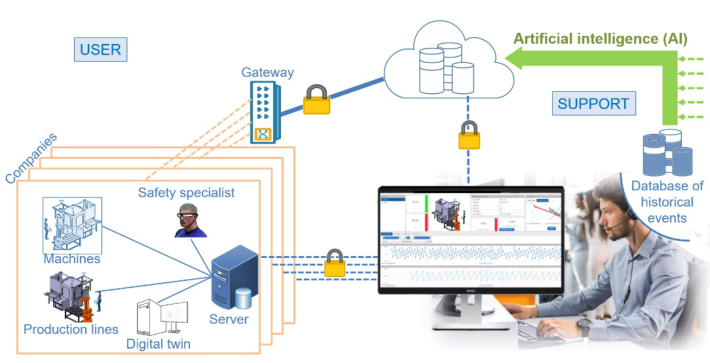
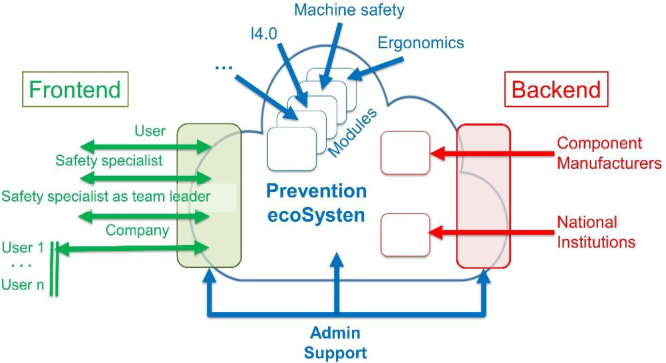
Figure 4 shows the basic components of the national “Prevention ecosy- stem”, which also serves as a coordination point for other subsystems such as countries and sectors. Support monitors the system, integrates modules into the system, maintains the database, installs new languages, manages role permissions, updates frontend and backend, takes care of backup, etc.
It is planned to store the historical data separately and use it to train the AI. The aim is to use the AI to improve health and occupational safety at specific workplaces.
It is conceivable that the AI will also be used for chat bots, live chats, semantic analysis of reports from operational systems, etc.
Figure 5 shows a schematic overview of the main information flow from users, occupational safety and health component manufacturers and national hazard prevention institutes. The structure of ecoSystem will be modular, so that modules can be easily extended or new modules can be added. Modules can be technical in nature, but also assessment modules, etc. Support and data will all be entered in English. However, multiple languages will be available to users for communication.
Figure 4: National “prevention ecosystem” for Austria and coordinating body for international subsystems (Malisa, Effenberger and Wittig, 2022).
100 Viktorijo and Georg
Figure 5: Schematic representation of the flow of information in/out of the ecosystem.
Cross-country prevention means rapid cross-border dissemination of infor- mation, so that in the event of accidents at a particular machine or workplace, prevention measures can be developed immediately and information can be passed on to all other users of the same type of machine.
It is also possible to compare country-specific differences at the same or similar workplaces in terms of standardisation or applicable laws, evaluate safety measures and make workplaces safer overall.
The prevention platform is designed to provide users with information through both traditional and all digital media channels. New information channels will also be developed, e.g. Presentation of prevention measures for a specific machine directly on the display or on a monitor at the work- place. For being able to address all sectors, company sizes and employees evenhandedly, the information should be prepared in a scalable way.
CONCLUSION
The integration of information technology in production companies is chan- ging work equipment, processes and, at the same time, workplace safety. To ensure safety and health in the workplace, up-to-date information must be transmitted to workplaces in a preventive manner, e.g. via various infor- mation channels to the users of the prevention platform, an ecosystem. If an accident or near-accident occurs on a particular machine, users with the same type of machine are informed worldwide and the necessary preventive measu- res are communicated. Corporate safety professionals, employers, operators and other service providers have online access to the information they need via a “Prevention ecoSystem” platform built on ecosystem principles. Infor- mation is disseminated through multiple communication channels to quickly share publications and updates with registered users. This is especially impor- tant when it comes to cyberattacks and their impact on machines, production systems and workplaces.
Prevention Ecosystem Integrated Into Digitalized Manufacturing 101
In order for the prevention service to keep pace with changes in production, an expansion of the “Prevention ecoSystem” platform is underway. To this end, agreements are currently being drawn up with cooperation partners, various models are being tested and research projects are being defined. It is also being examined whether the latest results of artificial intelligence can be used for prevention and how they can be integrated into the ecosystem.
REFERENCES
Fraunhofer. (2022) “Digitale Ökosysteme und Plattformökonomie - Fraunh- ofer IESE”, Fraunhofer-Institut für Experimentelles Software Engineering IESE”. Webseite: https://www.iese.fraunhofer.de/de/leistungen/digitale- oekosysteme.html#Was-sind-Digitale-oekosysteme. Leah. (2022) “Die 9 wichtigsten Kommunikationskanäle für Kunden – Vorteile und Nachteile”, Userlike. Retrieved May 12, 2022, from https://www.userlike.com/d e/blog/kommunikationskanaele 2022. Malisa, Viktorijo. (2018) “Safety Relevance of New Technology”, Forum News, N
49 – 12. European Forum. Malisa, Viktorijo. (2019) “Digitization of production: safety & security groups of new technologies for prevention”, Conference NES 2019 - Nordic Ergonomics Society, Elsinore, Denmark. Malisa, Viktorijo and Effenberger, Georg. (2022) “Prevention on the path of digitiza-
tion”, 11th international conference of WorkingOnSafety.net – Focus on Humans in a Technological World (WOS2022), Olhao, Portugal. Malisa, Viktorijo. Effenberger, Georg and Wittig, Klaus. (2022) “AI-enabled Prevention ecoSystem”. 7th European Conference, EUROSHNET, Paris, France.
LISTED IN THE AHFE DIGITAL BOOKSTORE CATALOGUE
Explore the complete digital volume
Safety Management and Human Factors
Read this individual research paper free through the original publisher, or explore the full digital proceedings book.
ISBN 978-1-958651-81-0
Explore this ISBN in the AHFE Bookstore ↗Listed in the July 2026 bookstore catalogue; search by ISBN to confirm current availability · Digital book purchase optional