Asta Savanevičienė, Gita Šakytė-Statnickė, Lina Girdauskiene (2023). How stress and time spent on task affect safe behavior at work: evidence from experiment by simulating work in hazardous conditions in VR. In: Safety Management and Human Factors. AHFE Open Access, vol. 105, pp. 102–112. https://doi.org/10.54941/ahfe1003075
The rapid development of digital technologies has enabled significant advances in the training of workers working in hazardous conditions. VR technologies have made it possible not only to make the training process cheaper, but also to transfer it to a safe space. Employees, when working in hazardous conditions, often have to deal with complex technical operations and at the same time strictly follow safe work rules and work procedures. The paper examines the interaction of time spent on tasks, stress (based on biomarkers: HR, HRV, GSR), safe behavior in training skills by simulating work in dangerous conditions in VR. In doing this, 50 experiments were performed testing VR applications for work in hazardous conditions in the construction sector. The results of the study showed that time spent on tasks and stress influence the safe behavior at work (number of errors) when working in hazardous environments. Moreover, immersion in VR was assessed using the adapted Slater-Usoh-Steed questionnaire (SUS), and based on the interview after simulation, insights are provided on how to enhance the immersion in VR applications for training of workers working in hazardous conditions.
Despite predictions that robots may replace up to 800 million employees worldwide by 2030 (McKinsey, 2017), the number of accidents at work is worrying. Every year, more than 2.78 million people die from occupational accidents and work-related diseases, while an additional 374 million suffer from non-fatal occupational accidents (ILO, 2019). Moreover, the statistics show that this number is growing compared to 2.3 million deaths due to occupational accidents and another 317 million non-fatal accidents at work in 2011, (ILO, 2011). The International Social Security Association (ISSA) estimates that the cost of non-fatal accidents at work alone is approximately 4 percent of global gross domestic product (GDP) each year (ISSA, 2014).
How Stress and Time Spent on Task Affect Safe Behavior at Work 103
This encourages paying attention both to the tightening of safety require- ments at work, especially when working in hazardous conditions, and to the implementation of the preventive safety policy, emphasizing the elimination of the causes of accidents due to the human factor. Thus, skills’ development of employees working in hazardous conditions becomes a key point ensuring occupational safety and achieving zero injuries at work.
Rapid development of digital technologies has enabled significant progress in the training of employees working in hazardous conditions. VR techno- logy made the training process less expensive and moved it to a safe space. Moreover, dangerous jobs are often associated with certain phobias that the trainees may not be aware of, whereas careless actions, overconfidence, and hurried completion of tasks can lead to unsafe behavior at work and injuries as a result. The training of skills when working in dangerous con- ditions in the VR space enables ensuring safe training as well as registering the parameters describing the trainee’s actions (mistakes, time spent on task, stress). Having information about the progress of training, it is possible to identify the lacking knowledge, regulate the pace of training and assess the psychological readiness to work in dangerous conditions.
The purpose of this paper is to examine the impact of time spent on tasks and stress (based on the following biomarkers: heart rate, heart rate vari- ability, and galvanic skin response) on safe behavior in skills’ training by simulating work in dangerous conditions in VR.
Framework for VR-Based Tool for Simulating Work in Dangerous Conditions With the emergence of new technologies, the work environment is rapidly changing, and increasingly more researchers are focusing on both the bene- fits provided by technological progress and the emerging new tension zones (Ehnert et al., 2014) and the new challenges posed to employees who often have to deal with complex technical operations and remain rational and responsible while working in dangerous conditions(Grzywacz et al., 2016; Fang et al., 2016).
Recent studies (Ahmady et al., 2021; Mata et al., 2021; Cappitelli, 2020) highlighted the links between time, stress, performance, and risky behavior at work. Scharf et al. (2001) argued that the most dangerous work environ- ments had one thing in common - constant change. Abdalla et al. (2017), besides such sectors as agriculture, manufacturing, mining, and transport, in particular singled out the construction sector, where many different types of hazards occur at the same time: electricity, noise, confined spaces, heights, etc. Scharf et al. (2001) distinguished a number of key features of hazardous work environments: (1) controllability and degree of control, (2) predictability, (3) hiddenness, obscureness, difficultness to detect, unexpectedness, (4) moving or movable — fixed or unrestricted path, (5) degree of speed and force, and rate of change, (6) dynamic work process as a hazard, (7) multiple, intera- cting hazards, (8) human-generated hazards. The studies have shown that accidents at work are often related to the individual characteristics of emplo- yees. Individuals have different susceptibility to workplace injuries, and this
104 Savaneviˇcien˙e et al.
variability is related to professional competence and individual characteri- stics (Schulte et al., 2012; Abdalla et al., 2017). Many studies have found that occupational accidents and injuries are more common among younger workers (Breslin et al., 2011; Okun et al., 2016), while workers with low levels of education (Breslin, 2008) are consistently at increased risk of injury.
The research (Ahmady et al., 2021; Mata et al., 2021; Cappitelli, 2020; Abdalla et al., 2017; Živkovi´c and Veljkovi´c, 2019) revealed that stress is one of the most important indicators of safe and efficient work. Leung et al. (2012) determined that stress can be caused by inappropriate safety equipment and insufficient training, i.e. lack of knowledge and experience. Moreover, various phobias can affect work safety: agoraphobia - fear of open spaces and crowds (people); acrophobia - fear of heights; claustrophobia - fear of a (narrow) space; pantophobia - fear of everything that can hap- pen; pseudophobia - fear whose existence is yet unproven, etc. (Živkovi´c and Veljkovi´c, 2019). Based on these studies, it can be argued that stress is a cri- tical indicator on which to base a personalized trainee-centered work skills’ training tool for working in hazardous conditions.
Chenarboo et al. (2022) found a significant relationship between the time allotted for completing the tasks and safety behaviors. However, the speed of task completion is often related not only to the time needed for completing the tasks, but also to the decision made by the employee. Different people have different risk tolerance. Research findings of Zhang et al. (2020) in the construction sector showed that construction workers’ personality traits, risk propensity, and unsafe behavior were interrelated.
In the case of unreasonable risk, the individual may also become stres- sed due to the inability to cope with the task. Luger (2013) pointed to the Health Beliefs model, which emphasizes the importance of 8 competencies that ensure safe behavior at work. Competencies such as perceived suscepti- bility, perceived benefits of taking action, perceived barriers to taking action, cues to act, etc. should be noted.
Most of the research carried out so far has used the traditional approach and sociological surveys - opinion research. However, modern technologies make it possible to eliminate the subjectivity aspect inherent in opinion polls. The problem of subjectivity can be solved by using VR technologies and by applying the monitoring of the individual’s psychophysiological chan- ges when the corresponding biosignals are registered and processed. VR can produce dosed stimuli to which the individual’s response is reflected in the parameters of autonomic nervous system (ANS). Recording of the ANS has been quite successful in trying to determine the level of stress (Cho et al., 2017). In addition, by simultaneously recording errors and the time during which tasks are performed, assumptions can be made about the level of mastering of skills when working in hazardous conditions and the need for further training can be identified.
Protocol of the Experiment The purpose of the experiment was to examine the impact of time spent on tasks and stress (based on biomarkers: heart rate, heart rate variability,
How Stress and Time Spent on Task Affect Safe Behavior at Work 105
and galvanic skin response) on safe behavior in training skills by simulating work in dangerous conditions in VR. In doing this, 50 experiments were conducted.
The experiment was carried out according to a pre-prepared protocol: 1) 10 minutes of general calm in the waiting room, filling in the general data form; 2) 5 minutes were then spent to instruct the respondents on the use of VR and biometric data measurement devices; VR headsets and biometric data measurement equipment were put on, and the questions were answered (labo- ratory); 3) the experiment (maximum 90 minutes), when the respondents performed the tasks (laboratory); 4) short feedback about the first impres- sion of the respondent (laboratory); 5) 10 minutes of relaxation, filling in the form of immersion in virtual reality and unstructured short interview in the waiting room.
The experiment consisted of three stages: a) the instruction, when the respondent performed the tasks while listening to the audio recording with the possibility to ask the instructor for help; b) independent performance of tasks (training) without the possibility of asking the instructor for help; c) independent performance of tasks (assessment of skills) - data (mistakes, time spent on task, and biomarkers) were recorded.
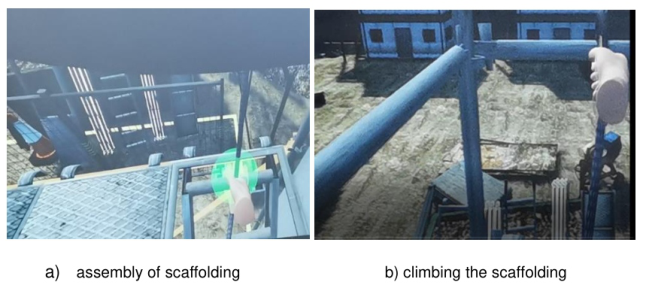
Task scenarios for working in dangerous conditions consisting of four different task stages have been prepared for conducting the experimental research: 1) putting on safety equipment; 2) tidying up the workplace; 3) assembly of scaffolding; 4) climbing the scaffolding. Figure 1 shows examples of VR applications.
Critical (CE) and non-critical (NCE) errors were registered at each task stage: 1) putting on safety equipment (maximum number of errors: CE = 9; NCE = 0); 2) tidying up the workplace (maximum number of errors: CE = 2; NCE = 6); 3) scaffold assembly (maximum number of errors: CE = 3; NCE = 0); 4) climbing the scaffolding (maximum number of errors: CE = 6; NCE = 0). Time spent on independent performance of tasks was calcula- ted (assessment of skills). Heart rate (HR), heart rate variability (HRV), and galvanic skin response (GSR) were also recorded. Based on biomarkers, stress was estimated and presented in ranks.
Sum of critical and non-critical errors Time 50 373 4124 858.89 583.332 Stress 50 .00 3.00 1.6141 .96711 Valid N (listwise) 50
The classic Slater-Usoh-Steed (SUS) scale (Usoh et al., 2000) was used as the basis for the questionnaire to assess the immersion in virtual rea- lity. Six questions were formulated: V1- immersion in VR (V1.1 - reality of working conditions, identifying with the real workplace, tasks, etc.; V1.2 - reality of visualization of working conditions; V1.3 - clarity of the tasks); V2 - VR equipment-related challenges, i.e. convenience of equipment, non- interference with the performance of tasks; V3 - subjective stress (V2.1 - feeling of constant stress; V2.2 - feeling of random stress associated with certain stimuli).
Integrated quantitative data from questionnaire surveys and laboratory experiment were analyzed using IBM SPSS Statistics 25.0 software. The analysis of the normality of the quantitative research results made it possible to select suitable methods for further data analysis. Correlation, linear and multiple regression analyses were performed, whereas the multidimensional analysis enabled revealing the linkage and dependencies of parameters, and presenting a visual generalization of the results. Analysis of the qualitative research findings allowed disclosing the diversity of the opinions of respon- dents about training in hazardous conditions in VR and identifying critical areas for improvement of the tool.
RESULTS
Totally, 50 respondents, 32 men and 18 women, participated in the study. Twelve respondents had no work experience in dangerous working conditi- ons, 11 respondents had more than 10 years of work experience in dangerous working conditions. The maximum possible number of critical errors (CE) was 21, the number of non-critical errors (NCE) was 6. During the experi- ment, the number of critical errors made by respondents ranged from 0 to 9, and non-critical errors – from 0 to 2. There was very large dispersion of time spent on tasks (from 373 to 4124). Stress was measured on a 4-point scale and the respondents’ stress level ranged from 0 to 3.
The correlation between the main constructs of the study (number of errors, time, and stress) showed the existence of an inverse relationship betw- een the number of errors and time (−.288, p < 0.05)) and between time and stress (−.390, p < 0.01), which allows the regression analysis.
How Stress and Time Spent on Task Affect Safe Behavior at Work 107
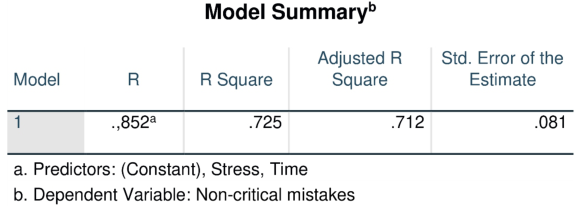
After carrying out a multiple regression analysis, it was found that time and stress explained 8.3% of all errors and 5.7% of critical errors. This suggests that there is a dependency, but does not imply valid conclusions. Meanwh- ile, time and stress explained as much as 72.5% of non-critical errors, and validated the model as being of high statistical significance.
It can be assumed that the respondents have a good grasp of essential kno- wledge, but the lack of experience implies stress and a need for more time, as a result of which small mistakes are made.
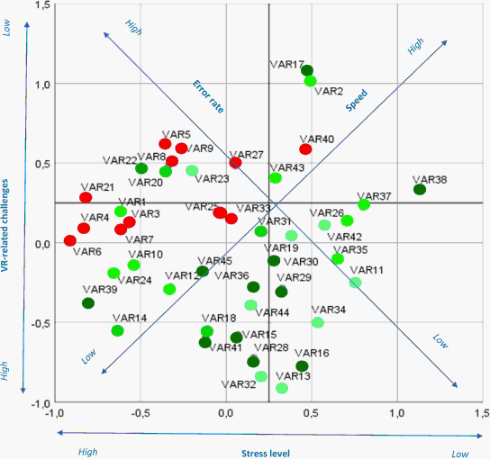
Multidimensional Scaling (PROXSCAL) analysis was used for data inter- pretation. A Euclidean Distance Model was constructed integrating the following parameters: errors (sum of critical and non-critical), time, stress, and challenges caused by VR equipment. The data of 6 respondents were removed as outliers identified by testing the normality of the data.
Multidimensional analysis enabled explaining some relationships. Some correlations were found between time and sum of errors in certain stages;
Figure 2: A multiple regression model of the effects of time and stress on non-critical errors.Figure 3: Multidimensional analysis integrating errors, time, stress, and VR challenges.
108 Savaneviˇcien˙e et al.
however, in the final constructs, time correlated only with non-critical errors. Looking at the results of individual respondents, it can be seen that some of the respondents who completed the tasks quickly made mistakes, while others did not. Similarly, some of the respondents who performed the tasks slowly also made mistakes, whereas the others did not. Paradoxically, most of the respondents who performed the tasks incorrectly had not felt much stress, while the group of really experienced high climbers, probably due to the stress possibly caused by controlling the VR equipment, could not cope with the tasks quickly and without the mistakes. There is a significant corre- lation between age and challenges related to VR equipment (.403, p < 0.01), and this demands spending more time getting used to working in a VR envi- ronment. This is also evidenced by the links between the challenges of wearing the VR equipment and the number of mistakes. Basically, significant corre- lation was recorded in the first stage, which allows for the assumption that there were problems with the operating the VR equipment. In addition, sta- tistically significant correlation between VR equipment operation and time in the third stage was recorded. This was the most complicated part of the tasks (building the scaffolding) and as it later became clear from the experie- nce of the respondents during the interviews, this is where the VR equipment operation issues arose.
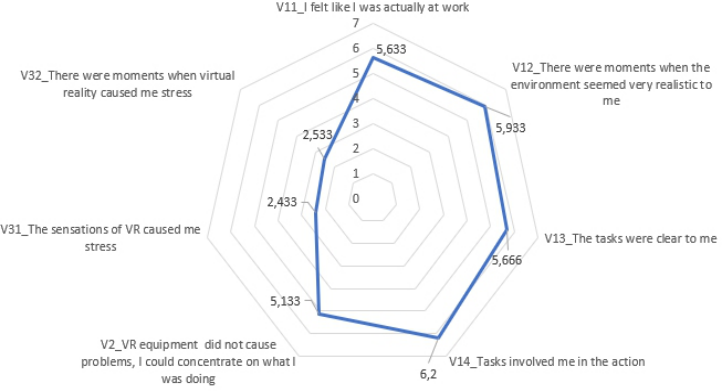
Assessment of the immersion in virtual reality is presented in Figure 4. After filling out the questionnaire for assessment of the immersion in VR, an interview was conducted with the research subjects in order to find out the experiences of those who participated in the experiment and to get the insights for improving the layout of the training tool for skills’ training when working in dangerous conditions. This also led to an understanding of the immersion in VR of research subjects. When examining the first category - VR immersion (V1), all three subcategories were rated highly. However, at the very beginning of the tool development, there was a discussion about whether
Figure 4: Assessment of the immersion in VR.
How Stress and Time Spent on Task Affect Safe Behavior at Work 109
everything could be transferred to the VR space, or maybe, for example, putting on safety equipment could be done ‘live’. The last option was chosen; however, this stage was skipped during the experiment, and this was noticed by the respondents: “<...> I think it is important to put on high-climbing equipment, I would say that it is even the basics, without which there is no step. It is not emphasized here. There is a Snap-hook fastening, but it’s more of an emphasis on the fact, because you can’t do it otherwise in VR” [R12]
“I missed the beginning, in reality here you start with organizing the workplace, and there is no belt check, no actual putting on of them. I just don’t know how to solve it, how to teach it in VR, how to do it and to check whether they know how to do it” [R23] There was a proposal to introduce a ‘visualized test’ asking the resea- rch subjects to choose one answer from several options. It was proposed to present the options of the answers in both visual and verbal form, e.g. by presenting several belt options, indicating both their validity and showing their defects in pictures. Considering the limitations of VR, the evaluation of the wearing of safety equipment should still be carried out during this phase ‘live’, for example, before the start of the VR training session. However, it is advisable to establish the fact that safety equipment has been put on.
In general, the respondents emphasized the logical consistency of the tasks. Furthermore, some respondents observed that the training material could be more diverse, covering more aspects, because the same tasks were repeated in training and in the examination; the only difference being that there were no instructions [R2; R8; R15; R24; R30]. In response to these comments, it is suggested to create modules focused, for example, on the specifics of the work of a surveyor-electrician or surveyor-telecommunications engineer.
The instructions were characterized as very clear and useful: “<...>short and clear instructions, if you don’t understand something, you can press the Repeat button” [R29]
“<...> it’s really clear, I can’t find any faults<...>” [R3] The research showed that there were VR equipment-related challenges (V2). It has been noted that experience with VR has a significant impact on training success. Depending on the existing VR experience, it is sugge- sted to lengthen or shorten the duration of time allocated for mastering VR equipment and basics of behavior in VR space. Some research subjects noted the link between age and lack of skills when acting in a VR environment: “Really good. Only the younger will find it easier than the older” (R2). The- refore, it is necessary to pay attention to this when training respondents to work with VR equipment, allocating more time and providing more detai- led instructions, and ensuring that the research subjects is familiar with them and that technical questions will not arise during the task performance. This is especially relevant seeing that there were such comments:
“I’d rather have climbed it live... Well, the kids would love it, I wouldn’t. For young people here, where they sit on computers.” [R4].
110 Savaneviˇcien˙e et al.
Subjective stress included the assessment of two subcategories: constant feeling of stress (V3.1) and occasional feeling of stress associated with cer- tain stimuli (V3.2). It should be noted that the averaged estimates for both subcategories were not very high, although some people felt very high stress. Nonetheless, there were suggestions for modeling stronger sensations: “And in the end, if you put it (scaffolding) in a bad way, it would be cool to model the collapse.” [R46]
“<...>a shock would be needed to simulate a fall if the scaffolding was built badly, it would be really healthy, I speak from experience, because I build and climb scaffolding myself.” [R18] However, these suggestions are debatable because of the potential negative effects of redundant effects. According to Xi et al., (2022) additional stimuli cannot be misused in the VR environment; their excess has the opposite effect, regardless of the introduction of sound and sensory effects imparting realism at a first glance.
The respondents noted that the tool for training of skills when working in dangerous conditions could be used both for training to work in dan- gerous conditions as well as for improving and refreshing knowledge and skills, and for testing. It should be noted that younger respondents especially emphasized that this tool was innovative and timely: “Very cool. When climbing, the legs actually bent. Really worth using in training, very interesting.” [R27]
“<...> {such a system} has been needed for a long time, it needs to be interesting to learn, it needs to keep pace with innovations.” [R44] “I think in five years we’ll learn only in such innovative way. Look, all the kids are immersed in VR, it’s already everyday life for them. Well, maybe it will be more difficult for older people, but after all, in any job, technology is developing rapidly, and you have to master it, otherwise you will simply drop out from the {labor} market.” [R31]
“If you told me that there were some options like trainings in VR and training online or lecture, I would definitely choose VR. Here is a great possibility to attract customers.” [R15]
CONCLUSION
The results of the research substantiated the main parameters of the tool for skills’ training the skills when working in dangerous conditions, and enabled formulating specific empirically based proposals for both the technical speci- fication of the product and the development of skills training programs. The results of the study showed that stress and time spent on tasks affect safe behavior at work (number of mistakes) when working in hazardous environ- ments. Creating an immersive work environment in a VR space ensures deep experiential learning, fully involving the trainee in an interactive learning environment.
How Stress and Time Spent on Task Affect Safe Behavior at Work 111
ACKNOWLEDGMENT
The authors would like to thank UAB Gluk Media for the opportunity to participate in the experiment and collect data.
REFERENCES
Abdalla, S., Apramian S. S, Cantley L. F., Cullen M. R. (2017). Occupation and Risk for Injuries. In.: Injury Prevention and Environmental Health. 3rd edition. (edited by Nugent R., Kobusingye O., Smith K. R.) Washington (DC): The Inter- national Bank for Reconstruction and Development / The World Bank; 2017 Oct. Chapter 6. Ahmady, S., Khajeali, N., Kalantarion M, Sharifi, F., Yaseri, M. (2021). Rela-
tion between stress, time management, and academic achievement in preclinical medical education: A systematic review and meta-analysis, J EDUC HEALTH PROMOT. Breslin, F. C. (2008). Educational Status and Work Injury among Young People: Refining the Targeting of Prevention Resources, CANADIAN JOURNAL OF PUBLIC HEALTH Volume 99 No. 2. Breslin F. C., Smith P. M, Moore I. (2011). Examining the Decline in Lost-Time Claim
Rates across Age Groups in Ontario between 1991 and 2007, OCCUPATIONAL AND ENVIRONMENTAL MEDICINE Volume 68 No. 11. Cappitelli, S. (2020). The effect of stress on individuals’ propensity toward risky decision-making. NORTH AMERICAN JOURNAL OF PSYCHOLOGY Volume 22 No. 1. Chenarboo, F. J., Hekmatshoar, R., Fallahi, M. (2022). The influence of physical and
mental workload on the safe behavior of employees in the automobile industry, HELIYON Volume 8 No. 10. Cho, D., Ham, J., Oh, J., Park, J., Kim, S., Lee, N. K., & Lee, B. (2017). Detection of Stress Levels from Biosignals Measured in Virtual Reality Environments Using a Kernel-Based Extreme Learning Machine, SENSORS Volume 17 No. 10. Ehnert, I., Harry, W., Zink, K. J. (2014). The future of sustainable HRM. Concluding
thoughts and ways forward. In I. Ehnert, W. Harry, & K. J. Zink (Eds.), Sustai- nability and Human Resource Management. Developing sustainable business organizations, pp. 423–442. Fang, D., Zhao, Ch., Zhang, M. (2016). A Cognitive Model of Construction Workers’ Unsafe Behaviors, JOURNAL OF CONSTRUCTION ENGINEERING AND MANAGEMENT Volume 142 No. 9. Grzywacz, J. G., Segel-Karpas, D., Lachman, M. E. (2016). Workplace exposu-
res and cognitive function during adulthood: evidence from national survey of midlife development and the O*NET, JOURNAL OF OCCUPATIONAL AND ENVIRONMENTAL MEDICINE Volume 58 No. 6. ILO (2011). The Health and Safety Executive Statistics 2011/12. Web- site: https://www.ilo.org/wcmsp5/groups/public/--ed_protect/--protrav/--safewor k/documents/publication/wcms_212131.pdf. ILO (May 6, 2019). 2.78 million workers die from occupational accidents annually. Website: https://safety4sea.com/ilo-2-78-million-workers-die-from-occupat ional-accidents-annually/. ISSA (International Social Security Association). (2014). Towards a Global Culture of Prevention: Working Conditions Have a Major and Direct Impact on the Health and Well-Being of Workers. ISSA, Geneva. Website: http://www.issa.int/topics/occupational-risks/introduction.
112 Savaneviˇcien˙e et al.
Leung, M. Y., Chan, I. Y., Yu, J. (2012). Preventing construction worker injury incidents through the management of personal stress and organizational stressors. ACCID ANAL PREV Volume 48. Luger T. M. (2013). Health Beliefs/Health Belief Model. In: Gellman M. D., Turner
J. R. (eds) Encyclopedia of Behavioral Medicine. Springer, New York, NY. Mata, M. N., Sohail, M., Haider, S. A., Sheraz, F., Rita, J. X., … & Correia A. B. (2021). Impact the relationship between time management, work stress and work performance-a quantitative study in Portugal, ACADEMY OF STRATEGIC MANAGEMENT JOURNAL Volume 20 No. 6. McKinsey Global Institute. (December, 2017). Jobs lost, jobs gained: Workforce
transitions In a time of automation. Website: http://www.mckinsey.com/mgi. Okun, A. H., Guerin, R. J., Schulte, P. A. (2016). Foundational workplace safety and health competencies for the emerging workforce. JOURNAL OF SAFETY RESEARCH Volume 59. Scharf, T., Vaught, Ch., Kidd, P., Steiner, L., Kowalski, K., Wiehagen, B, Rethi, L.,
Cole, H. (2001). Toward a Typology of Dynamic and Hazardous Work Envi- ronments. National Occupational Injury Research Symposium (NOIRS) 2000, Pittsburgh, Pennsylvania, October, 2000. Schulte, P. A., Pandalai, S., Wulsin, V., Chun, H. (2012). Interaction of Occupational and Personal Risk Factors in Workforce Health and Safety, AMERICAN JOURNAL OF PUBLIC HEALTH Volume 102 No. 3. Usoh, M., Catena, E., Arman, S., Slater, M. (2000). Using Presence Questionnaires
in Reality, PRESENCE Volume 9 No. 5. Xi, N., Chen, J., Gama, F. et al. (2022). The challenges of entering the metaverse: An experiment on the effect of extended reality on workload. INF SYST FRONT. Zhang, J, Xiang, P., Zhang, R., Chen, D. (2020). Mediating Effect of Risk
Propensity between Personality Traits and Unsafe Behavioral Intention of Con- struction Workers. JOURNAL OF CONSTRUCTION ENGINEERING AND MANAGEMENT Volume 146 No. 4. Živkovi´c, S., Veljkovi´c, M. (2019). The psychophysiological basics of work safety.
WORKING AND LIVING ENVIRONMENTAL PROTECTION Volume 16 No. 1.
LISTED IN THE AHFE DIGITAL BOOKSTORE CATALOGUE
Explore the complete digital volume
Safety Management and Human Factors
Read this individual research paper free through the original publisher, or explore the full digital proceedings book.
ISBN 978-1-958651-81-0
Explore this ISBN in the AHFE Bookstore ↗Listed in the July 2026 bookstore catalogue; search by ISBN to confirm current availability · Digital book purchase optional