Dovile Valantiejiene, Lina Girdauskiene (2025). Gamification Impact on Agile Team Motivation: Theoretical Framework. In: Human Factors and Wearable Technologies. AHFE Open Access, vol. 175, pp. 107–117. https://doi.org/10.54941/ahfe1006364
Contemporary organisations face the challenge of responding to growing requirements and expectations in a modern and dynamic business environment. Moreover, changes in the workforce and modern work culture are leading to an increasing need for complex problem-solving, progressiveness, flexibility and rapid adaptation in the management of organisations. Employees enable the organisation to rapidly sense and respond to unpredicted threats and opportunities through their actions, leveraging them for strategic advantage. Altogether it led to adopting the Agile approach in management, initially created for manufacturing and software development methods. Today the Agile approach helps to improve teamwork, adapt to changes, and achieve goals more efficiently. Moreover, it is becoming more strongly associated with the management of organisations and emerging as a standard in modern business environments. Furthermore, the Agile approach has transformed into a method to organise work in the organisation. So, Agile teams are becoming a critical and central unit in the organisation. This poses new challenges in Human Resource Management (HRM) on how to motivate Agile teams, because not only the individual motivation of the employees within the team becomes important, but also the overall motivation of the team as a whole. One of the well-known and recognised tools for motivating employees is gamification. Researchers and HRM practitioners defined gamification as the application of game elements in non-game environments. Gamification application aims to create stimuli that enrich the work environment by stimulating employee motivation and encouraging employees to achieve their goals in an engaging, novel and fun way. It is known that gamification has been applied in the context of Agile teams. With the growing popularity of Agile teams in organisations, gamification is becoming an integral part of their work environment. Despite gamification and Agile team embedding in organisations, existing research does not provide enough knowledge about Agile team motivation from the collective perspective, specifically, what set of shared needs an Agile team has and how these can be met through gamification. So, this study aims to address theoretical gaps in understanding how gamification impacts Agile team motivation by reviewing existing research and developing a conceptual theoretical model explaining the impact of gamification on Agile team motivation. The systematic literature review examines empirical research on gamification in HRM and analyses peer-reviewed articles on agile teams, their performance and effectiveness published in Web of Science, Scopus, and other databases over the last decade. The literature analysis revealed that an Agile team can be characterised by a set of shared needs that can be met through gamification to increase team motivation. This study contributes to the development of theory on how gamification affects the collective level of a team in general. Moreover, this research can provide insights that can be applied to organisational management practice and policy creation.
In response to changing market demands, technological advances and globalisation, organisations are increasingly adopting the Agile approach. From what started as a set of methods, Agile has evolved into a broader management principle, requiring structural and cultural transformations. This shift prioritizes self-organised, cohesive, and collaborative teams and interconnected networks making team a key attribute of the Agile approach implementation and critical for success (Stacho et al., 2023). However, because in teams are important to foster both individual and collective
motivation (Chen and Kanfer, 2024), ensuring motivation working in Agile teams becomes a challenge.
Gamification is not only well-established in the field of HRM (Cardador et al., 2017; Hammedi et al., 2021) but it has also been applied in the context of Agile teams. Even though, it has been integrated into popular tools used by Agile teams (Marques et al., 2020). According to Stacho et al. (2023), the use of gamification in people management is essential to introduce and embed an agile approach in an organisation and to increase efficiency. Nevertheless, the application of gamification in this specific context has not been much explored.
Research on gamification in HRM has examined various aspects, including motivation (Herranz et al., 2019). Gig workers and crowdsourcing as a specific type of employee is increasingly researched area (Behl et al., 2022). Contradictory results of gamification application on work environment revealed that gamification outcomes are highly context-dependent (Patricio et al., 2022; Chang et al., 2023). It suggested the need for further studies in different work context (Wibisono et al., 2023). There are studies on the impact of gamification on team cohesion (Benitez et al., 2022), team performance (Waizenegger et al., 2020; Benitez et al., 2022), teamwork and team collaboration (Waizenegger et al., 2020). Still, the research on gamification in Agile team context remains limited. Also, team motivation is still a relatively new research topic in HRM. Despite this, there are studies in other fields (e.g. computer science, and software engineering) showing result that gamification enhances motivation in Agile teams (Marques et al., 2020) and increases employee agility (Nivedhitha, 2023). Moreover, there are evidence that gamification aligns with Agile principles (Stacho et al., 2023). Nevertheless, research on gamification application in Agile team’s context remains fragmented and a deeper understanding of how gamification impacts Agile team motivation is still lacking.
Working in Agile teams is becoming very usual and gamification is an integral part of this context. Moreover, it is known that team motivation is influenced by both individualistic and collectivistic motives, so it is important to investigate how gamification impact team motivation from a collective perspective. This systematic literature review explores existing research, identifies key gaps, and provides a theoretical framework explaining impact of gamification on Agile team motivation. Beyond theoretical contributions, these findings offer valuable insights for organisational management, supporting more effective implementation of gamification in Agile team.
THEORETICAL BACKGROUND Gamification
Gamification is a well-known tool for motivation in the business and management fields. Moreover, Stacho et al. (2023) stated that the majority of Central and Eastern European organisations have already used various gamified platforms in HRM. Gamification is defined as enhancing services and systems with affordances that aim to support and motivate users
Gamification Impact on Agile Team Motivation: Theoretical Framework 109
toward the behaviours targeted by the gamified system, by creating gamified experiences (Koivisto and Hamari, 2019). In gamification, the affordance approach focuses on the interaction between the employee and the gamified environment and the psychological outcomes of this interaction. Koivisto and Hamari (2019) proposed categorising gamification affordances into immersion-related, achievement-related and social-related affordances (see Table 1). Later Xi and Hamari (2019) identified the relationship between these affordances and intrinsic need satisfaction. These categories are now widely used for gamification research in various scientific fields.
Table 1: Gamification affordances (Xi and Hamari, 2019; Koivisto and Hamari, 2019).
Table available in the original PDF paper.
Affordances Definition Immersion-related Aimed at immersion in autonomous and curious activities, providing freedom of choice and a stronger sense of autonomy, as well as a sense of meaningfulness in one’s actions and a voluntary willingness to participate. Achievement-related Aimed to increase the chances of learning new skills,
setting clear goals, experiencing a sense of progress after overcoming difficulties, completing a task, and receiving feedback, which reinforces a sense of competence. Social-related Aimed at creating a stronger sense of connection and belonging, experiencing social interaction with others, cooperation, and competition, promoting reciprocity, sharing ideas, building personal relationships with others, and enhancing social participation.
Research showed that gamification can enhance employee motivation (Silic et al., 2019). Also, gamification can increase work engagement by satisfying psychological needs (Wibisono et al., 2023). Moreover, results revealed that an employee’s perceived motivation in the gamified HRM system is positively associated with job engagement (Silic et al., 2019). Furthermore, the use of gamification can improve employee behaviour in the work environment but this effect is stronger when employees are engaged because gamification has satisfied their psychological needs (Hamza and Tóvölgyi, 2022). Despite these positive results, studies also provide negative ones. Behl et al. (2021) revealed that a gamified environment contributes to employees’ willingness to accept change by creating a satisfying experience. However, this satisfaction is momentary and therefore does not lead to an increase in employee motivation (Behl et al., 2021). Furthermore, gamification contributes to performance but not to employee motivation (Herranz et al., 2018). Overall, these contradictory results suggest that there are unexplored factors or unexamined circumstances that lead to these different results.
110 Valantiejien˙e and Girdauskien˙e
Agile Team Motivation Agile teams serve as the backbone of Agile work, fostering collaboration, adaptability, and efficiency in dynamic environments. They are structured as self-organised, cross-functional units that operate with shared responsibility, emphasizing flexibility, communication, and collective problem-solving (Junker et al., 2024; Heidt et al., 2023). An agile team is understood as a distinct type of team, that is defined as a team that applies agile work practices to coordinate the activities of team members, either directly (by applying selected agile methods) or indirectly (by organising work operations organically based on an agile approach) (Junker et al., 2024). The processes and emergent states emerging in the Agile team determine the team’s ability to function in a dynamic, fast-changing and task-diverse environment to solve complex tasks (Käosaar et al., 2022). These mediators also enable the team’s resources to be converted into results (Käosaar et al., 2022). Agile team processes involve action planning, goal achievement, and motivational and emotional team states (Steegh et al., 2024), while emergent states encompass cognitive, motivational, and emotional team states (Steegh et al., 2024). Thus, the processes and states that occur in Agile teams can be important for the motivation of Agile teams (Käosaar et al., 2022).
Team motivation is understood as an evolving and iterative process over time, influenced by various contextual factors (Chen and Kanfer, 2006). It is defined as “the collective system by which team members coordinate the direction, intensity, and persistence of their efforts” (Chen and Kanfer, 2006, p. 233). Thus, motivation cab be considered not only an individual phenomenon but extends to the collective level, where becomes important a shared goals and coordination of mutual effort. Also, the concept of team needs emerges as a critical element. Team needs can be defined as “internal tensions that are shared by team members and that determine the direction, intensity, and persistence of team behaviour over time.” (Park et al., 2013, p. 5). Based on the literature, shared leadership, reflexivity, team empowerment, team orientation and team psychological safety are most common shared needs in Agile teams (see Table 2).
Table 2: The shared needs of Agile team.
Table available in the original PDF paper.
Need Definition in Agile Context Shared leadership The dynamic and mutual sharing of leadership roles and responsibilities among team members, fostering collective responsibility, cooperation and motivation to achieve common goals (Imam and Zaheer, 2021). Reflexivity Reflecting on the team’s past actions, evaluating the
team’s working processes and making deliberate changes to improve future cooperation and efficiency (Krüger, 2023). Team empowerment The extent to which a team enhances its autonomy, control, self-organisation, and self-confidence fosters an environment that enables shared leadership and collective decision-making (Steegh et al., 2024).
Continued
Gamification Impact on Agile Team Motivation: Theoretical Framework 111
Table 2: Continued Need Definition in Agile Context
Table available in the original PDF paper.
Team orientation The extent to which team members adopt shared norms, demonstrate cohesion, value team membership, and commit to a flexible mindset, prioritising team goals, actively engaging in team activities, and fostering a collective “we” perspective (Steegh et al., 2024). Team psychological safety The extent to which all members feel safe to express
their thoughts, admit mistakes, seek help, and collaborate openly without fear of negative consequences (Alami et al., 2023).
By addressing these collective needs, gamification can enhance agile teams’ motivation and increase agile team effectiveness, productivity and overall performance by converting agile team’s resources into positive psychological and behavioural outcomes.
RESEARCH METHODOLOGY A systematic literature review following PRISMA guidelines was conducted using the Web of Science, Wiley Online Library, and Scopus. These databases were chosen for their extensive coverage of business and management studies. The search query was conducted as described here: gamif* AND (agil* OR team* OR scrum). The filtering criteria required articles to be in business and management, written in English, peer-reviewed journal publications, and primary literature, excluding meta-analyses and systematic reviews. The publications were analysed using MaxQDA Analytics Pro (24.7.0) on January 25.
RESULTS
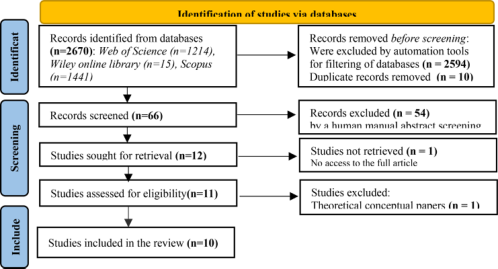
The initial search yielded 2,670 articles across three databases (see Figure 1).
Figure 1: Study selection procedure.
112 Valantiejien˙e and Girdauskien˙e
Applying the predefined filtering criteria reduced the count to 66. Next, duplicate records were removed, followed by a manual review of titles, abstracts, and keywords based on the same criteria. The majority of articles were excluded in this step because the subject area was out of business and management. Also, a lot of the articles were in the field of education, examining student groups/teams in a gamified learning environment. In the fourth step, the full text was manually reviewed, with one article excluded due to inaccessible sources. In the last step, one article was removed for being a theoretical paper without empirical results. Ultimately, 10 articles from 2015 to 2024 were selected for the final review.
DISCUSSION
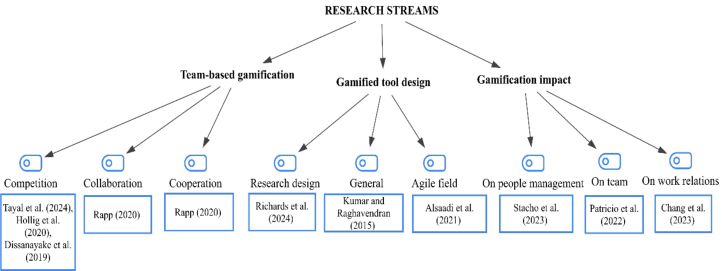
The first step in understanding gaps was to identify the main streams of research in existing studies. A systematic literature review has shown that gamification research on the application of gamification in the context of teams in HRM can be divided into three groups based on the objectives pursued concerning gamification (see Figure 2).
Figure 2: Research streams.
Team-based gamification stream is focused on activities in team or social-related affordances. Tayal et al. (2024) found that team competition encourages productivity and individual collaboration. Holling et al. (2020) showed that team-based leaderboards enhance progress tracking and system usage. Dissanayake et al. (2019) found that competitive reward structures (top rankings, winning targets, performance comparison) enhance team effort and performance. Rapp (2020) identified collaboration and cooperation strategies that can inspire the creation of novel virtual organisations, enhancing motivation, collaboration, and engagement. To sum up, this stream helps to understand how to design gamification that encourages collaboration, cooperation and competition within teams, balancing individual contributions and collective performance.
Gamified tool design stream is focused on analysing a specific gamified tool or gamifying the research design. Richards et al. (2024) applied an escape room as a gamified environment to study how generational diversity
Gamification Impact on Agile Team Motivation: Theoretical Framework 113
impacts team performance. Kumar and Raghavendran (2015) revealed that a gamified contest creates a teaming opportunity that strengthens organisational culture. Alsaadi et al. (2021) applied gamification to a Scrum Poker Estimator tool to increase the accuracy of story point estimation. The gamified tool design stream offers practical examples and methodologies and highlights how gamified tools can address real-world problems.
The gamification impact research stream focuses on impact research on various team-related aspects and team-relevant issues. The results showed that gamification impact team motivation by fostering engagement and participation, alleviating stress, encouraging teamwork, and inspiring innovative thinking, overcoming collaboration issues and creating a more engaging and rewarding work environment (Patricio et al., 2022). Moreover, digital gifts as a gamification practice in the work environment are positively related to the employee’s relationship with the team regarding prosocial motivation, team satisfaction and team cohesion (Chang et al., 2023). Stacho et al. (2023) findings confirm that gamification is appropriate and useful in the Agile context as it aligns with agile principles of collaboration, communication, and adaptability by leveraging digital tools that enhance team cohesion and streamline processes. All in all, this research stream focuses on the broader impact of gamification and provides evidence-based insights into the outcomes of gamification.
This analysis has led to the identification of several possible research gaps. Firstly, gamification’s effect on teams at the team-level is unclear. Existing research has focused on social-related affordances, partly on achievement- related affordances, or gamification design, which focuses on team behaviour. However, little is known about how different gamification affordances influence the team processes and emergent states. Next, it is not clear how gamification affects the specific context of an Agile team, although gamification is known to be context-dependent. Chang et al. (2023) found that various contextual factors influence its impact. Thirdly, there is a lack of empirical studies on gamification’s impact on Agile team motivation. While research in other fields suggests gamification benefits Agile teams by enhancing motivation (Marques et al., 2020; Nivedhitha, 2023), studies specifically exploring its role in Agile teams within HRM remain scarce. Lastly, there is limited research on the negative effects of gamification in Agile teams. The analysis reveals that most of the studies reviewed have focused on the positive effects of gamification but the effects can be negative or gamification can have unexpected consequences in the work environment (Ikhide et al., 2022), or even lead to stress (Bizzi, 2023), anxiety and depression, and reduced well-being (Hammedi et al., 2021). This insight is in line with Riar et al. (2022), who argue that most studies seek to demonstrate the effectiveness of gamification in collaborative and collective settings, although it is still relevant to investigate the potential negative psychological and behavioural outcomes of gamification.
Evidence that gamification increases social dynamics through cooperation, collaboration and competition (Hammedi et al., 2017), shapes the social structures, organisational culture and communities (Rapp, 2018; Spanellis
114 Valantiejien˙e and Girdauskien˙e
and Pyrko, 2020) showed that gamification effect can extend to the team- level. In gamification research We-intention theory are used to explain collective action and cooperation in teams (Morschheuser et al., 2017; Riar et al., 2023). This theory explains how collective intentions are formed and considers the role of mutual knowledge and mutual belief among the team (Tuomela, 2005). Furthermore, this theoretical lens allows scientists to research how cooperation can be fostered through collective psychological outcomes, group norms or social identity (Riar et al., 2022). This theory offers a new theoretical lens for studying gamification in HRM, emphasizing collective intentions and shared needs.
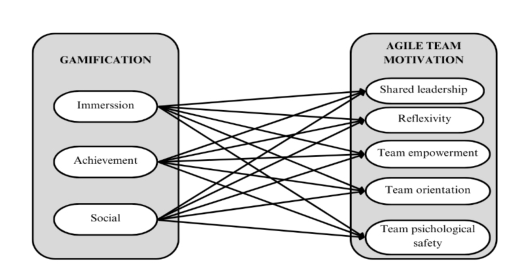
Based on gamification affordances (Koivisto and Hamari, 2019), the identified agile team collective needs (Imam and Zaheer, 2021; Alami et al., 2023) and We- intention theoretical lens, a research framework that explains how gamification impacts Agile team motivation, are presented (see Figure 3).
Figure 3: Research framework.
Cardador et al. (2017) argued that gamification in the workplace, in addition to making tasks more enjoyable, affects motivation and performance by increasing the visibility of performance information, providing easier comparability, and providing more timely presentation. In this respect, gamification can contribute to a stronger sense of common purpose and to the accountability and cooperation that refers to shared leadership. However, it is not known what effect gamification has on team autonomy, although it has a positive effect on individual autonomy, which may have consequences for shared leadership. Moreover, feedback is information that is provided in the context of the agile team and is integral to collaboration (Handke et al., 2021). If gamification provides positive feedback for collaborative behaviour and rewards individual employees for engaging when collaboration increases (Nivedhitha, 2023). Also, feedback helps the team to identify differences between the current and desired situation (Handke et al., 2021). Furthermore, timely rewards are the form of feedback that is important for engagement (Hamza and Tóvölgyi, 2022), which can reinforce the prioritization of team goals, engagement in team activities, and fostering a collective “we”
Gamification Impact on Agile Team Motivation: Theoretical Framework 115
perspective. In this regard, gamification can enhance team reflexivity. In addition, monitoring, rules and control can be seen as management control form implemented in various forms of gamification affordances that can impact team empowerment both in negative or positive way (Norlander et al., 2021). Besides, reinforcing a shared sense of purpose and team identity can strengthen team orientation by allowing members to feel part of a cohesive group (Imam and Zaheer, 2021). This can be achieved by strengthening cooperation and collaboration or even inter-team competition. Additionally, gamification can increase psychological safety in an Agile team by allowing team members to freely express ideas and experiment without fear of being criticised. In addition, social-related affordances can help to build trust, open communication and a supportive culture. Having a clear and transparent goals can help team feel trust and admit mistakes that enhances team psychological safety. However, Agile teams are characterised by horizontal social control, and increasing peer pressure can undermine individual intrinsic motivation (Khanagha et al., 2022) or increase pressure, stress or overload. Despite the possible positive effects, the potential conflicting linkages suggest the need for more empirical comprehensive research on the impact of gamification on Agile team motivation, as identified by Marques et al. (2020).
CONCLUSION
The systematic literature review was applied to research the impact of gamification on Agile team motivation. The results revealed that gamification impact on Agile team motivation has not been researched enough and there is a demand for a new structured theoretical framework. The result of the research has been one such theoretical framework showing the linkages between gamification affordances and Agile team shared needs. This shows the potential gamification impact on Agile team motivation. Also, this study contributes to the gamification research in HRM field by applying We- Intention theory as a new theoretical lens. The result indicated that despite increasing shared leadership, reflexivity, empowerment, team orientation, and psychological safety, gamification may also increase peer pressure, stress, and social overload. Future empirical research is needed to evaluate the positive and negative impact of gamification on Agile team motivation to improve its implementation and strengthen its usefulness. Furthermore, this study sheds light on gamification potential to foster Agile team motivation for practitioners while also recognizing its potential challenges such as peer pressure and stress.
REFERENCES
Alami, A., Zahedi, M., & Krancher, O. (2023). Antecedents of psychological safety in agile software development teams. Information and Software Technology, 162, 107267. Alsaadi, B., Alsaadi, B., Alfhaid, M., Alghamdi, A., Almuallim, N., & Fakieh, B.
(2021). Scrum Poker Estimator: A Planning Poker Tool for Accurate Story Point Estimation. International Journal of Computer Information Systems and Industrial Management Applications, 13, 12–12.
116 Valantiejien˙e and Girdauskien˙e
Behl, A., Pereira, V., Sindhwani, R., Bhardwaj, S., Papa, A., & Hassan, Y. (2022).
Improving Inclusivity of Digitalization for Employees in Emerging Countries Using Gamification. IEEE Transactions on Engineering Management. https:// doi.org/10.1109/TEM.2022.3216553 Benitez, J., Ruiz, L., & Popovic, A. (2022). Impact of mobile technology-enabled HR gamification on employee performance: An empirical investigation. https:// doi.org/10.1016/j.im.2022.103647 Bizzi, L. (2023). Why to gamify performance management? Consequences of user
engagement in gamification. Information & Management, 60, 103762. https:// doi.org/10.1016/j.im.2023.103762 Cardador, M. T., Northcraft, G. B., & Whicker, J. (2017). A theory of work gamification: Something old, something new, something borrowed, something cool?. Human Resource Management Review, 27(2), 353–365. Chang, C., Fang, E., Suseno, Y., & Hudik, M. (2023). Digital Gifts at the
Workplace: An Exploratory Study on the Impact of E-Hongbao. Journal of Global Information Management, 31(1). Chen, G., & Kanfer, R. (2024). The Future of Motivation in and of Teams. Annual Review of Organizational Psychology and Organizational Behavior, 11(1), 93–112. Dissanayake, I., Mehta, N., Palvia, P., Taras, V., & Amoako-Gyampah, K. (2019).
Competition matters! Self-efficacy, effort, and performance in crowdsourcing teams. Information & management, 56(8), 103158. Hammedi, W., Leclerq, T., & van Riel, A. C. R. (2017). The use of gamification mechanics to increase employee and user engagement in participative healthcare services: A study of two cases. Journal of Service Management, 28(4), 640–661. https://doi.org/10.1108/JOSM-04-2016-0116 Hamza, I., & Tóvölgyi, S. (2022). Empirical analysis of the influence of gamification
on employees ‘behaviour. Dynamic Relationships Management Journal, 11(2), 71–78. Heidt, L., Gauger, F., & Pfnür, A. (2023). Work from Home Success: Agile work characteristics and the Mediating Effect of supportive HRM. Review of Managerial Science, 17(6), 2139–2164. Herranz, E., Guzmán, J. G., de Amescua-Seco, A., & Larrucea, X. (2018).
Gamification for software process improvement: a practical approach. https:// doi.org/10.1049/iet-sen.2018.5120 Ikhide, J. E., Timur, A. T., & Ogunmokun, O. A. (2022). The potential and constraint of work gamification for employees’ creative performance. Service Industries Journal, 42(5–6), 360–382. https://doi.org/10.1080/02642069.2022.2045278 Imam, H., & Zaheer, M. K. (2021). Shared leadership and project success: The roles
of knowledge sharing, cohesion and trust in the team. International journal of project management, 39(5), 463–473. Junker, T. L., Bakker, A. B., & Derks, D. (2024). Toward a theory of team resource mobilization: A systematic review and model of sustained agile team effectiveness. Human Resource Management Review, 101043. Käosaar, A., Marques-Quinteiro, P., & Burke, S. (2022). Fantastic teams and where
to find them: Understanding team processes in space and analog environments through the IMOI framework. Team Performance Management: An International Journal, 28(3/4), 109–124. Khanagha, S., Volberda, H. W., Alexiou, A., & Annosi, M. C. (2022). Mitigating the dark side of agile teams: Peer pressure, leaders’ control, and the innovative output of agile teams. Journal of Product Innovation Management, 39(3), 334–350.
Gamification Impact on Agile Team Motivation: Theoretical Framework 117
Koivisto, J., & Hamari, J. (2019). The rise of motivational information systems: A review of gamification research. International journal of information management, 45, 191–210. Kumar, H., & Raghavendran, S. (2015). Gamification, the finer art: Fostering creativity and employee engagement. Journal of Business Strategy, 36(6), 3–12. Marques, R., Costa, G., Mira da Silva, M., Gonçalves, D., & Gonçalves, P. (2020).
A gamification solution for improving Scrum adoption. Empirical Software Engineering, 25(4), 2583–2629. Morschheuser, B., & Hamari, J. (2018). The gamification of work: Lessons from crowdsourcing. Journal of Management Inquiry, 1056492618790921. Nivedhitha (2023). Key in socially driven game dynamics, open the doors of
agility-an empirical study on gamification and employee agility. Behaviour & Information Technology, 42(11), 1659–1685. Norlander, P., Jukic, N., Varma, A., & Nestorov, S. (2023). The effects of technological supervision on gig workers: Organizational control and motivation of Uber, taxi, and limousine drivers. In Technologically Mediated Human Resource Management (pp. 59–83). Routledge. Park, G., Spitzmuller, M., & DeShon, R. P. (2013). Advancing our understanding of
team motivation: Integrating conceptual approaches and content areas. Journal of Management, 39(5), 1339–1379. Patricio, R., Moreira, A. C., & Zurlo, F. (2022). Gamification in innovation teams.
International Journal of Innovation Studies, 6(3), 156–168. Rapp, Amon. “An exploration of world of Warcraft for the gamification of virtual organizations.” Electronic Commerce Research and Applications 42 (2020): 100985. Riar, M., Morschheuser, B., Zarnekow, R., & Hamari, J. (2022). Gamification
of cooperation: A framework, literature review and future research agenda. International Journal of Information Management, 67, 102549. Richards, M. B., Becker, K. L., & Stollings-Holder, J. (2024). Escaping generational conflict: using gamification to examine intergenerational communication & problem-solving. Review of Managerial Science, 18(6), 1597–1616. Silic, M., Marzi, G., Caputo, A., & Bal, P. M. (2020). The effects of a gamified
human resource management system on job satisfaction and engagement. Human Resource Management Journal, 30(2), 260–277. Stacho, Z., Krynke, M., Vadkertiova, A., Hamar, M., & Heged˝us, E. (2023). The impact of financial performance of companies on the extent of digitalization implementation in HRM. Polish Journal of Management Studies, 28(2), 289–304. Tayal, S., & Rajagopal, K. (2024). Gamification with Codeathon for Productivity
Toward Sustainable Development Goal 8–Decent Work and Economic Growth. Brazilian Journal of Operations & Production Management, 21(4), 2089–2089. Tuomela, R. (2005). We-intentions revisited. Philosophical Studies, 125, 327–369. Waizenegger, L., McKenna, B., Cai, W., & Bendz, T. (2020). An affordance perspective of team collaboration and enforced working from home during COVID-19. European Journal of Information Systems, 29(4), 429–442. https:// doi.org/10.1080/0960085X.2020.1800417 Wibisono, G., Setiawan, Y., Aprianda, B., & Cendana, W. (2023). Understanding the
effects of gamification on work engagement: The role of basic need satisfaction and enjoyment among millennials. Cogent Business & Management, 10(3), 2287586. https://doi.org/10.1080/23311975.2023.2287586 Xi, N., & Hamari, J. (2019). Does gamification satisfy needs? A study on the relationship between gamification features and intrinsic need satisfaction. International Journal of Information Management, 46, 210–221.
LISTED IN THE AHFE DIGITAL BOOKSTORE CATALOGUE
Explore the complete digital volume
Human Factors and Wearable Technologies
Read this individual research paper free through the original publisher, or explore the full digital proceedings book.
ISBN 978-1-964867-51-9
Explore this ISBN in the AHFE Bookstore ↗Listed in the July 2026 bookstore catalogue; search by ISBN to confirm current availability · Digital book purchase optional