Živilė Stankevičiūtė, Asta Savanevičienė, Lina Girdauskiene (2023). Transformational versus transactional leadership styles in ensuring wellbeing of STEM workers. In: Human Factors in Management and Leadership. AHFE Open Access, vol. 92, pp. 55–64. https://doi.org/10.54941/ahfe1003734
Work environment is characterized as unstable and unpredictable. Accordingly, employees need to adapt to and cope with radical changes occurring in the work and social environment. Based on previous literature, leaders may play a central role in helping employees to deal with complexity and to respond to various pressures. Although the previous studies have broadly discussed the appropriateness of using different leadership styles for organizational and employee effectiveness, nonetheless the domain of employee well-being tackling it from the SCARF model perspective remains somewhat neglected. Moreover, although the number of employees working in STEM (science, technology, engineering, and math) jobs is growing, there is still a gap in analyzing STEM workers’ well-being and the factors influencing it. The aim of the paper is to reveal the impact of the transactional and transformational leadership styles on employee well-being in terms of the way the status, certainty, autonomy, relatedness, and fairness perceived by STEM workers could be enhanced or reduced by leaders. With this in mind, interviews were conducted with STEM workers. The core findings revealed the duality of both leadership styles, where both styles served as antecedents for enhancing or reducing employee well-being. The paper calls for rethinking the leadership style while striving for STEM workers’ and organizational sustainability.
In the last couple of years, organizations have been facing increasing uncer- tainty as they navigate today’s “grand challenges” (Carnevale and Hatak, 2020), which are diverse and involve a range of complex issues such as the COVID-19 pandemic, technological innovations, economic crises, and political instability. Facing these problems may be very complicated for orga- nizations, especially admitting that changes in work setting might generate harmful consequences for employees (Salas-Vallina et al., 2021). In this sce- nario, leaders play a central role in helping employees to respond to a variety of pressures (Vignoli et al., 2018), seeing that leadership behavior, which is defined as a set of behaviors used by the leaders to influence followers
(Vignoli et al., 2018), has important implications for individual, team, and organizational performance (Ceri-Booms et al., 2017). Although the previ- ous studies have provided some initial evidence that leadership style acts as an antecedent for employee well-being (Arnold et al., 2007; Vignoli et al., 2018), some questions remain unanswered. Accordingly, the paper tries to narrow several gaps.
Drawing upon earlier studies (Koeslag-Kreunen et al., 2018), the paper focuses on two types of leadership styles, namely transformational and transactional. Such attributes as charisma, inspirational stimulation, and individualized concern have been mainly linked to transformational leader- ship (Alrowwad et al., 2020). Meanwhile, transactional leadership “takes into account the context that is agreed, accepted, or adhered by follo- wers for the sake of praise, rewards, and resources or the avoidance of disciplinary actions” (Alrowwad et al., 2020, p. 197). The paper seeks to reveal how these two styles might support employees, in particular those in science, technology, engineering, and mathematics (STEM) pro- fessions. Turning the attention to STEM workers, the paper supports the notion that STEM workers are the core pillars of national economies (Waite and McDonald, 2019).
Generally, employee well-being refers to the overall quality of an emplo- yee’s experience and functioning at work (Grant et al., 2007). Relying on this definition, the current paper perceives employee well-being through the lenses of SCARF model (Rock and Cox, 2012). The SCARF model in neu- roscience research offers a framework that can be applied to identifying social threats and rewards (Hansen et al., 2022). The paper argues the five domains of SCARF model, namely Status, Certainty, Autonomy, Relatedness and Fairness (Rock and Cox, 2012) activates threats and rewards in the brain of employees while leading to better or worse quality of functioning at work (Grant et al. 2007; Lovery, 2019). Thus, the paper analyzes how SCARF domains experienced by employees are positively or negatively influenced by leaders.
The aim of the paper is to reveal the impact of transactional and transfor- mational leadership styles on employee well-being in terms of the way status, certainty, autonomy, relatedness, and fairness perceived by STEM workers could be enhanced or reduced by leaders.
The paper contributes to the scientific literature in several ways. First, the paper responds to the call of Avolio et al. (2009) while implementing a more follower-centric approach in looking at the well-being of employees (follow- ers). Second, the paper deals with a specific set of employees, namely STEM workers. Third, in order to better understand the impact of what leaders do in terms of enhancing or damaging employee well-being, SCARF models is employed.
The remainder of the paper is structured as follows. The theoretical part describes leadership styles and SCARF domains. Then, the research method applied is described. The empirical results come next. Finally, conclusions are drawn.
Transformational Versus Transactional Leadership Styles 57
THEORETICAL BACKGROUND: LEADERSHIP STYLES AND SCARF MODEL The core message supported by scholars and practitioners is explicit: good leadership brings success to an organization (Passakonjaras and Hartijasti, 2020) and can assist organizations in increasing their competitiveness (Alro- wwad et al., 2020). Leadership refers to the personal and interpersonal dynamics of how individuals influence each other when moving toward organizational goals (Northouse, 2015). Among the styles of leadership high- lighted in the literature (Ceri-Booms et al., 2017; Hansen and Pihl-Thingvad, 2019; Jensen et al., 2019), transformational and transactional leadership sty- les are considered to be the most popular and influential (Vignoli et al., 2018). Further, these two styles are briefly explained.
According to Avolio et al. (2009), transformational leadership can be defined as “leader behaviors that transform and inspire followers to per- form beyond expectations while transcending self-interest for the good of the organization” (p. 423). Transformational leaders are charismatic, chal- lenge employees to break the status quo and seek alternatives, consider individual concerns, and set a compelling vision and purpose (Bass and Avolio, 1994; Koeslag-Kreunen et al., 2018). Such leaders are able to inspire their subordinates to the extent that they perform beyond expe- ctations (Abbas and Ali, 2020). Transformational leadership is seen as empowerment-based leadership, where power emanates from the followers, albeit not quite bottom-up but it is shared (Passakonjaras and Hartijasti, 2020). Summing up, transformational leadership reflects person-focused behavior (Burke et al., 2006) which is about encouraging communication, supporting self-management, and challenging employees to move beyond their self-interest (Koeslag-Kreunen et al., 2018).
Transactional leaders are “those who focus on the motivation of follo- wers through rewards or discipline, clarifying for their followers the kinds of rewards that should be expected for various behaviors” (Goodwin et al., 2001, p. 759). Transactional leadership behaviors are built on dyadic exch- anges whereby the leader provides praise, rewards, or withholds punishment from a subordinate who complies with role expectations (Burke et al., 2006). Transactional leadership is seen as power-based leadership, where power is strongly associated with the leader and is top-down (Passakonjaras and Hartijasti, 2020). Summing up, transactional leadership is considered as task- focused behavior, which emphasizes the task by providing task information, structuring the task, and monitoring team performance (Burke et al., 2006).
Despite the differences, the main claim of both styles is that leaders’ patterns of behaviors or behavioral tendencies influence the followers’ per- formance and well-being (Vignoli et al., 2018).
SCARF model originated in neuroscience leadership research over the past decade (Rock, 2008). From organizational perspective, the SCARF model improves employees’ capacity to understand and accordingly to modify their own and other employees’ behaviors in different social situations in work setting (Rock and Cox, 2012). The SCARF model encompasses five domains. Status is one of the five domains and refers to one’s sense of importance
58 Stankeviˇci ¯ut˙e et al.
relative to others. Certainty is about one’s need for clarity and the ability to make accurate predictions about the future. Autonomy implies a sense of control over the particular events in one’s life and the perception that one’s behavior has an effect on the outcome of a particular situation. Relatedness is about one’s sense of connection to and security with another person. Finally, fairness refers to just and non-biased exchange between employees (Rock and Cox, 2012).
METHODOLOGY
A qualitative research method was applied in this research. In doing this, the qualitative data were collected from Lithuanian organizations using semi-structured interviews with 30 STEM workers. The information with invitation to take part in the research was sent to organizations and their human resource managers via emails obtained from public available data on internet. The interview questions covered the five domains of the SCARF model in terms of the possible impact of leaders on the perception of a parti- cular domain by STEM workers. The interviews lasted from 40 to 55 minutes. All interviews were conducted in the Lithuanian language, recorded and later transcribed. The study included both male (22) and female (8) respondents.
RESULTS
As the length of the paper is limited, only the core findings are provided and explained. Before presenting the findings for each domain of SCARF, the core general empirical insight has to be underlined: some behaviors of leaders can have a dual impact on employee well-being. Where the behavior was balanced and helped followers to achieve their goal effecti- vely or facilitated it, or offered followers the necessary support to attain both their own and organizational goals (Cho et al., 2018), it was trea- ted as having positive impact on the particular domain of SCARF model. In the opposite case, where the leader demonstrated behavior that was not balanced and was perceived by STEM workers as non-preferred behavior (Cho et al. 2018), it was considered as negatively affecting the respective SCARF domain and employee well-being. Indeed, the leadership behavior and style are significant in both the employees’ well-being success and failure (Alrowwad et al., 2020).
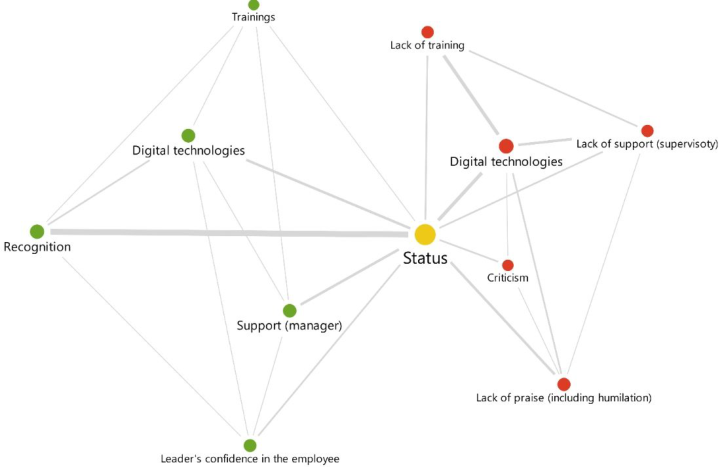
As it is seen from Figure 1, STEM workers reported several leaders’ behaviors, which enhanced or decreased the employee status (Figure 1).
Turning to the positive aspects (Figure 1), leader’s confidence in the emplo- yee was revealed: “I feel that the manager himself shares information with me. It somehow makes me feel important” (R. 22). Further, training toge- ther with confidence in employee were pointed: “In my past workplace, a new logistics program was implemented. Some people were very unhappy, <…> some even quit their jobs. I learned the new program very quickly, the manager praised me for it. I think I looked like the best trainee in his eyes, he even sometimes asked me how to do this or that function” (R. 5).
Transformational Versus Transactional Leadership Styles 59
Figure 1: Leaders’ behavior in relation to status perceived by employees (in all figures, green colour indicates positive impact, red colour indicates negative impact).
Moreover, training and recognition were mentioned: “At my work, the pro- duction process changed, so I had to learn new things, but I learned them quickly. So, I received praise from the manager. Now I distribute tasks to others, I receive a higher salary. I think I have a good status as an emplo- yee” (R. 7). Turning to the negative side of leader behavior, the lack of training and fear to approach the manager were reported by STEM wor- kers: “I was afraid to ask my old manager why no one trained me” (R23). Further, difficulties while using digital technologies and receiving no support were introduced: “When I started working at the company, I had a problem understanding the scanning system. <…> the manager was angry that I didn’t know how to use it <…>. I thought about quitting the job. <…> but after a while I got used to the system. The manager also changed, he was also new, so we were learning together. It was much easier with the new leader, and I am doing great with my work now” (R. 24). Based on the findings (for instance, praise of employees), it could be concluded that transactional lea- dership style tends to enhance STEM workers’ status and accordingly their well-being.
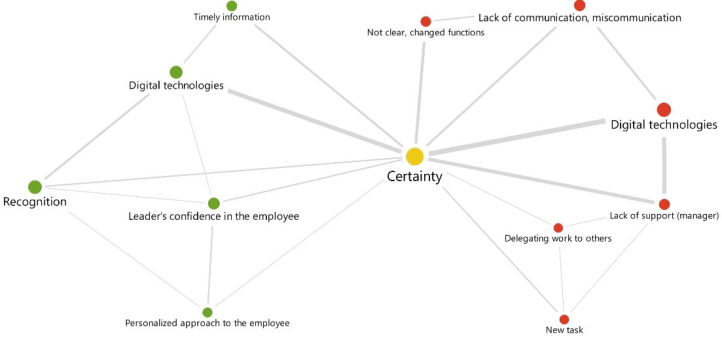
As it is seen from Figure 2, STEM workers reported several leaders’ behaviors, which enhanced or decreased the employee certainty (Figure 2).
Clear communication as a part of transformational leadership was menti- oned as increasing certainty: “The leader’s personal statement that salary will rise and the company will continue its activities and will not move to a less costly country reinforced the feeling of certainty” (R. 2). From transactional leadership perspective, provision of information about tasks was mentioned:
60 Stankeviˇci ¯ut˙e et al.
Figure 2: Leaders’ behavior in relation to certainty perceived by employees.
“Work security is strengthened by activity plans, which provide information for what needs to be done and when (R. 15).
Turning to behaviors which were found to act as reducing the STEM wor- kers’ certainty, unclarity of organizational structure and tasks were identified based on the workers’ statements “reorganization was carried out, depar- tments were changed/merged <…>. After the change of responsibilities, chaos partially prevailed, nobody knew who was responsible for what and where to turn with relevant questions, so it was sometimes very difficult to find answ- ers to everyday questions” (R. 4). The lack of inspiration from the leader was mentioned too: “When the organizational structure changed, the internal emotional atmosphere at work deteriorated, people working in the depar- tment became distant from each other, became more passive, less involved in daily activities, unwilling to cooperate, which made it difficult to perform certain tasks” (R. 4). Finally, the lack of “respect of the managers and their communication reduce my confidence in how long I will be working here” (R. 17). The findings let to conclude that both leadership styles (transformati- onal and transactional) were revealed as antecedents to enhanced or reduced certainty of STEM workers.
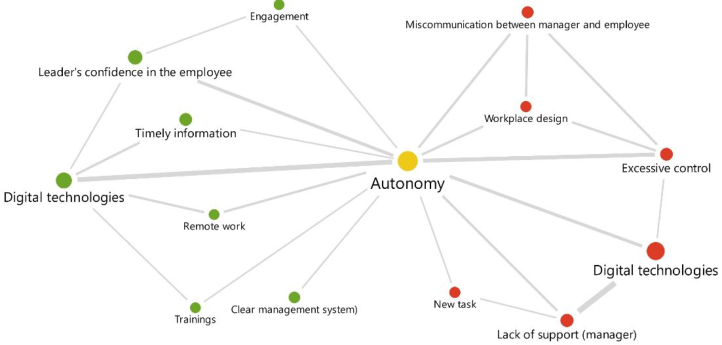
Figure 3 shows leader’s behaviors aimed at influencing STEM workers’ autonomy. Possibility to make decisions regarding work schedule or place was reported: “As digital technologies are so advanced, leaders think that I can safely work from anywhere in the world” (R. 2) or “as for our department, we are not restricted by working hours. As the administration members say: “you may not show up at work, the most important thing is the result you will show at the end of the month” (R. 11). Regarding tran- sformation leadership, one of the informants mentioned that “Leaders allow employees to reveal themselves, they accept their initiatives. The freedom provided gives them new opportunities to create and then it becomes obvious that very cool things are happening with that employee”(R. 13). Nonetheless, excessive control and lack of trust in employees were found to be reducing autonomy, as: “the company secretly installed tracking systems in ours cars.
Transformational Versus Transactional Leadership Styles 61
Figure 3: Leaders’ behavior in relation to autonomy perceived by employees.
The actual reduction in fuel consumption was only a few percent, however people felt very hurt that they were not trusted, that they were being fol- lowed” (R. 9). The lack of support seems to be a part of culture in some organizations, as: “I don’t get much support from the manager while making important decisions myself” (R. 3). Thus, in the case of autonomy, the situa- tion is more or less similar to the case of certainty: both leadership styles act as antecedents to higher or lower levels of autonomy.
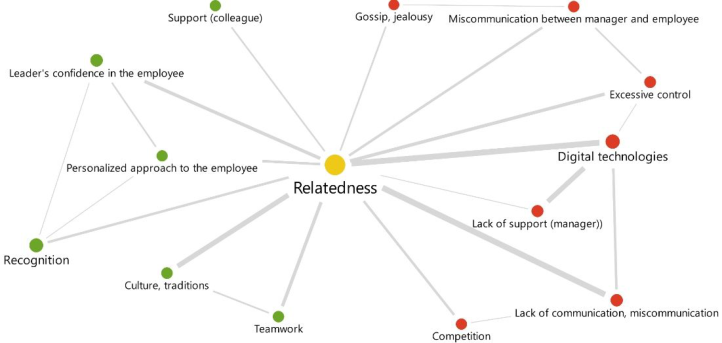
Turning to the fourth domain of SCARF model – relatedness, Figure 4 presents the core findings. Here, active role of leaders as team creators was mentioned. Informant R. 2 explained that “various events and fun team pro- jects improve relationships. For example, kayaking together and going on a trip helped to get to know colleagues in completely different situations. It strengthened the relationships” or, as informant R. 19 said, “we celebrate small victories in the team, after which there is a feeling of fellowship and sup- port”. However, the promotion of competition and failure to prevent rumors were observed in the responses as well: “well, that’s the thing, that you really don’t know what exactly was said and by whom” (R. 17). As such, tran- sformational leadership style was more often indicated as encouraging or hindering STEM workers’ relatedness.
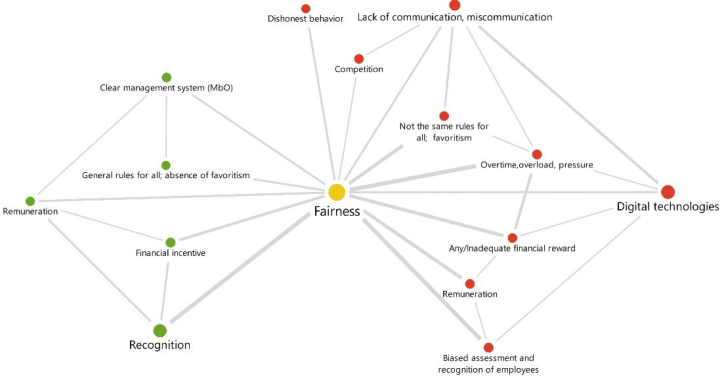
Finally, looking at the last domain on SCARF, it was seen that fairness is ‘the hot topic’ among STEM workers (Figure 5).
Clear communication and personalized approach inherent to transforma- tional leadership were uncovered: “I know that I am getting a salary that matches my functions and competences. My salary is reasonable. <…> My leader explained, clarified it to me and each employee” (R. 2) or “There are weekly meetings and monthly meetings <…> all meetings are announced, recorded, and discussions and decisions are made public” (R. 11). As regards the negative aspects, unfairness in work design was mentioned, as: “During the installation of the new application, functions in that were allocated incor- rectly. The IT manager partially gave the development of this project to IT trainees who did not know much” (R. 5). At the end, the fairness of salary
62 Stankeviˇci ¯ut˙e et al.
Figure 4: Leaders’ behavior in relation to relatedness perceived by employees.Figure 5: Leaders’ behavior in relation to fairness perceived by employees.
determination and the role played by leader in this process were discussed by the majority of informants. Moreover, the questions of procedures were raised. Summing up, both leadership styles were revealed as antecedents for the perception of fairness.
CONCLUSION
The aim of the paper was to reveal the impact of transactional and transfor- mational leadership styles on employee well-being in terms of the way status, certainty, autonomy, relatedness, and fairness perceived by STEM workers can be enhanced or reduced by leaders. The literature review allows sta- ting that the importance of leadership for directing, driving, and developing sustainable organizations is acknowledged by researchers and practitioners
Transformational Versus Transactional Leadership Styles 63
alike. Empirical findings provided support for the duality phenomenon impl- ying that both leadership styles, transactional as well as transformational, might increase or lower the levels of perception of status, certainty, autonomy, relatedness, and fairness while leading to enhanced or reduced well-being of STEM workers.
The paper has several limitations. The first concern is related to the sample size, which the possibility to draw generalized conclusions. Thus, future stu- dies should address this aspect. The second concern deals with the profile of the informants. The interviews were conducted only with STEM workers, not including leaders. As such, the perspective of leaders was missing. The new studies could incorporate both perspectives (leaders and followers). The third concern refers to the comparative nature of the study. In order to gain a bro- ader picture, a study with two groups, namely STEM workers and workers from other setting, could be conducted.
The paper has several practical implications. First, the paper calls the lea- ders to rethink their behaviors and accordingly their leadership style while seeking for employee well-being as “preferred leadership behaviors have posi- tive influences on subordinates’ motivation, commitment, satisfaction, and performance” (Cho et al., 2019, p. 3). Second, the organizations are encou- raged to establish clear procedures, structures, and systems for supporting leaders and accordingly STEM employees in organizing their work to under- stand the “rules of game” while striving for employee and organizational sustainability.
ACKNOWLEDGMENT
This project has received funding from the Research Council of Lithuania (LMTLT), agreement No. [S-MIP-22-28].
REFERENCES
Alrowwad, A. A., Abualoush, S. H., & Masa’deh, R. E. (2020). Innovation and intellectual capital as intermediary variables among transformational leadership, tran- sactional leadership, and organizational performance. Journal of Management Development, 39(2), 196–222. https://doi.org/10.1108/JMD-02-2019-0062. Arnold, K. A., Turner, N., Barling, J., Kelloway, E. K. and McKee, M. C. (2007),
“Transformational well-being: the mediating role of meaningful work”, Journal of Occupational Health Psychology, Vol. 12 No. 3, pp. 193–203, doi: 10.1037/1076- 8998.12.3.193. Avolio, B. J., Walumbwa, F. O., & Weber, T. J. (2009). Leadership: Current theories, research, and future directions. Annual review of psychology, 60, 421–449. Bass, B., & Avolio, B. J. (1994). Improving organizational effectiveness through
transformational leadership. Thousand Oaks, CA: Sage. Burke, C. S., Stagl, K. C., Klein, C., Goodwin, G. F., Salas, E., & Halpin, S. M. (2006).
What type of leadership behaviors are functional in teams? A meta-analysis. Leadership Quarterly, 17, 288–307. doi:10.1016/j.leaqua.2006.02.007. Carnevale, J. B., & Hatak, I. (2020). Employee adjustment and well-being in the era of COVID-19: Implications for human resource management. Journal of business research, 116, 183–187. https://doi.org/10.1016/j.jbusres.2020.05.037.
64 Stankeviˇci ¯ut˙e et al.
Ceri-Booms, M., Cur¸seu, P. L., & Oerlemans, L. A. (2017). Task and person-focused leadership behaviors and team performance: A meta-analysis. Human Resource Management Review, 27(1), 178–192. Cho, Y., Shin, M., Billing, T. K., & Bhagat, R. S. (2019). Transformational leader-
ship, transactional leadership, and affective organizational commitment: a closer look at their relationships in two distinct national contexts. Asian Business & Management, 18, 187–210. https://doi.org/10.1057/s41291-019-00059-1. Goodwin, V. L., Wofford, J. C., & Whittington, J. L. (2001). A theoretical and empirical extension to the transformational leadership construct. Journal of Orga- nizational Behavior: The International Journal of Industrial, Occupational and Organizational Psychology and Behavior, 22(7), 759–774. Grant, A. M., Christianson, M. K., & Price, R. H. (2007). Happiness, health, or rela-
tionships? Managerial practices and employee well-being tradeoffs. Academy of management perspectives, 21(3), 51–63. https://www.jstor.org/stable/27747391. Hansen, J. A., & Pihl-Thingvad, S. (2019). Managing employee innovative behaviour through transformational and transactional leadership styles. Public Management Review, 21(6), 918–944. DOI: 10.1080/14719037.2018.1544272. Hansen, J. M., Hansen, J. W., & Madsen, S. R. (2022). Improving how we lead and
manage in business marketing during and after a market crisis: the importance of perceived status, certainty, autonomy, relatedness and fairness. Journal of Busi- ness & Industrial Marketing, (ahead-of-print). https://doi.org/10.1108/JBIM-01- 2021-0073. Jensen, U. T., Andersen, L. B., Bro, L. L., Bøllingtoft, A., Eriksen, T. L. M., Holten, A. L.,... & Würtz, A. (2019). Conceptualizing and measuring transfor- mational and transactional leadership. Administration & Society, 51(1), 3–33. DOI: 10.1177/00953997166671. Koeslag-Kreunen, M., Van den Bossche, P., Hoven, M., Van der Klink, M., & Gijse-
laers, W. (2018). When leadership powers team learning: A meta-analysis. Small group research, 49(4), 475–513. Lowery, K. (2019), “Educators’ perceptions of the value of coach mindset development for their well-being”, International Journal of Mentoring and Coaching in Education, Vol. 8 No. 4, pp. 310–324. https://doi.org/10.1108/IJMCE-02-2019- 0032. Northouse, P. G. (2015). Leadership: Theory and practice. London: Sage publications. Passakonjaras, S., & Hartijasti, Y. (2020). Transactional and transformational lea-
dership: a study of Indonesian managers. Management Research Review, 43(6), 645–667. DOI: 10.1108/MRR-07-2019-0318. Rock, D. (2008). SCARF: A brain-based model for collaborating with and influencing others. NeuroLeadership journal, 1(1), 44–52. Rock, D., & Cox, C. (2012). SCARF in 2012: Updating the social neuroscience of
collaborating with others. NeuroLeadership journal, 4(4), 1–16. Salas-Vallina, A., Alegre, J., & López-Cabrales, Á. (2021). The challenge of increasing employees’ well-being and performance: How human resource management practices and engaging leadership work together toward reaching this goal. Human Resource Management, 60(3), 333–347. Doi: 10.1002/hrm.22021. Vignoli, M., Depolo, M., Cifuentes, M., & Punnett, L. (2018). Disagreements on
leadership styles between supervisors and employees are related to employees’ well-being and work team outcomes. International Journal of Workplace Health Management. https://doi.org/10.1108/IJWHM-11-2016-0084. Waite, A. M., & McDonald, K. S. (2019). Exploring challenges and solutions facing STEM careers in the 21st century: A human resource development perspective. Advances in Developing Human Resources, 21(1), 3-15. DOI: 10.1177/1523422318814482.
LISTED IN THE AHFE DIGITAL BOOKSTORE CATALOGUE
Explore the complete digital volume
Human Factors in Management and Leadership
Read this individual research paper free through the original publisher, or explore the full digital proceedings book.
ISBN 978-1-958651-68-1
Explore this ISBN in the AHFE Bookstore ↗Listed in the July 2026 bookstore catalogue; search by ISBN to confirm current availability · Digital book purchase optional