Florian Beuss, Hans-ullrich Balzer, Paul Edler, Laura Robl, Jan Sender (2025). Industry 5.0 - Human-centered work process design through the psychological measurement of stress, thanks to new wearables. In: Human Factors and Wearable Technologies. AHFE Open Access, vol. 175, pp. 12–21. https://doi.org/10.54941/ahfe1006354
The effects of demographic change are having a clear impact on German companies. There is a growing shortage of workers to perform manual processes, particularly in production companies, which is leading to a long-term decrease in company productivity and an increase in stress levels among employees. In addition, the rising level of customer-specific product diversification intensifies the stress situation for employees due to the greater and faster adaptation to new product configurations, which foster psychological stressors. While the consideration of the physiological stress situation is state of the art and work design uses these results to design workplaces, there is a lack of easy-to-use devices for measuring the psychological stress situation of employees in order to meet the individual needs for recovery. This paper describes an approach that uses a new wearable to determine the mental stress situation of employees by analyzing psycho-physiological parameters and deriving the need for recovery. The connection between the psycho-physiological parameters and the human performance potential is presented and the functionality of the wearable is explained. In addition, the approach is being tested in a laboratory study with six test subjects in a production-like environment. The initial results show a high potential to sustainably improve workforce scheduling.
The consequences of demographic transition can be clearly felt in German companies. Especially in production companies, there is a growing shortage of workers for manual tasks (Hellwagner et al., 2023), which results in a long- term downturn in company performance. In addition, increasing customer- specific product diversification intensifies the stress situation for employees due to the need to adapt more quickly to new product configurations
Industry 5.0—Human-Centered Work Process Design 13
and production processes. This generally favors physical and psychological stressors, leading to an increase in work-induced sick days and negative economic consequences in the long term.
To protect employees better from overload in the future, the most recent approaches focus on employee-centered workplace design using various measurement systems to identify physical and psychological stressors.
The identification of physical stressors and their effects on employees has already been thoroughly investigated, and adequate assessment methods and measurement systems have been developed (BAuA/DGUV, 2020; Ellegast and Kupfer, 2000; Schiefer et al., 2022). Furthermore, industrial application has also been investigated on numerous occasions (Beuß et al., 2019).
However, the situation is different when it comes to psychological stressors and their effects on employees in manufacturing companies. Due to the complex interactions of the human mind, there is a lack of easy-to-use instruments for measuring the psychological stress situation to determine the individual recovery needs of employees and integrate them into production planning.
For this reason, this article describes an approach that uses chronopsy- chobiological regulation diagnostics (CRD) to investigate employees’ mental stress levels with the help of a new wearable. Based on this, the approach explained further describes how the individual stress situation and the resulting individual recovery needs can be considered in personnel workforce planning and thus also in production planning in order to minimize the stress that occurs and increase employee productivity.
The article is structured in seven sections and refers to the approaches of Industry 5.0 and employee-centered work design. The methods section explains the concept of employee-centered work process design by developing a human-cyber-physical production system and how the wearable works. Furthermore, the approach described is validated within a laboratory study. To this end, the study design is first described and then the results obtained are presented. The article will be completed with a discussion of the results and the application potential in industrial environments as well as a conclusion.
INDUSTRY 5.0—PEOPLE AT THE HEART OF DEVELOPMENT Until now, it has not been possible to provide a precise and conclusive definition of Industry 5.0, as the existing descriptions are too heterogeneous. On the one hand, the term is seen as the next stage of the industrial revolution, which will go beyond the effects of the fourth industrial revolution using new technologies (including digital twins, cloud computing, etc.) (Mukherjee, Raj, & Aggarwal, 2023). Even greater increases in efficiency and productivity are expected.
On the other hand, Industry 5.0 is understood as an extension of Industry 4.0. Here, the current methods and approaches are expanded to include the goals of sustainability and environmental compatibility through the optimal use of resources. In this respect, the solutions no longer only focus on manufacturing companies, but also promote the bioeconomy and thus also developments in healthcare and the life sciences (Masoomi et al., 2023).
On the other hand, the new goals and approaches mentioned above are fully integrated into the approaches of Industry 4.0 and the naming is misleading and obsolete (Liggesmeyer and Schöning, 2024).
When looking objectively at the original definition of Industry 4.0, all technical innovations, developments and methodological approaches included a constant consideration of people as an important element in the production environment. Compared to the actual implementations within Industry 4.0, it can be stated that only very few solutions take people directly into account (Culot et al., 2020).
For this reason, the term Human-Cyber-Physical-Production-System (HCPPS) is introduced for this publication, which extends cyber-physical production systems (Industry 4.0) to include the systematic participation of humans (Industry 5.0) and thus combines the integral components of both guiding principles in a consistent system approach.
HUMAN-CENTERED WORK PROCESS DESIGN USING HCPPS In many manufacturing companies, production planning and control is still conventionally based on planning data and heuristics of the planning staff. This favors large deviations between target and actual states and leads to faulty information flows and productivity losses due to waiting or downtimes of the machinery or incorrect personnel deployment planning.
The virtual mapping of existing production systems through the integration and use of various sensors in the production machines enables real-time, continuous analysis of operating states. These production systems, known as cyber-physical production systems (CPPS), enable flexible, automated, and decentralized production. The use of embedded systems and modern information technology also enables human-independent machine communication and provides a basis for AI-based optimization options in production systems. (Monostori, 2014) The data derived from the CPPS enables better production planning compared to conventional production systems and favors automated production control (Francalanza et al., 2017).
In production environments in which manual processes cannot be automated for economic reasons, the use of CPPS has its limits at the human interface. The stressors acting on people through the work processes lead to strains that directly influence process execution and process times. Mentally demanding work processes, in which a high level of concentration is expected, lead to high levels of mental stress, which can result in rapid fatigue and therefore a reduction in the quality of work. To avoid this, individual recovery breaks are the method of choice.
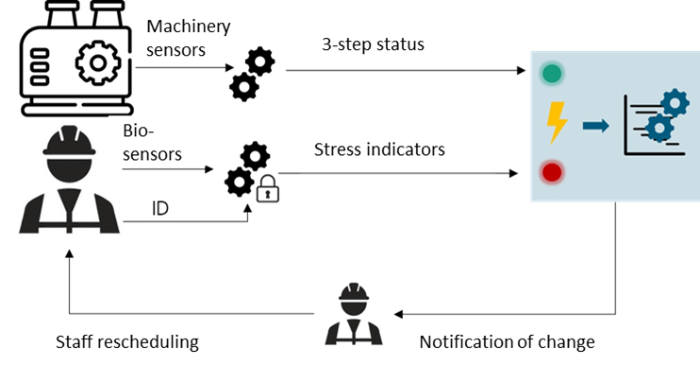
To integrate human performance into the overall view of the production system, it is necessary to expand the existing CPPS approaches to include human stress states (Figure 1).
A distinction is first made between physical and mental stress states. The physical strain on people can be determined by physiological sensors (e.g. EEG, ECG) but also by ergonomic assessment methods. Sensory determination has already been extensively researched and in some cases even integrated into consumer products (e.g. heart rate measurements in
Industry 5.0—Human-Centered Work Process Design 15
smartwatches). The processing of the data obtained and the derivation of recommendations for action for everyday operations are currently the subject of research activities.
Figure 1: Human centered work process approach using HCPPS.
The mental stress situation in the work environment is usually determined using structured questionnaires (e.g. BASA II, ERI) (Richter and Schatte, 2011), but can also be determined invasively using blood, saliva or urine tests. Here, information about the stress can be derived from the concentration of the hormones adrenaline, cortisol or noradrenaline (Junne et al., 2017). These assessment methods are unsuitable for long-term use due to the time and personnel involved. An alternative is the measurement of physiological and behavioral parameters to derive the intra-individual stress situation, as demonstrated in chronobiopsychological regulation diagnostics (Balzer and Hecht, 2000).
CHRONOPSYCHOBIOLOGICAL REGULATION DIAGNOSTIC While chronobiology deals with the temporal organization of physiology and the behavior of living organisms, chronopsychobiological regulation diagnostics (CRD) expands the object of investigation to include the temporal processes of the psyche (Balzer et al., 2025).
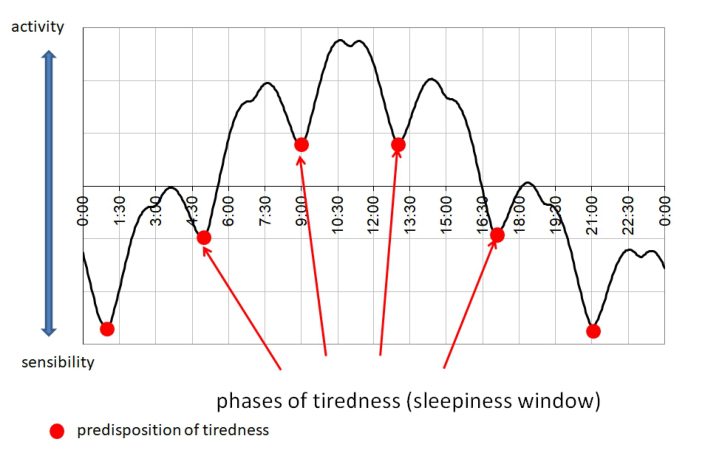
The changes relevant to the temporal dependence of the response reaction are shown in Figure 2 as a superposition of the circadian rhythm with the ultradian rhythm (2-4 h cycle) - i.e. as a periodic modulation of basic bodily functions.
For the deactivation times shown in Figure 2 (red), a distinction must be made as to whether they occur in the cognitive area, the emotional area or the physical (muscular) area. Optimally, the deactivation times of all three components mentioned coincide, so that we can speak of a general deactivation (tiredness or exhaustion). Multifactorial influences (e.g. work task and noise) as well as summary effects due to rapid successive
Figure 2: Model of the superposition of circadian and ultradian rhythms of bodily functions.
stress typically lead to a shortening of the chronobiologically predetermined deactivation intervals (originally 2 or 4 hours) and at the same time to an extension of the deactivation phases in the course of the day. This can vary depending on the conditions and influences for the components mentioned (cognitive reaction, emotional reaction, and muscular reaction). Sustained high levels of stress without sufficient opportunities for regeneration lead to exhaustion and even burnout in the long term.
The activation and deactivation phases are accompanied by characteristic psychological features and biochemical changes that influence performance in the work process.
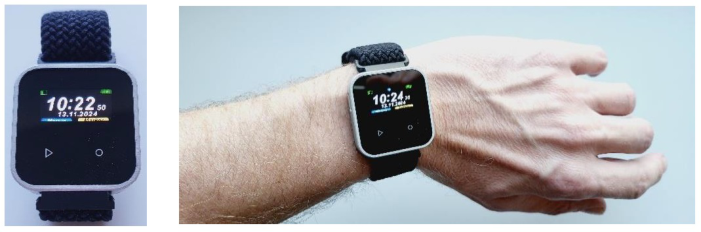
Based on the results of various studies (Balzer and Hecht, 1996, 2000), Balzer was able to integrate the CRD into a wearable by using various sensors to determine physiological parameters (see Figure 3).
Figure 3: Measuring system smardWatch®.
Industry 5.0—Human-Centered Work Process Design 17
The smardWatch® measuring system used continuously records the following physiological and behavioral parameters using four titanium electrodes at a sampling rate of 10 Hz.
The regulatory processes in the organism are investigated in the backend of the measurement system with the help of CRD using spectral analysis methods and neural networks (Balzer and Hecht, 2000). Among other things, intra-individual synchronization, intra-individual stress, the basic rest-activity cycle (BRAC) and overload inhibitions according to Pavlov are determined.
The analysis parameters listed can be used to draw conclusions about the user’s mental stress situation, which is necessary for the HCPPS.
CASE STUDY The HCPPS approach described above and the determination of a person’s state of mental stress were tested in a laboratory study. For this purpose, a sample task from the industrial environment was created, which was divided into the three subtasks described below:
1. Determine the production dimensions of a CAD model on the computer. 2. Prepare a construction drawing based on the information from 1. 3. Produce the wooden components and assemble the module.
The maximum time to complete the task was not allowed to exceed 120 minutes. The laboratory study was conducted with equal gender representation with six participants with an engineering background. All participants were familiar with the use of CAD models, the creation of production drawings, the production of components and the use of tools (including saws, drills) and measuring equipment (calipers). The test subjects were between 21 and 23 years old. In addition to completing the task described, the test subjects filled out four questionnaires to determine their chronotype, individual stress perception, basic rest-activity cycle, and high-sensitivity behavior. The purpose of these is to contextualize the measured values.
The test procedure stipulated that each test subject was fitted with the smardWatch® measuring system at 2 p.m. on the day before the test. The measuring system recorded the parameters listed in Table 1 until the test
subjects went to sleep. The measuring system was not used during the night’s rest. On the test day, the smardWatch® was put on again after getting up and the measurement recording was started. In the laboratory, the questionnaires were presented to the test subjects for completion. After completing the questionnaires, the practical task was explained to the test subjects and the execution of the task was started. While the practical task was being carried out, the test subjects described the individual stress situation to the test personnel.
After completing the practical task, the test subjects carried out their normal routine work tasks until the end of working hours. At the end of the working time, the measurement was stopped using smardWatch® and the data saved.
RESULTS
The evaluation of the measurements yielded comprehensive results for all analysis parameters. Of these, the BRAC and intra-individual stress are presented in more detail for use in the HCPPS approach.
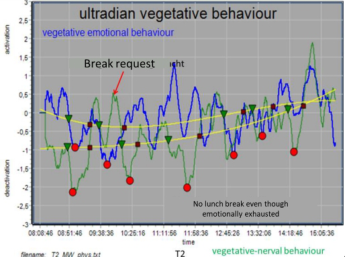
The average recording time for the BRAC analysis was 06:40 h. The results of the BRAC are shown in Figure 4 as an example for test subjects 2 and 6.
Figure 4: Results of the BRAC for subject 2 (left) and subject 6 (right).
The yellow graphs show the courses of the circadian cycles related to skin resistance or skin potential. For reasons of comparability, the courses of the basic rest-activity cycles for vegetative-nervous reactions (skin potential, green graph) and the vegetative-emotional reaction (skin resistance, blue graph) were each summarized in one graph. The markings to be recognized show the minimum of deactivation (red dot), the beginning of the deactivation phase (green triangle) and the end of the deactivation phase (brown rectangle).
Figure 4 shows that the subjects’ individual wishes for a break were expressed in line with the highest registered vegetative-nervous stress.
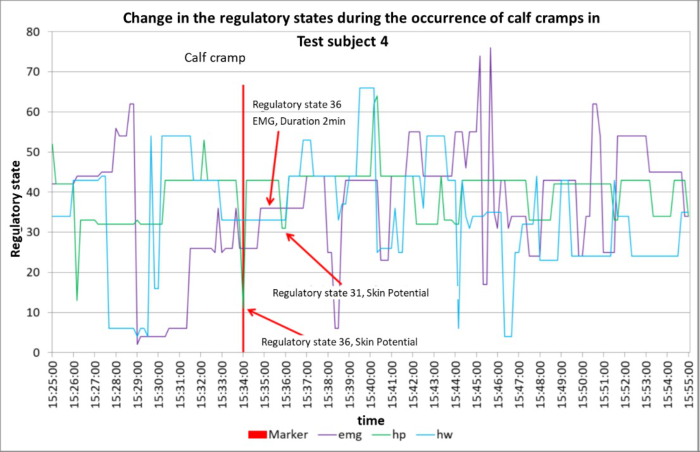
Within the intra-individual stresses of the test subjects, the descriptions of the stress situations were compared with the individual regulation states. During the practical task, subject 4 experienced a calf cramp because of prolonged standing (Figure 5). At the time of recording the occurrence of
Industry 5.0—Human-Centered Work Process Design 19
calf cramps in the activity log, a strong reaction - jump - was registered in the autonomic nervous response from regulation state 43 (dysregulated, relaxed) to state 11 (strongly deactivated, relaxed). From 15:34:50 h to 15:36:50 h, the state of acute stress (tension) is registered for the muscular reaction. This indicates that when a part of the body is under strong muscular strain, the so- called whole-body cramp (increased central muscle tone) becomes effective and therefore a muscular reaction is also recorded in other parts of the body (as in this case with the measurement of forearm muscle activity). After approx. 1 min from 15:35:00 h to 15:36:00 h, condition 31 is registered in the nervous reaction (HP), possibly a kind of overload reaction to the ongoing muscular tension 15:36:50 h is the end of the muscular strain.
Figure 5: Change in the regulation states of test subject 4 when calf cramps occur during physical exertion legs static.
DISCUSSION
The reported results are promising for the use of the smardWatch® as a measurement system for determining the individual stress state of employees in manufacturing companies. The measurement system indicates the individual necessity for breaks due to muscular or psychological loads and appears suitable for the HCPPS approach.
Statistical validation of the results was not possible due to the complexity of the task, the multitude of influencing factors on the individual well-being and performance of the participants, and the small number of participants. However, the principle differentiation of various stress on employees could be demonstrated. In further tests, the influencing factors and the complexity of the study design should be reduced. Furthermore, it is recommended that
a gender-sensitive investigation of the stress states is conducted to potentially capture menstrual discomfort through the measurement system.
CONCLUSION
The results of the conducted study suggest that the deployed wearable can be used to determine the stress state of employees. It is further concluded that the use of the tested device in combination with the presented HCPPS approach represents an opportunity for production companies to ascertain the stress situation of the entire production system and derive necessary actions, such as for rescheduling breaks.
In addition to the study presented here, further investigations are needed to assess the validity and reliability of the approach. Initially, simple production systems should be used, and the complexity should be gradually increased.
ACKNOWLEDGMENT
These studies were supported by the state of Mecklenburg-Western Pomerania, Germany with financial resources from the European Structural and Investment Fund (Funding Reference Number: TBI-V-5-075). The authors would like to express their sincere thanks for the substantial support.
REFERENCES
Balzer, H.-U. and Hecht, K. (1996) ‘Categorization of different Personality Typs with respect to susceptibility to stress and coping skills’, Proceedia of 8th International Montreaux Congress on Stress. Montreaux, p. 1. Balzer, H.-U. and Hecht, K. (2000) ‘Chronobiologische Regulationsdiagnostik
(CRD). Ein neuer Weg zur objektiven Bestimmung von Gesundheit und Krankheit’, in Hecht, K. (ed) Stressmanagement, Katastrophenmedizin, Regulationsmedizin, Prävention: Beiträge der Arbeitstagung, Lengerich, Berlin, Riga, Rom, Wien, Zagreb, Pabst, pp. 134–155. Balzer, H.-U., Stück, M. and Annatagia, L. (eds) (2025) Chrono-Bio-Psychological Basics in Education and Health, Lausanne, Peter Lang Group AG. BAuA/DGUV (2020) MEGAPHYS. Mehrstufige Gefährdungsanalyse physischer
Belastungen am Arbeitsplatz [Online]. Available at https://www.dguv.de/ifa/ publikationen/reports-download/reports-2020/dguv-report-3-2020/index.jsp. Beuß, F., Sender, J. and Flügge, W. (2019) ‘Ergonomics Simulation in Aircraft Manufacturing – Methods and Potentials’, Procedia CIRP, vol. 81, pp. 742–746. Culot, G., Nassimbeni, G., Orzes, G. and Sartor, M. (2020) ‘Behind the definition of
Industry 4.0: Analysis and open questions’, International Journal of Production Economics, vol. 226, p. 107617. Ellegast, R. and Kupfer, J. (2000) ‘Portable posture and motion measuring system for use in ergonomic field analysis’, in Landau, K. (ed) Ergonomic Software Tools in Product and Workplace Design: A review of recent developments in human modeling and other design aids, Würzburg, Ergon-Verlag; ERGON, pp. 47–54. Francalanza, E., Borg, J. and Constantinescu, C. (2017) ‘A knowledge-based tool
for designing cyber physical production systems’, Computers in Industry, vol. 84, pp. 39–58. Hellwagner, T., Söhnlein, D. and Weber, E. (2023) Modelling Migration Dynamics in Stochastic Labor Supply Forecasting, Institute for Employmnent Research.
Industry 5.0—Human-Centered Work Process Design 21
Junne, F., Rieger, M., Michaelis, M., Nikendei, C., Gündel, H., Zipfel, S. and Rothermund, E. (2017) ‘Psychische Belastungsfaktoren in der Arbeitswelt: Modelle und Prävention’, Psychotherapie, Psychosomatik, Medizinische Psychologie, vol. 67, 3–04, pp. 161–173. Liggesmeyer, P. and Schöning, H. (2024) The fourth industrial revolution and
“Industry 5.0” - a critical perspective, Research Council Industrie 4.0. Masoomi, B., Sahebi, I. G., Ghobakhloo, M. and Mosayebi, A. (2023) ‘Do industry 5.0 advantages address the sustainable development challenges of the renewable energy supply chain?’, Sustainable Production and Consumption, vol. 43, pp. 94–112. Monostori, L. (2014) ‘Cyber-physical Production Systems: Roots, Expectations and
R&D Challenges’, Procedia CIRP, vol. 17, pp. 9–13. Richter, G. and Schatte, M. (2011) Bericht “Psychologische Bewertung von Arbeitsbedingungen Screening für Arbeitsplatzinhaber II-BASA II”//Psychologische Bewertung von Arbeitsbedingungen, Screening für Arbeitsplatzinhaber: BASA, 2nd edn, Dortmund, Bundesanstalt für Arbeitsschutz und Arbeitsmedizin. Schiefer, C., Griemsmann, S., Hermanns, I., Derakshani, M., Göbel, F., Jäger, M., Koch, U., Ditchen, D. and Ellegast, R. (2022) ‘Auswirkungen von alternativen Hilfsmitteln auf die körperlichen Belastungen beim Patienten- transport im Rettungsdienst’, Zeitschrift für Arbeitswissenschaft, vol. 76, no. 2, pp. 118–128 [Online]. doi: 10.1007/s41449-022-00308-8.
LISTED IN THE AHFE DIGITAL BOOKSTORE CATALOGUE
Explore the complete digital volume
Human Factors and Wearable Technologies
Read this individual research paper free through the original publisher, or explore the full digital proceedings book.
ISBN 978-1-964867-51-9
Explore this ISBN in the AHFE Bookstore ↗Listed in the July 2026 bookstore catalogue; search by ISBN to confirm current availability · Digital book purchase optional