Fábio Barros, Pedro Reisinho, Bernardo Marques, João Alves, Mariana Leite, Tiago Coelho, Jorge Neves, Jorge Figueiredo, Duarte Almeida, Carlos Ferreira, Paulo Dias, Beatriz Sousa Santos (2026). Designing Together at a Distance: Mediating Industrial Remote Co-Design Through eXtended Reality Technologies. In: Human Interaction and Emerging Technologies (IHIET-FS 2026): Future Systems and Design Applications. AHFE Open Access, vol. 235, pp. 304–313. https://doi.org/10.54941/ahfe1007284
Remote collaboration is increasingly central to today’s globalized economy, yet distributed teams still face challenges related to limited shared context, reduced expressiveness, and lower engagement. These issues are especially critical in industrial co-design, where complex physical artifacts, spatial reasoning, and multidisciplinary coordination play a key role. Conventional remote tools often fail to adequately convey geometry, scale, and functional relationships, resulting in misunderstandings and extended iteration cycles. To address these challenges, we explore eXtended Reality (XR) to support remote co-design in industrial settings. XR enables collaborators to establish common ground through spatially anchored digital content, such as three-dimensional models, annotations, measurements, and multimodal communication, bridging gaps between physical and remote collaboration. We propose a pervasive Augmented Reality (AR) tool for distributed co-design that allows users to manipulate digital models, generate exploded views, inspect components, perform precise measurements to assess tool applicability, and create three-dimensional annotations. Collaboration can occur synchronously or asynchronously, enabling iterative contributions and refinement of design decisions until consensus is achieved. We evaluated the approach through a user study with 30 participants in a real-world industrial scenario involving the central mold of a heavy hydraulic press. Results show that the tool establishes a shared discussion space, promotes attentional engagement, enhances understanding of complex design information, and supports articulation of ideas, while maintaining low mental and physical workload. Overall, the findings highlight the potential of immersive technologies to enhance industrial co-design beyond physical boundaries and reinforce the value of a human-centered design approach aligned with existing work practices.
Industry 5.0 is paramount to address the growing complexity and demands of modern manufacturing, combining technological innovation with human- centered approaches (Maddikunta et al., 2022; Masood & Egger, 2020) to create production environments that are more sustainable, adaptive, and resilient to the challenges of global markets (Devagiri et al., 2022; Yin et al., 2023). In such contexts, ensuring the proper functioning of the shop floor requires effective maintenance procedures (Coelho et al., 2024; Fidalgo et al., 2023). These activities are essential for minimizing downtime, extending the lifespan of equipment, and guaranteeing safe and efficient operations across diverse industrial systems, from individual machines to complex assembly lines (Cardenas-Robledo et al., 2022; Wang et al., 2025).
Yet, to ensure these maintenance activities can be properly performed, co-design teams responsible for creating the various elements of the manufacturing process (Egger & Masood, 2020; Cardoso et al., 2020), ranging from simple instruments to complex machines, robots, and even full assembly lines, must carefully account for key requirements during the design phase (Cardenas-Robledo et al., 2022; Sereno et al., 2020).
These requirements include guaranteeing that maintenance processes can be performed with ease and efficiency. This involves aspects like sufficient space for applying specific tools, facilitating the replacement of parts, reducing unnecessary complexity, and supporting intuitive access to critical components (Maio et al., 2023; Marques et al., 2023). Taken together, these considerations are crucial to ensure that interventions can be carried out effectively once the equipment is deployed (Maio et al., 2024; Marques et al., 2022).
However, current practices rely on traditional desktop-based approaches, centered around CAD models with limited interactivity (Ben Guefrech et al., 2023; Wang et al., 2020). These processes are often carried out by isolated individuals working sequentially rather than collaboratively. Consequently, distributed team members are frequently required to travel extensively to align their contributions, resulting in a time- and resource-intensive co-design process before a final product can be realized.
This creates an opportunity to improve the effectiveness of collaborative co-design, particularly in distributed scenarios. More interactive solutions can facilitate discussion, support the sharing of ideas, and enable the establishment of a common ground for decision-making. Technologies that allow simultaneous interaction with shared models hold significant potential to transform the way teams collaborate during design and maintenance planning.
This work explores a Pervasive Augmented Reality (AR) tool to support co-design activities among remote team members. Developed with industrial partners, following a Human-Centered Design (HCD) methodology, the tool enables participants to use headsets to visualize and interact with a shared model through hand gestures. Main features include model manipulation, exploded views, part selection, precise measurements, and 3D annotations, supporting both synchronous and asynchronous collaboration until
consensus is reached. A user study with 30 participants was conducted to validate these features in a real-life scenario involving the central mold of a heavy hydraulic press.
METHODS AND MATERIALS To investigate remote co-design within the industrial sector, a use case focused on a heavy hydraulic press was selected, applying a Human-Centered Design (HCD) methodology in collaboration with industry partners. The hydraulic press is a key asset in shaping metal sheets, enabling the production of components that are fundamental to the factory’s commercial products. Because of its critical function, ensuring optimal performance is necessary to safeguard product quality, maintain operational efficiency, and protect worker safety. Accordingly, maintenance procedures carried out by technicians are indispensable to prevent breakdowns and guarantee continuous operation.
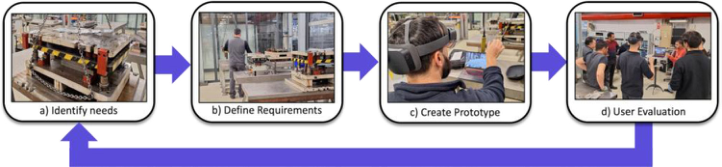
To guide the development of the new tool, a series of in-person meetings were conducted with individuals having distinct profiles (e.g., engineers, technicians, Industry 5.0 managers, etc.) to gain deeper insight into the challenges and needs encountered during co-design activities. These discussions resulted in the identification of key requirements, which directly shaped the design and implementation of the proposed solution (Figure 1).
Figure 1: Methodology adopted to bring domain experts into the design of a Pervasive AR tool: a) identify needs of target users; b) definition of requirements; c) creation of a remote-based prototype; d) user evaluation. Assets from iconfinder.com.
The industry partners emphasized that the development of every new mold requires an iterative and often lengthy process involving multiple individuals, some of whom are located in different countries, frequently requiring international travel to review each new iteration before a final product can be approved. The process typically begins with the creation of a digital model using CAD software on desktop computers by the company responsible for producing the physical mold. This initial version is then shared with factory technicians, who must carefully validate that the design complies with the original specifications, contains the necessary measurements, and allows adequate space for maintenance interventions such as tool access or part replacement. Once the first prototypes are manufactured, technicians travel to the mold-making company to conduct additional checks, repeating the cycle of validation and adjustment, this time with the physical object. Throughout this entire process, which can span multiple iterations and
Designing Together at a Distance 307 demand significant time and resources, effective communication is critical to building a shared understanding of the identified constraints and determining the most appropriate solutions at each stage of the co-design effort.
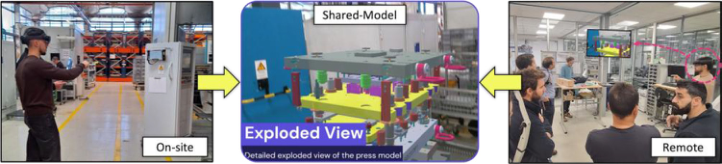
Pervasive AR Tool for Remote Co-Design Given that technicians were already familiar with the Microsoft HoloLens 2 headset for other factory use cases, this AR-based device was selected to enable interaction with digital content overlaid onto the physical environment through spatial mapping and hand recognition. The headset can be operated alongside regular activities, allowing technicians to participate in the co-design process from anywhere on the shop floor, taking advantage of the pervasive characteristics of the proposed tool, and even to superimpose virtual models onto physical components to support maintenance procedures. To facilitate remote co-design, the proposed AR-based tool integrates a set of collaborative features (Figure 2) accessible to all team members, regardless of their physical location.
Figure 2: Scenario of remote collaboration illustrating how distributed team members supported by a Pervasive AR tool participate in a co-design activity for a heavy hydraulic press based on a shared-model approach (showing an exploded view of the mold pieces).
This ensures that whenever one technician performs an action on the mold, all modifications are reflected for the others, enabling them to visualize and interact with a shared model in real time and in a synchronous manner:
Exploded view - The mold can be expanded by deconstructing it into its individual components, enabling a detailed inspection of each piece (Figure 2). This offers a clearer understanding of the structure, facilitates discussion about specific parts, and supports more precise diagnostics and planning;
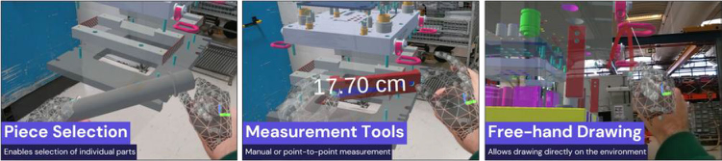
Piece selection - A particular piece of the shared model can be selected to facilitate closer analysis and discussion. Technicians simply point their index finger at the desired component and perform a pinch gesture, causing the selected piece to move toward them (Figure 3 – Left);
Measurement Tools - Technicians may perform specific measurements to verify whether there is enough room for the necessary tools to operate effectively (Figure 3 – Center). This enables them to verify any intervention can be carried out safely and efficiently;
Annotations - A key feature for expressing ideas, raising questions, and supporting the brainstorming is the ability to draw directly on the shared model using distinct colors (Figure 3 – Right). These annotations remain
attached to specific parts of the model for as long as needed but can be removed at any time. This promotes communication and helps maintain context during discussions.
Figure 3: Scenario of remote collaboration illustrating how distributed team members supported by a Pervasive AR tool participate in a co-design activity for a heavy hydraulic press based on a shared-model approach (showing an exploded view of the mold pieces).
The tool was developed using the Unity game engine with the Mixed Reality Toolkit (MRTK). To ensure real-time synchronization of shared content among team members, the Photon PUN 2 (Photon Unity Networking) was integrated. QR Code tracking was employed to align virtual content accurately within the physical environment. This was performed over Wi-Fi through a WRT 1200 AC Dual-Band Router operating on the 5GHz band.
USER STUDY To evaluate the effectiveness of the tool, a user study was conducted. The goal was to collect feedback on usability, interaction, collaboration quality, and acceptance, allowing refinement of the co-design tool and guiding the next phases of the research. In randomly selected teams, participants were instructed to use the proposed tool and explore all its main features. After conducting an exploded view, they were asked to select a given piece, inspect it, and discuss it with their counterpart. They then performed measurements of selected pieces and spaces and annotated several components of the mold, demonstrating how to express opinions and request assistance. All activities were carried out simultaneously to ensure that participants remained actively engaged throughout the process and that each individual had the opportunity to contribute.
Data was collected at the conclusion of the experience using a survey with a Likert-type scale ranging from 1 (Low) to 7 (High), along with open-ended questions. The survey targeted specific dimensions: D1 – level of attentional allocation; D2 – effectiveness of perceived information understanding; D3 – effectiveness of expressing ideas properly; D4 – level of physical effort; D5 – level of mental effort; D6 – level of satisfaction; and D7 – effectiveness in completing the intended tasks (Kim et al., 2020; Marques et al., 2024; Medeiros et al., 2022; Merino et al., 2020; Piumsomboon et al., 2019). Additional insights into participants’ demographics, previous experience with AR and collaborative scenarios, as well as their preferences and opinions, were gathered through a post-task interview.
Designing Together at a Distance 309 Given the remote setting, the study was conducted in two distinct spaces to enforce the collaborative paradigm without participants seeing each other. At the beginning, participants received an overview of the objectives, tasks, and experimental setup. After providing informed consent, they were given an adaptation period to become familiar with the prototype. They then completed the assigned tasks. Upon completion, participants filled out a post-task questionnaire to document their experience, preferences, and demographic information. Finally, an interview was conducted to gather additional insights. During the study, two researchers, one in each space, were present to assist participants if needed and to record relevant observations.
A total of 30 participants (15 female and 15 male), aged between 19 and 46 years, took part in the study. All participants were familiar with remote collaboration scenarios and the basic concepts of co-design. Among them, 14 had prior knowledge of AR technology, and 20 were familiar with their assigned counterpart.
RESULTS AND DISCUSSION
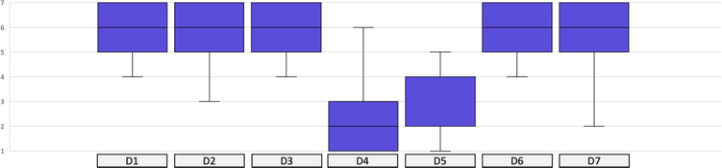
Figure 4 provides an overview of participants’ evaluations across all considered dimensions. Regarding the level of attentional allocation (D1), the overall median score was 6, suggesting that participants were highly engaged and consistently focused during the co-design activity. Similarly, the effectiveness of perceived information understanding (D2) reached a median of 6, indicating that users were able to interpret and process the manipulated mold with clarity and confidence.
Concerning the effectiveness in expressing ideas properly (D3), the median score was also 6, highlighting that the tool effectively supported communication between participants. In contrast, the level of physical effort (D4) obtained a median of 2, showing that interaction required minimal physical demand, even though the experience lasted on average around 30 minutes while wearing the AR headset. The level of mental effort (D5) also presented a median of 2, demonstrating that participants did not experience significant cognitive overload and reinforcing the perception of intuitive interaction.
Figure 4: Boxplot chart representing the overall experience, based on a seven-point Likert-type scale (1 – Low; 7 – High). The following dimensions are considered: D1 – level of attentional allocation; D2 – effectiveness of perceived information understanding; D3 – effectiveness of expressing ideas properly; D4 – level of physical effort; D5 – level of mental effort; D6 – level of satisfaction; and D7 – effectiveness in completing the intended tasks.
The level of satisfaction (D6) achieved a median score of 6, suggesting a positive overall experience and indicating that the tool was perceived as both enjoyable and useful for collaboration. Lastly, the effectiveness in completing the intended tasks (D7) also reached a median of 6, confirming that participants were able to accomplish the required activities successfully and without major obstacles.
Overall, these results point to a high perceived quality of collaboration, combining strong engagement, clear communication, successful task completion, and low cognitive and physical demands. In the context of remote co-design, the findings suggest that the proposed AR-based tool provides a solid foundation for enabling distributed teams to collaborate effectively. By fostering shared understanding, reducing interaction constraints, and supporting efficient decision-making, the tool shows potential to reshape co-design practices in industrial settings, connecting on-site personnel with remote team members in a unified collaborative environment.
During the study, participants also shared valuable feedback. One relevant aspect was the possibility for both individuals to maintain distinct points of view while simultaneously working on the same shared model and observing each other’s interactions. At the same time, some participants emphasized the importance of having a personal workspace to brainstorm or test ideas independently before sharing them, suggesting the need to balance shared and private interaction modes. The annotation feature was particularly appreciated, as it allowed participants to highlight specific elements, express ideas, and raise questions directly within the shared AR environment. Some suggested adding a screenshot functionality to document the evolution of sessions and automatically generate reports summarizing the co-design activity.
Participants also expressed interest in enhancing the virtual representation of their counterparts to strengthen the sense of social presence. Currently, only the shared model, its modifications, and two small spheres representing the other participant’s hands are visible. The absence of a more complete virtual embodiment was identified as an aspect for improvement, as richer representations could further enhance engagement, awareness, and overall collaboration quality in distributed co-design scenarios.
Study Limitations Although encouraging results were obtained, it is important to acknowledge and reflect on the limitations of the work. There was a lack of comparison with the existing desktop-based solution. Such comparison could help determine whether AR can improve efficiency, user experience, and collaborative effectiveness. Equally relevant, co-design requires coordination across larger, many-to-many teams (Marques et al., 2022), with diverse roles and expertise contributing to the process. We must examine how the tool scales under such conditions, evaluating its capacity to manage parallel interactions, avoid communication overload, and sustain shared understanding when several members contribute. Furthermore, the study was limited to a single session, preventing assessment of how user engagement, learning curves, or adoption patterns evolve over time. A longitudinal study will provide evidence of the tool’s long-term value (Merino et al., 2020), a critical next step.
CONCLUSION AND FUTURE WORK As production environments continue to evolve, finding more intuitive and streamlined solutions to overcome the constraints of distributed collaboration becomes essential. Traditional approaches often rely on desktop-based tools or repeated on-site visits, both of which can be time-consuming, resource- intensive, and limited in terms of interactivity.
This work explores the use of a Pervasive Augmented Reality tool to support co-design activities among distributed team members. Developed in collaboration with industrial partners following a human-centered design methodology, the tool enables participants to use AR headsets to visualize and interact with a shared model through hand gestures. Features include model manipulation, exploded views, part selection, precise measurements, and 3D annotations, supporting both synchronous and asynchronous collaboration until consensus is reached. A user study with 30 participants validated these features in a real-life scenario involving the central mold of a heavy hydraulic press. Results highlight the tool’s potential to establish a shared discussion space, fostering high attentional allocation, improved information comprehension, and effective idea expression, while maintaining low mental and physical workload.
Moving forward, we intend to compare the AR-based tool with the desktop-based approach to better understand its relative benefits and limitations in terms of efficiency, collaboration quality, and user experience. Equally important is the exploration of the Pervasive AR tool with larger teams, extending its use over longer periods to capture longitudinal effects on adoption, learning, and usability, while also introducing virtual avatars to represent all team-members.
ACKNOWLEDGMENT
We thank everyone involved for their time and expertise. This research was developed in the scope of Project “Agenda ILLIANCE” [C644919832- 00000035], financed by PRR – Plano de Recuperação e Resiliência under the Next Generation from the European Union. It was also supported by the Foundation for Science and Technology (FCT) through contract doi. org/10.54499/UID/00127/2025 - IEETA.
REFERENCES
Ben Guefrech, Fatma, Jean-François Boujut, Elies Dekoninck, and Gaetano Cascini.
(2023). Studying interaction density in co-design sessions involving spatial augmented reality. Research in Engineering Design 34, 2 (2023), 201–220. Cardenas-Robledo, Leonor Adriana, Óscar Hernández-Uribe, Carolina Reta, and Jose Antonio Cantoral-Ceballos. (2022). Extended reality applications in industry 4.0. - A systematic literature review. Telematics and Informatics (2022). Coelho, Tiago, Bernardo Marques, Pedro Ramalho, Duarte Almeida, Paulo Dias,
and Beatriz Sousa Santos. (2024). Improving Inspection Procedures: Pervasive Augmented Reality and Situated Visualization for Industrial Environments. In International Conference Information Visualisation (IV). 89–94.
Devagiri, Jeevan S, Sidike Paheding, Quamar Niyaz, Xiaoli Yang, and Samantha Smith. (2022). Augmented Reality and Artificial Intelligence in industry: Trends, tools, and future challenges. Expert Systems with Applications 207 (2022), 118002. Egger, Johannes, and Tariq Masood. (2020). Augmented reality in support of
intelligent manufacturing – A systematic literature review. Computers & Industrial Engineering 140 (2020). Fidalgo, Catarina G, Yukang Yan, Hyunsung Cho, Maurício Sousa, David Lindlbauer, and Joaquim Jorge. (2023). A Survey on Remote Assistance and Training in Mixed Reality Environments. IEEE Transactions on Visualization and Computer Graphics 29, 5 (2023), 2291–2303. Kim, Seungwon, Mark Billinghurst, and Kangsoo Kim. (2020). Multimodal interfaces
and communication cues for remote collaboration. In Journal on Multimodal User Interfaces, Vol. 14. 313–319. Maddikunta, Praveen Kumar Reddy, Quoc-Viet Pham, Natarajan Deepa, Kapal Dev, Thippa Reddy Gadekallu, Rukhsana Ruby, Madhusanka Liyanage, et al. (2022). Industry 5.0: A survey on enabling technologies and potential applications. Journal of Industrial Information Integration 26 (2022). Maio, Rafael, Tiago Araújo, Bernardo Marques, André Santos, Pedro Ramalho,
Duarte Almeida, Paulo Dias, and Beatriz Sousa Santos. (2024). Pervasive Augmented Reality to support real-time data monitoring in industrial scenarios: Shop floor visualization evaluation and user study. Computers & Graphics 118 (2024), 11–22. Maio, Rafael, André Santos, Bernardo Marques, Carlos Ferreira, Duarte Almeida, Pedro Ramalho, Joel Batista, Paulo Dias, and Beatriz Sousa Santos. (2023). Pervasive Augmented Reality to support logistics operators in industrial scenarios: a shop floor user study on kit assembly. The International Journal of Advanced Manufacturing Technology 127, 3 (2023), 1631–1649. Marques, Bernardo, Samuel Silva, João Alves, António Rocha, Paulo Dias, and
Beatriz Sousa Santos. (2022). Remote collaboration in maintenance contexts using augmented reality: insights from a participatory process. International Journal on Interactive Design and Manufacturing (IJIDeM) 16, 1 (2022), 419–438. Marques, Bernardo, Samuel Silva, Paulo Dias, and Beatriz Sousa Santos. (2022).
One-to-many remote scenarios: The next step in collaborative extended reality (XR) research. In Workshop on Analytics, Learning & Collaboration in eXtended Reality. ACM International Conference on Interactive Media Experiences (IMX). 1–6. Marques, Bernardo, Samuel Silva, Rafael Maio, Liliana Vale Costa, Paulo Dias, and Beatriz Sousa Santos. (2023). Remote work is here to stay! reflecting on the emerging benefits of mixed reality solutions in industry. In International Conference on Human-Computer Interaction. 253–260. Marques, Bernardo, Samuel Silva, and Beatriz Sousa Santos. (2024). Measuring
Remote Collaboration Supported by Extended Reality: A Multidimensional Evaluation Approach. In International Conference on Applied Human Factors and Ergonomics (AHFE) 121 (2024). Masood, Tariq, and Johannes Egger. (2020). Adopting Augmented Reality in the age of industrial digitalisation. Computers in Industry 115 (2020). Medeiros, Daniel, Mark McGill, Alexander Ng, Robert McDermid, Nadia Pantidi,
Julie Williamson, and Stephen Brewster. (2022). From shielding to avoidance: Passenger augmented reality and the layout of virtual displays for productivity in shared transit. IEEE Transactions on Visualization and Computer Graphics 28, 11 (2022), 3640–3650.
Designing Together at a Distance 313 Merino, Leonel, Magdalena Schwarzl, Matthias Kraus, Michael Sedlmair, Dieter
Schmalstieg, and Daniel Weiskopf. (2020). Evaluating mixed and augmented reality: A systematic literature review (2009-2019). In IEEE International Symposium on Mixed and Augmented Reality (ISMAR). 438–451. Piumsomboon, Thammathip, Arindam Dey, Barrett Ens, Gun Lee, and Mark Billinghurst. (2019). The effects of sharing awareness cues in collaborative mixed reality. Frontiers in Robotics and AI 6 (2019), 5. Sereno, M., X. Wang, L. Besancon, M. J. Mcguffin, and T. Isenberg. (2020).
Collaborative Work in Augmented Reality: A Survey. IEEE Transactions on Visualization and Computer Graphics 28, 6 (2020), 2530–2549. Souza Cardoso, Luís Fernando de, Flávia Cristina Martins Queiroz Mariano, and Ezequiel Roberto Zorzal. (2020). A survey of Industrial Augmented Reality. Computers & Industrial Engineering 139 (2020). Wang, Peng, Shusheng Zhang, Mark Billinghurst, Xiaoliang Bai, Weiping He, Shuxia
Wang, Mengmeng Sun, and Xu Zhang. (2020). A comprehensive survey of AR/ MR-based co-design in manufacturing. Engineering with Computers 36, 4 (2020), 1715–1738. Wang, Peng, Huan Yang, Mark Billinghurst, Shuang Zhao, Yao Wang, Zhou Liu, and Yi Zhang. (2025). A survey on XR remote collaboration in industry. Journal of Manufacturing Systems 81 (2025), 49–74. Yin, Yue, Pai Zheng, Chengxi Li, and Lihui Wang. (2023). A state-of-the-art survey
on Augmented Reality-assisted Digital Twin for futuristic human-centric industry transformation. Robotics and Computer-Integrated Manufacturing 81 (2023).
LISTED IN THE AHFE DIGITAL BOOKSTORE CATALOGUE
Explore the complete digital volume
Human Interaction and Emerging Technologies (IHIET-FS 2026): Future Systems and Design Applications
Read this individual research paper free through the original publisher, or explore the full digital proceedings book.
ISBN 979-8-950676-11-6
Explore this ISBN in the AHFE Bookstore ↗Listed in the July 2026 bookstore catalogue; search by ISBN to confirm current availability · Digital book purchase optional