Bernardo Marques, Sérgio Oliveira, Hugo Ferreira, Paula Amorim, Paulo Dias, Betriz Sousa Santos (2024). The Role of Collaborative Virtual Reality Engagement in Stroke Survivors' Rehabilitation. In: Accessibility, Assistive Technology and Digital Environments. AHFE Open Access, vol. 121, pp. 27–35. https://doi.org/10.54941/ahfe1004611
Stroke stands out as a significant contributor to disability and mortality rates among individuals worldwide. Despite their important role, conventional rehabilitation methods often struggle to maintain motivation due to their repetitive nature, leading to potential social and mental health repercussions. This work advocates for the integration of Virtual Reality (VR) serious games in a collaborative, multi-user setting, informed by a Human-Centered Design (HCD) methodology with stroke survivors and healthcare professionals from a rehabilitation center. Through immersive, task-specific exercises in dynamic virtual environments, we strongly believe that stroke survivors can engage in shared experiences, fostering motivation and social interaction. We report our initial efforts toward the creation of a collaborative VR framework and delve into the next steps of the proposed research line. With this, we hope to transform existing approaches and better complement traditional rehabilitation methods for improving the overall quality of life for stroke survivors.
Each year, around 17 million individuals are affected by stroke, a promi- nent contributor to disability and mortality all over the world (Bui et al., 2021; Juan et al., 2023). This condition arises from the disruption of cerebral blood flow, resulting in a spectrum of physical and cognitive deficits. Notably, survivors face challenges that extend to psychological, cognitive, social, and motor domains, impacting daily living and overall quality of life (Bui et al., 2021; Patsaki et al., 2022). In these circumstances and given the documented rise in life expectancy among stroke survivors, it is imperative to allocate resources for addressing the challenges survivors need to face (Amorim et al., 2023; Juan et al., 2023). Following a stroke, individuals have the opportunity to access rehabilita- tive care with the primary aim of enhancing the overall quality of life for both
survivors and their families. However, conventional rehabilitation procedures may, over time, become monotonous and uninspiring. The repetitive nature of these exercises often poses a significant challenge to maintaining moti- vation among survivors. This decline in enthusiasm for the rehabilitation process can, in turn, lead to potentially severe repercussions for survivors, including social isolation, depression, and anxiety, while hampering recovery outcomes (Bui et al., 2021; Marques et al., 2023; Paraense et al., 2022).
To help overcome some of these challenges, Virtual Reality (VR) tech- nologies offer promising benefits by immersing stroke survivors in dynamic, multi-sensory environments that replicate real- life scenarios. These immer- sive experiences can eclipse the clinical environment and monotonous exer- cises, while concurrently fostering entertainment and interaction. Exploring VR solutions as a complementary approach to traditional therapy has the potential to boost motivation and engagement during rehabilitation rou- tines, having the potential to prolong their treatment over extended periods (Andreikanich et al., 2019; Dias et al., 2019; Felipe et al., 2020; Patsaki et al., 2022). Despite the promising of VR technologies for stroke survivors’ rehabilitation, a notable gap exists in the literature concerning the use of VR in a multi-user scenario, in particular, when considering the most recent VR technologies and headsets. Thus far, most of the research efforts have been devoted to the design and creation of isolated experiences (Høeg et al., 2023; Liang et al., 2023; Thielbar et al., 2020).
This work proposes the use of VR serious games in a collaborative man- ner, following insights collected through a Human-Centered Design (HCD) methodology with a multidisciplinary team from a rehabilitation center. After introducing a single-player VR serious game to multiple stroke survivors and healthcare team members, it was possible to collect their feedback and suggestions, illustrating the potential of considering a multi-player setting to support physical and cognitive rehabilitation for stroke survivors mov- ing forward. To elaborate, by immersing survivors in multi-user interactive virtual environments, we believe that VR can simulate real-life activities, fos- tering task-specific rehabilitation exercises while eliciting engagement, social interaction, and collective experiences, thereby helping to improve recovery outcomes and quality of life. The subsequent sections delve into the method- ology used and the proposal of a VR framework, share avenues for further research and refinement, and offer concluding remarks.
COLLABORATIVE VIRTUAL REALITY FOR STROKE SURVIVORS Next, we present the rationale behind the motivation for addressing col- laborative settings for the rehabilitation of stroke survivors through the use of VR.
Over the last 8 years, our team has been highly active, together with a multidisciplinary team from a renowned rehabilitation center at our country, creating VR solutions to help improve the quality of life of stroke survivors. Given the skills and reputation of our group, we were first contacted by the responsible of the rehabilitation center, who were looking for ways to improve the motivation and engagement of their survivors. Over time, this
The Role of Collaborative Virtual Reality Engagement in Stroke Survivors Rehabilitation 29
resulted in four master’s degree dissertations, as well as various small-scale projects created during different iterations of an elective course on Virtual and Augmented Reality.
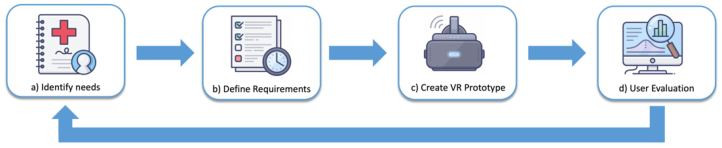
This long-standing collaboration has prevailed, even during the COVID-19 Pandemic. During this period, distinct hardware and game-design approaches have been explored, ranging from the Oculus DK1 with controllers, a leap motion sensor, or Kinect V1, or the more modern Meta Quest 2. Likewise, multiple VR serious games have been designed and developed, varying from more traditional games to more daily activities including cooking, washing plates, perform exercises similar to the gym or shopping at a supermarket, always following a HCD methodology (Figure 1) (Andreikanich et al., 2019; Dias et al., 2019; Paraense et al., 2022; Marques et al., 2023; Oliveria et al., 2024).
Figure 1: Methodology adopted to bring stroke survivors and healthcare professionals into the design of VR-based applications: a) identify needs of target users; b) defini- tion of requirements; c) creation of VR prototypes; d) user evaluation. Assets from iconfinder.com.
All of these had in common a single-user focus. This was done, given that our team was trying, at an initial stage, to take the most potential of the existing hardware to create serious games that followed the necessary princi- ples for use at the rehabilitation center. Then, as time went by, and as the technology mature, we started to create more immersive game narratives and environments, in which survivors could experience a simulated reality. Regardless, more recently, during multiple visits to the rehabilitation center, the topic of collaborative, multi-player scenarios have started to emerge.
While single-user VR experiences remain important, given its ability to address individual needs and foster motivation, we argue that the conver- gence of technology and innovative narrative design opens new frontiers, which people are starting to notice. As such, we believe that collabora- tive activities may empower healthcare professionals and stroke survivors to embark on a collective journey towards recovery, motivation, and improved quality of life.
These collaborative setting may introduce a dynamic and interactive dimension, reflecting the social nature of rehabilitation and providing a platform for shared engagement and support. Engaging in VR exercises with others can boost motivation and adherence to rehabilitation routines. Competition, cooperation, and the desire to outperform peers can serve as
powerful motivators. We argue that stroke survivors are more likely to com- mit to their rehabilitation programs when they are actively engaged in a social, gamified VR environment.
Using multi-user VR experiences can also facilitate social interaction, allowing survivors to engage with peers or therapists in virtual group sessions, promoting social support and motivation. Additionally, real-time feedback and performance monitoring can enable therapists to adjust exercises and track progress accurately. This way, therapists and peers can monitor progress and offer guidance, corrections, and encouragement during VR exercises. This immediate feedback can enhance the effectiveness of rehabilitation efforts. Overall, this social interaction can alleviate feelings of loneliness and depression, offering emotional support and motivation during the reha- bilitation process, important factors, that are largely missing in traditional methods being used.
What makes this shift particularly noteworthy is the maturation of tech- nology and the evolution of game narratives. Only now, with advancements in VR technology and the ability to craft immersive and captivating game scenarios, can we seamlessly transition from single-user to multi-user set- tings. These collaborative environments have the potential to transform the rehabilitation journey by offering shared experiences that extend beyond the individual, creating a sense of community and shared accomplishment.
On-Going Work
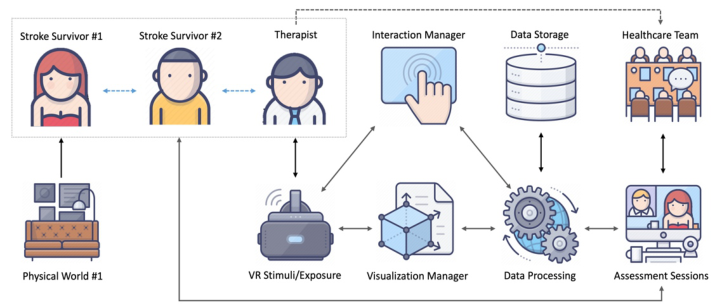
Figure 2 displays a framework of what a vision for a Collaborative VR shared experience could be, illustrating how multiple stroke survivors and/or health- care members (co-located in the same physical location) could participate in activities in a multi-user mode in a synchronous mode. Each participant is granted access to an instance of the same VR serious game, creating a shared virtual environment where interactions and manipulations are not only indi- vidual but also collectively impactful. This collaborative setting allows for a dynamic and engaging rehabilitation process, fostering shared experiences among participants.
Through client-server approach, information can be seamlessly shared among all participants in real-time. As each individual interacts with the VR environment, their actions are communicated to a dedicated server, acting as the central hub, broadcasting updates to all participants, and ensuring that every stroke survivor and healthcare professional involved receives the latest status of the shared VR game. This synchronous communication enhances the sense of collaboration and allows participants to witness and respond to each other’s actions, creating a truly immersive and interconnected experience.
Beyond the immersive collaborative experience, the proposed VR frame- work may serve as a valuable tool for data collection. The dedicated server not only manages the synchronization of the VR environment but may also record relevant data regarding the rehabilitation process. This data includes insights into how stroke survivors interact with the VR serious games and how they progress over time. Such information provides healthcare teams with a wealth of data for making informed decisions, adjusting rehabilitation
The Role of Collaborative Virtual Reality Engagement in Stroke Survivors Rehabilitation 31
Figure 2: Framework overview, allowing various stroke survivor to experience an immersive VR serious game in a shared manner. The information collected may also be used during assessment sessions by healthcare professionals to adjust the rehabilitation process. Assets from iconfinder.com.
processes, and personalizing the VR serious games to better suit the individ- ual needs and progress of each survivor. This dual-purpose framework stands as a promising avenue for both collaborative rehabilitation and data-driven decision-making in stroke recovery.
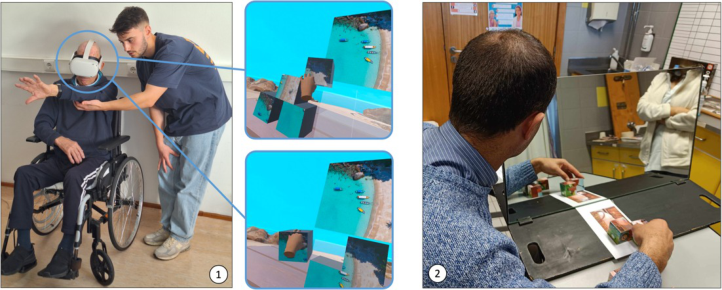
As for the shared VR experience, we have developed a puzzle game (Figure 3-1), inspired by a traditional mirror therapy (i.e., rehabilitation tech- nique using a mirror to create a visual illusion, helping survivors to perceive movement in paralyzed limbs) approach largely used at the rehabilitation cen- ter (Figure 3-2). Survivors are confronted with a pre-established image, and must pick various cubes and assemble the same image on their own using gesture recognition. Currently, the game usability and interaction are being evaluated at the center with over 20 participants already being recruited, to ensure it is ready to be expanded into a collaborative setting. This game was selected due to being easy to learn and play, providing a large amount of
Figure 3: 1- VR puzzle game being evaluated at the rehabilitation center; 2- traditional mirror therapy, which survivors already experience during their rehabilitation process.
autonomy to the survivors and being easier to expand into a multi-user set- ting, while still being familiar to survivors. Plus, healthcare professionals can personalize the game, by including recognizable images to the survivors (e.g., plants at their home, their pets, or family members).
Discussion and Next Steps Moving forward, the next natural step is to evolve the existing puzzle seri- ous game to a multi-user setting, as expected. With this, we hope to facilitate simultaneous engagement of multiple stroke survivors and healthcare pro- fessionals, enhancing their rehabilitation process while immersed in the VR experience. This step will involve refining the multiplayer dynamics, ensur- ing seamless connectivity, and gathering feedback from both stroke survivors and healthcare professionals to optimize the collaborative experience.
In this vein, a preliminary user study in a controlled laboratory setting must be conducted, allowing to assess usability, system responsiveness, interaction and collaborative aspects of the proposed VR framework. Subsequently, a formal user study at the rehabilitation center will be carried out, compar- ing the proposed collaborative approach against a traditional mirror therapy. With this, we hope to assess the impact of the collaborative setting on moti- vation, engagement, and rehabilitation outcomes, providing valuable data to further improve the proposed XR framework, allowing it to be easily used for long periods of time by the stroke survivors and healthcare professionals. Understanding how the benefits persist over an extended period is crucial for establishing the sustained impact on stroke survivors’ functional abilities and overall well-being.
Conducting all these evaluations will generate large amounts of data, col- lected during and after the VR experience. As such, besides devoting efforts to the immersive framework, it is also important to design and develop a proper visualization tool. This tool will assist therapists in gaining a comprehensive understanding of the rehabilitation sessions and tracking the evolution of stroke survivors over time. By providing visual representations of progress, therapists can make informed decisions, tailor interventions, and optimize rehabilitation plans. This visualization tool serves as a valuable adjunct to the collaborative VR approach, promoting a holistic and data-driven understanding of stroke rehabilitation dynamics.
From this effort, it may also be possible to infer some new requirements. For example, regarding how to expand the range of serious games. Introduc- ing a variety of new game scenarios tailored to different rehabilitation needs is another paramount topic of research. Examples may include interactive simulations of daily activities, adaptive motor skill challenges, and cognitive training games. This diversification aims to cater to a broader spectrum of stroke survivors, addressing individualized rehabilitation requirements while maintaining engagement and motivation throughout the recovery process.
In summary, these future directions aim to advance the collaborative VR rehabilitation approach by embracing multi-user dynamics, expanding the range of serious games, conducting thorough user studies, and develop- ing visualization tools. These efforts contribute to the ongoing evolution of technology-assisted stroke rehabilitation, with the ultimate goal of enhancing the quality of care and outcomes for stroke survivors.
The Role of Collaborative Virtual Reality Engagement in Stroke Survivors Rehabilitation 33
CONCLUDING REMARKS Rehabilitation plays a pivotal role in the comprehensive therapeutic jour- ney of stroke survivors, addressing the multifaceted challenges arising from diminished functional capacity. Traditional rehabilitation methods, while essential, often face hurdles in maintaining long-term motivation. The advent of VR technology presents a transformative opportunity to complement tra- ditional therapy by providing immersive and engaging experiences. As VR technology evolves, it enables the creation of tailored solutions based on daily tasks, that go beyond monotonous exercises, offering a promising avenue to enhance the overall quality of life for stroke survivors.
Our exploration on VR scenarios for stroke survivor rehabilitation, fol- lowing HCD methodologies with the collaboration of a renowned rehabili- tation center, unveils a relatively uncharted territory with immense potential. Feedback from stroke survivors underscores the positive impact of collabo- rative experiences, suggesting that integrating social/multi-user interactions in VR settings could significantly boost physical and cognitive motivation. This not only addresses the prevalent issues of social isolation and depression but also introduces the possibility of collaborative rehabilitation scenarios involving both stroke survivors, therapists, and even survivors’ family or friends.
As we delve into this new research line, further efforts are paramount to comprehensively understand the nuances of collaborative VR rehabilita- tion. This unexplored territory presents multiple opportunities to refine and expand our current understanding, ensuring that these advancements trans- late into tangible improvements in the rehabilitation outcomes and overall well-being of stroke survivors. The collaborative potential of VR technology in stroke rehabilitation marks an exciting frontier, encouraging continued exploration and development in the pursuit of optimal therapeutic strategies for this resilient population.
ACKNOWLEDGMENT
We thank everyone involved for your time and expertise, in particular the stroke survivors and the healthcare professionals of the Rehabilita- tion Medicine Center of the Central Region - Rovisco Pais. This research was developed in the scope of the institutional CEEC [10.54499/CEECIN- ST/00013/2021/CP2779/CT0007], funded by FCT - Foundation for Science and Technology. It was also supported by IEETA - Institute of Electronics and Informatics Engineering of Aveiro, funded by National Funds through FCT, in the context of the project [UIDB/00127/2020].
REFERENCES
Amorim, P., Serra, H., Sousa, B. S., Dias, P., Castelo-Branco, M. and Martins, H.
(2023) ‘Chronic stroke survivors’ perspective on the use of serious games to moti- vate upper limb rehabilitation–a qualitative study’, Health Informatics Journal, 29(2). Andreikanich, A., Santos, B. S., Amorim, P., Zagalo, H., Marques, B., Margalho, P., Laíns, J., Faim, F., Coelho, M. and Cardoso, T. (2019) ‘An exploratory study
on the use of virtual reality in balance rehabilitation’, in Annual International Conference of the IEEE Engineering in Medicine and Biology Society (EMBC). IEEE, pp. 3416–3419. Bui, J., Luauté, J. and Farnè, A. (2021) ‘Enhancing upper limb rehabilitation of stroke patients with virtual reality: a mini review’, Frontiers in Virtual Reality, 2, p. 595771. Van Damme, S., Van de Velde, F., Sameri, M. J., De Turck, F. and Vega, M. T. (2023)
‘A Haptic-enabled, Distributed and Networked Immersive System for Multi-User Collaborative Virtual Reality’, in Association for Computing Machinery (ACM), pp. 11–19. Dias, P., Silva, R., Amorim, P., Lains, J., Roque, E., Serôdio, I., Pereira, F. and Santos, B. S. (2019) ‘Using virtual reality to increase motivation in poststroke rehabilitation’, IEEE computer graphics and applications, 39(1), pp. 64–70. Feigin, V. L., Forouzanfar, M. H., Krishnamurthi, R., Mensah, G. A., Connor, M.,
Bennett, D. A., Moran, A. E., Sacco, R. L., Anderson, L. and Truelsen, T. (2014) ‘Global and regional burden of stroke during 1990–2010: findings from the Global Burden of Disease Study 2010’, The lancet, 383(9913), pp. 245–255. Felipe, F. A., de Carvalho, F. O., Silva, É. R., Santos, N. G. L., Fontes, P. A., de Almeida, A. S., Garção, D. C., Nunes, P. S. and de Souza Araújo, A. A. (2020) ‘Evaluation instruments for physical therapy using virtual reality in stroke patients: a systematic review’, Physiotherapy, 106, pp. 194–210. Høeg, E. R., Bruun-Pedersen, J. R., Cheary, S., Andersen, L. K., Paisa, R., Serafin, S.
and Lange, B. (2023) ‘Buddy biking: a user study on social collaboration in a virtual reality exergame for rehabilitation’, Virtual Reality. Juan, M.-C., Elexpuru, J., Dias, P., Santos, B. S. and Amorim, P. (2023) ‘Immersive virtual reality for upper limb rehabilitation: comparing hand and controller interaction’, Virtual Reality, 27(2), pp. 1157–1171. Kern, F., Winter, C., Gall, D., Käthner, I., Pauli, P. and Latoschik, M. E. (2019)
‘Immersive virtual reality and gamification within procedurally generated envi- ronments to increase motivation during gait rehabilitation’, in IEEE Conference on Virtual Reality and 3D User Interfaces (VR). IEEE, pp. 500–509. Liang, H., Liu, S., Wang, Y., Pan, J., Zhang, Y. and Dong, X. (2023) ‘Multi-user upper limb rehabilitation training system integrating social interaction’, Computers and Graphics (Pergamon), 111, pp. 103–110. Marques, B., Silva, S., Maio, R., Alves, J., Ferreira, C., Dias, P. and Santos, B. S.
(2023) ‘Evaluating Outside the Box: Lessons Learned on eXtended Reality Multi- modal Experiments Beyond the Laboratory’, in Proceedings of the International Conference on Multimodal Interaction, pp. 234–242. Oliveria, S., Marques, B., Amorim, P., Dias, P. and Santos, B. S. (2024) ‘Stepping Into Recovery with an Immersive Virtual Reality Serious Game for Upper Limb Rehabilitation: A Supermarket Experience for Stroke Survivors’, in International Conference on Human-Computer Interaction, pp. 1–12. Paraense, H., Marques, B., Amorim, P., Dias, P. and Santos, B. S. (2022) ‘Whac-A-
Mole: Exploring virtual reality (VR) for upper-limb post-stroke physical rehabil- itation based on participatory design and serious games’, in IEEE Conference on Virtual Reality and 3D User Interfaces Abstracts and Workshops (VRW). IEEE, pp. 716–717. Patsaki, I., Dimitriadi, N., Despoti, A., Tzoumi, D., Leventakis, N., Roussou, G., Papathanasiou, A., Nanas, S. and Karatzanos, E. (2022) ‘The effectiveness of immersive virtual reality in physical recovery of stroke patients: A systematic review’, Frontiers in Systems Neuroscience, 16, p. 880447. Postolache, O., Hemanth, D. J., Alexandre, R., Gupta, D., Geman, O. and Khanna, A.
(2020) ‘Remote monitoring of physical rehabilitation of stroke patients using IoT
The Role of Collaborative Virtual Reality Engagement in Stroke Survivors Rehabilitation 35
and virtual reality’, IEEE Journal on Selected Areas in Communications, 39(2), pp. 562–573. Thielbar, K., Spencer, N., Tsoupikova, D., Ghassemi, M. and Kamper, D. (2020) ‘Utilizing multi-user virtual reality to bring clinical therapy into stroke survivors’ homes’, Journal of Hand Therapy, 33(2), pp. 246–253. Towfighi, A., Ovbiagele, B., El Husseini, N., Hackett, M. L., Jorge, R. E.,
Kissela, B. M., Mitchell, P. H., Skolarus, L. E., Whooley, M. A. and Williams, L. S. (2017) ‘Poststroke depression: a scientific statement for healthcare profession- als from the American Heart Association/American Stroke Association’, Stroke, 48(2), pp. e30–e43. Tsoupikova, D., Triandafilou, K., Rupp, G., Preuss, F. and Kamper, D. (no date) Multi-User Virtual Reality Therapy for Post-Stroke Hand Rehabilitation at Home.
LISTED IN THE AHFE DIGITAL BOOKSTORE CATALOGUE
Explore the complete digital volume
Accessibility, Assistive Technology and Digital Environments
Read this individual research paper free through the original publisher, or explore the full digital proceedings book.
ISBN 978-1-958651-97-1
Explore this ISBN in the AHFE Bookstore ↗Listed in the July 2026 bookstore catalogue; search by ISBN to confirm current availability · Digital book purchase optional