Claudia Pereira, Daniel Silva, Paula Lopes, Mariana Magalhães, Marta Santos (2025). Designing new technologies in an industrial workplace: what role do workers and their current and future work play in the design process?. In: Creativity, Innovation and Entrepreneurship. AHFE Open Access, vol. 166, pp. 155–162. https://doi.org/10.54941/ahfe1006121
This study examines an ongoing design process, monitoring a use-case in a metalworking company aiming to digitalize a product storage area for enhanced product and stock traceability. Two research questions were defined: i) what perspectives and concerns drive the design team’s discussions regarding the new work situation? ii) how is the work of operators who interact with the products in the storage area and their experience and potential for skills development considered in this design process? Data was collected through the monitoring of the design team meetings, work observation moments, and meetings with members of the design team to promote reflection and discussion of results. Findings suggest that the design team's concerns are exclusively driven by technical concerns with variation in the perspectives privileged between operational management and technology designers. This leaves aside concerns regarding the operators’ development in their work situation, the possibility to debate the actual work and the problems that are recognized by the workers and how they can provide key criteria to design future work situations. The originality of the study lies in the external monitoring of an ongoing design process by a research team, aiming to contribute to setting a “dialogical debate” between all actors involved in the design and implementation of I4.0/I.50 technologies. This will allow the definition of guidelines for decision-makers following a participatory approach and promoting a dignified and sustainable management of the design process.
According to some authors, the design of new work situations should consider ergonomic concerns as a strategy for maintaining production standards and improving working conditions (Hall-Andersen & Broberg, 2014; Neumann et al., 2009). However, research shows that the design phases of new work situations involving technology interactions often overlook workers’ actual work and their possible contribution based on
their experience (Barcellini et al., 2021). The lack or limited involvement of workers during the design phase of a technology that will be implemented in the future often results in a technological transition that is neither participatory nor collaborative. This can lead to systems that do not meet the real needs of workers in performing their tasks effectively (Bellantuono et al., 2021) and that may jeopardize workers’ health, safety, and overall development, while also having a detrimental effect on their daily work (Barcellini, 2022).
Against this backdrop, Industry 5.0 emphasizes the importance of designing future industrial workplaces that prioritize workers and their development at the center of production processes. Built on this up-to-date approach and considering the inevitability of changes in jobs and ways of carrying out the work resulting from the introduction of new technologies, we aim to understand how workers and their actual work are currently integrated into the design of new technologies and into deliberations of the design teams.
METHOD
This study examines an ongoing design process by monitoring a use case in a metalworking company that aims to digitalize a product storage warehouse area for enhanced product (PCB) and stock traceability. The transition process involves several changes, such as a reduction in storage levels, a shift in the way products are transported (from PCB to PCB cassette), and the design of a chaotic storage area (which corresponds to a dynamic form of warehousing where products will be stored in available spaces rather than in specific and exclusive locations). This will involve the creation of a new function – the “warehouse manager”, replacing both the role of the current operators who have to supply the storage area, and the role of the operators who must pick up the necessary products and transporting them to be delivered and used by the final production lines.
Two research questions were defined: i) what perspectives and concerns drive the design team’s discussions regarding the new work situation? ii) how is the work of operators who interact with the products in the storage area, their experience and potential for skills development considered in this design process?
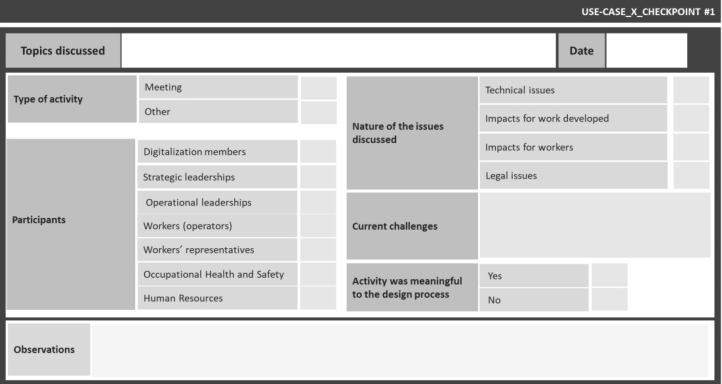
Design team meetings (4 in total over a period of three months) were monitored by a research team in work psychology and activity ergonomics, with detailed written records. Furthermore, a template was developed to systematically document the process, including discussed topics and their nature (e.g., technical aspects; impacts for workers; impacts for production), participants (including their function in the company, current challenges), and next steps in the design process. After each design meeting, the template was filled with the respective data by a member of the research team (see Figure 1).
Furthermore, there was a meeting to monitor the design process (with three members of the design team), in which the stakeholders filled out a checklist focused on an analysis of dimensions related to work, employees,
Designing New Technologies in an Industrial Workplace 157
and their contexts during the design phase. A session to share the results of the observations on the actual work of picking up the necessary products and the work of transporting them to the production lines for final use also took place.
Figure 1: “Checkpoint template” for documenting the design process after meetings.
Moreover, data was collected through observation of the operators’ current work activity, including workers who stock up products at the product storage area, and workers who pick up the products to be delivered to the final production lines. These observations included a few questioning moments regarding some of the planned changes and possible improvements workers considered necessary in order to carry out their work.
Concerning the data analysis, synthesis of the collected verbalizations in the different activities were produced.
It is worth noting that the design process is still ongoing and will continue to be monitored.
RESULTS AND DISCUSSION
Preliminary findings suggest that the design team’s concerns are driven by technical concerns (see Table 1). During the four monitored meetings, discussions centered on defining the technological concept and its operationalization to be incorporated into the product storage warehouse (“we have to think about how we’re going to do it”; “are we going to keep PCB transport or by cassette?”, “in principle we’ll have gantries to read the codes on the cassettes”; “what will the process of returning the products to the product storage warehouse be like”; “will there be interaction between AGV [referring to automated guided vehicle] and the operator?”), led by the head of logistics and the digitalization team. Questions were raised about what needs to be technically changed in the warehouse space, which work tools to create or change, and how the work will be carried out, but with a exclusive focus on the technical point of view. It should also be remarked that
the design team does not include any members whose contributions could be directly related to people’s management, and their current or future health and safety at work – Human Resources (HR) or Occupational Health and Safety (OHS). However, the reason for their absence from the team was not clear.
Table 1: Participants and nature of the issues discussed in the four design meetings.
Table available in the original PDF paper.
Participants Nature of the Issues Discussed 1st meeting (November/2024)
2 digitalization team members (responsible and a member)
1 logistics responsible and a logistics support member
1 Supply area responsible
Technical issues: Yes Impacts for work developed: Yes (work optimization) Impacts on workers: No Legal issues: No
2 production managers
1 head of supply and consumption department
Research team 2nd meeting (December/2024)
2 digitalization team members (responsible and a member)
1 logistics responsible member
1 Supply area responsible
Technical issues: Yes Impacts for work developed: No Impacts on workers: No Legal issues: No
Research team 3rd meeting (December/2024)
2 digitalization team members (responsible and a member)
1 logistics responsible
1 Supply area responsible
2 production managers
Technical issues: Yes Impacts for work developed: Yes (work optimization) Impacts on workers: No Legal issues: No
Research team 4th meeting (January/2025)
2 digitalization team members (responsible and a member)
1 logistics responsible
1 Supply area responsible
Technical issues: Yes Impacts for work developed: No Impacts on workers: No Legal issues: No
1 head of supply and consumption department
1 member of the continuous improvement team
Research team
Although aspects related to the impacts of the technological transition on the current/future work and on operators were not directly discussed, there were some referrals to the operators and their work, albeit in a subliminal or complementary way to the central ideas under discussion. These referrals fall into two predominant perspectives which vary mainly between operational management, emphasizing production impacts and error reduction, and
Designing New Technologies in an Industrial Workplace 159
technology designing, focusing on process optimization and digitalization (see Table 2).
Table 2: Predominant perspectives in the discussion and verbalizations in which workers and their work are referred.
Table available in the original PDF paper.
Verbalizations in Which Workers and Their Work are Referred Predominant Perspectives
“Are we going to have another task in the production chain?” (Production manager)
Operational management (emphasizing production impacts and error reduction)
“Since it would be just one worker, it’s easier to figure out who made the mistake.(…) The more people handle the supermarket, the harder it is to understand who made the mistake.” (Logistics manager)
“How can we define the concept without considering other factors, like the flexibility we lose if we introduce a scanning step?” (Production manager)
“And what about the process of returning the cassettes to the storage warehouse? How do I return them? It’s a task that isn’t done today...” (Production manager)
“If we switch to PCB cassette transport, we need to think about the concept for the transport vehicle for the people, otherwise, how will the label on the cassettes be read by the portal?” (Digitization responsible)
“The new operator will have to make many more trips... it needs to be fast.” (Digitization responsible)
Technology designing (focusing on process optimization and digitalization)
“If the workload increases a lot, instead of having one person (a warehouse manager), we’ll need two.” (Logistics responsible)
Although the results of the monitored meetings indicate a lack of explicit concerns focused on the impacts that such change can have on work and on people (e.g., physical overload, workload and pace, changes in the way tasks are carried out), the meeting to monitoring and filling in the human-centered checklist and the discussion about the data from the work observations made with the operators revealed relevant complementary contributions that indicate the possibility of providing moments for a dialogical debate with the workers (Daniellou, 2005). From the outset, the digitalization team identified concerns about the consequences of the transition: “I had never thought about it from this point of view [human-centered]... it’s difficult... but it’s important to consider here that if the worker stops using their developed skills, it could lead to unsatisfaction and the notion of wasting time” (digitalization team member); and a lack of knowledge about the actual work activity (e.g., route optimization strategies; number of products transported), which could impact the planned change “I didn’t know they transported so few PCB... this could be a problem when we switch to cassette transport” (digitalization responsible). Additionally, given the opportunity to reflect
on the process, which is still in the design phase, these members identified some commitments that could yet be integrated into the concept modelling. For example, to maintain/enhance the present forms of cooperation and other features of the collective activity, it was suggested to “map out the methodologies for interaction between colleagues in the concept phase”; to mobilize the experience previously acquired by operators, they could “think of the concepts in such a way as to allow the operator to make decisions when they consider it necessary”; and, to promote operator reflection on the work they do it was mentioned the possibility to “introduce access to the data collected organized in the form of individual feedback”.
In addition, the data collected from work observations reveals elements that could be considered in the design phase, such as suggestions made by workers and whether or not they recognize the changes that are being planned and their potential implications (or improvements) for their work. For example, the acknowledgment that having a chaotic storage area “is good, because we always have space to store the product (...) being chaotic it always has space, but there must always be confirmed in the system as well, because otherwise nobody knows where it is. That could be the problem with the chaos” (supply operator). Moreover, it should be considered the identification of potential improvements, such as having a tool that would provide real-time knowledge of the need to supply the product storage warehouse, and when the cassette has been replaced: “for me it would be very useful [to have a tablet], of course”.
This analysis leaves aside concerns regarding the operators’ development in their work situation, the possibility to debate the actual work and the problems that are recognized by the workers and how they can provide key criteria to design future work situations, reinforcing results from previous works e.g., Barcellini et al., 2021; Barcellini, 2022; Reiman et al., 2024.
CONCLUSION
This study reveals significant contributions regarding the creation of monitoring moments to accompany the design and promote discussion about people’s work. When faced with the possibility of reflecting on the role of work, both the design team and the workers identify elements that could be discussed in planning the design of the technologies and the new work situation. This shows that a human-centered process, when accompanied and questioned from the point of view of work and people, can indeed be considered.
Furthermore, with four design meetings having taken place in the space of three months where the concept is not yet fully defined, and considering the absence of HR or OHS members in the design team, the impacts on current workers and the discussion about the future function may be influencing the absence of discussion about the role of workers in the new function or the impacts of the transition for the professional paths of current workers from both areas. This reveals the prevailing technical concerns in technological transition processes, reinforced by the absence of stakeholders who could play an essential role (e.g., HR, OHS) in these processes. In the next stages
Designing New Technologies in an Industrial Workplace 161
of the study, it is expected to collect data with these stakeholders in order to discuss the role they can play in these technological transition processes. In this context, since the use-case is still in its design phase, the next steps will include moments of reflection with the design team to discuss the impacts of the transition on current work, and other tasks carried out by operators. Additionally, there will be simulation and training sessions focused on the “future activity” (Daniellou, 2005) to support people throughout the technological transition process, contributing to the development of the new activity itself.
The originality of the study lies in the external monitoring of an ongoing design process by a research team. The aim is to foster a “dialogical debate” between all actors involved in the design and implementation of I4.0/I.50 technologies, ultimately contributing to the definition of guidelines for decision-makers following a participatory approach (Daniellou, 2005; Garrigou et al., 1995). It is expected that the monitoring of the following phases of the design process, the further discussions with the design team considering the data collected with workers, and subsequent testing of the technology in site, can contribute to a progressive change towards a human-centered perspective that can recognize workers’ experience and their potential contribution to the design of technologies, while also addressing the real constraints associated with their work activity. Furthermore, it is expected that some of the materials produced within the scope of this use- case, such as the “checkpoint template” and the reflection form on the design phase from a human-centered point of view, can become tools for internal monitoring by the design and reflection teams. These tools will be integrated into an evaluation framework that is being built within the project to monitor and evaluate transition processes. This framework aims to promote technological transitions that consider work, people and their respective contexts in a dignified and sustainable manner.
ACKNOWLEDGMENT
This work was supported by Portuguese National Funding from the Agency for Investment and Foreign Trade of Portugal, E.P.E. (AICEP) (SI I&DT (Co-promotion) n.
182852) and by national funding from the Portuguese Foundation for Science and Technology (UIDB/00050/2020).
REFERENCES
Barcellini, F. (2022). The design of “future work” in industrial contexts. In H. Laroche, C. Bieder, & J. Villena-López (Eds.), Managing Future Challenges for Safety: Demographic Change, Digitalisation and Complexity in the 2030s (pp. 75–83). Springer. https://doi.org/10.1007/978-3-031-07805-7_10 Barcellini, F. et al. (2021). Collaborative Robotics and Industry 4.0: An Engineering, Sociology and Activity-Centered Ergonomics Cross-Experience. In N. Black, P. Neumann, & I. Noy (Eds.), Proceedings of the 21st Congress of the International Ergonomics Association (pp. 597-604). Springer. https://doi.org/10.1007/978-3- 030-74614-8_74
Bellantuono, N., Nuzzi, A., Pontrandolfo, P., & Scozzi, B. (2021). Digital transformation models for the I4. 0 transition: Lessons from the change management literature. Sustainability, 13(23), 12941. https://doi.org/10.3390/ su132312941 Daniellou, F. (2005). How far can future activity be foreseen ? Proceedings of
First ISCAR Congress, Actingin changing worlds, Universidad de Sevilla and Universidad Pablo Olavide de Sevilla (PDF) Des fonctions de la simulation des situations de travail en ergonomie. Garrigou, A., Daniellou, F., Carballeda, G., & Ruaud, S. (1995). Activity analysis in participatory design and analysis of participatory design activity. International Journal of Industrial Ergonomics, 15(5), 311–327. https://doi.org/10.1016/0169- 8141(94)00079-I Hall-Andersen, L., & Broberg, O. (2014). Integrating ergonomics into engineering design: The role of objects. Applied Ergonomics, 45, 3. https://doi.org/10.1016/j.apergo.2013.09.002. Neumann, W. P., Ekman, M., & Winkel, J. (2009). Integrating ergonomics
into production system development - The Volvo Powertrain case, Applied Ergonomics, 40, 3. https://doi.org/10.1016/j.apergo.2008.09.010 Reiman, A., Kaivo-oja, J., Parviainen, E., Takala, E., & Lauraeus, T. (2024) Human work in the shift to Industry 4.0: a road map to the management of technological changes in manufacturing. International Journal of Production Research, 62(16), 5613–5630. https://doi.org/10.1080/00207543.2023.2291814
LISTED IN THE AHFE DIGITAL BOOKSTORE CATALOGUE
Explore the complete digital volume
Creativity, Innovation and Entrepreneurship
Read this individual research paper free through the original publisher, or explore the full digital proceedings book.
ISBN 978-1-964867-42-7
Explore this ISBN in the AHFE Bookstore ↗Listed in the July 2026 bookstore catalogue; search by ISBN to confirm current availability · Digital book purchase optional