Liliana Cunha, Daniel Silva, Sarah Maggioli (2022). More than a Machine at Work: Exploring the Impacts of Technological Change on Mental Health. In: Social and Occupational Ergonomics. AHFE Open Access, vol. 65, pp. 163–172. https://doi.org/10.54941/ahfe1002672
With the current technological transformations being developed, the focus seems to rely mainly on the increase of productivity and on promises of the reduction of physical constraints for workers. However, in the analysis of the new human-machine relationships induced by technological advances, other less visible impacts should be debated, namely for workers’ health and well-being. In a garment factory in Portugal, characterized by rigorous quality demands, sectored and short production cycles, with production times controlled by the minute, this study aims to analyze human-machine interactions from the point of view of their protagonists. A qualitative and participatory methodology was used (observations; individual and collective interviews; and moments of auto-confrontation). The results show how these work situations potentiate a "contained" suffering due to the lack of space for its verbalization, which ends up being managed individually, under penalty of being considered unfit for the work’s current demands.
In the context of the current reconfigurations of workplaces brought about by the most recent technological advances, issues such as the content and division of labor, the human-machine relationships, and emerging professi- onal risks have still been little explored. Emphasis has mainly been given to the potential of new machines (e.g., automation of certain tasks; continuous production operations), favoring a techno-centered perspective (Barcellini, 2020; Kadir and Brodberg, 2020; Trentesaux and Millot, 2016). The repre- sentation of work from this perspective suggests less risky work environments driven by new technologies, with the promise of relieving human workers from monotonous and physically strainful tasks (Cimini et al., 2020; Kadir and Bordberg, 2020; Richert et al., 2016). Thus, perfectly healthy operators would work in harmony with machines (Trentesaux and Millot, 2016). Yet, such an approach seems to suggest that the human operator has the capacity
to handle all the variability that work environments entail and all situati- ons that were not foreseen -see Trentesaux and Millot (2016) for a synthesis. They are expected to oversee entire work systems and perfectly predict, solve and act according to any unexpected event on time. Consequently, the “work activity point of view” tends to remain concealed, not being considered when implementing new technologies (Barcellini et al., 2014; Béguin, 2007; Galey, Judon, and Garrigou, 2021). This reflects what has been debated in the areas of activity ergonomics and work psychology, considering whether the poten- tial of technological change to reduce risks associated with certain tasks (e.g., repetitive ones) may also cause new constraints. On the one hand, certain risks become clearer (e.g., intensification of the rhythm of work) (Cunha et al., 2020); on the other hand, the verbalization of their impacts becomes more restricted as it can be perceived as inappropriate in scenarios where technology is seen as technical progress and a trace of modernity. In this con- text, the existence of few possibilities for expression and discussion in the worker collective limits the construction of experience, while reinforcing the individualization of suffering at work (Cunha et al., 2022).
In Portugal, one sector of activity that has been going through a recent wave of automation is the textile and clothing sector. However, the implemen- tation of these new technologies is not homogenous and, in some cases, even forms hybrid work contexts (e.g., workplaces with both automated and non- automated machines) along the way. This is precisely the case of the factory where this research was developed in. In this textile company, new machines (incorporating automation applications) were implemented in an initial stage of the production process, while traditional sewing machines have been kept in the other stages of production. This alteration has reshaped how work is organized, giving rise to new human-machine interactions, and it has also cre- ated implications for the traditional machine operators, as they now depend on the work produced in the new sector. Therefore, the speed and quality of the work developed by the workers with the new automated machines will directly affect the work done by the other workers in different sectors of the factory.
The objective of this research was to access the lived experience at work of these factory workers. From a predominantly qualitative approach, the perceived impacts of work on health and well-being are explored, focusing on how technological change can promote health or be a source of vulnerability.
METHODOLOGY
Participants and Context The sample consists of 39 workers, two of whom are male, mainly operators and line supervisors, from different sectors of a garment factory in Portu- gal. The factory has approximately 300 workers, most of whom are female, and produces garment pieces for high-end clients with demanding quality standards. Each production sector specializes in a part of the process, and there is interdependence between them, so any delay has implications for the following sectors.
More Than a Machine at Work: Exploring the Impacts of Technological Change 165
Table 1. Methodological phases of the work activity analysis.
Table available in the original PDF paper.
Task Description Duration
14 hours
Free and systematic observations
Free observations supplemented with video recordings of critical moments of the workers’ activity. This enabled the researchers to collect information about the real activity under analysis, the requirements, and the risks perceived by the workers.
Auto-confrontation sessions
10 sessions, 30 minutes each
Discussions with each worker, in the form of individual interviews, focusing on the meaning and mental processes behind the actions which were recorded, as well as their perceived risks and impacts on health.
21 interviews, 60-75 minutes each
Individual semi-structured interviews
For a deeper understanding of the context and their risks, interviews using two versions of a semi-structured guide - one for line supervisors and one for operators.
Equation reproduced from the original PDF.
Collective semi-structured interviews
Collective interviews were done to stimulate discussion between workers from different production sectors and guide the design of the questionnaire. For this, an interview guide based on the job quality indices (Eurofound, 2017) was developed.
Procedure The methodology involved different methods for work activity analysis (see Table 1): free and systematic observations (with recordings being made of verbalizations and video of work activity sequences) which mediated the auto-confrontation sessions; semi-structured individual and collective inte- rviews; and, lastly, the development of a questionnaire, which is currently being implemented, for the assessment of the job quality indices (Eurofound, 2017), and the impacts of work on health. For the coding and thematic data analysis, NVivo 12 software was used for the interviews, following a data-driven approach, and observational-based data was handled with the use of Actograph® software.
RESULTS AND DISCUSSION
With the intent of exploring the impacts of work on health, the coding stra- tegy followed a data-driven approach. The analysis was done according to the themes which represent the dimensions in which work-related suffering is expressed: “Human-machine relationships”, “Workplace relationships”, “Regulation strategies”, “A job well done”, “Recognition” and “Impacts on health”.
Human-Machine Relationships The use of technological artifacts at work reveals a variety of constraints which the human workers have to manage (Rabardel and Béguin, 2005) in conformity with the specific contextual characteristics which determine it (Engeström, 1999). In the context under analysis, the workers mentioned the development of strategies for the use of their machines according to contex- tual work demands. For example, the traditional machine operators stated how learning to listen to the sounds their machines make, isolating them from all the other noise, helped them anticipate issues accordingly. They also refer- red to the importance of learning to solve problems which occur with their machines when they are not working properly - that is, without the need to interrupt work for longer periods of time while waiting for the help of the mechanics. In both examples, this is what enables them to keep up with the production objectives. However, even the choice of certain programs for the machines depends on other work factors, such as the fabrics in production which are dictated by the client: “Some [fabrics] are easier (…) because the canvas is just one and the fabric is easier. Others are [level] 5 because they are very hard, and we take a lot longer to make that piece and it has to come out nicely”. This represents, the “tailoring” of artifacts to human needs at work, as well as allowing the adjustment of human activities to what the machines permit (Rabardel, 2003).
The machine is the starting point of this relationship established with (and within) the work context and its constraints, which will allow, determine and limit how these are managed. This human-machine relationship can be protective as it is in the mastering of the use of the machine which allows the management of the job demands and the attainment of a job well done. This is particularly visible, for instance, when the traditional machine wor- kers are reluctant in swapping to other machines even if requested by the supervisors and in the way they describe their own machines: “It [the sound] is important when I’m working with my machine”; “When I first started to work with the machine I’m now, I thought it was strange (...) I thou- ght it was noisy. I got used to it in such a way, that if I have to change to another machine, I find it strange”. This is important for these workers as this relationship allowed them to create reference points which enable them to keep up with the very demanding quality and production standards of their work context. However, this relationship can also be, simultaneously, weakening when this management is limited by it. For operators working with the newest machines, for example, while the machines are working, they feel like they no longer have control over the final result that is produ- ced. That is, the workers prepare work to be sewn and then must supervise the machine and prepare the next lot, knowing that there is the possibility of producing defective pieces without having the chance to recover any potential faults.
There are many differences in the human-machine relationship between the work developed by these workers, even under similar working constraints. However, they are impacted by each other, by those external impositions, and by different types of workplace relationships which permeate them.
More Than a Machine at Work: Exploring the Impacts of Technological Change 167
Workplace Relationships Work activity is situated in a specific context, encompassing its material, social and historical elements, and it is influenced by the worker’s experi- ence and individual history (Béguin, 2007). When learning how to work, workers mentioned how they acquired certain strategies through their wor- ker collective - supervisors and more experienced colleagues who taught them to do the work in a certain way. Hence, the social workplace relationships, which are circumscribed to a given work context, influence activity but are also influenced by all the existing work limitations: “When we have very demanding objectives (…) relationships become harder because of it”.
Some workers mentioned the importance of their workplace relationsh- ips when, firstly, they use their supervisors as a source of motivation to keep going “We work at a good pace to please the boss, but also to be ok with our- selves”, or for feeling supported “She [the line supervisor] goes there, takes the bullet for us and says ‘no! It is not their fault’. Most of the time the pro- blem does not even get to us”. Secondly, when their colleagues’ help pushes them through harder days “We help each other. At least where I’m now, we do”, and shared experience within these relationships shaped the way they work “I would look at the operator next to me and she would say ‘do it like this’ possibly because it was easier”. Thus, these relationships can be protective for health, but also a source of tension. For instance, when they feel unsupported by their supervisors “You can be two or three days without having anyone checking in on you” and by other colleagues “I don’t think the factory is better because of that, because we don’t all row in the same direction”. Not only that, but also when they receive contradictory instructi- ons “We never know [which instruction to follow]”, or in the moments when “work comes back”to be fixed. In some cases, some seamstresses even menti- oned specific moments in which the relationships established with supervisors were crucial in triggering depressive episodes and anxiety.
Regulation Strategies Even if strongly influenced by the available resources (social, individual and technical), workers are active agents in the way they interact with their wor- king conditions. That is, they are not merely subjected to their working environment as they “resist, try, invent and create spaces for the regulation of their own activity” (Coutarel et al., 2015, p. 13, free translation), in an effort to merge time constraints, quality demands and their own health and well-being (Major and Vézina, 2015).
Regulation strategies can be individual, for example, the interactions they establish with their own machines, such as listening to the specific sounds it makes “If there is too much noise I cannot hear the way my machine works, if it vacuums or not”. What is more, they can also be collectively shared “Kno- wing the ideal temperatures to iron the clothes”, in the case of workers in the final assembly sector, or knowing they have to prioritize “The [client’s] instru- ctions in the technical sheet”. However, individual strategies are frequently collectively shared. For example, when they surpass production objectives,
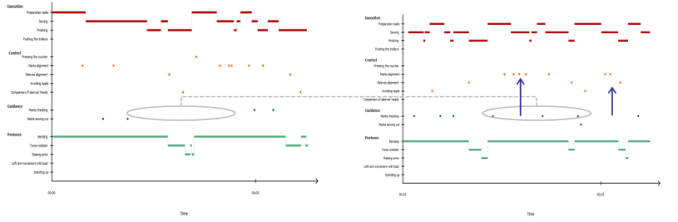
Figure 1: Activity chronicle of two workers performing the same activity.
they create a back-up pile of produced items, building a margin for mano- euvre to manage eventual unforeseen production events and moments when they are unable to maintain the same pace of production. Regulation strate- gies are always guided by the knowledge constructed through their experience at work: “Well, it is a long time [regarding their years of experience], right? So, we end up acquiring other techniques to deliver the necessary production” and go beyond what they do technically (even if those actions are, themselves, forms of attaining objectives and, thus, of preserving their well-being). Wor- kers pointed out other strategies, such as how they deal with physical pain to feel better “I try to stretch and sometimes I take something [medication]”, handle tension in their workplace relationships: “I laugh and pretend I did not hear anything”; or in what they tell themselves to be motivated to move on “I tell myself that I have to continue because I need to work”.
A Job Well Done Within the possibilities made available by the context, all the efforts wor- kers make to manage work demands have the objective of attaining a job well done. In short production cycles, they have to achieve production levels (which implies working at an intense pace), while also fulfilling the high- quality standards of the clients: “It’s the time [number of pieces per hour] (…) If we have enough time, we have quality and we have a well-executed piece”; “I think that to make good quality [pieces], we cannot be doing too many (…) nobody works in quality doing a lot”. Therefore, a job well done means reaching collectively shared objectives, such as the number of pieces produced per hour in each sector, but also making sure those produced pieces are approved by the quality and are not sent back to be re-done. In their own words, they always aim for “perfection”.
Despite sharing common guidelines for what is considered a job well done and what guides them during the production (e.g., following the client’s instructions and specificities), they have different ways of working while still accomplishing equally positive outcomes: “Nobody works in the same way”; “What matters is getting work done (…) As long as it is done well”.
Following this viewpoint, from the systematic observations and the video recordings of critical moments of their activity, we created chronicles of acti- vity (Figure 1). In the figure here shown, two experienced traditional machine operators were performing the same task. However, the way they organized
More Than a Machine at Work: Exploring the Impacts of Technological Change 169
it is very different. The first one works without interruptions for longer peri- ods of time, checking and sewing her marks at fewer specific moments. In contrast, the second worker stops more frequently to adjust, check, and sew hers. Both these workers reach objectives, managing to achieve a job well done.
Recognition The space provided for the creation of different forms of engagement with their work impacts well-being, insofar as the incentive given by supervisors for workers to be autonomous is a sign of trust and recognition of their exper- tise: “She [her supervisor] said to do it how I knew to, in my own way. And never any supervisor had said that to me (…) she lets us give our own opi- nion”. Dejours (2006) pointed out recognition as the main factor that can ease suffering at work. That is, as the recognition of the efforts that were made gives them a purpose, the activity developed then gains meaning, and pleasure at work is enabled. However, despite feeling valued for their know- how, in some cases, this leads to them being chosen to do more complex pieces “I end up being called on to do the trickiest jobs”, which are also more stressful and painful, further contributing to the deterioration of their health.
Recognition in this context assumes different forms. Either in moments when workers recognize the value of their work (e.g., ‘beauty judgments’ regarding the piece which is produced, or when they are able to solve pro- blems in the process), if they feel heard by other members of the hierarchy (e.g., feeling that their own opinion is or not considered), or if the effort done is rewarded monetarily, for instance: “If I told people what I earn compared to what I do, they would be shocked (…) It really hurts”; or by the increase of the level of demand “They are always asking us to do more, you know? I feel like we are not appreciated”.
In the relationships workers have with their superiors, the negative impacts of the lack of recognition were more evident, as they mentioned situations in which they do their best and get stressed as it is never enough, as they do not receive any feedback, and how this lack of recognition makes them feel, in their own words, “discouraged” and “devalued”.
Impacts on Health Work activity is constructed constantly through the mobilization of resources, according to objectives, and within existing limitations. As a result, several consequences emerge for workers and their worker collectives (Caroly, 2010). In this study, these impacts have been explored varying from more direct impacts (e.g., sticking needles in their fingers, occupational illnesses, allergies, or being exposed to loud noises from the machines) to less tangible ones (e.g., generalized fatigue, anxiety, the suffering associated with work which comes back to be fixed, and production demands).
Due to the continuous pressure to achieve the work demands explored in all previous themes under analysis, and with musculoskeletal problems being typically associated with these types of work settings, pain has become a daily
burden which is normalized as part of their work activity: “Most of the pain is in my left arm”; “It’s part of the job”; “I have it [pain] in my fingers. The thread that we’ve been working with is very sharp. I have to bend them so much that I don’t even have nails anymore”; “There are many cases of tendonitis here”; “It’s an occupational disease. (…) from always working in the same position”. The use of medication occurs as both a consequence of work but also as a means to continue working “I had to take an anti- inflammatory, so I could be fresh for today”; “I’m taking antidepressants”; “I went to the pharmacy to ask for some tranquillizers because I got to a point I thought I couldn’t be here like that”.
However, while the way these impacts are perceived is subjective, the moments when work is disapproved by the quality department and returns to the lines to be repaired occupies a central role regarding the impacts of work on health: “If I’m working on an order which seems to be going well and a piece comes back, I freeze.”; “It really makes me nervous. I tell them ‘This is passing through my hand again? Why?’ (...) It bothers me”; “It is really stressful (…) It is much worse to repair work than to do it all again”. These moments also mean the workers will have to go through the process of using their physical and mental resources once again, doubling the impact this will have during the production of that one item. In contrast, not having items returned contributes to their perception of having done the job well: “When the end of the day comes and I know that there is no item that comes back to get fixed, this is very important for us (…) we are pleased”; “One day it goes well when work goes better. Sometimes work comes out aligned and comes out perfect the first time”.
CONCLUSION
The methodology used in this paper, using mediation (symbolic and material), enabled the collective and individual discourses on work-related suffering to assume a center stage. It created conditions for accessing how work con- straints are perceived, the conflicts of different demands (e.g., production and quality), and the strategies developed (what each one says to oneself to be able to work, on a day-to-day basis), in a context that weakens well-being. Paradoxically, being able to work with the same machine is considered a protective factor. Knowing the uniqueness of their “own” machine, its “wea- knesses” (and how to get around them), or how to boost its pace in the face of production demands (e.g., considering the type of fabric), in a context marked by a strong intensification of work, is what allows them to do a job well done. Even so, the lack of consideration of the real work by those who manage it reinforces the idea that wanting to stay in their machine is seen as “resistance to change”.
The construction of these relationships with the machines is part of a long- term history in this context. In contrast, in the case of automated machines, there is a representation that these machines need less human intervention, that they do not require previous work experience, and that learning is almost immediate. Under these conditions, the time available for the appropriation of technological artifacts is limited. It is as if the variability of work with these
More Than a Machine at Work: Exploring the Impacts of Technological Change 171
machines was devalued. This invisibility is even more perpetuated when these uses of technology are not anchored in the sociohistorical characteristics of work or from the perspective of work activity.
This project will further be developed. The next step of the study seeks to create conditions for a collective expression of what is experienced at work. To this end, a questionnaire was created, based on the job quality indices defined by the Eurofound (2017), which will allow to portray the impacts of work on health and well-being, in a context like this, which is reconfigured by technological change.
ACKNOWLEDGMENT
This work is supported by the FCT under the Project 04/SI/2019 - I&DT Empresarial (Copromoção, Parcerias Internacionais) - “Operator: Digital Transformation In Industry With a Focus On The Operator 4.0” (NORTE- 01-0247-FEDER-045910 and LISBOA-01-0247-FEDER-045910).
REFERENCES
Barcellini, F. (2020). Quelles conceptions de la coopération humains-robots collaboratifs? Activités Volume 17 No 1. pp. 1–29. Barcellini, F., Van Belleghem, L. and Daniellou, F. (2014). Design projects as oppor-
tunities for the development of activities. In: Falzon, Pierre (Ed.) Constructive Ergonomics. pp. 150–163. NY, USA: Taylor and Francis. Béguin, P. (2007). Taking activity into account during the design process. Activités Volume 4 No 2. pp. 115–121. Braun, V. and Clarke, V. (2006). Using thematic analysis in psychology, Qualitative
Research in Psychology Volume 3 No 2. pp.77–101. Caroly, S. (2010). Activité collective et réélaboration des règles: des enjeux pour la santé au travail. (PhD thesis) Université Victor Segalen: Bordeaux. Cimini, C., Lagorio, A., Pirola, F. and Pinto, R. (2021). How Human Factors Affect
Operators’ Task Evolution in Logistics 4.0, Human Factors and Ergonomics In Manufacturing Volume 31 No 1. pp. 98–117. Coutarel, F., Caroly, S., Vézina, N., and Daniellou, F. (2015). Marge de manoevre situationnelle et pouvoir d’agir: des concepts à l’intervention ergonomique, Le Travail Humain Volume 78. pp. 9–29. Cunha, L., Silva, D., Maggioli, S., Barros, A. C., Correia, C., Ricaldoni, F., and Brito,
S. (2022). Pleasure and Suffering at Work in the Technical Act: A Case Study From a Garment Factory in a Context of Technological Transformation. In Intelligent Human Systems Integration 2022 (IHSI 2022). Advances in Intelligent Systems and Computing. Springer. Cunha, L., Silva, D., Santos, M. and Pereira, C. (2020). Do we want to keep working in 12-h shifts? The follow-up of the work schedule change in a Portuguese industrial company, International Journal of Industrial Ergonomics Volume 77. No 102958. Dejours, C. (2006). Subjectivity, Work, and Action. Critical Horizons Volume 7.
pp. 45–62. Engeström, Y. (1999). Innovative learning in work teams: analysing cycles of knowledge creation in practice. in: Perspectives on Activity Theory, Engeström, Yves et al. (Eds.). Cambridge University Press: Cambridge. pp. 377–406.
Eurofound (2017). Sixth European working conditions survey: Overview report (2017 update). Publications Office of the European Union: Luxembourg. Galey, L., Judon, N. and Garrigou, A. (2021). “Contribution to the Industry 4.0
Design Project Based on Exposure Situations”proceedings of the 21st Congress of the International Ergonomics Association IEA 2021. Lecture Notes in Networks and Systems. Springer. Kadir, B.A. and O. Broberg. (2020). Human Well-Being and System Performance in the Transition to Industry 4.0. International Journal of Industrial Ergonomics Volume 76 No 102936. Major, M-E. and Vézina, N. (2015). Analysis of worker strategies: A comprehen-
sive understanding for the prevention of work-related musculoskeletal disorders, International Journal of Industrial Ergonomics Volume 48. pp. 149–157. Rabardel, P. (2003). From artefact to instrument. Interacting with Computers Volume 15 Issue 5. pp. 641–645. Rabardel, P., and Beguin, P. (2005). Instrument mediated activity: from subject
development to anthropocentric design. Theoretical Issues in Ergonomics Science Volume 6 No.5. pp. 429–461. Richert, A., Shehadeh, M., Müller, S., Schröder, S. and Jeschke, S. (2016). Robotic Workmates: Hybrid Human-Robot-Teams in the Industry 4.0, proceedings of the International Conference on E-Learning, ICEL. Trentesaux, D., and Millot, P. (2016). A human-centred design to break the myth of
the “magic human”in intelligent manufacturing systems. In: Borangiu, Theorodre, Trentesaux, Damian, Thomas, André, and McFarlane, Duncan. (eds.). Service Orientation in Holonic and Multi-Agent Manufacturing. pp. 103–113.
LISTED IN THE AHFE DIGITAL BOOKSTORE CATALOGUE
Explore the complete digital volume
Social and Occupational Ergonomics
Read this individual research paper free through the original publisher, or explore the full digital proceedings book.
ISBN 978-1-958651-41-4
Explore this ISBN in the AHFE Bookstore ↗Listed in the July 2026 bookstore catalogue; search by ISBN to confirm current availability · Digital book purchase optional