Biruta Sloka, Ieva Brence, Henrijs Kalkis (2022). Application of information technologies for social inclusion: current trends and future prospective. In: Social and Occupational Ergonomics. AHFE Open Access, vol. 65, pp. 1–6. https://doi.org/10.54941/ahfe1002652
Remote work and remote studies has increased in great extent the requirements of information technologies use and skills to apply information technologies. In European Union countries annually it is checked the availability of computer software as well as skills of information technologies use: there are annually conducted surveys on survey on use of information and communication technologies (ICT) in households and by individuals. The aim of the paper is to research theoretical aspects and to analyze internet use in regions of Latvia for checking on whether there is statistically significant use. The source of the data is the questionnaire No. ICT-persons “Use of computers and the internet in households”. As well as Labor Force Surveys, EU-SILC survey data. Research methods applied: scientific publication analysis, time-series analysis of internet use in Baltic countries, analysis of data on differences of availability of computers in households by regions of Latvia by analysis if variance or ANOVA, by territories (urban and rural) by t – test and by household size by ANOVA.
Remote work and remote studies have increased in great extent the requi- rements of information technologies use and skills to apply information technologies. In the European Union countries the availability of computer software is checked annually as well as skills of information technologies use: there are annually conducted surveys on the use of information and commu- nication technologies (ICT) in households and by individuals. The aim of the paper is to research theoretical aspects and to analyze internet use in regions of Latvia for checking on whether there are statistically significant differe- nces on use of the internet by different society groups. The source of the
data is the questionnaire No. ICT-persons “Use of computers and the internet in households”, survey is conducted by Central Statistical Bureau, Republic of Latvia and data available on Official Statistics Portal. For data analysis is used also Labor Force Surveys, EU-SILC survey data. Research methods applied: scientific publication analysis, time-series analysis of internet use in Baltic countries, analysis of data on differences of availability of computers in households by regions of Latvia by analysis if variance or ANOVA, by territories (urban and rural) by t – test and by household size by analysis of variance or ANOVA.
THEORETICAL FINDINGS Researchers world-wide devote their research and reflect their research fin- dings in their scientific publications on several aspects related to social inclusion and availability of computers and use of internet especially when feeling needs for going digital which become a necessity for ensuring older adults’ needs for information, services, and social inclusion during COVID- 19 (Xie et al., 2020) with findings that rural online learning in the context of COVID-19 in South Africa has performed evoking an inclusive education approach (Dube, 2020) which has forced to apply computer and internet use in bigger extent (Sanders, Scanlon, 2021). Researchers have investiga- ted importance of different tools and performed evaluation of the library connectivity project through the lens of the digital inclusion model (Saheer Al-Jaghoub Al-Jaghoub and Westrup, 2009). Researchers have investigated aspects on improving social inclusion for young people diagnosed with “first episode psychosis” for employment for education and online support (Holt- tum, 2013) and supporting social inclusion of youth at risk using social software investigating the impact, sustainability and evaluation after one year after the pilot testing (Dekelver et al., 2013) and suggesting further innova- tive and creative steps for better use of such software for social inclusion. Researchers have underlined that ergonomic aspects (Kalkis et al., 2021; Kalkis et al., 2020) as well as marketing has big importance in social inclu- sion (Salkovska et al., 2020; Batraga et al., 2019). Municipalities in many countries have significant role for efficient social inclusion (Savrina and Sei- muskane, 2018; Seimuskane et al., 2017) and effective use of financial and human resources (Romanova et al., 2018) and reassessing social inclusion and digital divides (Al-Jaghoub and Westrup, 2009) as several parts of the population have different possibilities in use of computers and internet as well as often there is lack of digital skills. Researchers have found that Austra- lian farmers are left behind in the digital economy and the researchers have performed detailed analysis on insights from the Australian Digital Inclusion Index (Marshall et al., 2020). Researchers have analysed digital enforcement and have performed the steps for rethinking the pursuit of a digitally-enabled society (Díaz Andrade and Techatassanasoontorn, 2021) and suggest seve- ral innovative solutions for social inclusion and educating society on digital skills as well as finding different ways in getting computers for part of soci- ety in harder material conditions involving libraries and non-governmental organisations.
Application of Information Technologies for Social Inclusion 3
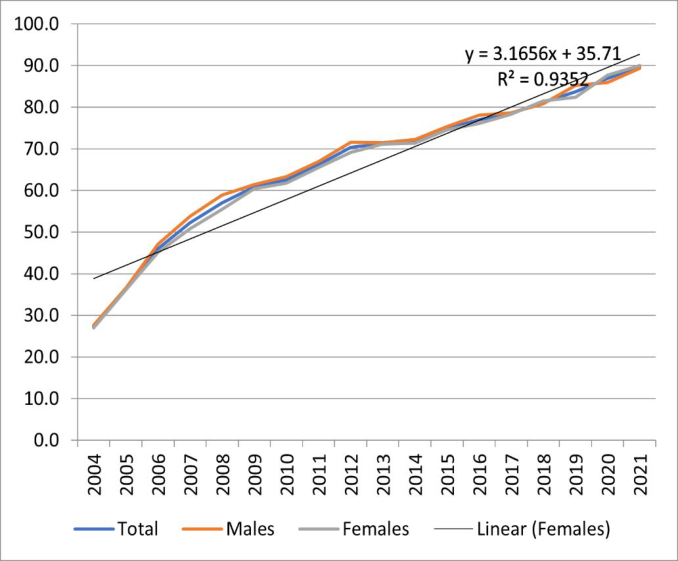
Figure 1: Internet usage by individuals at the beginning of the year (per cent of total population within the corresponding group – total, male, female) in Latvia in 2004- 2021. (Authors construction and calculations based on CSB data, 2021).
EMPIRICAL RESEARCH RESULTS Importance of internet use is stressed by many researchers and policy makers and availability of skills in application of internet use among different parts of society in Republic of Latvia. Data indicate that internet usage by indi- viduals at the beginning of the year (per cent of total population within the corresponding group – total, male, female) in Latvia in 2004-2021 is increa- sing with every year for the society in total, for male and female and data are included in Figure 1.
Data indicate that in average male and female persons in Latvia are using internet on approximately the same level, female use a little bit more: data analysis indicate that annually the share of female internet users among all female inhabitants is increasing annually in average by 3.2 percent points which indicate time-series analysis.
Data indicate that there is bigger share of inhabitants having computers, but there is a question, are those data statistically different in regions of Latvia (see Table 1).
Results on testing of significance of differences (ANOVA) on availability of computers in Latvia’s households by statistical regions in Latvia by auth- ors construction based on CSB survey EU-SILC data 2019 are reflected in Table 2.
Table 1. Distribution of responses on availability of computers in Latvia’s households by statistical regions in Latvia (Authors construction based on CSB survey EU- SILC data 2019).
Table available in the original PDF paper.
Answer Latvia Statistical Regions Total Riga Pieriga Vidzeme Kurzeme Zemgale Latgale Yes 1414 614 357 594 537 508 4024 No – cannot afford 134 70 76 86 139 159 664 No – other reason 365 175 146 247 181 212 1326 Total 1913 859 579 927 857 879 6014
Table 2. Testing of significance of differences (ANOVA) on availability of computers in Latvia’s households by statistical regions in Latvia (Authors construction based on CSB survey EU-SILC data 2019).
Table available in the original PDF paper.
Sum of Squares df Mean Square F Sig.
Between Groups 43.545 5 8.709 12.774 0.000 Within Groups 4096.078 6008 0.682 Total 4139.624 6013
Table 3. Distribution of responses on availability of computers in Latvia’s households by territories in Latvia (Authors calculations based on CSB survey EU-SILC data 2019).
Table available in the original PDF paper.
Answer Teritory Total Towns Rural areas Yes 2929 1095 4024 No – cannot afford 410 254 664 No – other reason 823 503 1326 Total 4162 1852 6014
Results of testing of statistical hypothesis on significance of differences by analysis of variance (ANOVA) on availability of computers in Latvia’s households by statistical regions in Latvia based on authors calculations by use of CSB survey EU-SILC data 2019 indicate that there is no statistically significant difference on availability of computers by statistical regions in Latvia. Researchers in the theoretical findings have indicated that there are differences on availability of computers in urban and rural areas. Distribution of responses on availability of computers in Latvia’s households by territories in Latvia is reflected in Table 3.
Data included in Table 3 reflecting distribution of responses on availability of computers in Latvia’s households by territories in Latvia prepared by auth- ors based on CSB survey EU-SILC data indicate that computers are available in households living in urban and rural areas. Theoretical findings indicate that number of persons in household can have influence on availability of computers in household. Results in Latvia are reflected in Table 4.
Data reflected in Table 4 indicate that most of households in Latvia have computers. Results of testing of statistical hypothesis on significance of dif- ferences by analysis of variance (ANOVA) on availability of computers in
Application of Information Technologies for Social Inclusion 5
Table 4. Distribution of responses on availability of computers in Latvia’s households by number of persons in household in Latvia (Authors construction based on CSB survey EU-SILC data 2019).
Table available in the original PDF paper.
Answer Number of Persons in Household Total 1 2 3 4 5 6 7 8 9 10 11 Yes 854 1371 834 594 235 85 34 7 6 2 2 4024 No – cannot afford 368 218 48 18 5 4 3 0 0 0 0 664 No – other reason 911 359 43 7 4 2 0 0 0 0 0 1326 Total 2133 1948 925 619 244 91 37 7 6 2 2 6014
Table 5. Testing of significance of differences (ANOVA) on availability of computers in Latvia’s households by number of persons in household in Latvia (Authors calculations based on CSB survey EU-SILC data 2019).
Table available in the original PDF paper.
Sum of Squares df Mean Square F Sig.
Between Groups 892.593 10 89.259 165.020 0.000 Within Groups 3247.030 6003 0.541 Total 4139.624 6013
Latvia’s households by number of persons in household in Latvia are included in Table 5.
Results of testing of statistical hypothesis on significance of differences by analysis of variance (ANOVA) on availability of computers in Latvia’s households by number of persons in household in Latvia based on authors calculations by use of CSB survey EU-SILC data 2019 indicate that there are no statistically significant difference on availability of computers by number of persons in the household.
CONCLUSION
Use of computers and internet is becoming more and more important for social inclusion around the globe even showing different real achievements in different countries, different territories and different regions in many coun- tries. The article concludes that despite differences in unemployment level in Latvia (approximately 5% in the Riga region and 15% in Latgale region), there are no statistically significant differences in internet use in regions of Latvia by territories. Marketing activities including ergonomic aspects are important for motivation of internet use in Latvia. Those results of analysis could be useful for policy makers for their decision making.
ACKNOWLEDGMENT
The authors would like to acknowledge National Research Program INTERFRAME-LV.
REFERENCES
Al-Jaghoub, S., Westrup, C. (2009). Reassessing social inclusion and digital divides.
Journal of Information, Communication and Ethics in Society, 7(2/3), 146–158.
Ayoung, D.A., Bugre, C., Baada, F.N.-A. (2020). An evaluation of the library connectivity project through the lens of the digital inclusion model. Information and Learning Sciences, 121(11/12), 805–827. Batraga, A., Salkovska, J., Braslina, L., Legzdina, A., Kalkis, H. (2019). New innova-
tion identification approach development matrix. Advances in Intelligent Systems and Computing, 783, 261–273. CSB (2021). Questionnaire No. ICT-persons “Use of computers and the internet in households”. Available at www.csb.gov.lv. Dekelver, J., Van den Bosch, W., Engelen, J. (2011). Supporting social inclusion of
youth at risk using social software: impact, sustainability and evaluation, one year after pilot testing. Housing, Care and Support, 14(2), 61–66. Díaz Andrade, A., Techatassanasoontorn, A.A. (2021). Digital enforcement: Rethinking the pursuit of a digitally-enabled society. Information Systems Journal, 31(1), 184–194. Dube, B. (2020). Rural online learning in the context of COVID-19 in South
Africa: Evoking an inclusive education approach. Multidisciplinary Journal of Educational Research, 10(2), 135–157. Holttum, S. (2013). Improving social inclusion for young people diagnosed with “first episode psychosis”: employment, education and online support. Mental Health and Social Inclusion, 17(3), 112–117. Kalkis, H., Andza, K., Roja, Z. (2020). Physical Load and Preventive Measures in
Metal Manufacturing Industry. Advances in Intelligent Systems and Computing, vol. 1215 AISC, pp. 48–55. Kalkis, H., Graveris, I., Roja, Z. (2021). Ergonomic Indicators and Physical Workload Risks in Food Production and Possibilities for Risk Prevention. Lecture Notes in Networks and Systems, 273, 47–53. Marshall, A., Dezuanni, M., Burgess, J., Thomas, J., Wilson, C.K. (2020). Australian
farmers left behind in the digital economy – Insights from the Australian Digital Inclusion Index. Journal of Rural Studies, 80, 195–210. Official Statistics Portal of Republic of Latvia (2022). Statistical database DLM010. Romanova, I., Grima, S., Spiteri, J., Kudinska, M. (2018). The payment services Directive II and competitiveness: The perspective of European fintech companies. European Research Studies Journal, 21(2), 3–22. Salkovska, J., Batraga, A., Braslina, L., ...Kalkis, H., Legzdina, A. (2020). Four
Conceptual Perspectives of Innovation Components, Advances in Intelligent Systems and Computing, 783, 72–82. Sanders, C.K., Scanlon, E. (2021). The Digital Divide Is a Human Rights Issue: Advancing Social Inclusion Through Social Work Advocacy. Journal of Human Rights and Social Work, 6(2), 130–143. Savrina, B., Seimuskane, L. (2018). Income and Quality of Life Influence on Citizens
Participation in Activities of Local Governments in Latbia. CBU INTERNATI- ONAL CONFERENCE PROCEEDINGS 2018: INNOVATIONS IN SCIENCE AND EDUCATION, vol. 6, 2018, pp. 424–432. Seimuskane, L, Vilka, I., Brekis, E. (2017). Assessment of Socio-Economic Status Relevance for Latvian Electoral Participation, LOCAL GOVERNMENT AND URBAN GOVERNANCE IN EUROPE, pp. 209–232. Xie, B., Charness, N., Fingerman, K., (...), Kim, M.T., Khurshid, A. (2020). When
Going Digital Becomes a Necessity: Ensuring Older Adults’ Needs for Informa- tion, Services, and Social Inclusion During COVID-19. Journal of Aging and Social Policy, 32(4-5), 460–470.
LISTED IN THE AHFE DIGITAL BOOKSTORE CATALOGUE
Explore the complete digital volume
Social and Occupational Ergonomics
Read this individual research paper free through the original publisher, or explore the full digital proceedings book.
ISBN 978-1-958651-41-4
Explore this ISBN in the AHFE Bookstore ↗Listed in the July 2026 bookstore catalogue; search by ISBN to confirm current availability · Digital book purchase optional