Arianna Bionda, Marta Tome Maintega, Oscar Noguero Torres, David Sanchez, Brendan Sullivan (2023). H2-fueled passenger ship hazards: challenges in risk assessment for a front edge technology application. In: Safety Management and Human Factors. AHFE Open Access, vol. 105, pp. 84–93. https://doi.org/10.54941/ahfe1003073
Achieving the ambition set out in the initial International Maritime Organization (IMO) greenhouse gas strategy will require zero-emission vessels to enter the fleet in 2030, forming a significant proportion of vessel new builds from 2025. Besides the cargo market, the passenger ferry industry is fastly moving to explore alternative fuels and low-emission technologies, promoting a large number of projects and pilot cases for inland and coastal navigation, mainly. However, compared to fossil fuels, around which the shipping industry has had decades to optimize the design, maintenance, and operation of ferries, the introduction of zero-carbon technologies, such as hydrogen fuel cells, brings new safety risks that need to be analysed and managed. This paper presents an initial result of the EU-founded e-SHyIPS project, investigating the methodologies for an early-stage risk assessment of hydrogen-fuelled passenger ships, where a compartment with a pressurized hydrogen supply system and passenger compartments are in proximity. The study objective is to present and discuss both the methodology adopted in international risk assessment workshops and the results obtained. The research activity involves identifying hydrogen-related hazards and selecting critical areas for more detailed explosion and fire risk studies. As a result, considerations are given on hazards and risks affecting the structural strength or the integrity of the ship, safety of crew on board, and preservation of the environment that will be used as input for consequence calculations and frequency assessments for release, dispersion, fire, and explosion experiments.
The passenger ferry market plays an important role in the EU Maritime Transport System contributing to the multimodality of EU transport with 437 million people embarking and disembarking in EU ports every year (European Commission, 2020). An important part of the European maritime passenger ferry economy is related to coastal and short sea operations cove- ring national or intra EU routing with two extremely ferry-intensive areas:
H2-Fueled Passenger Ship Hazards: Challenges in Risk Assessment 85
the Baltic, and the Mediterranean. Despite the increasing number of pas- sengers and the evolution of ferry operators in proposing new routes and services, the majority of European ferries are older than 20 years (Gagatsi et al. 2016). In a business-as-usual scenario, the continued growth in Gre- enhouse Gas (GHG) emissions from the sector has been predicted to grow by 130% within 2030. With the aim of tackling this challenge, the IMO (International Maritime Organization) has been introducing new and stri- cter legislations, experimenting an initial strategy from 2018 with a twofold approach: a green regulatory work framework building, and a zero-carbon fuels market boost. These initiatives resulted in a mind-changing in the pas- senger ferry industry with ship owners, operators and designers beginning to take actions on introducing alternative fuels and low-emission technologies ferries (Landmore and Campbell, 2010). Among others, LNG, LPG, meth- anol, dimethyl ether, biodiesel, biogas, hydrogen and hydrogen carriers, are nowadays considered alternative maritime fuels with a comparable energy capacity respect to conventional fossil fuels (Ren and Liang, 2017; Bilgili, 2021). On the other side, the interest of shipping sector in hybrid polymer electrolyte membrane fuel cells (PEMFC) fuelled by hydrogen has seen an unprecedented growth in the last years (Dall’Armi et al. 2023), with several pilot projects under development and testing (Sürer and Arat, 2022; Ustolin, et al. 2022).
Compared to fossil fuels, around which the shipping industry has had decades to optimize design, system maintenance and operation procedures management, the introduction of H2-based fuels and associated technologies brings with it new safety risks that need to be mitigated or managed. While the current risk management landscape is designed to meet the demands of traditional propulsion system, the properties and safety challenges related to hydrogen fuelled vessels are very different from those of conventional fuels (Atilhan et al. 2021).
The existing safety management approach for these kinds of vessels relies on three main strategies based on IMO’s references.
International Code of Safety for Ship Using Gases or Other Low- flashpoint Fuels, IGF Code, defining mandatory criteria for the arran- gement and installation of machinery, equipment and systems for vessels operating with gas or low-flashpoint liquids as fuel to minimize the risk to the ship, its crew and the environment.
IMO ‘Alternative Design’ process where safety, reliability and dependabi- lity of the systems is to be proven equivalent to that of traditional fuels and power generation systems. This approach, as specified in Safety of Life At Sea (SOLAS), applies to the whole concept of the ship or can be focused on particular systems, subsystems or individual components.
Formal safety assessment (FSA), that enhances maritime safety, including protection of life, health, marine environment. It is a structured and syste- matic methodology involving risk analysis and cost-benefit assessment.
These approaches generally require mature design proposals to be analy- sed (Hansen, 2019) lacking on early-stage management of risk in all design
and operational aspects, including vessel general arrangements and system engineering, bunkering procedures and logistic interface, safety systems for power generation and management. Since passenger ship safety and relia- bility are affected the most by decisions made during an early-stage design phase – where specifications of requirements are translated into shape and location of compartments – a risk assessment that can be performed with less mature data has critical importance (Lough et al. 2009).
This study focuses specifically on an early-stage risk assessment strategy based on FSA. The methodology can be used to identify hazards and assess risks for people (crew and passengers), equipment and environment, as early as the conceptual phase of design.
FORMAL SAFETY ASSESSMENT FOR H2-FUELED FERRY The objective of this study is to analyse the risks for passenger ships with a pressurized hydrogen supply system at early-stage design, evaluating both the methodology adopted and the results obtained. Activities involve identif- ying hydrogen-related hazards with the selection of critical areas where more detailed explosion and/or fire risk studies are needed.
Safety Related Hydrogen Proprieties At standard temperature and pressure conditions, hydrogen is a tasteless, nontoxic, noncorrosive, nonmetallic diatomic gas, which is, in principle, physiologically not dangerous (Dagdougui et al. 2018). However, the highly diffusive and buoyant proprieties, associated with low ignition energy, wide flammability range, and static spark energy, have impacts in managing design and safety engineering, especially in enclosed or semi enclosed spaces. For this reason, it is crucial considering safety-related properties of hydrogen early while designing not only the storage, fuel transfer systems, or powe- ring systems, but also on the structure of the vessel up to the architecture and layout of the ship to prevent accumulation of hydrogen at more reactive concentrations.
In order to optimize safety while ensuring cost efficient solutions, the fol- lowing safety related hydrogen properties and operation aspects that should require special attention include:
Low ignition energy (0.0019 mj), static electricity spark (1 mj);
Wide flammability range;
Low Volumetric energy density implies storage solutions at high pressures (up to 700 bar) or very low temperature (LH2, -253
C);
Potentially explosive, even as a secondary consequence from a hydrogen leak (and ignition) in an enclosed space;
Catastrophic rupture of pressurized storage tanks would release huge energy. It will drive the type and location of tanks as well as the structure.
Furthermore, the properties of hydrogen need to be considered when sele- cting materials that will be in contact with hydrogen (e.g. to avoid hydrogen
H2-Fueled Passenger Ship Hazards: Challenges in Risk Assessment 87
embrittlement and unwanted leaks). LH2 Leakages would produce embrit- tlement of carbon steel, H2 vapours denser than the air, leading to a freezing or O2 doped atmosphere.
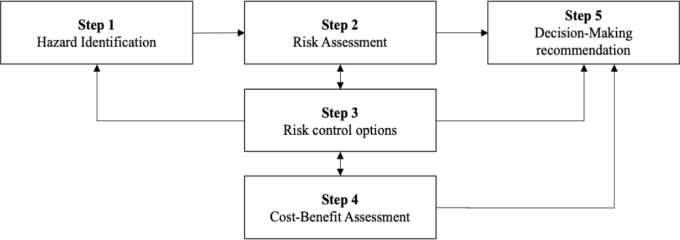
Methodology for Formal Safety Assessment The methodology used to complete the Qualitative Risk Assessment (QRA) is based on the IMO definition of FSA (IMO, 2018) following the five steps depicted in Figure 1. In the context of this QRA, the following steps of the FSA has been developed.
Step 1. Hazard Identification. Identify a list of hazards and associa- ted scenarios prioritized by risk level specific to the problem under review. This purpose is achieved through the use of standard techniques to identify hazards which can contribute to accidents, and by screening these hazards using a combination of available data in literature.
Step 2. Risk Assessment. The purpose of the risk analysis in Step 2 is a detailed investigation of the causes and initiating events and consequences of the more important accident scenarios identified in Step 1.
Step 3. Risk Control Options. The purpose of this step is to first identify Risk Control Measures and then to group them into a limited number of Risk Control Options for use as practical regulatory options.
Step 4. Cost-Benefit Assessment. The purpose of this step is to identify and compare benefits and costs associated with the implementation of each risk control options identified and defined in Step 3.
Step 5. Decision-Making Recommendations. The purpose of Step 5 is to define recommendations which should be presented to the relevant decision makers in an auditable and traceable manner. The recommendations would be based upon the comparison and ranking of all hazards and their underl- ying causes; the comparison and ranking of risk control options as a function of associated costs and benefits; and the identification of those risk control options which keep risks as low as reasonably practicable.
For the e-SHyIPS project, a simplified FSA analysis has been used following the FSA methodology and covering steps 1, 2, 3 and step 5 of the methodology in terms of qualitative risk assessment. This simplified FSA is from now as referred to as Preliminary Hazard Analysis.
Figure 1: Flow chart of the FSA methodology.
QUALITATIVE RISK ANALYSIS IN E-SHYIPS PROJECT As previously depicted, the early-stage qualitative risk analysis presented in this paper is based on FSA and aimed to identify and assess hazards regarding pressurized hydrogen supply systems installed on board at an early design phase. The Preliminary Hazard Analysis (PHA) developed in e-SHyIPS has the objective to identify hazards, their associated causal factors, effects, level of risk and mitigating design measures when detailed information is not avai- lable. Due to the nature of the research project, the analysis was conducted on the H2 system design and setting for passenger ferries, excluding the hazards related to cargo.
Scenario Design: Vessel Concept and System Description The case study analysed in the present paper was developed as a scenario for experimentation in the framework of the EU-funded HORIZON 2020 project e-SHyIPS (Ansaloni et al. 2022). It is representative of a main area of interest for the maritime passenger transportation within European countries (European Commission, 2020): the domestic short-range routing – mainly inland or coastal – with water-busses providing daily services for urban and suburban mobility. The analysed case study is a small catamaran ferry for an inland path service in the city of Rotterdam, Netherlands. The reference ves- sel is a new-build hybrid waterbus by Damen Shipyards Group of the length of 24,4 meters. Thanks to the flexible design, the vessels can be arranged with different internal and external layouts, according to the market demands. The new arrangement for the H2-vessel configuration (Minutillo et al. 2022) was chosen such that the Waterbus structure didn’t require any major modifica- tions: in the original design, a Diesel generator is present on the main deck, at the entrance of the passenger compartment. This generator is completely replaced by a fuel cell in the available generator room space. The whole ele- ctric system of this ship is integrated in the hull, including the batteries and two electric engines. Finally, 18 hydrogen storage tanks are selected to store 405kg of compressed hydrogen at 350 bar and placed on the top desk of the ship.
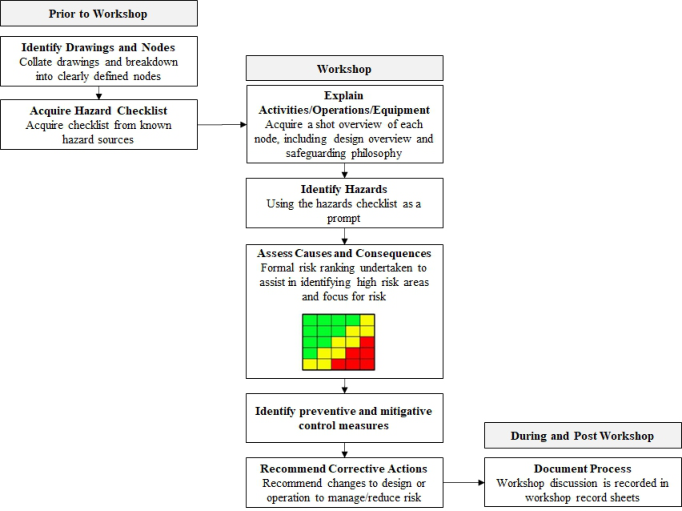
Preliminary Hazard Analysis The PHA was developed involving all the primary stakeholders of a vessel design project (naval architects and shipbuilder), as well as representatives from safety engineering studies, classification and certification bodies, ferry operators, and hydrogen technology suppliers. The hazard identification is considered the starting point and the core of the qualitative risk asses- sment, even if some PHA activities needs to be carried out prior to the safety workshop. The complete PHA was structured in the following main steps (Figure 2).
Identify Drawing and Nodes. The first step was focused on define, scope and bound the system, as well as acquire all the necessary design, operational, and process data needed and available for the analysis. For the PHA, each system has been divided into three main nodes: (i) Hydrogen storage and
H2-Fueled Passenger Ship Hazards: Challenges in Risk Assessment 89
Figure 2: PHA workshop steps in e-SHyIPS project based on Vista Oil & Gas (2019).
transfer system; (ii) Fuel cell and related systems; and (iii) Bunkering sub- systems.
Acquire Hazard Checklist. The approach used for hazard identification comprised the use of hazard checklist, where the design and system inte- gration information were compared to the hazard sources included in the checklist developed for the project. The checklist included hazardous sources related to potential energy, blast energy or thermal energy, and other types of energy, based on previous knowledge acquired from other projects.
Explain Activities/Operations/Equipment. Before the start of the PHA multi-actors workshop, an introduction to all Subject Matter Experts (SMEs) for each node was provided, including design overview and safeguarding philosophy.
Identify Hazards. The identification of the hydrogen major hazards was performed based on the fundamentals set in the previous step. The workshop covered the following spaces, zones and systems as suggested by Rule Note NR670 by Bureau Veritas (2022): tank connections spaces; enclosed and semi-enclosed fuel preparation rooms; enclosed and semi-enclosed bunkering stations; spaces containing very high-pressure gas or liquid hydrogen piping; ESD-protected machinery spaces; spaces where fuel cell units are installed and, zones where vent lines and safety valve discharge lines are led.
Assess Causes and Consequences. The objective was to provide a qua- litative measure of risk significance for the potential effect of hazards by identifying events or faults that can trigger the hazardous events to become a mishap or accident, along with the effects of hazards in terms of consequences for people, fitness for service, and environment. The risk index identification
was based on the project risk matrix, a combination of mishap severity and probability whose values are based on MSC-MEPC, IMO (2018).
Identify Preventive and Mitigative Control Measures. Recommended pre- ventive measures to eliminate or mitigate the identified hazards using the hierarchy of control were discussed, ranking risk controls measures from the highest level of protection and reliability to the lowest and least reliable one.
Recommend Corrective Actions. With the same approach of the previous step, recommended control measures to eliminate or mitigate the identi- fied hazards were highlighted together with further studies critical to solve uncertainties, such as CFD simulations on dispersion and explosion analysis.
Document Process. The discussion of the entire workshop with conclu- sions and uncertainties to be studied was recorded in a dedicated PHA worksheet to be used in the present study and in following project activities.
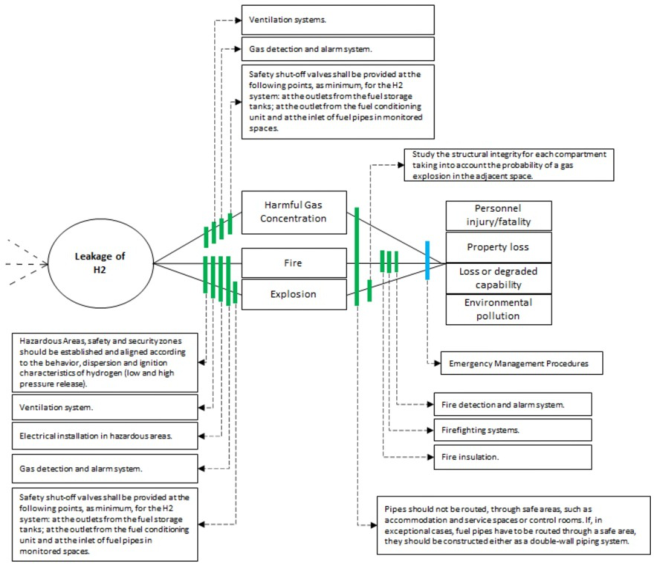
PRELIMINARY HAZARD ANALYSIS RESULTS The PHA results, shown below in a Bow-Tie diagram (Figure 3), reveal a significant number of causes (Figure 3a) related to hydrogen that could lead to a hazardous atmosphere and fire or explosion hazards (Figure 3b), with a special concern for those occurring in inner compartments due to the severity of the consequences associated with them. The major causes identified were related component failures, overpressure in system or tanks, and external impact mainly from ship motion and atmospheric conditions.
For the scenario analysed, the worst credible case is associated to PEMFC room, due to the proximity to the accommodation areas, while the level of risk related to compressed hydrogen storage location, located on top of the roof deck, was considered lower due to the ability of hydrogen do disperse upwards in an unconfined environment, in the event of a leakage.
At last, the results show the need of carrying out specific quantitative risk analysis, like CDF simulations, to assess the level of risk associated with a potential explosion in the PEMFC Room, as well as, the most appropri- ate control measures in order to reduce the probability and to mitigate the consequence, to verify that in case of fire and/or explosion, the conseque- nce should not: (i) damage any space other than where the incident occurs, with special attention to working areas and the accommodation compar- tment, (ii) disrupt the proper functioning of other zones, control stations and switchboard rooms for power distribution, (iii) damage the ship integrity occurring flooding, (iv) damage life-saving equipment or impede ship evacu- ation, (v) disrupt the functioning of fire-fighting equipment located outside the explosion-damaged space.
The objective of the PHA workshop analysis has been fulfilled with the identification of hydrogen related hazards and the areas of major risks. How- ever, the study highlights criticalities and challenges in performing all steps of the depicted methodology, principally in the assessment of causes and con- sequences with a complete risk matrix. The reason to this lies in the lack of detailed information on the vessel system level. On the other hand, the strategy of involving stakeholders coming from different areas of expertise in the PHA workshop activities – including hydrogen producers and system suppliers – was a key element for the study success.
H2-Fueled Passenger Ship Hazards: Challenges in Risk Assessment 91
(a)
(b)
Figure 3: PHA workshop results: (a) causes could lead to risks and control measures, (b) hazardous atmosphere, fire and explosion consequences with control measures.
The workshop results demonstrate how a preliminary qualitative risk analysis at early-stage design phase, involving multidisciplinary actors, could deliver critical information for the development of passenger ship concepts especially in the translation of functional and safety requirement specificati- ons into a general arrangement design. Furthermore, it serves as a guide to rank and prioritize the focus of quantitative risk assessment to be performed at vessel and system level in a detailed design stage, considering the MSC 86/26 (IMO, 2009).
CONCLUSION
The increasing interest in hydrogen-fuelled ferries brings challenges in risk assessment for early-stage design. Considering the inherent properties of hydrogen, it is critical to set up the vessel general arrangement and the energy generation system with a safe-by-design approach to tackle hazards and risks at first. This study presents and investigates a Preliminary Hazard Analy- sis (PHA) methodology based on the IMO Formal Safety Assessment (FSA), designed to identify hydrogen related hazards and the areas of major risks prior to detail design. The methodology resulted appropriate to qualitatively evaluate hazard and risk. It also served to identify areas of focus for a follo- wing quantitative risk assessment and CFD analysis. Challenges and major areas of interest for further studies are highlighted with impact on hazards that could lead to damage in any space other than that where the incident occurs, disrupting the ferry functions, control stations and power distribu- tion systems, vessel integrity, life-saving equipment or fire-fighting equipment located outside the damaged space.
ACKNOWLEDGMENT
This research has been part of the EU funded e-SHyIPS project (101007226) (https://e-shyips.com/). The authors thank colleagues from Damen, Ghenova, Politecnico di Milano, DNV, VTT, Atena, Proton Motor, Woikoski, IDF, UNI, Cineca, Levante Ferries, Kyllini Port and Danaos who provided insi- ght and expertise in the risk assessment workshops and hazard identification activities.
REFERENCES
Ansaloni, G. M. M., Bionda, A., & Rossi, M. (2022). EcoDesign strategies for zeroemission hydrogen fuel vessels scenarios. In 2022 7th International Conference on Smart and Sustainable Technologies (SpliTech). IEEE. Atilhan, S., Park, S., El-Halwagi, M. M., Atilhan, M., Moore, M., & Nielsen, R. B.
(2021). Green hydrogen as an alternative fuel for the shipping industry. Current Opinion in Chemical Engineering, 31. Bilgili, L. (2021). Comparative assessment of alternative marine fuels in life cycle perspective. Renewable and Sustainable Energy Reviews, 144. Bureau Veritas (2022). NR670 Methanol & Ethanol fueled ships. Dagdougui, H., Sacile, R., Bersani, C., & Ouammi, A. (2018). Hydrogen infra-
structure for energy applications: production, storage, distribution and safety. Academic Press.
H2-Fueled Passenger Ship Hazards: Challenges in Risk Assessment 93
Dall’Armi, C., Pivetta, D., Taccani, R. (2023). Hybrid PEM Fuel Cell Power Plants Fuelled by Hydrogen for Improving Sustainability in Shipping: State of the Art and Review on Active Projects. Energies, 16(4). Ericson, C. A. (2015). Hazard analysis techniques for system safety. John Wiley &
Sons. European Commission, Directorate-General for Mobility and Transport, (2020). EU transport in figures: statistical pocketbook 2020. Publications Office of the EU. Gagatsi, E., Estrup, T., Halatsis, A. (2016). Exploring the potentials of electrical
waterborne transport in Europe: the E-ferry concept. Transportation Research Procedia, 14. Hansen, O. R. (2019). Hydrogen Infrastructure-Efficient risk assessment and design optimization approach. Chemical Engineering, 77. IMO (2009), Report of the Maritime Safety Committee on its Eighty-sixth Session,
MSC 86/26/Add.1, Annex 1. Landamore, M. J., Campbell, D. J. (2010). Low Carbon Shipping-A Systems Approach: Conceptualising a full cost environmental model for sustainable shipping. In 11th International Symposium on Practical Design of Ships and Other Floating Structures (PRADS). Newcastle University. Lough, K. G., Stone, R., & Tumer, I. Y. (2009). The risk in early design method.
Journal of engineering design, 20(2). Minutillo, M., Cigolotti, V., Di Ilio, G., Bionda, A., Boonen, E. J., & Wannemacher, T.
(2022). Hydrogen-based technologies in maritime sector: Technical analysis and prospective. In E3S Web of Conferences (Vol. 334, p. 06011). EDP Sciences. MSC-MEPC, IMO (2018). Circ. 12/Rev. 2; Revised Guidelines for Formal Safety Assessment (FSA) for Use in the IMO Rule-Making Process. International Mari- time Organization, London, 9. Ren, J., Liang, H. (2017). Measuring the sustainability of marine fuels: A fuzzy
group multi-criteria decision making approach. Transportation Research Part D: Transport and Environment, 54. Sürer, M. G., & Arat, H. T. (2022). Advancements and current technologies on hydrogen fuel cell applications for marine vehicles. International Journal of Hydrogen Energy, 47(45). Ustolin, F., Campari, A., & Taccani, R. (2022). An Extensive Review of Liquid
Hydrogen in Transportation with Focus on the Maritime Sector. Journal of Marine Science and Engineering, 10(9). Vista Oil & Gas (2019). Hazard Identification (HAZID) Studies Terms of Reference (TOR).
LISTED IN THE AHFE DIGITAL BOOKSTORE CATALOGUE
Explore the complete digital volume
Safety Management and Human Factors
Read this individual research paper free through the original publisher, or explore the full digital proceedings book.
ISBN 978-1-958651-81-0
Explore this ISBN in the AHFE Bookstore ↗Listed in the July 2026 bookstore catalogue; search by ISBN to confirm current availability · Digital book purchase optional